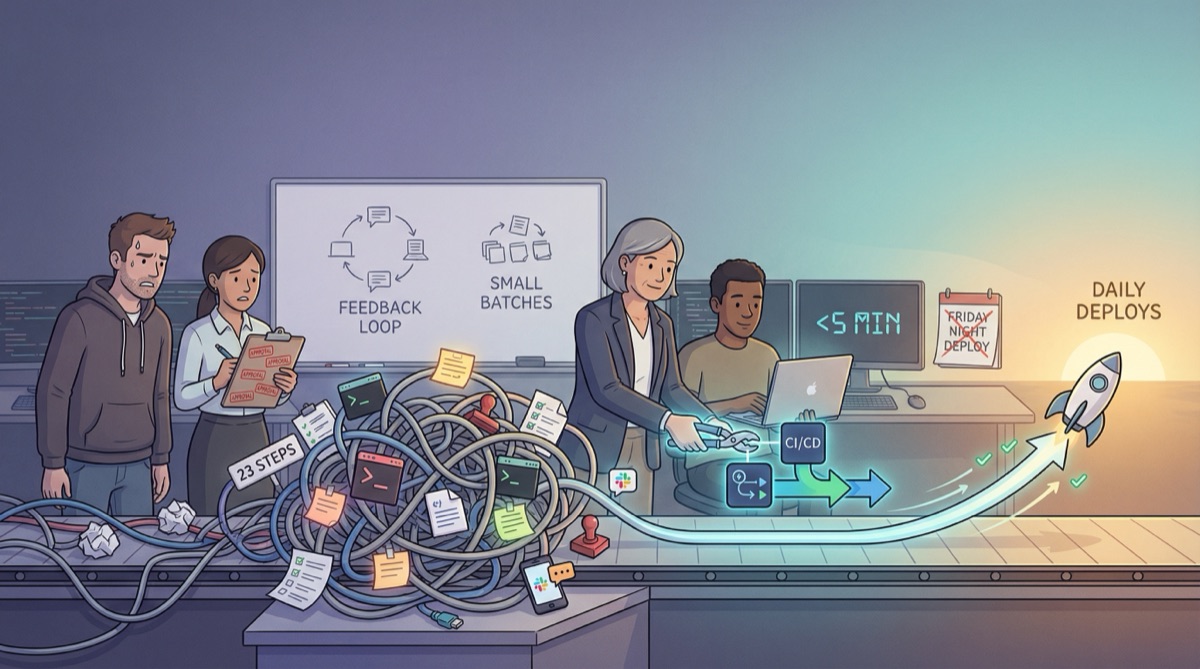
You’re Not Alone — Most Teams Can’t Ship Daily
You know your competitors ship multiple times per day. You’ve read the studies showing deployment frequency correlates with business outcomes. Your team has the technical skill. Yet releases remain stressful, infrequent events that consume entire weekends.
The problem isn’t your people. It’s not your technology stack. It’s the invisible friction that’s accumulated over years — manual steps that “just take a minute,” approval gates that “ensure quality,” and deployment processes so fragile that only one person dares touch them.
What’s Actually Happening
Most organizations can’t deploy frequently because their deployment process has become a minefield of organizational debt:
23-step deployment procedures — Each step added for a reason that made sense at the time. Now nobody remembers why you need to SSH into three servers, manually update four config files, and notify five Slack channels. The process works, barely, so nobody dares change it.
Approval theater — Release requires sign-off from QA lead, product owner, engineering manager, and sometimes the CTO. Each approval takes hours or days. The approvers don’t actually review anything meaningful — they just verify that the previous steps completed. It’s governance without insight.
Friday night deployments — Because the process is manual and error-prone, deployments happen when “if something breaks, we have the weekend to fix it.” This becomes self-fulfilling. Stressful deployments train everyone to fear deployment, which makes deployments rarer, which makes them scarier.
The one person who knows — Your deployment process lives in someone’s head. Maybe there’s documentation, but it’s three years out of date. When that person is on vacation, releases stop. When they leave the company, you panic.
Test suites that punish feedback — Your test suite takes 45 minutes to run. Developers skip it locally. CI runs it, but by then three other people have pushed changes. When tests fail, nobody knows which commit caused it. So developers stop trusting tests. Then bugs escape. Then someone mandates more process.
Batched changes — Because deployment is painful, you batch changes. Small features wait for big features. Bug fixes wait for releases. Urgency doesn’t matter; the deployment schedule matters. Batch size grows. Risk increases. Deployment becomes even scarier.
This isn’t technical failure. It’s organizational friction manifesting as deployment fear.
Articles: Understanding Deployment Friction
These articles examine the invisible obstacles that prevent frequent deployment — and how to remove them.
The Core Problems
-
Bridging the Great Divide
Since 1968, a pattern repeats: non-technical leadership and technical teams don't understand each other. Deployment friction often lives in this gap. -
Intrinsic Motivation and Software Developers
Developers want to ship their work. Deployment friction crushes morale by blocking the fundamental satisfaction of seeing code reach users. -
Treating Developers with Respect
Respect means removing obstacles. Teams that can't deploy frequently feel disrespected because their work sits in queues instead of reaching users.
Technical Practices That Enable Frequent Deployment
-
Beyond the Solo Developer Myth: Pair Programming, Mob Programming, and AI Collaboration
Collaborative practices spread deployment knowledge across teams, eliminating single points of failure. -
When Discovery Collides with Process
Deployment process often accumulates because teams add steps without removing them. Discovery reveals which steps actually add value.
Why Traditional Approaches Fail
-
When Developer Advocate Meant Something Else
How the Developer Advocate role evolved from embedded technical excellence to conference circuit celebrity — and why embedded work is essential for deployment transformation. -
The Gray Beard and the Machine
Experience meets automation. Deployment processes often reflect institutional memory — sometimes that memory is wrong.
Why “Just Do DevOps” Doesn’t Work
You’ve probably heard the advice: “Automate everything. Implement CI/CD. Adopt trunk-based development.”
The advice is correct. The implementation fails because:
Consultants install tools, not capability — They set up Jenkins or GitHub Actions. They write pipeline YAML. They deliver a “CI/CD system.” Then they leave. Your team inherits a system they don’t understand and can’t modify. Six months later, the pipeline is red more often than green, and everybody ignores it.
Nobody removes the manual steps — The new automated pipeline runs alongside the old manual process. You still have 23 manual steps. Now you also have a fragile YAML file. Deployment got harder, not easier. Naturally, teams revert to what they know.
Fear doesn’t vanish because you installed a tool — Deployment anxiety comes from experience: things break, customers complain, weekends get ruined. A CI/CD tool doesn’t erase that trauma. Until someone proves that frequent deployment is safe, the organization resists it.
Technical practice gaps remain invisible — Your team doesn’t write tests that give them confidence. They don’t know how to deploy database changes safely. They’re unfamiliar with feature flags or canary releases. No tool fixes these gaps. They need to learn by doing, with someone who’s solved these problems before.
The barrier isn’t technical knowledge. It’s the gap between knowing what to do and having the confidence and capability to actually do it.
What a Developer Advocate Actually Does
A Developer Advocate removes deployment friction by working inside your team as a senior technical peer. Not advising from the outside. Actually shipping code, fixing pipelines, and transferring deployment confidence to your people.
Automates deployment by pairing, not by doing it for you — Sits with your developers and walks through each manual step: “Why do we do this? What would break if we automated it? Let’s try.” Turns 23-step procedures into one-button deployments. Your team members do the work. They learn the reasoning. They own the result.
Shortens feedback loops — That 45-minute test suite? Refactors the slowest tests while teaching your team how to write fast, focused tests. Introduces parallel test execution. Breaks monolithic suites into targeted suites that run in under 5 minutes. Developers start running tests locally again. Confidence returns.
Removes approval theater — Works with leadership to replace sign-off gates with automated checks. If deployment passes tests, scans, and monitoring, it’s good. If not, the pipeline blocks it automatically. Humans don’t add value to decisions computers can make. This frees humans to focus on decisions that actually need judgment.
De-risks deployment through technical practice — Teaches database migrations that don’t break running systems. Demonstrates feature flags so incomplete features can deploy without exposing to users. Shows how to monitor deployments and roll back instantly if metrics degrade. Deployment stops being scary because the safety net is real.
Makes deployment knowledge collective — Documents decisions as they’re made. Commits runbooks to git. Teaches troubleshooting patterns through pairing. When deployment knowledge lives in code and collective practice, nobody is irreplaceable. Vacation doesn’t stop releases.
Proves safety through frequency — Early deployments are small, low-risk changes. Documentation updates. Configuration tweaks. Each successful deployment builds confidence. Frequency increases. Batch size shrinks. Eventually, deploying becomes boring. Boring is the goal.
Telenovela Episodes: Deployment Friction in Action
Sometimes dramatic stories reveal deployment dysfunction more clearly than any case study. These episodes show what happens when deployment becomes an obstacle instead of a capability.
La Startup: A Fintech Telenovela from Bogotá
A startup with $15 million in funding struggles with deployment chaos and technical debt that makes releasing dangerous.
-
Episode 1: El Pitch Perfecto
$15 million raised. Lead developer vanished. The deployment process is manual chaos. Nobody knows how to release safely. -
Episode 3: Los Secretos del Código
The codebase reveals deployment shortcuts, commented-out automation attempts, and manual steps that speak volumes about fear. -
Episode 5: El Demo Day
The investor demo requires a deployment. The fragile process collapses under pressure.
More episodes: La Startup — All Episodes
Signal Through Noise: Cutting Through Organizational Chaos
A game studio trying to gain visibility discovers how deployment bottlenecks compound organizational dysfunction.
-
Episode 1: The Crunch That Never Ends
An endless crunch. Deployment requires all-hands coordination. The friction is invisible to leadership until it's too late. -
Episode 3: The All-Hands Disaster
Leadership tries transparency about deployment problems. The organization isn't ready to face the truth.
More episodes: Signal Through Noise — All Episodes
What Actually Changes
When deployment friction disappears, the entire rhythm of software delivery changes:
Releases become routine — Deploy Tuesday afternoon, Wednesday morning, whenever. No countdowns. No all-hands war rooms. Just push the button, watch the monitors, move on. Deployment stops being an event.
Feedback loops close — Feature ships Monday. Users try it Tuesday. Product sees usage data Wednesday. Team adjusts Thursday. Deploys Friday. The cycle that used to take months now takes days. You learn faster. You waste less effort building the wrong thing.
Developers trust their tools — Tests run fast and reliably. Pipelines stay green. Deployments succeed predictably. Trust replaces fear. Productivity follows trust.
Business can respond to reality — Competitor launches a feature. You can match it this week, not next quarter. Regulation changes. You deploy compliance updates immediately. Customer reports a critical bug. Fix ships in hours. Speed becomes a competitive advantage.
People stop leaving — Developers leave organizations where deployment is hell. They stay where they can ship their work, see it used, and feel effective. Retention improves not because you improved “culture,” but because you removed the friction that was crushing morale.
How It Actually Works
The deployment transformation happens through embedded work, not external advice:
Weeks 1-4: Evidence gathering — Caimito Navigator tracks your team’s daily work, blockers, and deployment experiences. Data shows exactly where time is lost. No surveys. No opinions. Just observable patterns: “Deployment has 23 manual steps. Test suite takes 45 minutes. Three developers blocked on architectural decision.”
Months 2-4: Developer Advocate embeds — Joins your team as a senior technical contributor. Pairs with developers to automate deployment steps. Refactors tests while teaching testing strategies. Surfaces blocked decisions to leadership with clear options. Ships actual features while doing all this. Your team sees practices in action, not slides.
Months 5-6: Capability transfer — Your developers now know how to automate processes, write effective tests, and deploy confidently. The Developer Advocate tapers involvement. Your team owns the improved capability. Navigator continues tracking to confirm improvements stick.
Result: Deployment frequency increases not because someone mandated it, but because deployment stopped being painful. Your team has the skills, tools, and confidence to ship daily. No dependency on external help. No new methodology overhead. Just removed obstacles.
What You Can Do Right Now
If your team can’t deploy more frequently, start by understanding why:
Map the deployment process — List every step between “merge to main” and “live in production.” Include approvals, manual checks, and waiting periods. Count the steps. That number reveals the problem’s scope.
Measure test suite runtime — How long does your full test suite take? If developers skip tests locally, you’ve found your first bottleneck.
Track deployment frequency — How often do you deploy to production? Weekly? Monthly? Less? Frequency is a forcing function. Rare deployments hide problems. Frequent deployments expose them quickly, while they’re still cheap to fix.
Identify the fear — Ask your team: “What breaks when we deploy?” Their answers reveal where confidence is missing. Database migrations? Configuration changes? Third-party integrations? Each fear points to a teachable skill gap.
Question approval gates — For each required approval, ask: “What decision does this person make? Could an automated check make it instead?” Most approval gates exist to catch mistakes that automated tests should catch.
You don’t need executive buy-in to start. You need one deployment step automated. One slow test refactored. One approval gate replaced with an automated check. Small, concrete progress compounds.
Related Topics
-
Developer Advocate: The Role Explained
How embedded technical support transforms deployment capability from within. -
Development Team Struggles with Delivery
Deployment friction is often a symptom of broader delivery problems. -
Corporate Culture Examples
Deployment frequency reveals culture — teams that trust their processes deploy frequently. -
Caimito Navigator
Daily logbooks reveal deployment blockers as they happen, giving leadership visibility into friction.
Ready to Deploy Daily?
Deployment frequency isn’t a technical metric — it’s a measure of organizational health. Teams that deploy frequently have short feedback loops, low-fear cultures, and competitive delivery speed. Teams that deploy rarely accumulate friction, fear, and organizational debt.
You can have the first kind of team. It requires removing obstacles, building capability, and proving that frequent deployment is safer than rare deployment.
Schedule a 30-minute conversation to discuss your deployment blockers and whether embedded technical guidance makes sense for your situation.