Software Development Is Design: A Fresh Perspective for Business Leaders
The Creative Heart of Building Software
22.12.2025, By Stephan Schwab

Software development shares more with architecture, industrial design, and creative problem-solving than with manufacturing or construction. Understanding development as a design discipline — iterative, exploratory, and collaborative — reveals why great software emerges from skilled teams solving real problems, and how organizations can create conditions for remarkable digital products.
What Design Really Means
When we hear “design,” we might think of beautiful interfaces, elegant furniture, or striking buildings. But design, at its core, is something more fundamental: the thoughtful arrangement of elements to solve problems and create value for people.
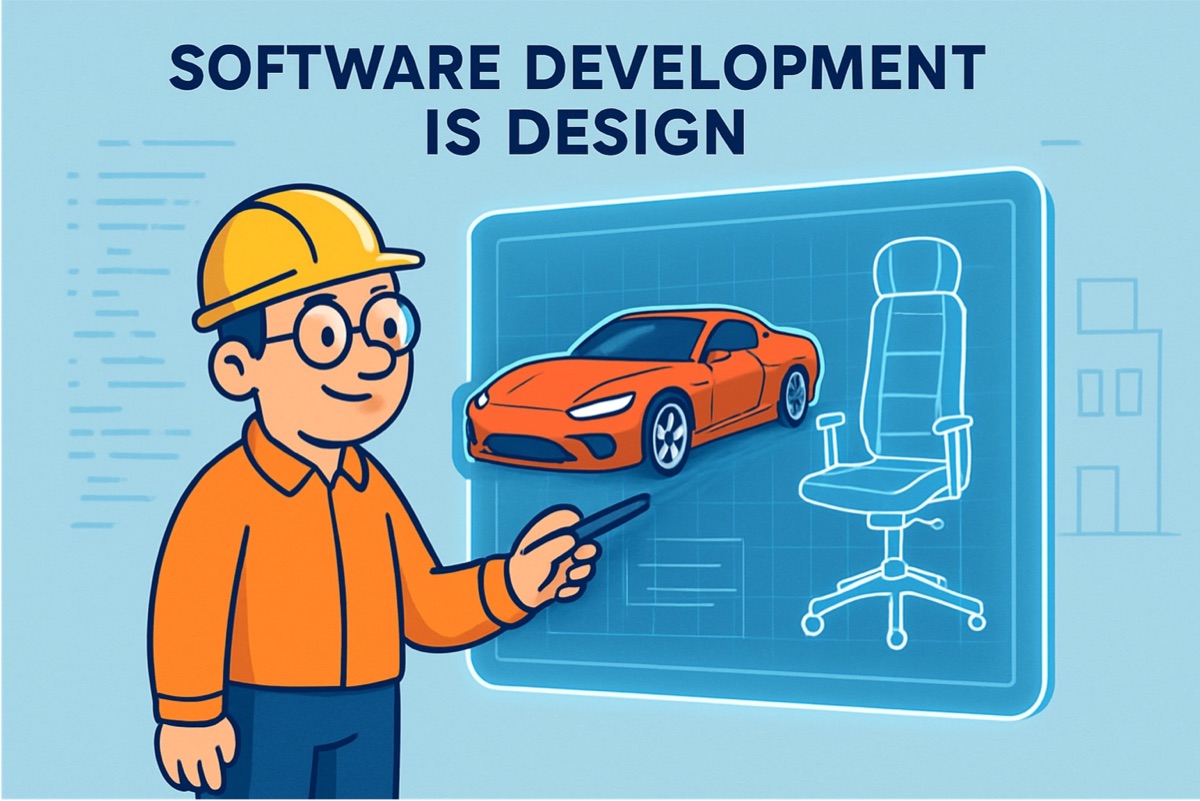
An industrial designer creating a new chair considers ergonomics, materials, manufacturing constraints, aesthetics, durability, and cost — all while keeping the person who will sit in it at the center. An architect balances structural integrity, natural light, traffic flow, building codes, budget, and the daily experiences of inhabitants.
Software developers do exactly this kind of work. They consider user needs, system constraints, performance requirements, security implications, maintainability, and business objectives — all while crafting something that serves real people in real situations.
The Journey of Discovery
Every design project begins with incomplete information. Architects don’t know exactly how occupants will use a building until people move in. Product designers prototype extensively because sketches can’t reveal how something feels in your hand. Fashion designers create samples because fabric behaves differently on a body than on paper.
Software development follows this same pattern of discovery. The most effective teams embrace this reality: they build small pieces, put them in front of users, observe what happens, and refine their understanding. Each iteration teaches something that couldn’t be known in advance.
This isn’t a weakness or sign of poor planning. It’s the nature of design work. The medium reveals its possibilities through engagement.
Craftsmanship in the Digital Realm
Watch a skilled woodworker select boards for a project. They consider grain direction, moisture content, how the wood will move over years, and which pieces will create visual harmony. Their expertise guides countless micro-decisions that add up to something beautiful and lasting.
Software developers exercise similar craftsmanship. When building a feature, experienced developers consider how data flows through the system, how the code will behave under stress, how future developers will understand and modify it, and how it will evolve as business needs change.
This craftsmanship isn’t visible in the final product the way woodgrain is visible in furniture. But its presence or absence becomes apparent over time. Well-crafted software adapts gracefully to new requirements. It performs reliably under pressure. It welcomes modifications without cascading problems.
Collaboration Creates Excellence
The most celebrated buildings emerge from close collaboration between architects, structural engineers, interior designers, and clients. No single person holds all the expertise. The magic happens in the space between disciplines.
Software development works the same way. Business experts understand customer needs and market dynamics. Designers understand human behavior and interface conventions. Developers understand technical possibilities and constraints. Operations specialists understand deployment and reliability.
When these perspectives come together in genuine collaboration — not just handoffs between silos — the results are remarkable. Each discipline enriches the others. Technical constraints inspire creative solutions. User insights reveal opportunities that pure analysis would miss.
The Medium Shapes the Work
Every design discipline has its medium, and the medium shapes what’s possible. Sculptors working in marble create differently than those working in clay. Architects designing with glass and steel think differently than those working with timber and stone.
Software’s medium is unique. Unlike physical materials, code remains malleable after creation — a finished feature can be reshaped, extended, or fundamentally rethought without starting over. Unlike buildings or products, software can be updated after delivery, can respond to individual users, and can connect with other systems in ways that create emergent capabilities.
This malleability means software can evolve with changing needs in ways that physical products cannot. But it also means the design process never truly ends. The best software organizations embrace this continuous nature, treating every release as the current best answer rather than the final answer.
Creating Conditions for Great Work
What enables excellent design work? The same conditions appear across disciplines:
Time for exploration. Designers need space to try approaches that might not work. Premature commitment to the first idea rarely produces the best outcome. The most elegant solutions often emerge after exploring several possibilities.
Direct engagement with users. Designing for abstract personas produces abstract results. Designers who regularly observe real people using their work develop intuition that no specification can provide.
Cross-functional dialogue. When perspectives stay in silos, solutions become compromised by handoffs. When disciplines work together continuously, solutions become enriched by diverse expertise.
Pride in craft. People who care about quality create quality work. Organizations that celebrate craftsmanship attract and retain talented practitioners who take pride in their creations.
What This Means for Organizations
Understanding software development as design work suggests practical approaches:
Invest in talent. Just as you’d want the best architect for a significant building, you want skilled developers for significant software. The difference between adequate and excellent practitioners is profound — not just in speed, but in the quality and longevity of what they create.
Enable iteration. Create mechanisms for frequent feedback. Let teams release small increments and learn from actual usage. The cost of early course corrections is far less than the cost of late discoveries.
Foster collaboration. Break down barriers between business, design, and technical teams. Encourage regular, informal interaction rather than formal handoffs. Great solutions emerge from ongoing dialogue.
Value the invisible. Much of what makes software excellent isn’t visible to non-practitioners: thoughtful architecture, comprehensive testing, clear documentation, security consciousness. Trust your technical teams when they invest in these foundations.
Think long-term. Like a well-designed building, well-designed software serves for years. Decisions made under short-term pressure often create long-term costs. Balance immediate needs with sustainable practices.
The Joy of Creation
There’s something deeply satisfying about design work done well. The architect who sees a building come to life, the industrial designer whose product appears in stores, the craftsperson who delivers something beautiful and useful — they experience a particular joy in creation.
Software developers experience this joy too. They envision solutions, shape them into existence, and see people using their creations — often within days or weeks rather than the years typical in physical design. This rapid feedback loop, when organizations support it, creates an energizing cycle of creation and learning.
The most effective software organizations tap into this creative energy. They recognize that engaged developers who take pride in their work produce better results than disengaged developers following specifications. They create environments where skilled practitioners can exercise their expertise fully.
Looking Forward
As software becomes more central to how organizations operate and compete, understanding its nature becomes more valuable. The organizations that thrive will be those that appreciate software development for what it is: a creative, collaborative, design-driven endeavor.
This perspective opens new possibilities. Instead of asking “Why can’t we predict exactly when this will be done?” leaders can ask “How can we learn faster about what will actually serve our customers?” Instead of measuring success by adherence to original plans, they can measure success by value delivered and capabilities gained.
The future belongs to organizations that embrace the design nature of software development — that invest in skilled practitioners, enable iterative discovery, foster genuine collaboration, and take pride in the digital products they create.
Software development is design. And like all design disciplines, it rewards those who engage with it thoughtfully, patiently, and with genuine respect for both the craft and the people who practice it.
Contact
Let's talk about your real situation. Want to accelerate delivery, remove technical blockers, or validate whether an idea deserves more investment? Book a short conversation (20 min): I listen to your context and give 1–2 practical recommendations—no pitch, no obligation. If it fits, we continue; if not, you leave with clarity. Confidential and direct.
Prefer email? Write me: sns@caimito.net