You Ask “When Will It Be Done?” — Nobody Has a Real Answer
Your leadership asks for timelines. Your team gives estimates. Those estimates turn out wrong. Features that “should take two weeks” consume two months. Releases slip. Commitments break. Trust erodes.
The problem isn’t your developers lying or being lazy. The problem is that nobody — not your engineers, not your managers, not your tools — actually knows where time goes or what’s blocking progress. You’re flying blind, and estimates made in the dark are just guesses.
What’s Actually Happening
Most organizations experience unpredictable delivery because they lack observable signals about the actual work:
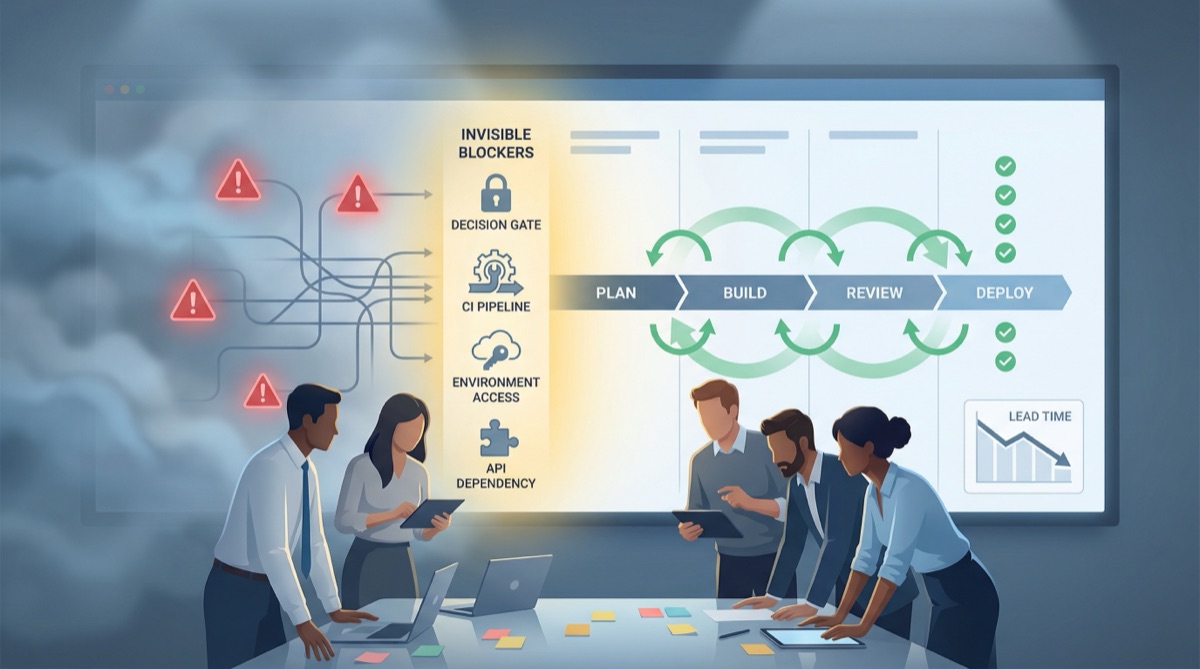
Invisible blockers consume weeks — Three developers spend a week waiting for an architectural decision that leadership doesn’t realize needs making. A deployment waits five days for a database migration approval buried in someone’s email. Code sits for three days because one person is out sick and they’re the only one who knows how to merge that subsystem. These delays are invisible until after they’ve already eaten your timeline.
Estimates assume perfect conditions — Your developer estimates “two days” based on writing code. They don’t estimate waiting for code review, waiting for CI to pass, waiting for staging environment access, waiting for design clarification, or discovering the API they planned to use doesn’t actually support their use case. The work might be two days. The waiting is three weeks.
Integration work gets forgotten — Teams estimate feature work: backend API, frontend UI, database changes. They forget to estimate integration: making sure those three pieces actually work together, discovering edge cases, handling error states, adjusting when assumptions don’t hold. Integration is where estimates explode.
Dependencies aren’t visible — Feature A depends on Feature B being deployed first. Feature B depends on a third-party API that’s behind schedule. Nobody mapped these dependencies. The estimate for Feature A assumed Feature B would be ready. It wasn’t. Now everything’s late, and leadership doesn’t understand why “simple” features take so long.
Technical debt slows everything silently — The codebase is brittle. Changing one thing breaks three others. Tests are flaky. Deployments are manual. Every feature carries invisible drag from years of shortcuts. Your developers know this. They try to estimate it. But estimating “how much extra time because the code is a mess” is nearly impossible.
Status reports hide reality — Your team reports “90% done” for weeks. What that actually means: “The easy 90% is done; the hard 10% is what remains, and we have no idea how long it will take.” By the time leadership realizes the project is in trouble, the deadline is already gone.
No feedback loops close fast enough — By the time you learn a feature isn’t working as expected, it’s been in development for a month. Rework takes another month. What could have been caught in a week if you’d deployed incrementally now costs two months because deployment is painful and rare.
This isn’t incompetence. It’s organizational structure failing to provide the visibility and feedback loops that predictable delivery requires.
Why “Better Estimation” Doesn’t Work
You’ve probably tried improving estimates: story points, planning poker, breaking work into smaller tasks, tracking velocity, adding buffer time.
The techniques are fine. The strategy fails because:
Estimation doesn’t remove blockers — You can estimate perfectly and still miss deadlines if three developers are blocked on decisions for days. Estimation assumes work flows smoothly. Work never flows smoothly. Blockers are where timelines die. Estimating harder doesn’t remove blockers.
You’re estimating the wrong thing — Most estimation focuses on coding time. But coding is 20-40% of the actual timeline. The rest is waiting: waiting for decisions, waiting for reviews, waiting for environments, waiting for dependencies. Until you make waiting visible, estimates will be wrong.
Estimates assume context that doesn’t exist — Your developer estimates based on what they know today. Tomorrow they discover the API doesn’t work as documented. Or the database schema changed. Or a key library has a breaking bug. Or requirements shifted mid-sprint. No estimation technique accounts for unknown unknowns.
Velocity is a lagging indicator — By the time velocity drops, you’ve already lost weeks. Velocity tells you that delivery slowed down. It doesn’t tell you why: Is it technical debt? New team members ramping up? Blocked decisions? Integration complexity? Without root cause visibility, velocity is just a number that makes everyone anxious.
Buffer time gets consumed by process — You add buffer to estimates. The organization fills that buffer with more meetings, more approval gates, more process to “ensure quality.” The work still takes as long as it would have taken. The buffer just hides in coordination overhead.
Predictability requires visibility, not estimation — You can’t predict what you can’t observe. Estimation is a substitute for observation. If you can actually see where time goes, what’s blocked, and what patterns cause delay, you stop needing elaborate estimation rituals. You see reality directly.
What a Developer Advocate Actually Does
A Developer Advocate makes delivery predictable by embedding evidence-based visibility and removing hidden friction. Not by imposing estimation frameworks. By making the actual work observable and fixing what slows it down.
Installs observable signals through Navigator — Caimito Navigator tracks daily work, blockers, and observations. Not status theater (“we’re 90% done”). Real signals: “Waiting 3 days for architectural decision on database sharding.” “Deployment blocked because staging environment down.” “Integration took 2 days longer than expected because API rate limits not documented.”
Surfaces invisible blockers to leadership — Navigator’s weekly reports show executives exactly where time is lost. Not opinions or complaints. Observable patterns: “Three developers blocked on same decision for 4 days.” “Deployment process has 23 manual steps; 18 hours of human time per release.” Leadership can’t fix what they can’t see. Navigator makes problems visible while they’re still fixable.
Removes blockers through embedded work — Doesn’t just report problems. Pairs with developers to automate those 23 deployment steps. Surfaces blocked architectural decisions with clear options and trade-offs. Refactors the slowest tests. Ships features while doing this. Problems disappear because someone competent is actually solving them, not documenting them.
Shortens feedback loops — Works with the team to deploy smaller changes more frequently. Feature flags let incomplete work deploy without exposing to users. Faster deployment means faster learning. Faster learning means fewer surprises. Predictability comes from short feedback loops, not elaborate upfront planning.
Builds team capability to stay predictable — Teaches the team how to spot blockers early, surface them clearly, and resolve them quickly. How to break work into deployable increments. How to write tests that give confidence. How to monitor production so they know immediately if something breaks. The capability persists after the Developer Advocate leaves.
Establishes baseline and tracks improvement — Navigator data from Week 1 shows where you started: lead time, deployment frequency, blocker patterns. Navigator data from Month 6 shows what improved and by how much. No guessing whether things got better. Observable evidence.
What Actually Changes
When delivery becomes predictable, the entire relationship between leadership and engineering shifts:
Timelines become reliable — Not because estimates got perfect. Because blockers surface early and get resolved quickly. Integration happens continuously. Feedback loops close fast. Small surprises get caught before they become big delays. You hit timelines not through better planning, but through removing friction.
Leadership has real visibility — Weekly Navigator reports show patterns: “Integration consistently takes 2× longer than feature work.” “Three developers repeatedly blocked on same type of decision.” “Deployment process is the bottleneck; features wait days to ship.” Leadership can act on observable patterns, not vague complaints about “technical debt.”
Trust replaces anxiety — When leadership asks “when will it be done?” and gets an answer based on observable patterns rather than hopeful guessing, trust builds. When teams can show exactly what’s blocking them with evidence, defensiveness evaporates. Conversations shift from blame to problem-solving.
Surprises become rare — With Navigator tracking daily, problems surface when they’re still small. “API integration not working as expected” gets caught on Day 2, not Week 6. Architectural decisions get elevated before three developers waste a week. Deployment issues get fixed before they block a release.
Strategic decisions get better — When leadership can see real data about where time goes, they make better trade-offs. “Should we invest in deployment automation or hire two more developers?” Navigator data shows deployment consumes 18 hours per release. Automation wins. Evidence drives strategy.
Developers feel heard — When blockers they’ve been complaining about for months suddenly get prioritized and fixed, morale improves. Not because someone gave a motivational speech. Because the organization responded to observable evidence. People stay where they feel effective.
How It Actually Works
The transformation from unpredictable chaos to reliable delivery happens through visible evidence and embedded capability building:
Weeks 1-4: Navigator establishes baseline — Your team logs daily work, blockers, and observations. No process change yet. Just observation. Navigator synthesizes these entries into weekly reports showing patterns you couldn’t see before: “Deployment has 23 manual steps consuming 18 hours per release.” “Three developers blocked waiting for API specs for 4 days.” “Test suite takes 45 minutes; developers skip it locally.”
Months 2-4: Developer Advocate embeds and fixes — Joins your team as a technical contributor. Pairs with developers to automate deployment (23 steps → 1 button). Refactors slowest tests while teaching testing strategies. Surfaces blocked decisions to leadership with clear options. Ships features while doing all this. Blockers disappear because someone’s actually removing them.
Months 5-6: Capability transfer and verification — Your team now knows how to spot blockers, automate processes, deploy confidently, and maintain visibility. Developer Advocate tapers involvement. Navigator continues tracking. Data confirms improvements stick: “Lead time dropped from 3 weeks to 2 days.” “Deployment frequency increased from monthly to daily.” “Blockers resolved in hours, not weeks.”
Result: Delivery becomes predictable not because you adopted a framework, but because you removed the invisible friction that made it unpredictable. Your team has the skills, tools, and visibility to deliver reliably. Navigator provides ongoing evidence. No dependency on external help.
What You Can Do Right Now
If your delivery is unpredictable, start by making the invisible visible:
Track blockers explicitly — For one week, have each developer log what blocked them each day and for how long. Don’t fix anything yet. Just observe. The patterns will reveal where unpredictability actually comes from.
Measure deployment frequency — How often do you deploy to production? Weekly? Monthly? Less? Rare deployments hide problems until they’re expensive. Frequent deployments expose problems quickly while they’re cheap to fix.
Map dependencies — Before estimating any feature, map its dependencies: other features, APIs, database changes, third-party services, infrastructure. Dependencies are where estimates fail. Make them explicit.
Measure integration time — Track how long it takes from “feature code complete” to “feature deployed and working in production.” That gap is where surprises live. If integration consistently takes 3× longer than development, you’ve found your blocker.
Question status report accuracy — When someone says “90% done,” ask: “What’s the remaining 10%? How confident are you in that estimate?” Usually the answer reveals hidden complexity. Surfacing it early prevents late surprises.
Install one feedback loop — Pick the smallest possible feature increment. Deploy it to production quickly. Learn whether it works. Use that learning for the next increment. Predictability comes from fast feedback, not perfect upfront planning.
You don’t need organizational transformation to start. You need one visible blocker removed. One feedback loop shortened. One estimate tested against reality and adjusted. Small, concrete progress compounds.
Articles: Understanding Unpredictability
These articles examine the invisible obstacles that make delivery unpredictable — and how to make the invisible visible.
The Core Problems
-
The Engine of Predictable Software Delivery
Predictable delivery doesn't come from better estimation. It comes from removing invisible friction and establishing fast feedback loops. -
Complexity in Software: What Non-Technical Leaders Need to Know
Software is a complex system where interactions produce emergent, unpredictable behaviors. Understanding complexity explains why traditional estimation fails. -
Bridging the Great Divide
Since 1968, non-technical leadership and technical teams haven't understood each other. Unpredictability lives in this gap.
Why Traditional Approaches Fail
-
From Delphi to SaaS: A Systemhaus Transformation Story
Fixed-price projects and upfront estimation trap teams. Shifting to evidence-based iteration reveals reality faster. -
The Framework Adoption Lifecycle
Frameworks promise predictability through process. They deliver ceremony overhead instead. Visibility requires observable signals, not compliance. -
When Developer Advocate Meant Something Else
How the Developer Advocate role evolved from embedded technical excellence to conference circuit celebrity — and why embedded work is essential for visibility.
Technical Practices That Create Visibility
-
Beyond the Solo Developer Myth: Pair Programming, Mob Programming, and AI Collaboration
Collaborative practices spread knowledge and surface blockers immediately, eliminating hidden delays. -
When Discovery Collides with Process
Process assumes known solutions. Discovery reveals unknowns. When you can't predict outcomes, visibility becomes essential. -
Treating Developers with Respect
Respect means removing obstacles and giving developers the visibility tools to surface blockers themselves.
Telenovela Episodes: Unpredictability in Action
Sometimes dramatic stories reveal unpredictable delivery more clearly than any case study. These episodes show what happens when organizations fly blind without visible signals.
Signal Through Noise: Cutting Through Organizational Chaos
A game studio trying to gain visibility into software delivery discovers how unpredictability compounds when leadership has no idea where time actually goes.
-
Episode 1: The Crunch That Never Ends
Leadership makes decisions based on what they want to be true, not what's happening in engineering. No visibility into real capacity, real technical debt, real risks. -
Episode 5: The First Synthesis
The first Navigator weekly synthesis arrives — and the patterns are ugly. Same blockers every day. Evidence that doesn't care about politics. -
Episode 8: The Onboarding Disaster
Hiring faster doesn't equal shipping faster. Navigator shows headcount increasing while absorption capacity collapses. The data is stubborn.
More episodes: Signal Through Noise — All Episodes
La Startup: A Fintech Telenovela from Bogotá
A startup with $15 million in funding struggles with unpredictable delivery because nobody understands the technical reality behind the polished investor story.
-
Episode 1: El Pitch Perfecto
Perfect pitch. Missing lead developer. Nobody knows when the next version can ship. -
Episode 3: Los Secretos del Código
The codebase reveals shortcuts, technical debt, and invisible friction that makes delivery unpredictable.
More episodes: La Startup — All Episodes
Related Topics
-
Why Can’t We Deploy More Frequently?
Deployment frequency is a forcing function. Rare deployments hide problems; frequent deployments expose them while they’re still cheap to fix. -
Development Team Struggles with Delivery
When talented teams struggle, the problem isn’t capability — it’s invisible technical friction blocking their flow. -
Corporate Culture Examples
Culture isn’t values on a wall. It’s the patterns of behavior rewarded or punished. Unpredictability thrives in cultures that reward status theater over observable signals.
Ready for Predictable Delivery?
Unpredictable delivery isn’t a people problem. It’s a visibility problem. When you can observe where time goes, what’s blocked, and what patterns cause delays, delivery becomes predictable because you’re responding to reality instead of guessing.
You can have that visibility. It requires making the invisible work observable, removing the blockers that consume your timelines, and building your team’s capability to maintain predictability after external help leaves.
Schedule a 30-minute conversation to discuss what makes your delivery unpredictable, where the invisible blockers hide, and whether Developer Advocate embedding with Navigator makes sense for your situation.