You Know Delivery Should Be Faster — But Nobody Can Explain Why It’s So Slow
Your competitors ship features in days. Your team takes weeks or months. Leadership asks “why is this taking so long?” Your developers give technical explanations. Leadership doesn’t understand them. Frustration builds on both sides.
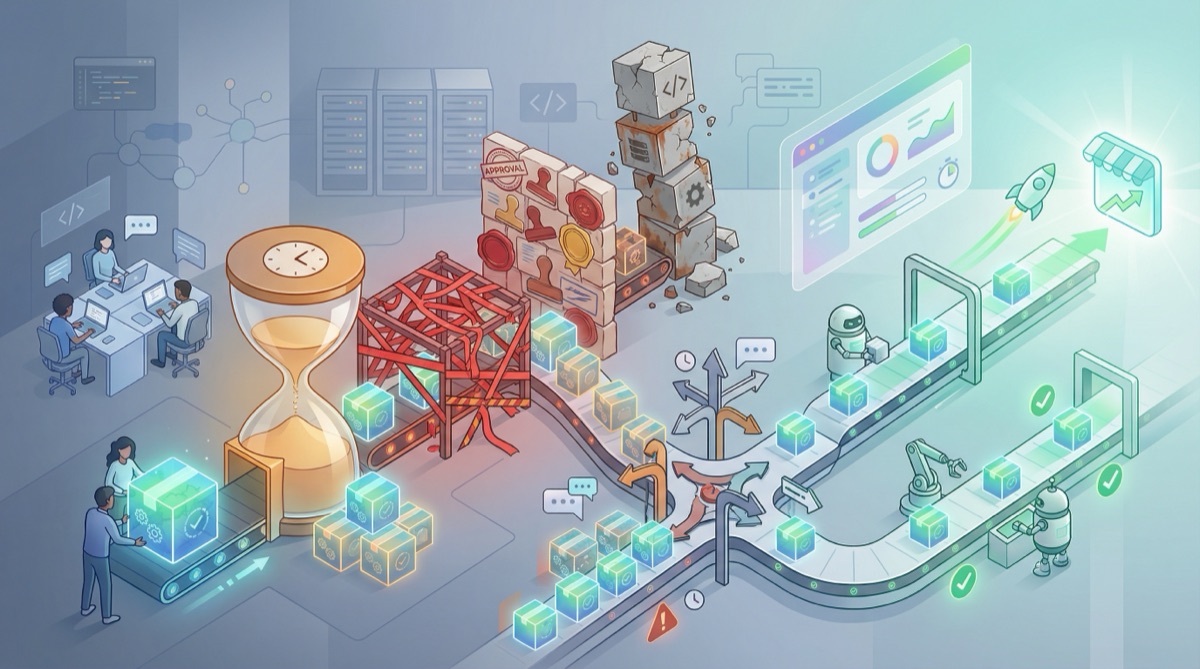
The problem isn’t insufficient effort. Your developers work long hours. They’re competent. The problem is invisible friction: obstacles that consume time without anyone noticing until timelines explode. Waiting. Manual steps. Integration delays. Approval theater. Technical debt. Each obstacle is small. Together, they paralyze delivery.
Seeing this pattern? Schedule a conversation to discuss what’s actually slowing your delivery.
What’s Actually Happening
Most organizations deliver slowly because organizational friction accumulates faster than anyone addresses it:
Waiting consumes most of the timeline — Your developer writes a feature in two days. Then waits three days for code review. Then waits two days for CI to finish and staging environment access. Then waits four days for product owner approval. Then waits five days for the deployment window. The work took two days. The waiting took two weeks. Nobody tracks waiting. So nobody fixes it.
Manual processes scale poorly — Deployment requires 23 manual steps. Each step “only takes a minute.” But 23 minutes of careful, error-prone work creates a bottleneck. Only two people know all the steps. Deployment becomes a coordination nightmare. Features pile up waiting to deploy. What should be a button press becomes a multi-hour ritual that blocks everything.
Integration is where timelines die — Backend API works. Frontend UI works. Database changes work. Putting them together reveals assumptions that don’t hold. The API returns data in the wrong format. The UI expects fields that don’t exist. Database migrations break running code. Integration takes 3× longer than development because nobody tested integration continuously.
Approval gates don’t add value — Each feature needs sign-off from QA lead, product owner, engineering manager, sometimes the CTO. Each approval takes days. The approvers don’t actually review anything meaningful — they verify previous steps completed. It’s governance theater. The process exists to catch mistakes that automated tests should catch. Instead, it just slows everything down.
Technical debt acts as invisible drag — The codebase is brittle. Changing one thing breaks three others. Tests are flaky, so developers don’t trust them. Deployments are manual and error-prone. Every feature carries extra time: navigating legacy code, fixing unrelated breakage, working around architectural limitations. Your developers know this. Leadership doesn’t see it. So it never gets prioritized.
Context switching destroys productivity — Your developer starts working on a feature. Gets pulled into a production incident. Spends two hours firefighting. Returns to the feature but has lost context. Takes an hour to remember where they were. Gets interrupted by a planning meeting. Loses context again. What should be a two-day feature takes eight days because nobody protects focus time.
Dependencies aren’t visible or managed — Feature A depends on Feature B being finished first. Feature B depends on a third-party API that’s delayed. Feature C blocks Feature D. Nobody mapped these dependencies. Teams discover them when timelines slip. By then, it’s too late to adjust. Dependencies turn sequential work into waiting marathons.
Nobody has authority to remove obstacles — Developers spot blockers daily. They raise them in standups. Nothing changes. The obstacles require decisions from leadership. Leadership doesn’t realize how much time these obstacles consume. So they don’t prioritize fixing them. The obstacles persist. Delivery stays slow. Everybody blames each other.
This isn’t developer incompetence. This is organizational structure failing to remove friction.
Why “Move Faster” Doesn’t Work
You’ve probably tried the obvious solutions: hiring more developers, mandating overtime, adopting agile frameworks, implementing velocity tracking.
The attempts fail because:
Adding people makes coordination harder — Nine developers can’t deliver a feature nine times faster than one developer. They need to communicate, integrate work, avoid stepping on each other. More people means more coordination overhead. If your process is already slow, adding people makes it slower. You’re scaling the friction, not the output.
Working longer hours burns out teams — Developers can sprint for a week, maybe two. Then productivity collapses. Tired developers write buggy code. Bugs create rework. Rework takes longer than doing it right the first time. Burnout leads to turnover. Turnover destroys institutional knowledge. Replacing someone costs six months of lost productivity. You don’t ship faster by breaking your team.
Frameworks don’t remove obstacles — You adopt Scrum, SAFe, Kanban, whatever. The framework gives you ceremonies, roles, and artifacts. It doesn’t remove the manual deployment steps. It doesn’t speed up approval gates. It doesn’t fix brittle code. It doesn’t make dependencies visible. The obstacles remain. Now you also have framework overhead. Delivery gets slower, not faster.
Velocity tracking doesn’t fix root causes — You track story points, sprint velocity, cycle time. The metrics show you’re slow. They don’t tell you why. Is it waiting? Manual processes? Technical debt? Integration complexity? Context switching? Without root cause visibility, velocity metrics just create pressure. Pressure doesn’t remove obstacles. It creates shortcuts that worsen technical debt.
Process doesn’t substitute for capability — You implement more code review requirements. More testing phases. More approval gates. More documentation. Each process step adds time. The intent is quality. The result is delay. Quality comes from capable teams with good practices, not from process checkpoints. Process-heavy organizations deliver slowly and produce low quality because process creates compliance theater, not capability.
Speed requires removing friction, not adding pressure — Delivery gets faster when obstacles disappear. Obstacles disappear when someone with competence and authority identifies them and removes them. Most organizations have neither visibility into what slows them down nor anyone empowered to fix it.
What a Developer Advocate Actually Does
A Developer Advocate makes delivery faster by identifying and removing organizational friction. Not by adding process. Not by pressuring teams. By making obstacles visible and eliminating them through embedded technical work.
Makes friction observable through Navigator — Caimito Navigator tracks daily work, blockers, and waiting time. Not status theater. Real patterns: “Waited 3 days for code review.” “Deployment blocked 5 days waiting for staging environment.” “Integration took 2× estimated time because API contract changed.” Friction becomes visible. Leadership can finally see what’s consuming timelines.
Removes manual processes through automation — Pairs with your developers to automate those 23 deployment steps. Automates environment provisioning. Scripts repetitive tasks. Turns multi-hour processes into button presses. Teaches your team how to automate while doing it. Manual bottlenecks disappear. Throughput increases.
Shortens approval cycles — Works with leadership to replace approval gates with automated checks. If tests pass, code scans pass, and monitoring looks healthy, the feature deploys. Humans don’t need to approve what computers can verify. This frees humans to focus on decisions that actually need judgment: prioritization, architecture, user experience.
Fixes technical debt strategically — Doesn’t rewrite everything. Identifies which technical debt actually slows delivery. Refactors the slowest tests. Decouples the most brittle dependencies. Pays down debt that’s blocking current work. Teaches the team how to avoid accumulating more. Technical drag decreases. Development speed increases.
Enables continuous integration — Helps teams break work into smaller increments that integrate daily. Feature flags let incomplete work deploy without user exposure. Deployment frequency increases. Integration problems surface immediately while they’re cheap to fix. No more “integration week” surprises.
Surfaces blockers to executives — Navigator’s weekly reports show leadership exactly where time is lost. Not complaints. Observable patterns: “Three developers blocked 4 days waiting for architectural decision.” “Deployment process consumes 18 hours per release.” Executives can prioritize removing obstacles because they finally see the cost.
Builds team capability to stay fast — Teaches developers to spot obstacles early, automate processes, write tests that give confidence, deploy frequently. The capability persists after the Developer Advocate leaves. Delivery stays fast because the team knows how to keep it fast.
What Actually Changes
When organizational friction disappears, delivery speed increases dramatically without cutting corners:
Lead time collapses — Features that took three weeks from idea to production now take three days. Not because developers code faster. Because waiting time disappeared. Manual steps automated. Approval gates replaced with automated checks. Integration happens continuously. Small batches move through the system quickly.
Deployment becomes routine — Deploying multiple times per day replaces monthly “deployment events.” Deployment is automated, monitored, and reversible. Risk decreases because batch size shrinks. Feedback loops close in hours instead of weeks. Problems surface immediately while they’re still small and cheap to fix.
Developers protect focus time — When deployment is automated and integration is continuous, firefighting decreases. Developers spend more time building features, less time fixing production incidents or merging conflict-ridden branches. Productivity increases not through longer hours but through less context switching.
Technical debt gets managed — With faster delivery, teams have breathing room to refactor. Small, continuous improvements replace “rewrite everything” fantasies that never happen. The codebase gets cleaner over time because maintaining velocity is easier than fighting growing drag.
Dependencies become visible — Navigator tracking makes dependencies obvious. Teams coordinate naturally because they see who’s blocked on what. Work flows smoothly instead of piling up behind invisible dependencies discovered too late.
Leadership sees reality — Weekly Navigator reports show where time goes. “Integration takes 2× development time” becomes a prioritizable problem instead of developer complaints nobody understands. Strategic decisions improve because they’re based on observable patterns, not guesses.
Teams trust the process — When obstacles get removed instead of accumulated, morale improves. Developers stay where they feel effective. Retention improves. Institutional knowledge persists. Productivity compounds over time instead of resetting with every hire.
How It Actually Works
The transformation from slow to fast delivery happens through making friction visible and systematically removing it:
Weeks 1-4: Navigator establishes baseline — Your team logs daily work, blockers, and waiting time. No process changes yet. Just observation. Navigator synthesizes this into weekly reports showing patterns: “Deployment has 23 manual steps consuming 18 hours per release.” “Average wait time for code review: 3.2 days.” “Integration consistently takes 2× estimated time.” Now you see what’s actually slowing you down.
Months 2-4: Developer Advocate embeds and removes obstacles — Joins as a technical contributor. Pairs with developers to automate deployment (23 steps → 1 button). Refactors the slowest tests. Helps teams integrate continuously. Surfaces blocked decisions to leadership with clear options. Ships features while doing all this. Obstacles disappear one by one.
Months 5-6: Capability transfer and verification — Your team now knows how to automate processes, integrate continuously, deploy confidently, and spot obstacles early. Developer Advocate tapers involvement. Navigator continues tracking. Data confirms improvements stick: “Lead time dropped from 21 days to 3 days.” “Deployment frequency increased from monthly to multiple times daily.” “Integration time no longer exceeds development time.”
Result: Delivery is fast not because you adopted a framework, but because you removed the friction that made it slow. Your team has the skills and tools to maintain speed. Navigator provides ongoing visibility. No dependency on external help.
Articles: Understanding Delivery Friction
These articles examine the specific obstacles that slow delivery and the technical practices that remove them.
Core Problems
-
The Engine of Predictable Software Delivery
The foundational technical practices that make delivery predictable: continuous integration, trunk-based development, and automated deployment. Not theory — concrete patterns that remove friction. -
Technical Practices That Drive Business Results
How TDD, CI/CD, and observable systems create business velocity. Connects engineering discipline to revenue, customer satisfaction, and competitive advantage. -
Continuous Integration
The specific practice that prevents "integration week" disasters. Small, frequent integrations surface conflicts immediately when they're cheap to fix.
Why Frameworks Fail to Fix This
-
Management Frameworks Don't Fix Software Teams
Why Scrum, SAFe, and similar frameworks add ceremony without removing obstacles. The dysfunction they're meant to solve persists because they don't address technical friction. -
Management Frameworks and Snake Oil
The sales pitch versus the reality. What framework vendors promise versus what teams actually need to ship reliably. -
The Framework Adoption Lifecycle
The predictable pattern: enthusiasm → disillusionment → abandonment. Why organizations keep adopting new frameworks instead of fixing root causes.
Developer Impact
-
Intrinsic Motivation and Software Developers
How organizational friction destroys developer motivation. Autonomy, mastery, and purpose require removing obstacles, not adding process. -
Treating Developers with Respect
Respect means removing blockers and protecting focus time. Not ping-pong tables or free snacks. -
Beyond the Solo Developer Myth
Why "10x developers" are a distraction. Speed comes from removing team-level friction, not hiring rockstars.
Telenovela Episodes: Delivery Dysfunction in Action
Sometimes dramatic stories reveal organizational dysfunction more clearly than any case study. These episodes show the human cost of delivery friction.
Signal Through Noise: A Gaming Studio’s Delivery Crisis
-
Episode 1: The Crunch That Never Ends
Launch deadline pressure meets manual deployment bottlenecks. When every release requires heroics, teams burn out and quality suffers. -
Episode 2: When Players Revolt
Production incidents caused by skipping quality gates under pressure. The customer-facing consequences of organizational friction. -
Episode 3: The All-Hands Disaster
Executive visibility without understanding creates misaligned priorities. Data theater replaces real insight.
More episodes: Signal Through Noise — All Episodes
La Startup: Funding Pressure and Technical Collapse
-
Episode 4: Phantoms of the Sprint
The missing lead developer's technical debt haunts the team. Nobody documented his decisions. Nobody can maintain his code. Velocity collapses. -
Episode 6: Ashes
When technical reality collides with investor expectations. The demo fails. Trust evaporates. Delivery friction becomes existential crisis.
More episodes: La Startup — All Episodes
Related Topics
-
Why Does My Development Team Struggle with Delivery?
The technical friction patterns that slow capable teams: integration delays, manual processes, knowledge silos. -
Software Delivery Unpredictable — What to Do?
How to establish predictable delivery through observable signals and systematic friction removal. -
Why Can’t We Deploy More Frequently?
The specific obstacles preventing frequent deployment and how to remove them.
Ready to Ship Faster?
Slow delivery isn’t a people problem. It’s a friction problem. When you make friction visible and systematically remove it, delivery accelerates because work flows smoothly instead of getting stuck in invisible obstacles.
You can have that speed. It requires making the hidden obstacles visible, removing them through competent technical work, and building your team’s capability to keep delivery fast after external help leaves.
Schedule a 30-minute conversation to discuss what’s slowing your delivery, where the friction hides, and whether Developer Advocate embedding with Navigator makes sense for your situation.