Caimito Navigator
The Cost of Dysfunction That Goes Unnoted
You invest heavily in engineering talent. Your teams are smart, motivated, capable. Yet somehow, problems surface too late. Deadlines slip. Blockers that “came out of nowhere” turn out to have been visible for weeks — to everyone except leadership.
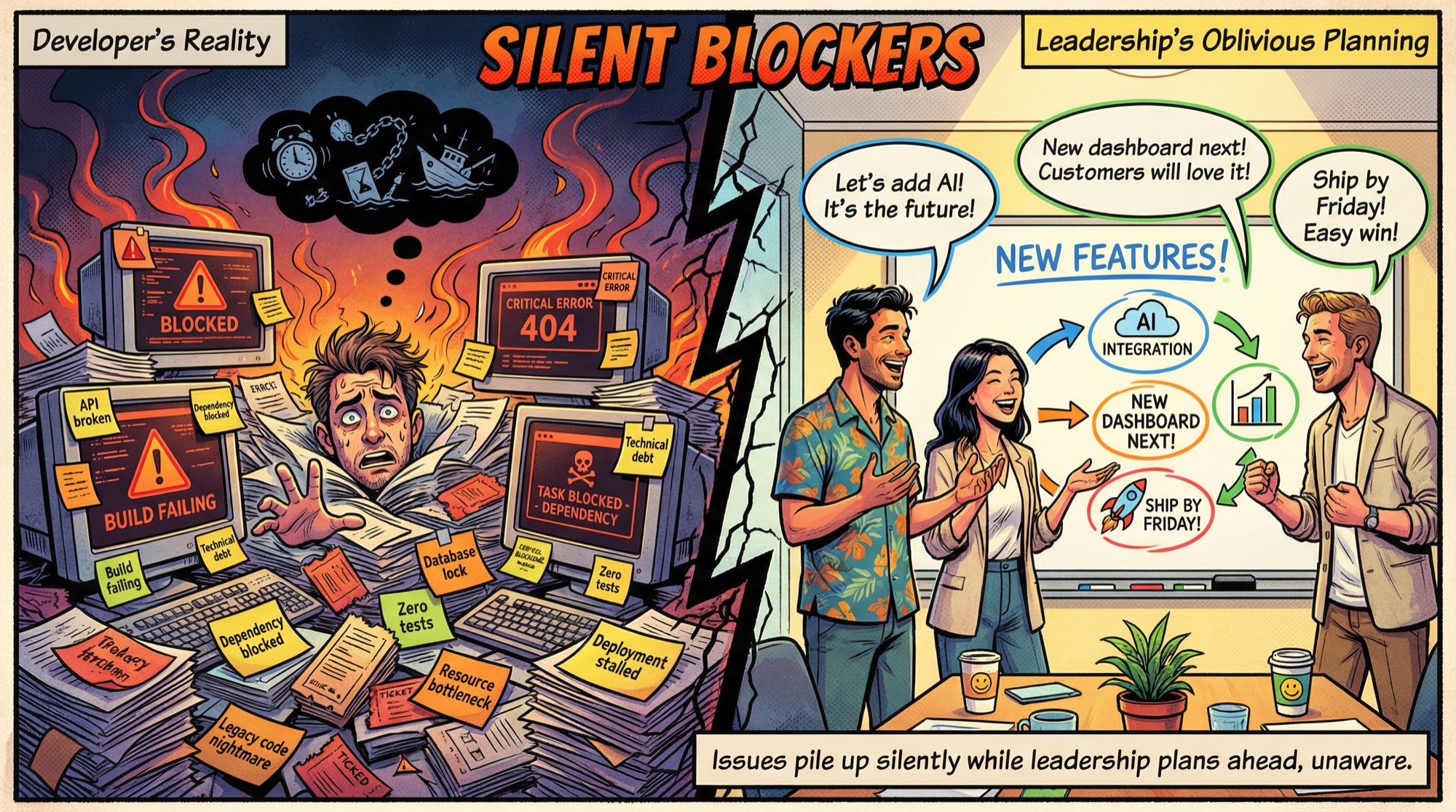
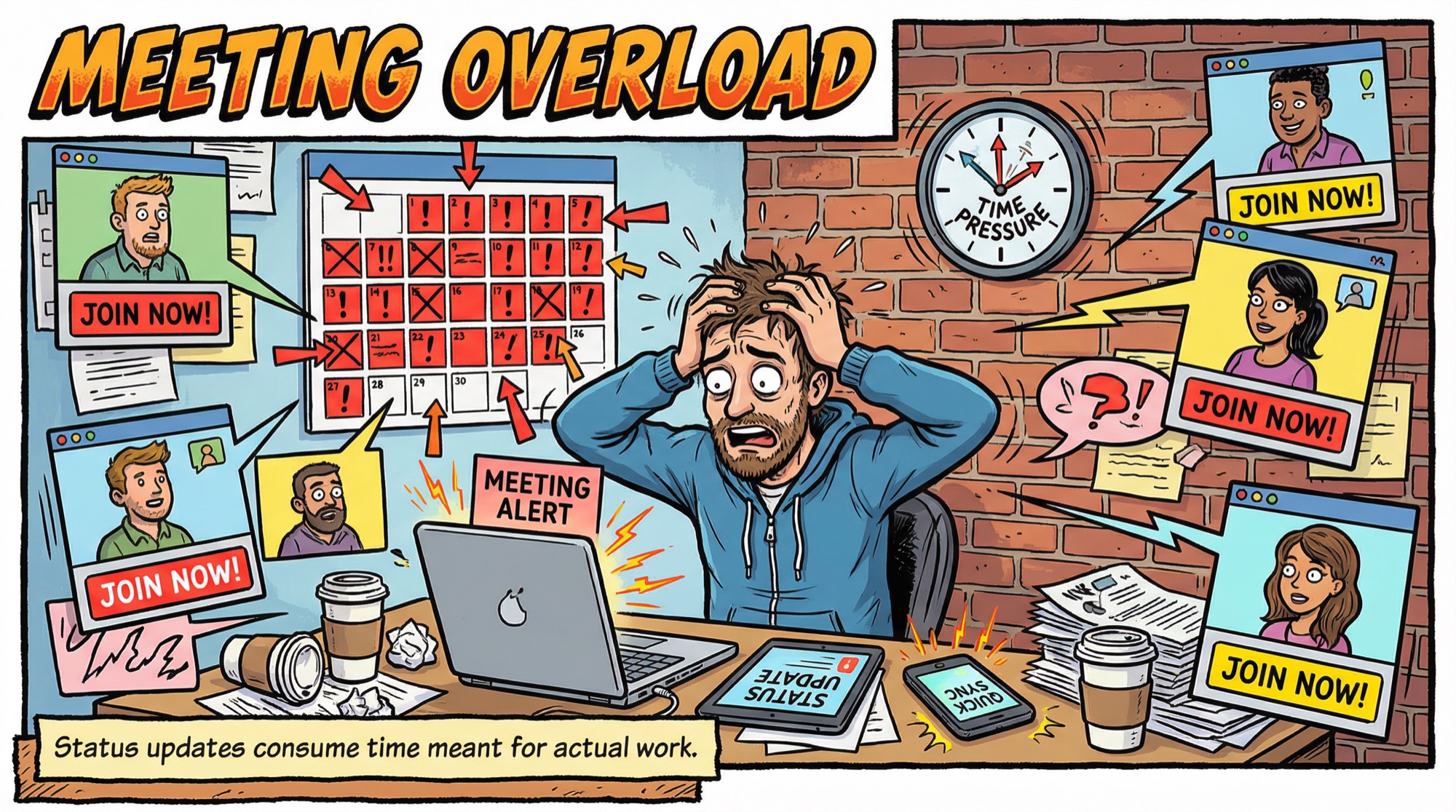
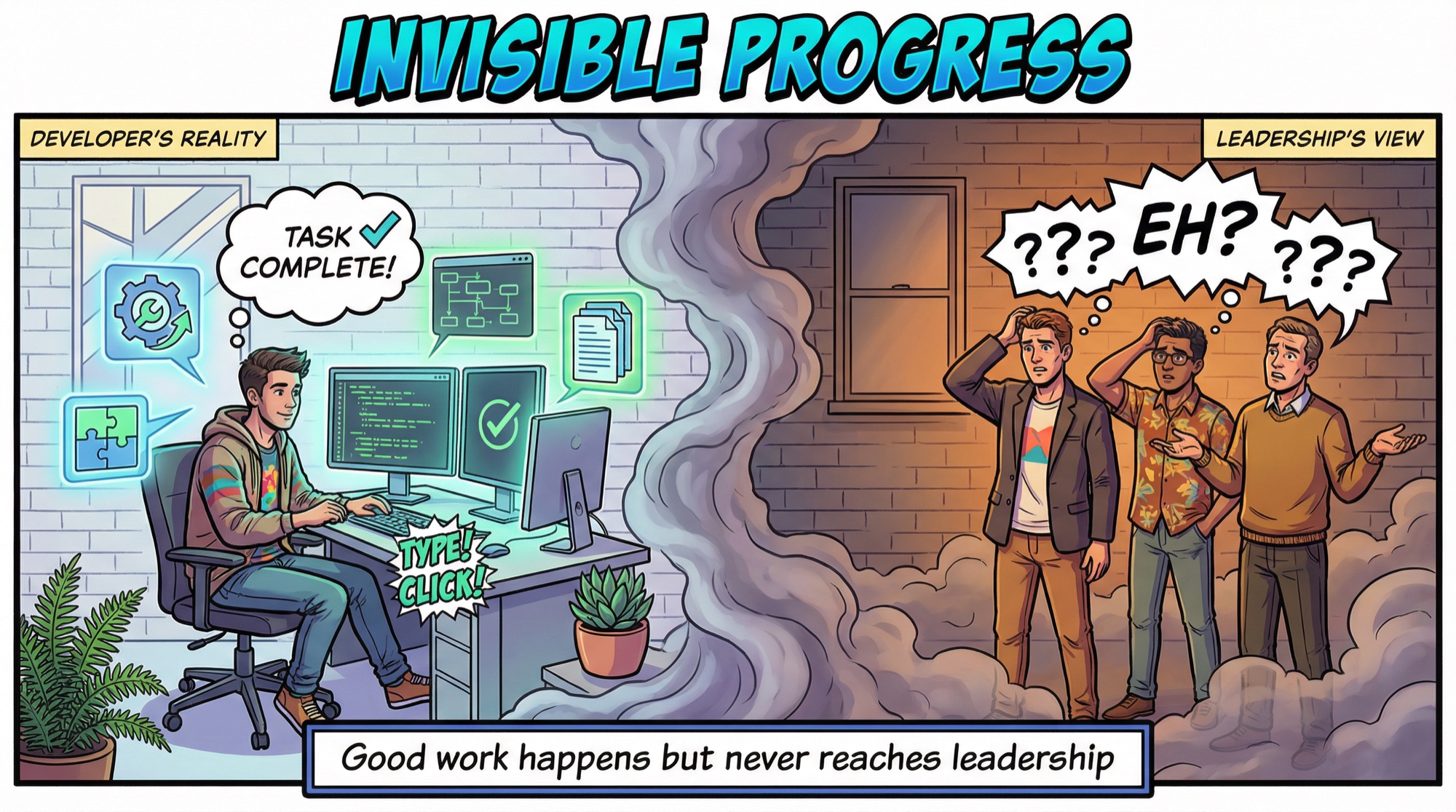
The culprit isn’t your people. It’s the gap between where work happens and where decisions are made. Status meetings consume the time meant for actual work. Good work happens but never reaches leadership.
The result? You make decisions on partial information. You learn about problems when it’s too late for early intervention. You can’t distinguish between teams that are busy and teams that are actually making progress.
The Solution
Navigator captures engineering reality at the source — brief daily observations from the people doing the work — and transforms those observations into practical weekly guidance for the people responsible for helping the team succeed.
Think of Navigator as our platform for structured visibility around delivery work. The Logbook and weekly synthesis are the most visible parts, but they are not the whole thing. Navigator also gives the engagement a clean operating frame: one place for signal, notes, scheduling, retainers, and invoicing.
The Logbook itself acts as an organizational logbook and synthesis layer — doing part of what a skilled Embedded Delivery Partner does when working with your teams: observe patterns, summarize them, and help you decide where support is needed. The difference? Navigator is always there. It doesn’t rely on confessions over coffee or the luck of being in the right room at the right moment. It captures signal continuously, from everyone, without adding overhead.
When Navigator reveals patterns that need hands-on intervention — delivery friction that requires coaching, technical practices that need strengthening, organizational constraints that block flow — an Embedded Delivery Partner can come in as an embedded role to improve things. Navigator provides the diagnosis; the Embedded Delivery Partner provides the treatment. Evidence shapes both.
Leaders Receive Clarity
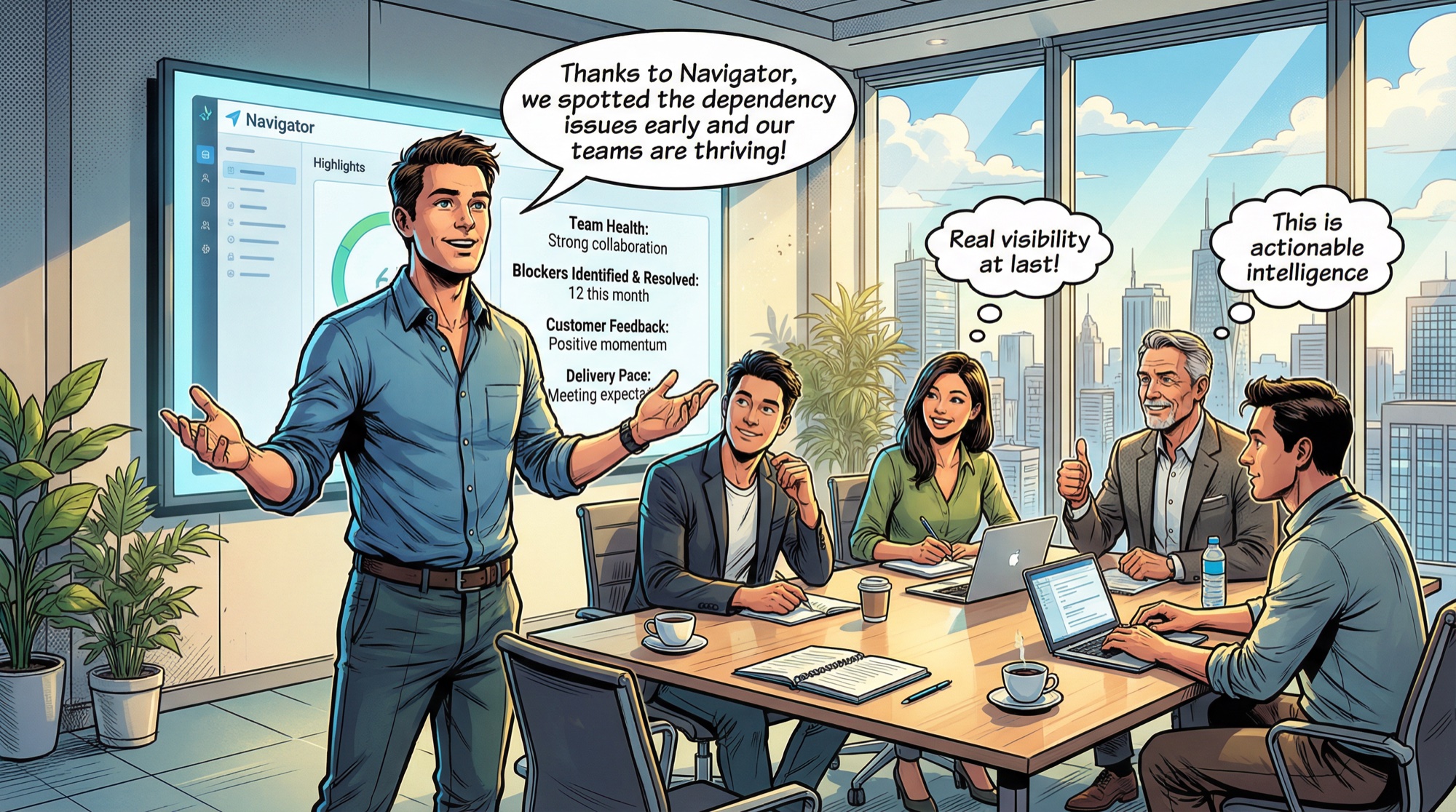
Each week, the responsible leader receives a concise summary: what’s progressing, what’s blocked, and what needs attention. Not data to analyze — guidance to act on.
You can finally distinguish between teams that are spinning their wheels and teams making real progress.
What You See
- Delivery momentum across teams
- Hidden blockers and dependencies
- Early warning of delivery risk
- Impact of organizational changes
What You Save
- Status meetings eliminated
- Developer focus protected
- Problems caught weeks earlier
- Decisions based on evidence
How It Works
At product level, Navigator follows a simple three-step flow: engineers log briefly, Navigator synthesizes patterns, and leaders receive clarity. In practice, that sits inside a broader platform that helps keep the whole engagement orderly and visible.
1. Engineers Log Briefly
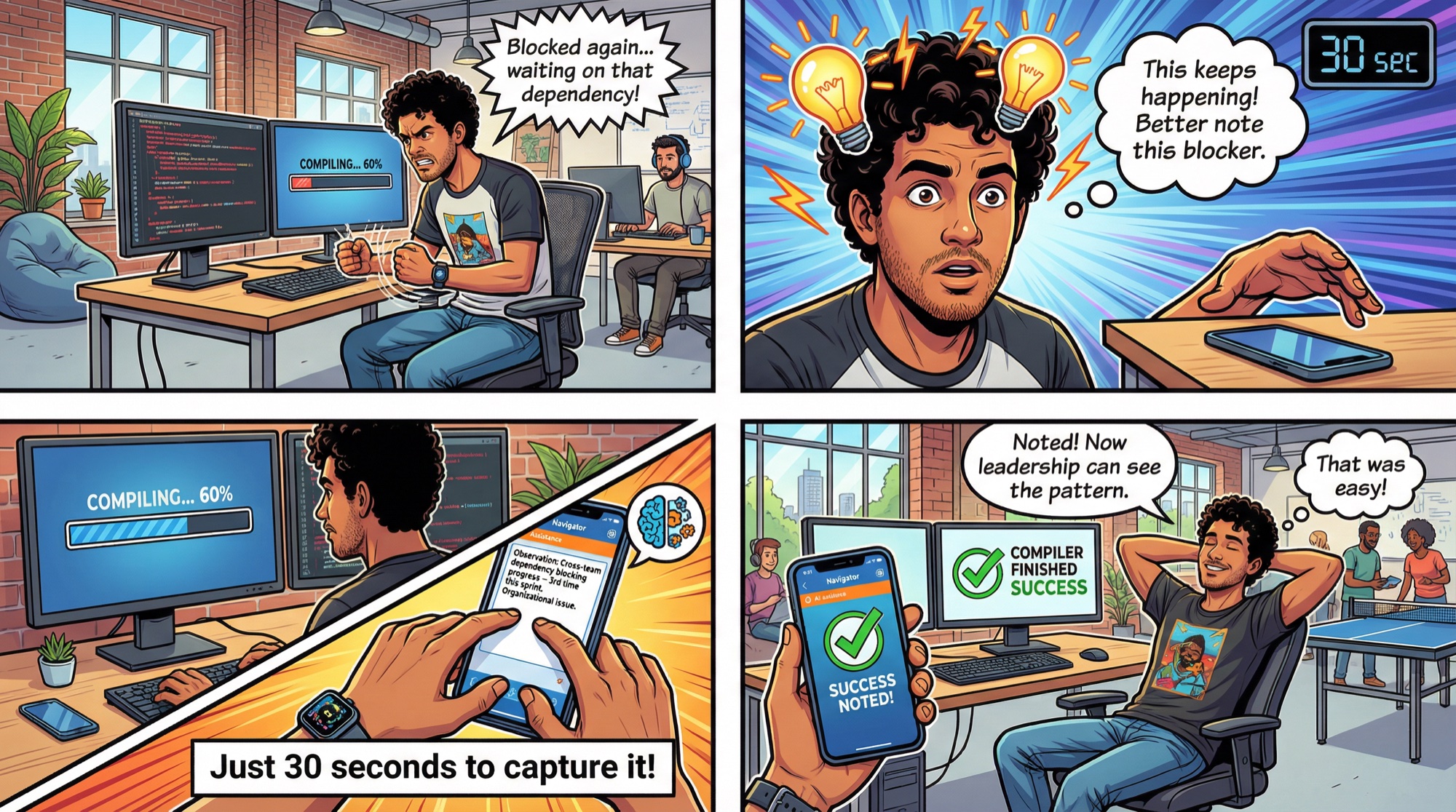
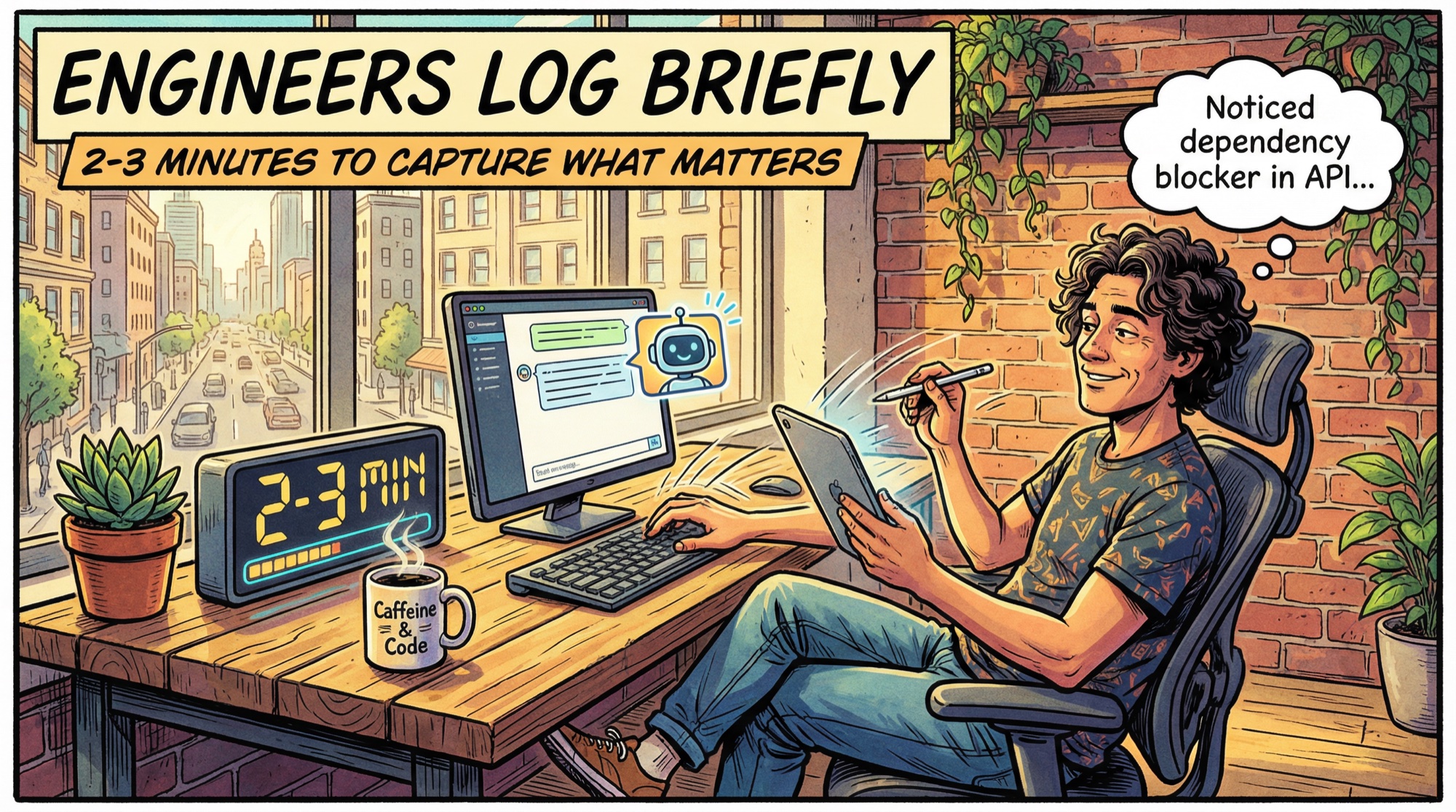
Each day, engineers spend 2–3 minutes capturing what actually happened — in their own words. Direction. Blockers. Outcomes.
Core Navigator needs no tool integrations and does no activity tracking. Its normal input is what engineers choose to share — their observations, their perspective, their voice. In some narrow cases, Navigator can add a DORA baseline as a separate input. That does not change the core product: the main output is still qualitative synthesis, recommendations, and conclusions built from daily logs and, when enabled, relevant Slack messages.
This isn’t a burden — it’s a relief. Engineers finally have a channel to surface friction without scheduling a meeting or writing a formal escalation.
2. Navigator Synthesizes
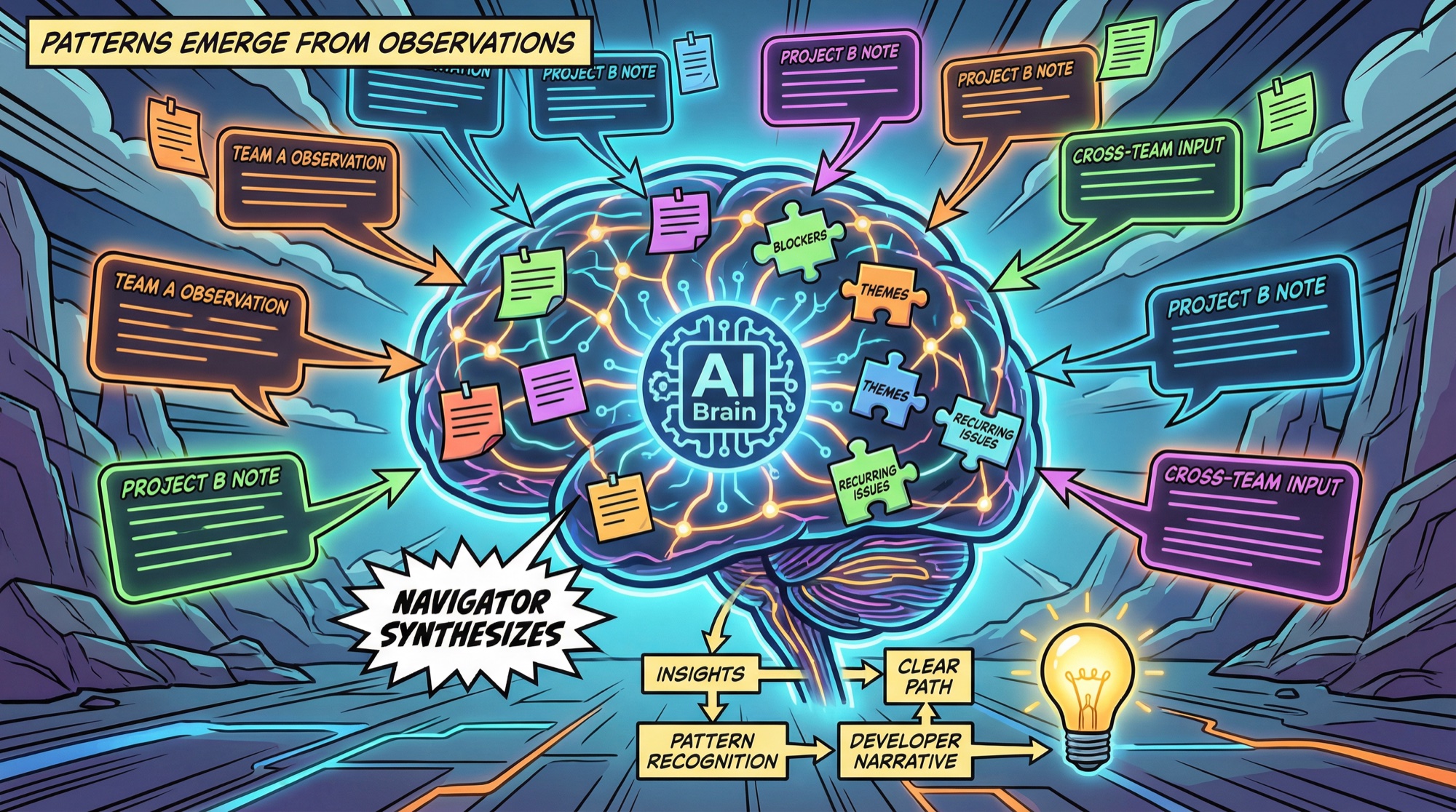
Navigator analyzes the stream of daily logs — and, when enabled, relevant Slack messages — identifying recurring themes, cross-team dependencies, emerging risks, and momentum shifts.
What surfaces isn’t a dashboard full of numbers to interpret. It’s a narrative — a coherent story of what’s happening across your engineering organization. No KPI theater. No burndown charts. No lines-of-code counting. Just human observations, synthesized into strategic insight. A narrow DORA view may exist for specific cases, but it is an add-on, not the center of the product.
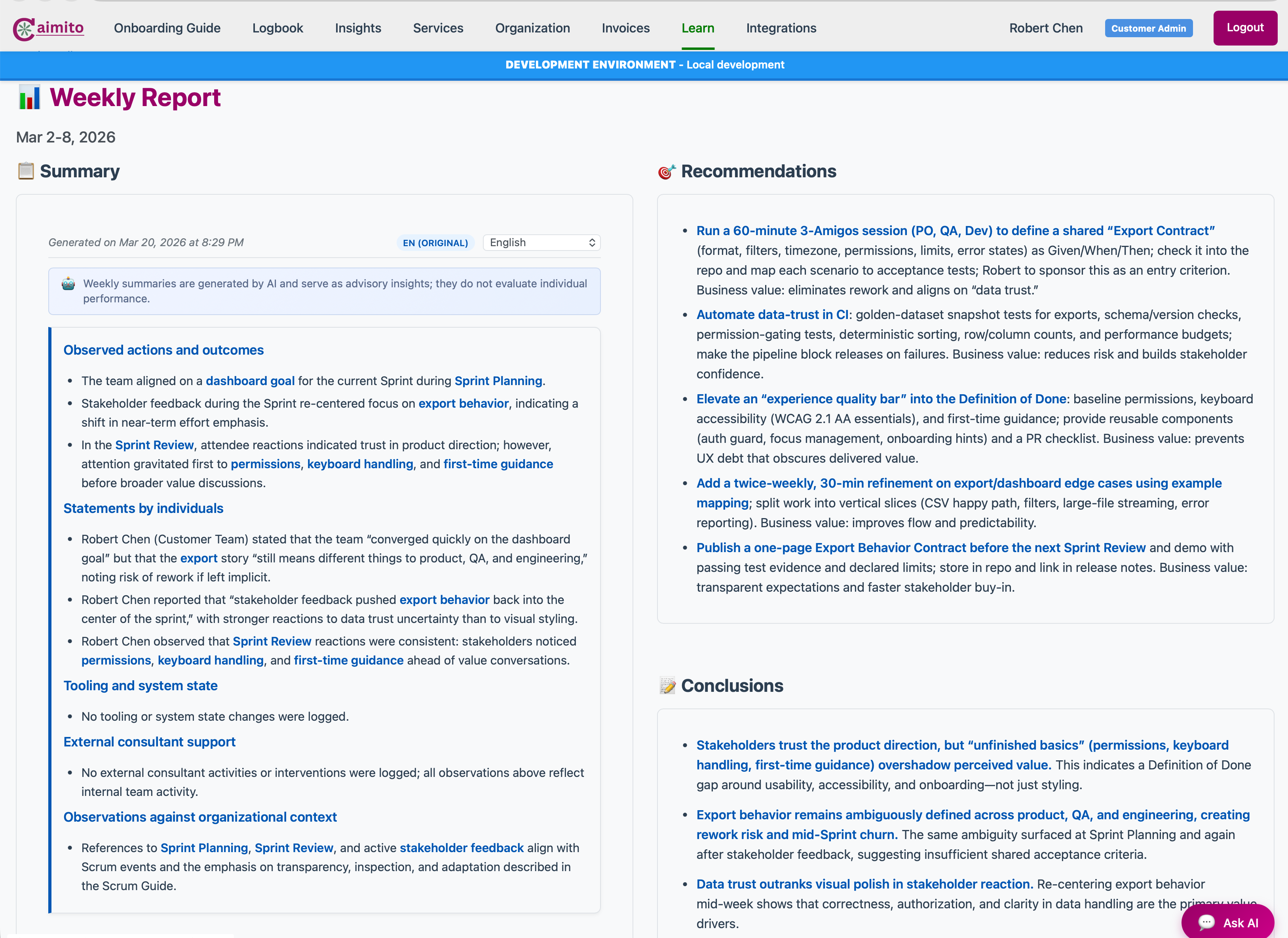
See an actual Navigator report.
Open a sample weekly report in a lightbox to see what synthesized organizational intelligence looks like in practice.
3. Leaders Receive Clarity
Each week, leadership receives actionable guidance — not raw data to sift through, but clear recommendations ready for decisions. “Address critical API dependency for Team Beta soon.” “Platform team capacity constrained — three teams blocked.”
This is where scattered signals become coordinated action. Pattern recognition surfaces what matters. Developer narratives provide context. Clear paths emerge from complexity. Leadership can support the team earlier instead of waiting for the next status meeting to reveal what everyone else already knew.

Early Warning Across Teams
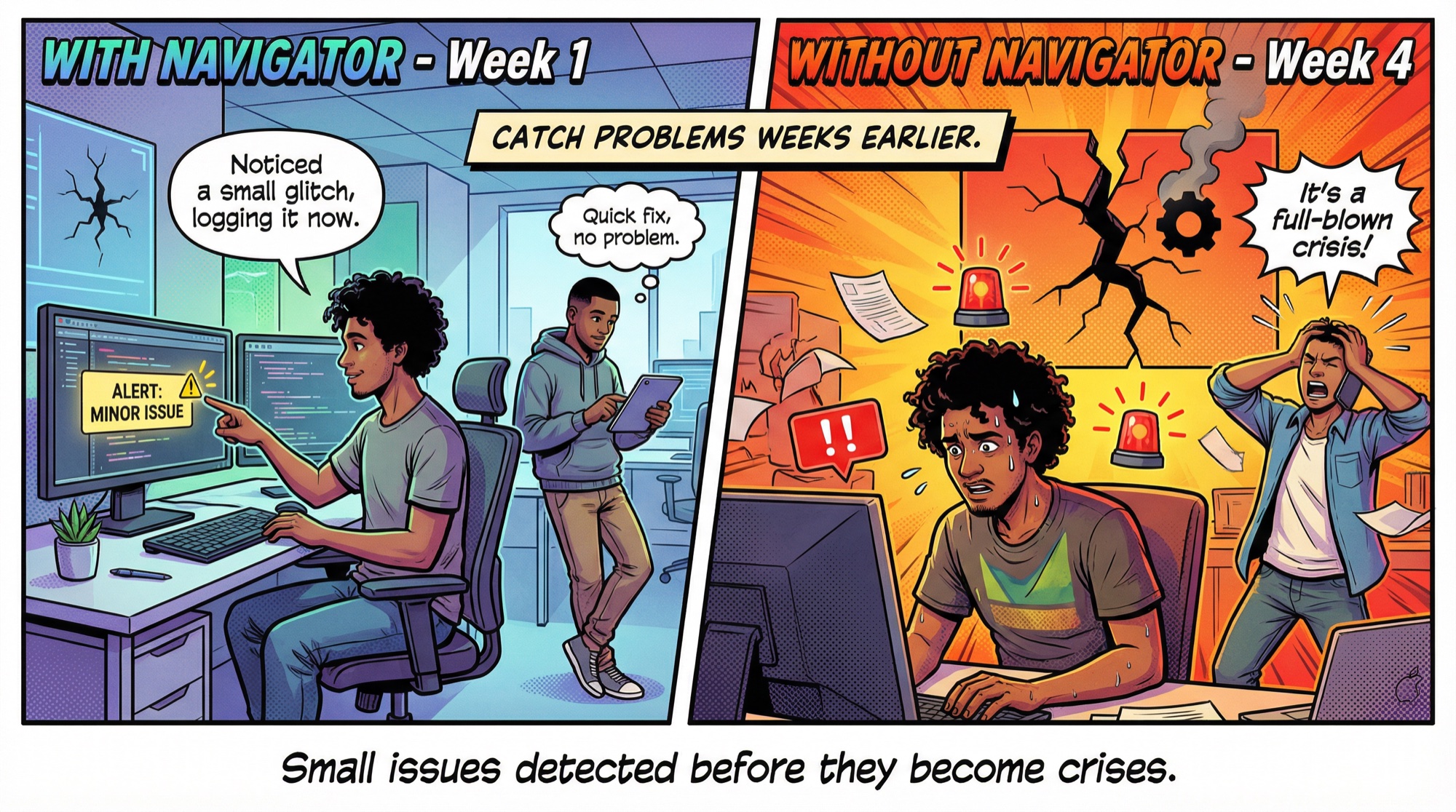
The most expensive problems are the ones you learn about too late. By the time a delivery risk becomes a delivery crisis, your options are limited and your costs are high.
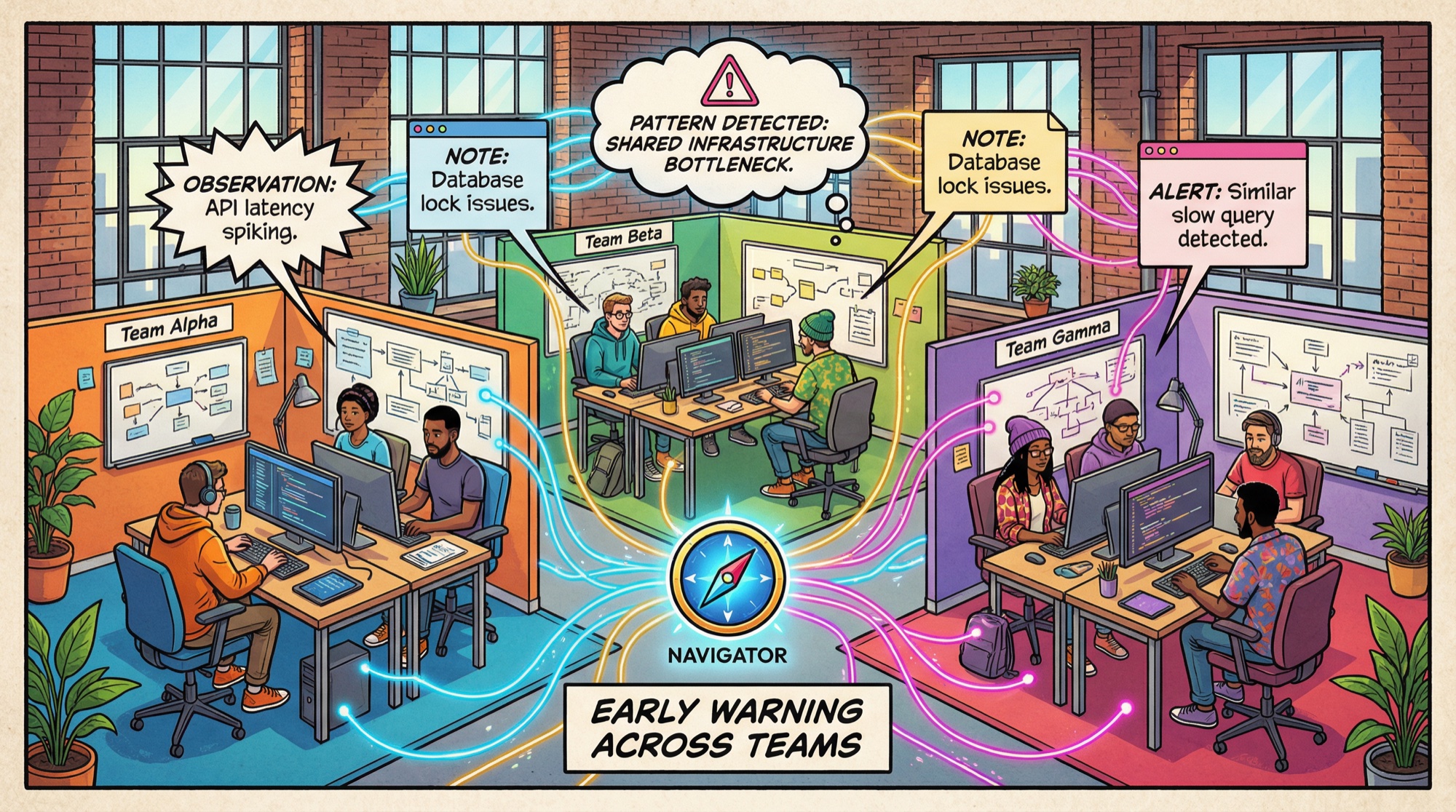
Navigator shifts detection upstream. When a blocker appears in one team’s daily logs, you see it. When that same blocker pattern emerges across multiple teams, Navigator flags the systemic issue before it cascades into widespread delays.
Modern software organizations don’t work in silos. Teams depend on each other — shared services, platform capabilities, external integrations. Navigator makes these dependencies visible. When Team Alpha is blocked waiting for Team Beta, and Team Beta is blocked waiting for Team Gamma, Navigator shows you the chain. Address the root constraint instead of fighting symptoms.
This isn’t surveillance. It’s a structured way to work from shared evidence. The difference matters. Surveillance distorts behavior. Shared evidence improves coordination and decisions.
What Navigator is NOT:
- Not a KPI system for tracking commits, tickets, or velocity theater
- Not a keystroke logger or activity monitor
- Not a performance management tool measuring developer output
- Not another dashboard full of metrics to interpret
What Navigator IS:
- A channel for engineers to share observations in their own words
- A synthesis engine that finds patterns across human reflections
- An intelligence layer that turns scattered signals into strategic insight
- A way for leadership to understand reality without interrogating teams
Evidence-Based Decisions
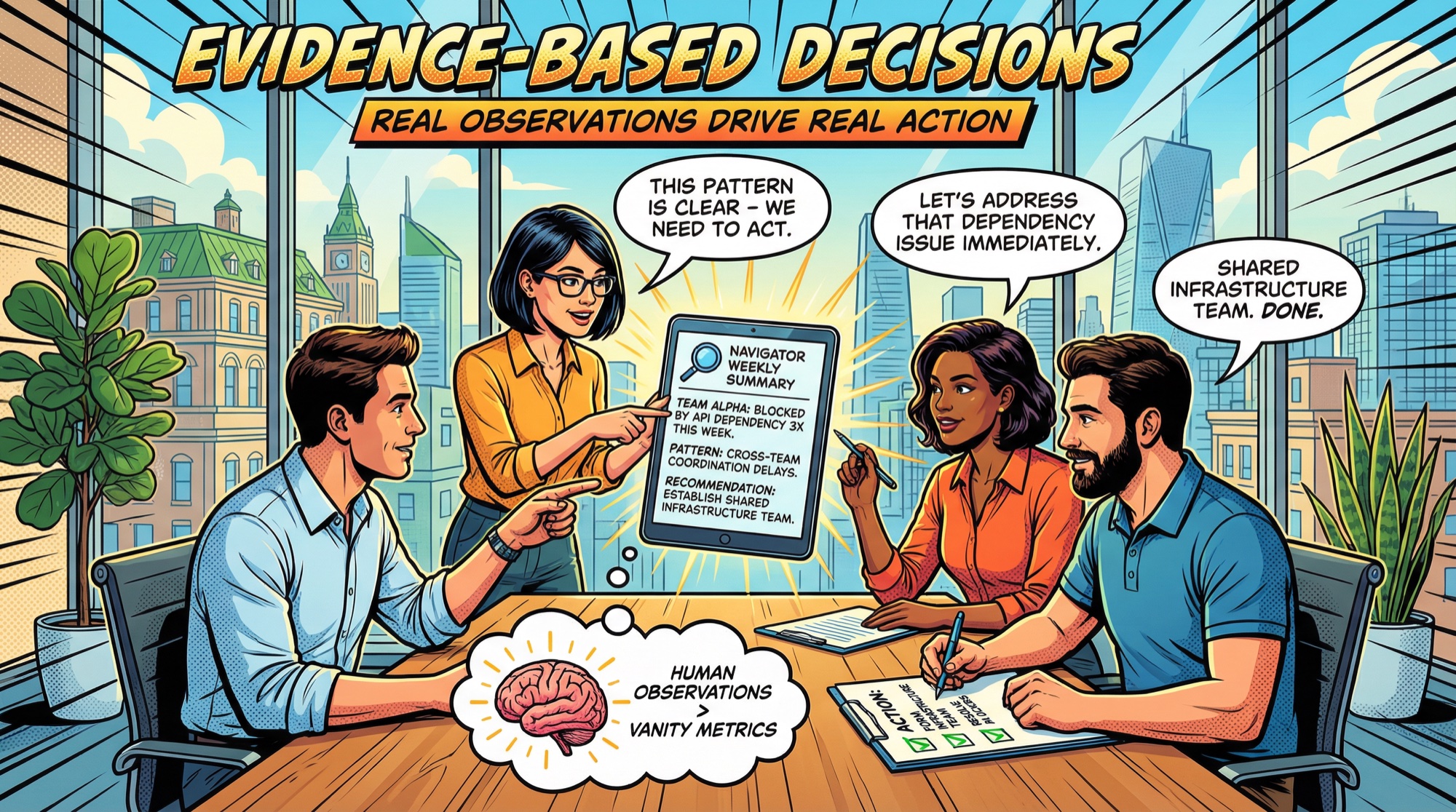
“We feel like we’re making progress” is different from having a coherent account of what actually moved, what stayed blocked, and why. Navigator provides the latter through human observation and synthesis. Where a narrow DORA baseline is useful, it supports that picture. It does not replace it.
When you’re deciding where to invest, what to prioritize, or how to reorganize, you’re working from evidence rather than impressions. This changes conversations. It enables accountability without blame. It helps teams and leaders coordinate around the same facts.
“For the first time, I can tell where the team needs support instead of guessing from status calls.” — VP Engineering
“Navigator replaced three recurring meetings and gave us better insight than all of them combined.” — CTO
Why Not Just Use Chat?
“We already have Slack. Can’t people just post updates there?”
They can. They do. And that’s precisely the problem.
Chat is where signals go to die. Important observations drown in a river of reactions, threads, and off-topic banter. By the time leadership scrolls through a busy channel, the context is gone and the moment has passed. Nobody synthesizes. Nobody connects patterns across teams. The information exists — scattered, unsearchable, and ultimately useless for strategic decisions.
Chat creates pressure to respond. Every message is an implicit interruption. Engineers learn to ignore channels to protect their focus, which means your visibility tool becomes another source of noise they tune out. The result: the people with the most valuable observations stop sharing them.
Chat lacks structure. “Had a rough day” and “blocked on the payments API for three days” look identical in a chat stream. There’s no way to distinguish between venting and signal, between one-off frustration and systemic issues affecting multiple teams.
Navigator is different by design:
- Async-first — Engineers log whenever it suits them. No pressure to respond. No interruption.
- Flexible capture, structured output — Engineers write however they want — bullet points, stream of consciousness, even mixed languages. The AI transforms raw input into consistent, comparable entries. No format to learn. No template to fill. Just capture what happened, and Navigator extracts the signal.
- Automatic synthesis — Patterns emerge across time and teams. Leadership receives intelligence, not a firehose.
- Private by default — Daily logs aren’t broadcast. Engineers can be honest about friction without performing for an audience.
Chat is for coordination. Navigator is for organizational intelligence. They solve different problems.
Getting Started
Two Paths, Same Intelligence
For organizations outside the EU — Americas, Asia-Pacific, Switzerland, UK — Navigator is a self-service platform. Sign up, onboard your teams, and start capturing observations immediately. Use it independently for as long as you need. Higher tiers include explanation of reports and conclusions. When you want embedded hands-on help acting on what Navigator reveals, Embedded Delivery Partner services are available to book separately. Navigator stands on its own; hands-on support is optional.
For EU organizations, GDPR shapes the engagement differently — and that’s a good thing. Because your organization is the data controller for the observations your teams capture, Navigator is always delivered as a consulting engagement. This means your first four weeks with Navigator become what traditional consulting would call an assessment phase — except instead of interviews and opinions, you get evidence. Real patterns. Actual blockers. A baseline grounded in what’s happening, not what people remember from last quarter’s status meetings.
From there, you continue the consulting engagement with Navigator providing ongoing intelligence, or move into Embedded Delivery Partner work scoped by what the evidence revealed. The human relationship stays — that’s the benefit of the EU model.
🌍 International Edition
Self-service platform. Use Navigator independently. Book consulting or Embedded Delivery Partner services when you're ready.
🇪🇺 EU Edition
Consulting engagement. Four-week evidence-based assessment replaces traditional interviews. GDPR-compliant from day one.