AI Makes Technical Execution Cheap. Judgment Stays Scarce.
Hiring more developers or replacing them with AI agents leaves the same question unanswered: who will make the decisi...
9 min read
19.01.2026, By Stephan Schwab

SpaceX builds rockets the way great software teams build software — through rapid iteration, learning from failure, and relentless focus on the feedback loop. Their approach to hardware development offers powerful lessons for software organizations stuck in analysis paralysis or waterfall thinking. When you can afford to test your assumptions quickly, you discover reality faster than any planning document ever could.
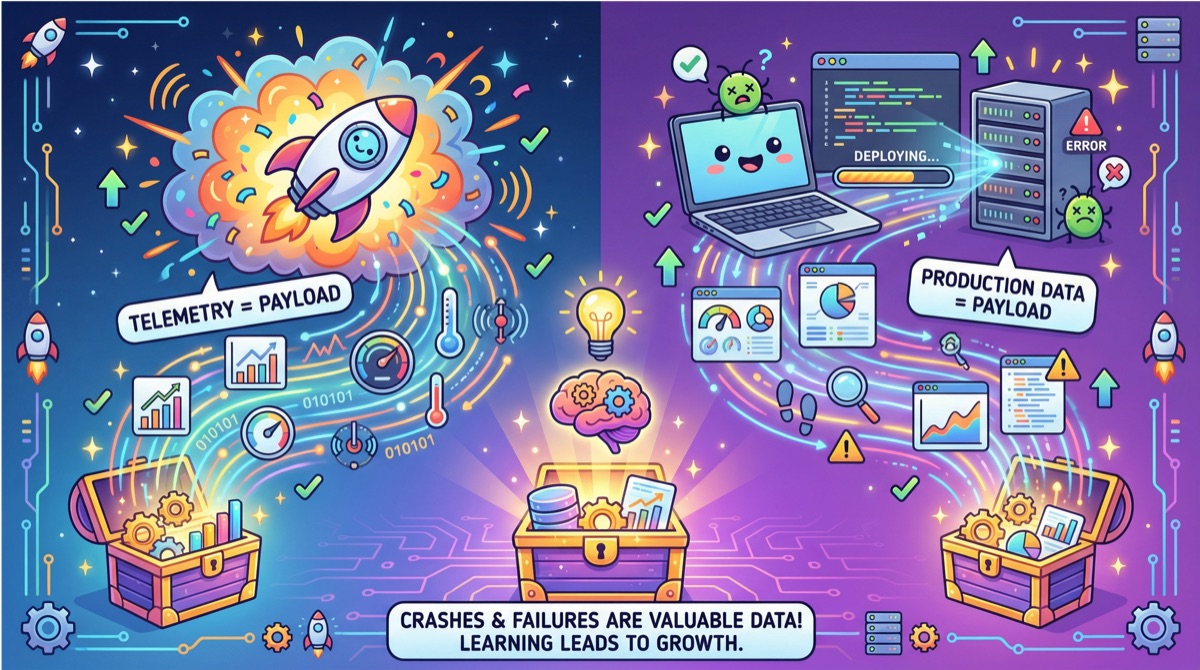
SpaceX’s Starship program has become legendary for its approach to development. Rather than spending decades perfecting designs on paper before building anything, they build prototypes rapidly, test them to destruction, learn from the failures, and build the next version. The graveyard of exploded Starship prototypes at Boca Chica isn’t a record of failure — it’s a record of learning at unprecedented speed.
Traditional aerospace operates differently. The Space Launch System took over a decade of development before its first flight, with engineers attempting to anticipate every possible problem through analysis and simulation. The result was a rocket that cost billions more and flew years later than planned.
SpaceX’s philosophy inverts this. Build something. Test it. Watch what breaks. Fix it. Repeat.
What makes SpaceX’s approach possible is a deliberate focus on reducing the cost of each iteration. When building a prototype costs less and takes less time, you can afford more iterations. More iterations mean faster learning. Faster learning means reaching your destination sooner.
This principle transfers directly to software development. Teams that can deploy changes quickly learn faster than teams that bundle weeks of work into massive releases. The team deploying ten times a day gets ten opportunities to observe reality. The team deploying monthly gets one.
But reducing iteration cost requires investment. SpaceX built their own factories, developed their own manufacturing techniques, and vertically integrated their supply chain — all to make each iteration cheaper and faster. Software teams need similar investments: automated testing, continuous integration, feature flags, observability infrastructure. These aren’t optional improvements; they’re the foundation that makes rapid learning possible. The connection between technical practices and business results becomes clear when you see iteration capability as a strategic asset.
The first Starship orbital test flight ended in an explosion. SpaceX called it a success. This wasn’t spin — they meant it. The vehicle cleared the launch tower, demonstrated the unprecedented coordination of 33 engines firing simultaneously, gathered telemetry data no simulation could provide, and revealed exactly where the design needed improvement.
Compare this to organizations where failure is punished. Teams hide problems. Experiments become career risks. Learning grinds to a halt because no one can afford to be wrong. The irony is that these organizations, in their pursuit of perfection, become far less capable than organizations that embrace productive failure.
Software teams need the same relationship with failure. A bug that escapes to production isn’t just a problem to fix — it’s information about where your testing was inadequate, where your assumptions were wrong, where your system behaves differently than you expected. Organizations that treat every production incident as a learning opportunity improve faster than those that treat incidents as occasions for blame.
SpaceX builds prototypes expecting them to be replaced. Early Starship prototypes were explicitly designated as test articles, not flight vehicles. This mindset — building something to learn, not to keep — enables a kind of freedom that perfectionism never allows.
Software developers often resist this approach. We want our code to be permanent, our architectures to be final, our solutions to be complete. But this desire for permanence creates its own problems: over-engineering, analysis paralysis, and the fear of starting because we might have to throw it away.
The prototype mindset liberates teams. Build the simplest thing that could possibly work. Deploy it. Watch real users interact with it. Discover the requirements you never knew you had. Then build the next version with that knowledge.
This doesn’t mean building garbage. SpaceX prototypes are sophisticated engineering achievements. But they’re built with the understanding that learning is the primary goal, and that learning will reveal what the next version needs to become. This connects to a deeper truth: software development is itself a design discipline, where discovery and iteration are fundamental to the craft.
Rockets can be simulated extensively, but there’s no substitute for actual flight. The interactions between thousands of components, the stresses of actual launch conditions, the behavior of propellants in real tanks — these reveal themselves fully only through real testing.
SpaceX takes this principle seriously. They test at their launch site in conditions as close to actual flight as possible. When they can’t test the full system, they test subsystems in realistic conditions. Every piece of real-world data improves their models and reduces uncertainty.
Software teams often miss this lesson. They test in environments that barely resemble production. They validate features with fictional data that doesn’t reflect real usage patterns. They simulate load conditions that don’t match actual traffic. Then they’re surprised when production reveals problems their testing never caught.
True iterative design requires testing against reality as early and as often as possible. This means production-like test environments, real data (appropriately anonymized), actual user behavior, and production deployments that provide genuine feedback about how your software performs in the world.
SpaceX made an early strategic decision to build most components themselves rather than relying on traditional aerospace suppliers. This wasn’t arrogance — it was recognition that iteration speed depends on controlling the entire feedback loop.
When a design change requires renegotiating contracts with external suppliers, iteration slows to the pace of procurement. When you build it yourself, you can change it tomorrow. SpaceX’s vertical integration enables experimentation that would be impossible with a fragmented supply chain.
Software organizations face similar choices. Heavy reliance on external vendors, rigid enterprise contracts, and outsourced development can make iteration prohibitively slow. Each design change requires approvals, negotiations, and handoffs that consume weeks or months.
This doesn’t mean building everything yourself — that’s often impractical. But it means being intentional about where you need iteration speed and structuring your technology organization to enable it. Core differentiating capabilities often need to be owned internally. Commodity functions can be outsourced without sacrificing agility.
SpaceX’s approach works because the organization is structured to learn from each iteration. Engineers who designed a component watch the test, analyze the failure, and design the improvement. The feedback loop is tight, the people are close to the problem, and decisions can be made quickly.
Contrast this with organizations where development teams hand off to testing teams who file reports that go to different teams who eventually plan fixes that get prioritized by yet another team. Each handoff introduces delay, loses context, and dilutes learning.
The most effective software organizations keep teams close to their work. The developers who build a feature monitor it in production, respond to incidents, and observe how users actually use it. This proximity creates learning loops that no process document can replicate.
SpaceX’s iterative approach is often misunderstood as recklessness. It’s the opposite. Every test is instrumented. Every failure is analyzed. Every lesson is incorporated into the next design. The speed comes not from carelessness but from systematic investment in making each iteration cheaper and more informative.
“Move fast and break things” became a problematic mantra because it was interpreted as permission to be sloppy. SpaceX moves fast and breaks things — very expensive things — but they do so with engineering discipline that ensures each broken thing teaches maximum lessons.
Software teams seeking faster iteration need the same discipline. Comprehensive observability so you know what happened. Feature flags so you can limit blast radius. Automated rollbacks so recovery is fast. Thorough post-incident analysis so learning is captured. Speed without these safeguards is just chaos.
SpaceX’s current iteration speed is the result of years of investment in iteration capability. Each rocket they built taught them how to build rockets faster. Each factory they constructed taught them how to construct factories more efficiently. The learning compounds.
Software organizations experience the same compounding — or its absence. Teams that invest in deployment automation, testing infrastructure, and observability get faster with each iteration. Teams that defer these investments find each iteration harder than the last, buried under the accumulated friction of manual processes and technical debt.
The choice of whether to invest in iteration capability is the choice of whether learning will accelerate or stagnate. SpaceX chose acceleration. Successful software organizations make the same choice.
Iterative design doesn’t mean abandoning thought for action. SpaceX performs sophisticated analysis, simulation, and planning. But they use analysis to guide experiments, not to replace them. They simulate to identify risks, then test to verify whether the risks are real.
The failure mode of traditional organizations is using analysis to defer action indefinitely. There’s always another study to conduct, another risk to evaluate, another stakeholder to consult. Action requires certainty, and certainty never arrives.
The failure mode of naive iteration is action without reflection. Building the same wrong thing repeatedly, faster and faster. Speed without direction.
Effective iterative design balances both. Analyze enough to form a hypothesis. Build enough to test the hypothesis. Observe closely enough to learn from the test. Repeat.
SpaceX’s hardware development offers software leaders several actionable insights:
Invest in iteration infrastructure. The ability to iterate quickly is itself a capability that requires investment. Automated testing, continuous deployment, feature flags, and observability aren’t overhead — they’re the foundation of learning.
Embrace productive failure. Create environments where teams can experiment, fail, and learn without career risk. Celebrate the lessons learned from failures, not just the successes.
Keep teams close to their work. Minimize handoffs and organizational distance between those who build software and those who observe its behavior in production.
Reduce the cost of each experiment. When experiments are cheap, you can run more of them. More experiments mean faster learning.
Use analysis to guide experiments, not replace them. Think carefully about what you’re trying to learn, then build something to test your thinking.
The rocket scientists at SpaceX have demonstrated that even the most complex hardware can be developed iteratively. Software, which can be deployed in seconds rather than months, has even more potential for rapid learning. The question is whether organizations will embrace it.
Tell me what is happening. I listen, ask a few practical questions, and reflect back what I see: where the risk may sit, what may be blocking delivery, and what looks worth checking next. No pitch, no obligation. Confidential and direct.
Talk it through. Practical reflection, no pitch.
Start a ConversationVisibility and hands-on delivery
Navigator gives your leadership clear insight into patterns, blockers, and capacity. Our Embedded Delivery Partner writes production code with your team and gets delivery moving.