Test Production Without Leaving a Mess
Staging cannot prove the customer journey works in production. A controlled, disposable test can—without polluting re...
5 min read
17.09.2024, By Stephan Schwab

Continuous Integration (CI) is a practice where team members frequently integrate their work into the main codebase, ensuring that the software product evolves smoothly and efficiently. This article explores the essence of CI, emphasizing the importance of small, frequent contributions, avoiding branching, and leveraging local and automated testing. It also addresses common misconceptions, such as the necessity of a central CI server, and highlights the power of modern developer workstations in facilitating CI practices.
Continuous Integration is something that a team does. It means that all contributions in code or other artifacts from all team members are constantly being integrated into the software product as it gains more and more functionality. It does not matter how the team does this. It does not matter if there is a Continuous Integration server or another tool with “CI” in its name.
Once one team member is done with a small contribution, this contribution gets integrated. Small means something that took an hour or two to make. Small is not something that takes longer than a day or even more.
As software is made by writing code and code is text, we need a version control system that allows us to merge text from different authors easily. To practice Continuous Integration, we do not need branches and much less a system that is good and fast at branching. In fact, we don’t want branches at all.
Branches mean that the software system exists multiple times and each version is different. We don’t want that. We only want the one and only current version of the system.
That being said, there is nothing wrong with a local branch for some experiment here and there. But note that the moment you create a branch, you have effectively stopped practicing Continuous Integration. You can also do your own work locally in a branch if that makes you feel safer or you are unsure about using the code from that branch. At the moment you want to share the results of your work, you integrate your new code into the one and only main line of the codebase.
When practicing Continuous Integration, we want to make sure that we won’t break the system with our new code. So we leverage local and automated testing to ensure that everything still works before we share our new code.
We get the latest version of the system from version control, then integrate our work, and finally put the whole thing to a test.
As it is impossible to perform manual testing of the whole system, we need to have meaningful automated tests that also run reasonably fast. Ideally, we want the whole system to be tested in a minute or two but definitely in less than 10 minutes. This process should be enough to get fresh water or coffee but not enough to start new work or be distracted by another activity.
In 2024, developer workstations or laptops are so powerful that they frequently outperform machines used as servers. While in the past Continuous Integration was associated with having a central CI server running some special software to perform integration builds — for example, Jenkins or GitHub Actions — the reality is that CI is fundamentally about the practice, not the tooling.
A central build server can be useful for running the full test suite after code has been pushed, for building release artifacts, or for enforcing quality gates before code reaches production. But the core practice of Continuous Integration happens at the developer’s workstation: pulling the latest code, integrating your changes, running the tests locally, and pushing only when everything passes.
The key insight is that Continuous Integration is about reducing the time between when code is written and when integration problems are discovered. Whether that happens on a developer’s laptop or a server farm is secondary. What matters is that integration happens frequently — multiple times per day — and that feedback comes quickly.
When teams practice Continuous Integration effectively, several important benefits emerge:
Problems surface immediately. When you integrate your work with the work of others multiple times per day, incompatibilities appear within hours of being created. They’re fixed while the context is fresh and the change is small.
No integration phase. Traditional approaches involve weeks of parallel development followed by a painful “integration phase” where everything comes together. With CI, there is no integration phase because integration is continuous.
Always releasable. Because the codebase is always in an integrated state and all tests pass, you can release at any time. This flexibility is invaluable when business needs change.
Reduced risk. Small, frequent integrations mean small, manageable risks. If something breaks, you know exactly what changed and can fix it quickly.
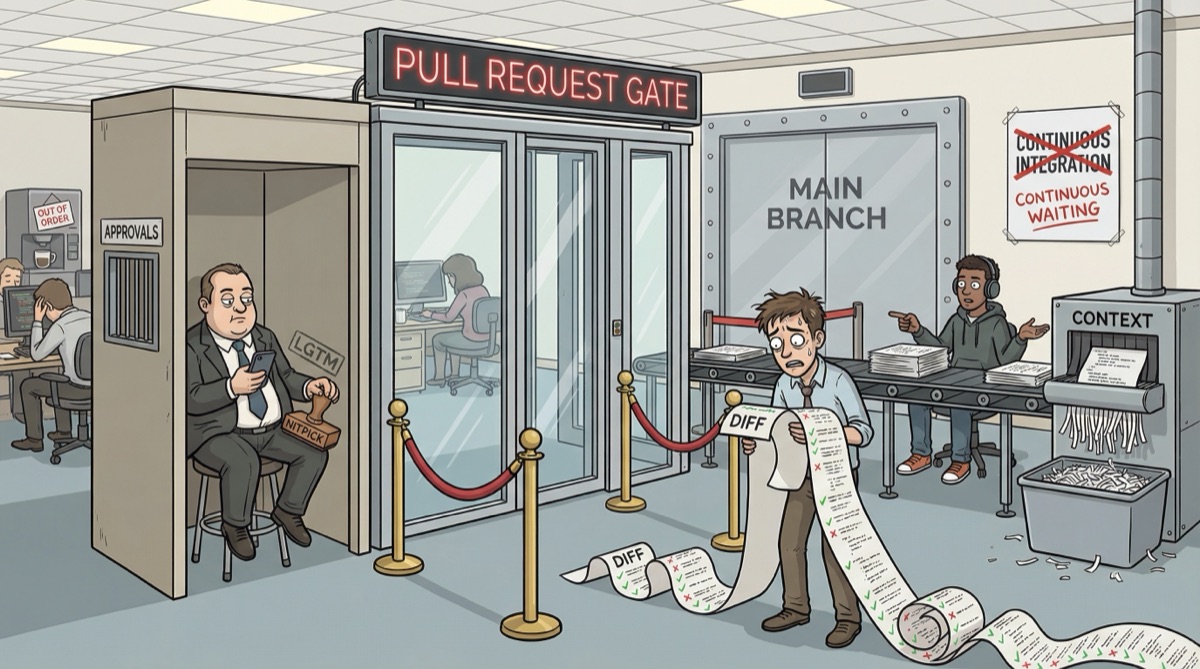
“We do CI because we use GitHub Actions.” Using a CI tool doesn’t mean you’re practicing Continuous Integration. If developers work in long-lived branches and only merge after days or weeks, you’re not doing CI regardless of what tools you use.
“CI means running tests automatically.” Automated testing is essential to CI, but it’s not the same thing. CI is about the integration pattern — the rhythm of small, frequent contributions from the whole team.
“We can’t do CI because our tests are too slow.” Slow tests are a problem to solve, not a reason to abandon CI. Invest in faster tests, parallelize your test suite, or identify which tests can run locally versus on a server.
The essence of Continuous Integration is simple: everyone integrates their work frequently, at least daily. This simple discipline, consistently applied, transforms software development from a high-risk gamble into a predictable, sustainable process.
Tell me what is happening. I listen, ask a few practical questions, and reflect back what I see: where the risk may sit, what may be blocking delivery, and what looks worth checking next. No pitch, no obligation. Confidential and direct.
Talk it through. Practical reflection, no pitch.
Start a ConversationTelenovelas show what we can't say in client meetings. The drama is heightened, but the patterns are real.
 Documentation Avalanche
The forty-seven questions from Passau become a daily occupation. Stefan finds a gap the navigation team cannot investigate without Marcus's approva...
Embedded into your team as an active contributor, reducing delivery friction and helping important work move cleanly.
Peer-style technical assessments before far-reaching decisions; reduce architectural and product risk early.
Ship working software to real users earlier. Measure impact and adapt based on evidence rather than assumption.
High quality, maintainable software. Short-term augmentation that leaves lasting capability in your own team.
A senior developer for your team
Our Embedded Delivery Partner writes production code with your team, improves the pipeline, and accelerates delivery. 60-70% coding, 30-40% coaching. A temporary teammate who ships from day one.