
AI Makes Technical Execution Cheap. Judgment Stays Scarce.
Hiring more developers or replacing them with AI agents leaves the same question unanswered: who will make the decisi...
11 min read
24.01.2026, By Stephan Schwab

Software development oscillates between two modes: craft, where skilled practitioners make judgment calls in novel situations, and trade, where established patterns solve familiar problems. Understanding which mode applies — and when to shift between them — determines whether organizations invest appropriately, whether modernization projects succeed, and whether developers find satisfaction in their work.
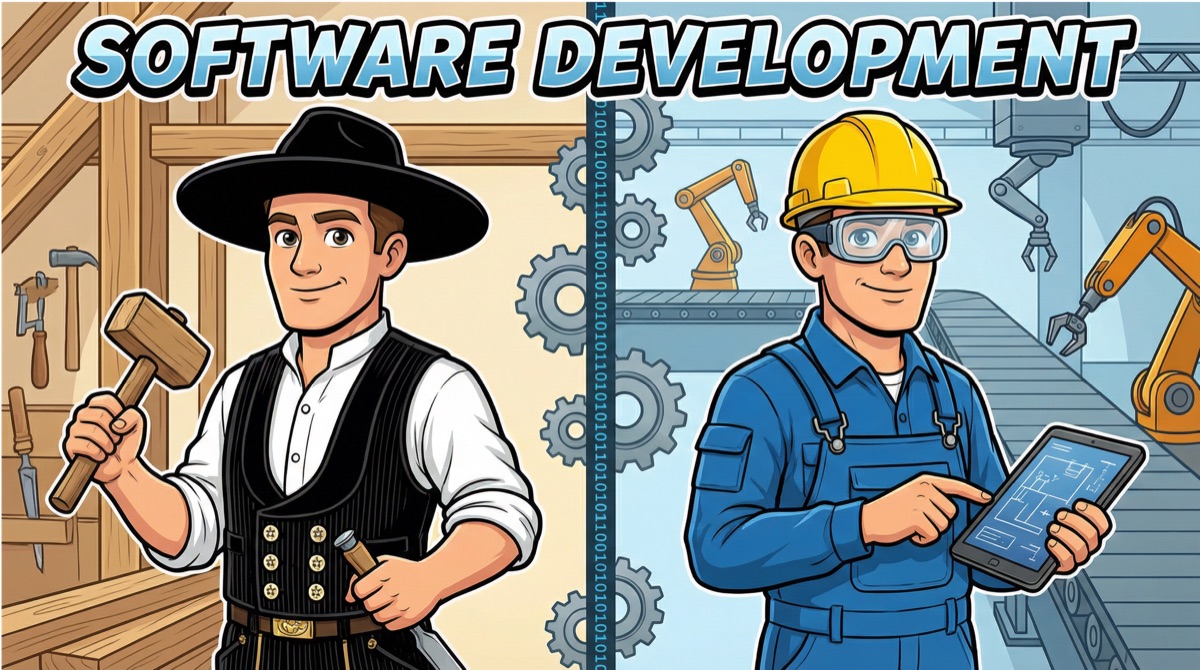
Before we proceed, we should clarify our terms. English uses “craft” and “trade” somewhat interchangeably, which obscures an important distinction. German preserves this distinction more clearly, and understanding it illuminates what we’re really discussing.
Handwerk (craft) in German refers to the traditional, regulated, highly skilled manual professions. The path to mastery is long: a formal apprenticeship of about three years, followed by several years working as a Geselle (journeyman) — traditionally traveling between workshops to learn from different masters — before finally qualifying to take the Meisterprüfung (master examination). The Zimmerer (timber-frame carpenter), Elektriker (electrician), Goldschmied (goldsmith), and master baker all practice Handwerk. When Germans say “Handwerk hat goldenen Boden” (craft has a golden foundation), they express genuine admiration. These are professions where judgment, tradition, and deep skill combine — earned over many years.
Gewerbe or Beruf (trade, occupation) describes work that can be learned more quickly — sometimes through a shorter training period, sometimes through on-the-job experience alone. Assembly work, machine operation, many warehouse roles. Valuable work, certainly, but work where the patterns are established and the skill lies primarily in reliable execution rather than judgment.
This distinction matters for software because both modes exist in our field, often within the same project or even the same day. The question isn’t which is better — both are necessary — but which applies to the work at hand.
Walk into a furniture workshop and you’ll observe something instructive. The master carpenter cutting dovetail joints for a drawer doesn’t reinvent the joint each time. Centuries of woodworking tradition have established optimal angles, spacing, and techniques. The skill lies in execution — consistent cuts, tight fits, appropriate wood selection — not in reimagining what a dovetail should be.
Yet when that same carpenter encounters an unusual commission — perhaps furniture that must fold in unconventional ways, or a curved surface that standard techniques don’t address — the work shifts. Now judgment, experimentation, and creative problem-solving take over. The carpenter is no longer executing known solutions but discovering new ones.
Software development works the same way. Much of development isn’t novel. Authentication systems, database queries, form validation, API integrations — these are dovetail joints. We know how they work. The patterns are established. The skill lies in reliable execution: writing clean code, handling edge cases properly, testing thoroughly, deploying safely.
Calling something “trade work” carries unfortunate connotations in software circles. Developers often want to see themselves as creative problem-solvers, not workers following blueprints. But this view misunderstands both the value of trade work and the reality of what most software development requires.
A skilled electrician wiring a house follows established codes and patterns. Nobody would dismiss this as uncreative or unimportant. The work demands expertise, attention to detail, and pride in doing things properly. Lives depend on correct execution. The same is true for much of software development.
When a developer implements a standard REST API, writes unit tests for a service layer, or configures a deployment pipeline, they’re doing trade work. They’re applying known patterns reliably. This work keeps businesses running. It serves customers. It requires skill and care. Dismissing it devalues the contributions of countless developers who build and maintain the systems our economy depends on.
Craft work in software emerges from genuine novelty — but developers must be honest about what counts as novel.
Imagined novelty is common: a developer convinces themselves their situation is unique, then builds a custom solution for a problem that established tools already handle well. They create a bespoke authentication system when OAuth exists, write a homegrown ORM when mature frameworks abound, or design a custom message format when JSON would suffice. This often happens because building something new feels more interesting than applying something existing — or because the developer hasn’t fully explored what’s already available.
Real novelty is different. You’ve genuinely evaluated the established approaches and found they don’t fit. Your domain constraints are unusual, the integration boundaries are unique, or the performance requirements exceed what commodity solutions can deliver. In these situations, craft work is necessary — not because it’s more prestigious, but because no ready-made pattern applies.
You’ll find genuine craft work in several places:
Domain complexity that defies standard patterns. When the business domain has genuine intricacy — financial derivatives with unique risk characteristics, manufacturing processes with unusual constraints, logistics problems with novel optimization criteria — standard solutions won’t fit. Developers must understand the domain deeply and invent approaches tailored to its specific challenges.
System integration across unusual boundaries. Connecting systems that weren’t designed to work together, bridging legacy and modern architectures, making disparate data models cohere — these situations demand creative problem-solving. The patterns for connecting System A to System B don’t exist because nobody has connected these particular systems before.
Performance at unusual scales. When a system must handle loads or data volumes beyond common experience, standard approaches may fail. Craft work discovers what works in these specific circumstances.
User experience innovation. Creating genuinely new ways for people to interact with systems requires craft. Not the superficial novelty of different button colors, but fundamental rethinking of how users accomplish goals.
Organizations get into trouble when they misclassify work in either direction.
Treating trade work as craft leads to over-engineering, inflated timelines, and unnecessary complexity. Every feature becomes a research project. Developers build custom solutions for problems that commodity tools solve perfectly well. Simple applications balloon into architectural monuments. Technical debt accumulates not from cutting corners but from over-elaborate solutions that nobody can maintain.
Treating craft work as trade leads to failed projects and missed opportunities. Organizations expect predictable timelines for inherently unpredictable work. They pressure developers to commit to deadlines before exploration has revealed what the work actually requires. Teams implement the first approach that seems workable rather than discovering the approach that actually fits.
How do you know which mode applies? Several signals help:
Has this problem been solved many times before? If experienced developers immediately recognize the pattern and can name the standard approach, you’re likely looking at trade work. If they furrow brows, ask clarifying questions, and propose exploratory spikes — craft work.
Do established libraries and tools address it? Rich ecosystems of libraries suggest trade work — others have encountered this enough that solutions have been packaged. Sparse options suggest craft territory.
Can you estimate with confidence? Trade work supports reasonably accurate estimation because the patterns are known. Craft work resists estimation because the discovery hasn’t happened yet. If teams can’t estimate confidently, that’s a signal about the work’s nature, not the team’s competence.
Does the business domain drive complexity? When complexity comes from the business domain rather than technical requirements, craft work is more likely. Technical complexity has often been solved; domain complexity is specific to this situation.
A significant portion of software work involves neither building new systems from scratch nor maintaining stable ones. Many developers spend their days modernizing existing systems — improving aging architectures, replacing legacy components, or migrating to new platforms. This work deserves special attention because it blends craft and trade in distinctive ways.
Understanding the existing system is craft work. Legacy systems rarely come with accurate documentation. The developers who built them have often moved on. The code embodies decisions made under forgotten constraints, workarounds for problems no one remembers, and integrations with systems that have themselves evolved. Making sense of this — understanding not just what the code does but why it does it that way — requires investigation, hypothesis, and judgment. No established pattern tells you how to understand a specific legacy system.
Deciding what to preserve and what to change is craft work. Not everything in a legacy system is technical debt. Some apparent complexity reflects genuine business requirements that new developers don’t yet understand. Some seeming inefficiencies exist because faster approaches failed under production load. The craft lies in distinguishing valuable complexity from accidental complexity, in recognizing which behaviors must be preserved exactly and which can be reimagined.
The actual replacement often follows trade patterns. Once you understand what the new system must do, much of building it may be straightforward. Implementing a modern REST API to replace an aging SOAP service uses established patterns. Migrating data from one schema to another follows known approaches. Setting up CI/CD pipelines for the new system is trade work. The novelty was in understanding what to build; the building itself may be routine.
But integration and migration require craft again. Running old and new systems in parallel, gradually shifting traffic, handling the edge cases where they behave differently — this demands judgment and creativity. Every migration has unique characteristics. The established patterns for strangler fig migrations or parallel runs provide starting points, but the specific decisions about what to migrate when, how to handle data synchronization, and when to cut over require craft judgment.
Organizations often underestimate modernization projects because they see “replace legacy system with modern equivalent” and assume trade work. The hidden craft — understanding the legacy system, making judgment calls about what to preserve, navigating the transition — is where projects stumble.
A common mistake is assuming craft work requires expertise while trade work doesn’t. Both modes demand skill — different kinds of skill.
Trade work requires:
Craft work requires:
Understanding these two modes helps organizations make better decisions:
Staff appropriately. Trade work benefits from developers who find satisfaction in reliable execution and take pride in well-implemented standard patterns. Craft work benefits from developers who thrive on ambiguity and novel challenges. Mismatches create frustration on both sides.
Set expectations correctly. Trade work should come with predictable timelines and reliable estimates. Craft work should come with explicit acknowledgment of uncertainty and iterative approaches that reveal scope as work progresses.
Invest proportionally. Trade work should use commodity tools and established libraries. Craft work may justify custom solutions — but only when the genuinely novel aspects require it.
Recognize transitions. Work often begins as craft and becomes trade. The first implementation of a novel system involves significant discovery. Subsequent maintenance and enhancement may be largely trade work — applying established patterns within a now-understood system. Staff and expectations should shift accordingly.
Perhaps most importantly, organizations and developers should have honest conversations about which mode applies to their work. Developers who frame trade work as craft — because craft feels more prestigious — do themselves and their organizations a disservice. Organizations that insist all work is trade — because trade is more predictable — create conditions for failure.
The master carpenter feels no shame in cutting dovetail joints well. The satisfaction comes from quality execution, from contributing to something useful, from the pride of work done properly. The same carpenter feels different satisfaction when solving an unusual problem — the excitement of discovery, the creativity of inventing approaches, the reward of making something genuinely new.
Both forms of work have dignity. Both require expertise. Both contribute value. The wisdom lies in recognizing which mode applies and responding appropriately — as practitioners and as organizations.
Understanding software development as a design discipline helps here: design work naturally oscillates between applying proven patterns and inventing new approaches. And recognizing what intrinsically motivates developers — pride in craft, curiosity, the satisfaction of solving real problems — helps organizations create conditions where both modes of work can thrive.
Tell me what is happening. I listen, ask a few practical questions, and reflect back what I see: where the risk may sit, what may be blocking delivery, and what looks worth checking next. No pitch, no obligation. Confidential and direct.
Talk it through. Practical reflection, no pitch.
Start a ConversationVisibility and hands-on delivery
Navigator gives your leadership clear insight into patterns, blockers, and capacity. Our Embedded Delivery Partner writes production code with your team and gets delivery moving.