You Never Needed a Fad to Invest in Your People
Companies wait for management fads before helping their own people. Then blame AI when the real problem is neglect.
8 min read
15.06.2026, By Stephan Schwab

Software decisions inside many companies are still made by people who have never done the work themselves. That is not shameful. It does, however, mean software gets bought through patterns borrowed from procurement categories that do not resemble it. When the search fails, the phrase talent shortage sounds plausible. Often the market is not the first thing failing. The filter is.
One distinction disappears quickly in corporate hiring. A classic resume comes from the world of employment history. It lists employers, titles, dates, and a tidy sequence of roles. It is optimized to answer one question: where has this person been employed?
That format does not fit many of the strongest software specialists. They are not employees climbing a ladder. They are independent consultants, small-firm principals, turnaround specialists, and senior operators who get called when something is stuck, fragile, or politically difficult. Many do not maintain a conventional resume at all. What they have is an expert profile: the classes of problems they have solved, the environments where they were effective, the methods they rely on, and the situations that tend to bring them in.
That is a different document. A resume answers where were you. An expert profile answers what are you for. When HR or procurement expects the first and cannot interpret the second, the people you most need often disappear before the first conversation.
Anyone who has requested profiles from a U.S. staffing firm will recognize the pattern. The document may be shorter than the German version. Usually it shows the last few roles, a compressed project history, and a long tail of tool names. The principle is unchanged: a chronological resume with keyword padding. Even the consultant version with a project list is still a resume in disguise.
That matters because real consulting work is often hard to present in resume form. The more sensitive the client situation, the less detail the consultant is allowed to disclose. NDAs are normal. The consultant who has seen the worst outages, the ugliest migrations, or the most expensive delivery failures is often the one who can say the least in writing. A format that proves credibility through client logos and named projects quietly filters that person out.
The deeper problem is methodological. A resume shows surface markers: companies, industries, frameworks, versions, certifications. It does not show how someone thinks when a system behaves in ways nobody expected. It does not show how they narrow a failure, challenge a requirement, or spot an architectural mistake hiding under a staffing request. A good conversation can reveal that in thirty minutes. A resume never will.
The second design flaw is easier to miss. Even when a profile suggests somebody might be useful, the staffing model leaves almost no room for that person to speak with the client before selection. An account manager talks to procurement, HR, and sometimes the hiring manager. A recruiter then searches the internal pool for matching talent. The expert is not in that loop.
That missing conversation is exactly where real consulting starts. An experienced specialist can listen to a problem for ten minutes and say: that is not actually your problem. Or: you do not need my depth here. Or: before you hire anyone, you need to revisit the architectural decision that created this mess in the first place. That early reframing is the point.
Inside the staffing channel, that path is closed. The account manager has commercial goals, not technical authority. The recruiter searches for keyword overlap, not diagnostic ability. The specialist arrives at the end of the chain with a job description and a yes-or-no choice. That is efficient if your goal is comparability. It is terrible if your goal is to find the person most likely to help.
The model works that way for a reason. Direct expert-to-client conversation reduces interchangeability, weakens commercial control, and makes neat price comparison harder. From the vendor’s perspective, that is rational. From the buyer’s perspective, it means the person most capable of improving the situation never gets the chance to challenge the framing before the shortlist is frozen.
This weakness did not disappear with AI. It became easier to see. When learning a new stack was slow and expensive, resume-level tool identity had at least some defensive value. Today that value is shrinking fast. Someone with thirty or forty years of systems experience can become productive in an unfamiliar stack with AI support far faster than most hiring filters assume. Whether the codebase is C#, Java, Python, Go, Rust, or TypeScript matters less than the quality of judgment guiding the work.
AI handles syntax, idioms, library lookup, and a surprising amount of local unfamiliarity. What it does not handle is whether the design holds, where the risk sits, which assumptions are false, and how to change an existing system without breaking the business. That is what expensive expertise is for. A framework list is becoming a weaker filter. Evidence of judgment is becoming a stronger one.
The productivity side is no longer just vendor enthusiasm. GitHub reported that developers using Copilot completed a controlled task 55% faster on average, while Stanford HAI’s AI Index 2025 describes a wider pattern of AI adoption, productivity gains, and narrowing skill gaps. GitHub Research, Stanford HAI, AI Index 2025.
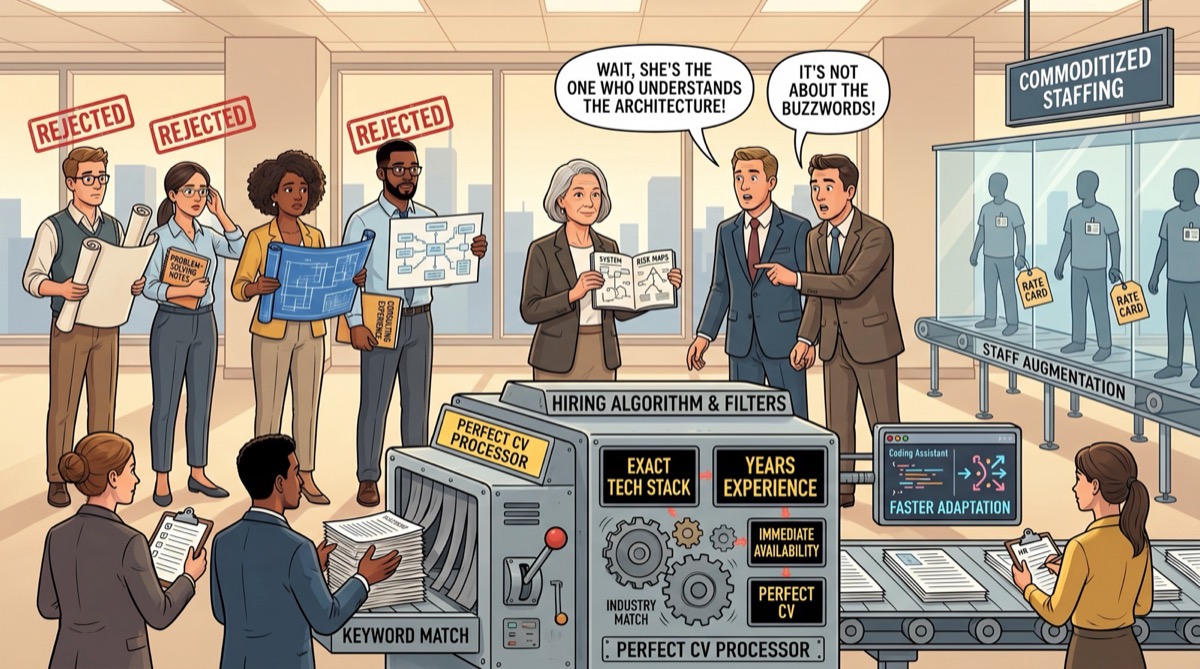
Once these habits turn into an actual requisition, the brief usually reads like this: senior engineer, exact cloud stack, exact industry background, exact U.S. work authorization, exact overlap with the current team, immediate availability, no long ramp-up, preferably someone who has already solved this exact kind of problem in this exact kind of company.
That sounds responsible. It is also a fear response disguised as rigor. The buyer wants to reduce risk, so every uncertainty gets converted into one more mandatory line item. In the end the role no longer filters for capability. It filters for frictionless insertion into the current system.
The distortion shows up most clearly with the strongest people. Good rescue specialists and senior consultants rarely sit in the same environment for years waiting to accumulate identical keywords. They move from problem to problem. They fix something concrete, leave the team stronger, and get called somewhere else. In a resume filter, that can look unstable. In real delivery, it is often the strongest signal you will get.
Harvard Business School describes a similar pattern in Hidden Workers: Untapped Talent: hiring systems optimize for efficiency and false precision, then systematically exclude qualified people.
There is another confusion hiding underneath. In many industries, deep expertise really is tied to one machine, one process, one regulation set, or one local environment. Software expertise is different. The deepest expertise is not “I have seen your exact stack before.” It is “I understand how complex systems fail, how risk accumulates, and how to restore control before the damage compounds.” That kind of expertise transfers.
Demand is real. The U.S. Bureau of Labor Statistics projects much-faster-than-average growth in computer and information technology occupations and about 317,700 openings per year on average from 2024 to 2034. But real demand and bad filtering can both exist at the same time. U.S. Bureau of Labor Statistics, Computer and Information Technology Occupations
Staffing feels controlled. The company defines a need, procurement opens a channel, vendors send profiles, and everyone can document the chain. Clean process. Clear rates. Less internal argument.
In the U.S. market the language sounds more polished than the mechanics. Companies talk about flexible talent, specialized contractors, staff augmentation, contingent workforce, and strategic partners. Much of the time they are still buying temporary labor capacity through a model optimized for speed, comparability, and vendor control rather than diagnosis.
There is also a legal shadow around the whole setup. Misclassification and contractor-status questions are real enough that many buyers prefer vendor structures that keep the relationship at arm’s length and highly standardized. The U.S. Department of Labor’s guidance on employee versus independent contractor classification is one sign that this is not just abstract compliance theater. U.S. Department of Labor, Employee or Independent Contractor Classification
The missing question stays the same: will this person make your team stronger in three months, or are you mostly trying to cover the demand with the lowest internal friction?
Talent shortage is a convenient explanation because it locates the problem outside the company. Sometimes that explanation is fair. Often part of the problem is internal: hiring processes without technical authority, ATS-style screening that mistakes sameness for competence, no planned onboarding, and a budgeting model that treats context as waste.
Behind the demand for the perfectly matching profile is a familiar executive wish: reduce risk, move fast, avoid disruption. Fair enough. The trouble is that this wish often removes exactly the people most likely to improve the situation, because they do not look like a clean keyword mirror of the role.
If you want better people, buy differently.
If you do that, the market often looks larger very quickly.
Then maybe it was not talent shortage first.
Maybe it was filter failure.
Tell me what is happening. I listen, ask a few practical questions, and reflect back what I see: where the risk may sit, what may be blocking delivery, and what looks worth checking next. No pitch, no obligation. Confidential and direct.
Talk it through. Practical reflection, no pitch.
Start a ConversationTelenovelas show what we can't say in client meetings. The drama is heightened, but the patterns are real.
 Collapse
Year-end arrives with the force of something everyone has been preparing not to name. A critical COBOL tax-calculation path fails on an undocumente...
 What Valentina Knows
Valentina takes Sophie out alone — no Stefan — on the forest trails above the finca. The horses walk. Valentina has been Stefan's closest friend in...
Embedded into your team as an active contributor, reducing delivery friction and helping important work move cleanly.
Peer-style technical assessments before far-reaching decisions; reduce architectural and product risk early.
Ship working software to real users earlier. Measure impact and adapt based on evidence rather than assumption.
High quality, maintainable software. Short-term augmentation that leaves lasting capability in your own team.
Visibility and hands-on delivery
Navigator gives your leadership clear insight into patterns, blockers, and capacity. Our Embedded Delivery Partner writes production code with your team and gets delivery moving.