Outside the Door
Ethan Carter arrives early, carrying the same packet that should have started a disciplined fix, and learns what Whitaker Payroll does when it wants someone gone without admitting it. His badge fails, security follows procedure, and Nathan Cole finally sees Derek Lawson's budget email for what it was built to be: a firing translated into administrative weather. Their meeting in the cafe across from the office becomes a small public humiliation and the beginning of Nathan's fight to pull one competent man back through a door the company has already decided should stay closed.
Thursday, 07:11 — The Red Light
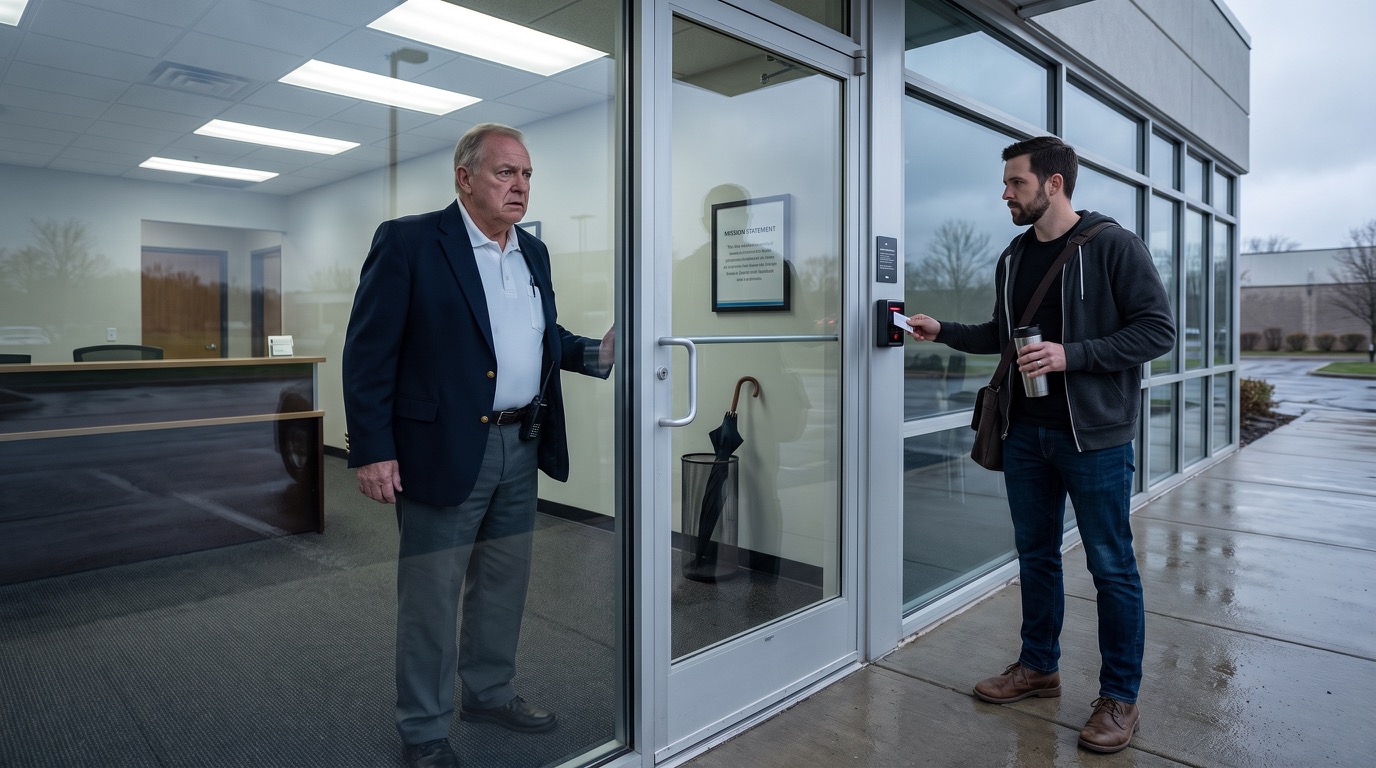
The first bad sign was how ordinary it looked.
Ethan touched the badge to the reader the way he always did, already half thinking about the packet in his bag and whether Nathan had slept at all. The little panel blinked red and let out a flat unhappy chirp.
He frowned, stepped back, then tried again more slowly.
Red again.
The lobby beyond the glass was empty except for the security guard who had started showing up earlier in the year when Graham decided access control was part of becoming “more intentional about stewardship.” His name was Ray. Former deputy, thick hands, late sixties, the kind of man who still ironed polo shirts. He had always treated Ethan with the wary politeness of someone who had learned not to get emotionally involved in offices full of people who thought badges were cleaner than conversations.
Ray pushed open the inner door but kept one hand on it.
“Morning,” he said. He looked at the badge in Ethan’s hand, then at the reader, though the little red light had already said enough. “Mind trying that one more time?”
Ethan held it up again. The reader rejected him with the same tiny note of mechanical disapproval.
Ray exhaled through his nose.
“Yeah,” he said softly. “All right. Just hang on a second. Let me check the access list.”
It would have been easier if Ray had looked triumphant or bored. Instead he looked like a decent man being asked to become a wall.
Ethan shifted the bag higher on his shoulder. The packet inside pressed against his side, the pages still squared from the night before. Bounded fix. Feature flag. Compare outputs. All the sane words he and Nathan had tried to bring into the building like an offering.
Ray stepped to the side desk, typed something into the terminal, and went still in the way people did when they found the answer they had hoped not to find.
Behind Ethan, tires hissed on the wet street. A delivery truck downshifted at the light. Somewhere above the parking lot an unseen air-conditioning unit coughed into life.
Ray came back to the door but did not open it wider.
“Mr. Carter,” he said, and the use of the last name made the morning colder. “Your access is inactive. I can’t let you in until I get authorization from operations.”
Ethan looked at him for a beat, not because he had not understood, but because the sentence arrived with such studied impersonality that his mind reached for a second meaning anyway.
“Inactive because of an error?” he asked.
Ray’s jaw shifted.
“I don’t have that level of visibility. I just have active or inactive. Right now it’s inactive.”
Ethan let the silence sit long enough for the lie in the structure to become visible. Nobody had to say fired. Nobody even had to say decision. A database field changed states in the night and now an older man in a pressed polo shirt had inherited the job of humiliation.
He could feel anger trying to rise and choosing, for the moment, not to. Anger would only make Ray’s posture harder. The guard was following rules written by people whose specialty was making their own will look procedural.
“Can you call Nathan Cole?” Ethan asked.
“I can call operations,” Ray said. “That’s the instruction.”
“Nathan is operations as far as anything real around here goes.”
A flicker passed across Ray’s face, almost agreement, almost warning.
“I still have to call the number they gave me.”
He reached for the phone.
Ethan set his thermos on the outer ledge beneath the window and stepped back from the door. Through the glass he could see the framed trade-show photos in reception, the old booth backdrop with slogans about reliability and trust, smiling men in branded polos shaking hands over a system none of them could have explained. The fluorescent lights made everything inside look already embalmed.
Ray spoke quietly into the receiver. Listened. Spoke again. His eyes did not come back up for several seconds.
When he hung up, he did not open the door.
“They said Nathan isn’t in yet,” he said. “Derek’s assistant will reach out when they know what’s going on.”
The phrase when they know hung between them like a stale joke.
Ethan reached into his pocket for his phone.
“I’ll save them the trouble,” he said.
He called Nathan.
It rang four times. Voicemail.
He hung up, then sent a text instead.
Outside front door. Badge inactive. Security won’t let me in.
He watched the message go.
A car turned into the lot. Donna Reeves got out carrying her canvas tote and a cardigan over one arm, even though the air was already sticky enough to make shirts cling at the lower back. She saw Ethan standing outside and slowed just enough to register him fully.
Her face performed three things in quick succession: surprise, concern, and the tiny disciplined retreat into not wanting to know too much.
“Morning,” she called through the glass, too brightly.
“Morning,” Ethan said.
She looked toward Ray. Ray did not move. She pressed her own badge to the reader. Green light. The door released.
For one second Donna stood with the door half open, the cool conditioned air brushing out around her ankles. Ethan could see the decision moving through her. Ask the plain question and become part of the event. Or step through, tell herself someone with more authority will handle it, and preserve the shape of an ordinary Thursday for another minute.
“I’m sure it’s just a mix-up,” she said at last.
She did not sound stupid. She sounded like a woman trying to keep her internal story from collapsing before eight in the morning.
Ethan gave her the courtesy of not answering.
Donna went inside.
Ray pulled the door shut again with a soft hydraulic sigh.
The red reader light faded to dark.
Ethan picked up his thermos and looked at the reflection of himself in the glass: overshirt damp at the shoulders from mist, messenger bag strap cutting across his chest, face more tired than angry. He thought of the packet, of Nathan reading Derek’s email in a kitchen full of unfinished domestic life, of the bounded fix lying inside his bag like something almost embarrassingly rational.
He had helped stabilize their staging environment. He had given them feature flags, repeatable builds, scenarios that turned superstition into something answerable. He had spoken too plainly in a room that needed truth to arrive escorted by status.
Now he was outside a locked door while the building prepared to pretend it had not chosen this.
His phone vibrated.
Nathan.
Ethan answered before the first buzz finished.
“I’m at the front,” he said.
Nathan’s breathing was already wrong. Too fast, too high in the chest, with the hollow car acoustics of someone who had not even made it inside yet.
“Stay there,” Nathan said. “No. Actually don’t. Go across to Marley’s. I’ll be there in ten minutes.”
“Nathan. Did Derek kill my access?”
A pause. Not long. Worse than long.
“Go to Marley’s,” Nathan said again, voice flattening with shame. “I need to look at something before I answer that cleanly.”
Ethan turned and looked across the street at the small cafe wedged between a dry cleaner and a tax-prep office that never seemed to die, no matter how many April deadlines passed. Red awning damp with rain. Two metal patio tables chained together by habit rather than necessity.
“All right,” he said.
“I’m sorry,” Nathan said, too quickly, as if the sentence had forced itself out before he could make it more strategic.
Ethan closed his eyes for a moment.
“Yeah,” he said. “I figured you might be.”
He ended the call, slung the bag more firmly onto his shoulder, and crossed the parking lot while morning traffic moved past the building that had decided to let a security reader speak in its place.
Thursday, 07:24 — The Missing Line
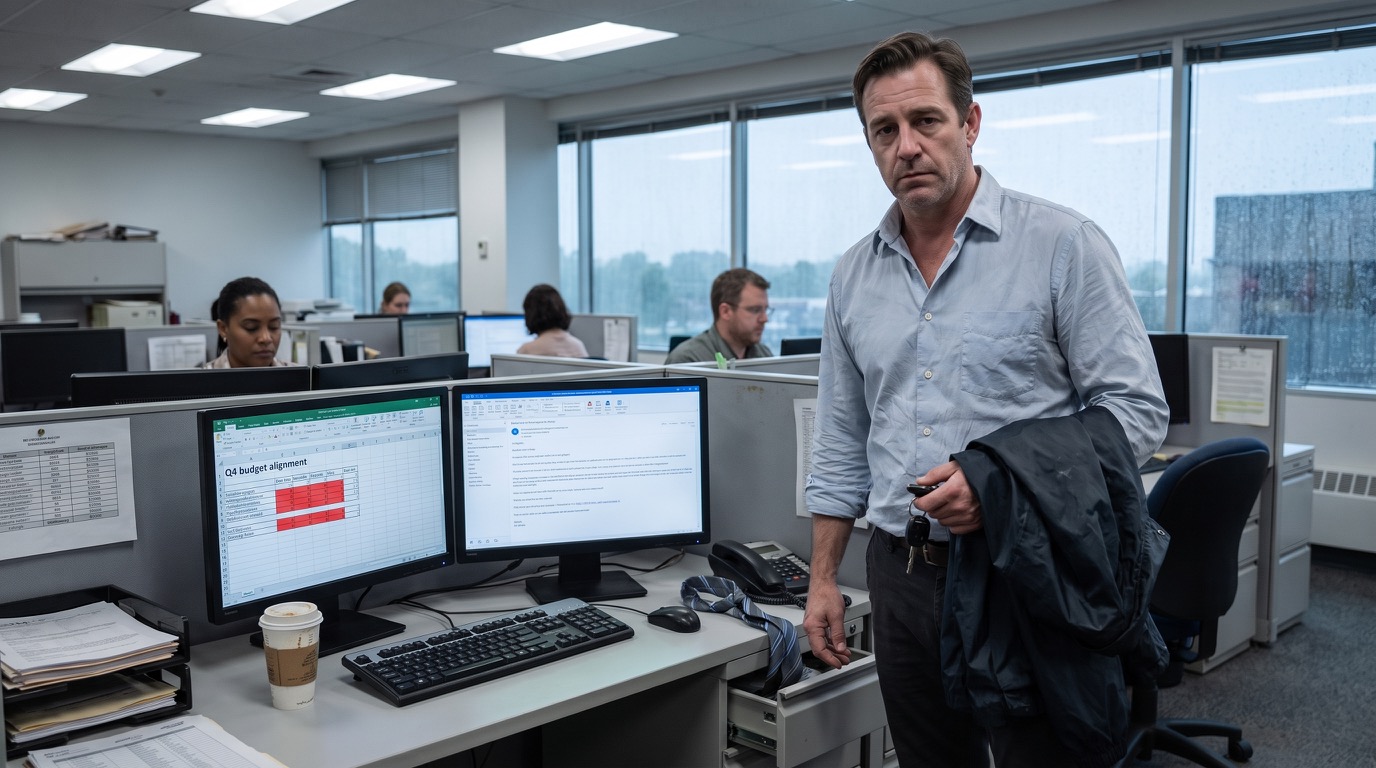
Nathan came in through the side entrance three minutes after hanging up with Ethan.
He had parked crooked, left his travel mug in the cup holder, and crossed the wet service alley behind the building without even noticing the drizzle catching in his hair.
Nathan had read Derek’s email four times the night before and still let exhaustion talk him into uncertainty.
By the fifth reading, in the office, with Ethan outside and the shame already active in his bloodstream, the sentence changed shape.
Not because Derek had written anything new.
Because Nathan had enough immediate pain now to see what the language had been designed to hide.
He stood at his desk with his laptop open and Derek’s message centered on the screen like a specimen pinned under glass.
Please act accordingly on Ethan Carter’s line.
Not invoice.
Not hours.
Line.
He clicked into the quarter budget workbook Derek guarded as if spreadsheets constituted management. The contractor tab loaded. Ethan’s name had been there Tuesday. Nathan had looked at it then only long enough to confirm remaining runway for the Detroit remediation work.
Now there was a blank row between external QA support and cloud hosting.
Nothing dramatic. No strikethrough. No comment bubble. No red flag.
Just absence arranged neatly enough to pass for order.
Nathan could hear Linda somewhere to his left turning pages with exaggerated care. Sharon was whispering to Donna near the copier. The office had the strange acoustics of places where people sense an event and begin building little islands of innocence in advance.
He picked up the desk phone and dialed Derek’s extension.
Voicemail.
He dialed again.
Voicemail.
Then he called Melissa, Derek’s assistant, and got her before the first ring finished.
“Where is he?” Nathan asked.
Silence on the line. A quick intake of breath.
“Good morning, Nathan,” Melissa said.
“Melissa, where is he?”
“He’s with Graham for the executive budget pass.”
Nathan stared at the monitor until the pixels seemed to vibrate.
Of course he was. Of course the firing had been smuggled into the hour of the week when hierarchy wore a blazer and called itself alignment.
“Did Derek tell security to kill Ethan’s badge?”
Melissa lowered her voice though Nathan already knew she was alone.
“I was asked to let Ops know access would be updated overnight,” she said. “I assumed you had been briefed.”
There it was.
Not the official truth. The clerical afterimage of it. Enough to confirm he had failed Ethan in exactly the way he had promised himself he wouldn’t.
Nathan pressed his thumb and forefinger hard into his eyes.
He had spent years learning Derek’s dialect: the euphemisms, the pre-justifications, the passive constructions that turned acts into atmospheres. He had taught himself to read danger in phrases like fit and governance and alignment. He had trained that skill the way other men trained aim.
And last night, because he was too tired and too used to being used, he had let one more ugly thing pass as administrative mood.
His phone buzzed again with Ethan’s earlier text visible above his missed call, stark and humiliating in its restraint.
Outside front door. Badge inactive. Security won’t let me in.
Nathan grabbed his keys.
Linda appeared at the edge of his cubicle with a binder against her chest.
“Nathan,” she said, soft and careful, “before you run off, I wanted to mention there may be some concern around visibility this morning. I don’t know the full context, obviously, but if there are staffing adjustments, perhaps we should think about what gets displayed on shared screens until everyone feels grounded.”
Nathan turned his head slowly enough to make her wait inside her own sentence.
Linda’s face was composed in the way women who had survived offices for decades learned to compose them: no malice visible, no appetite either, just concern pressed flat until it could pass as professionalism.
She was afraid. That part was real. Afraid of the numbers. Afraid of Ethan. Afraid of what visible truth did to categories people had lived inside for twenty years. But fear in this building rarely came out as confession. It came out as caution, as tone management, as a request that the evidence please stop being so socially loud.
“He helped build those screens so people would stop lying to themselves,” Nathan said.
Linda’s fingers tightened once on the binder rings.
“No one is lying,” she said.
He looked at her and saw, not villainy, but the smaller and more durable ugliness underneath. She needed that to be true because the alternative would require saying she had seen enough to worry and still preferred not to stand behind the plain sentence.
“Not aloud,” Nathan said.
He left before she could refine the argument into something more survivable.
As he crossed the open floor, he saw Donna glance away from the front windows too late. Sharon kept her attention on a printout upside down in her hands. Ryan, already at his desk, met Nathan’s eyes for one second, then looked toward the wall monitor where the run dashboard had been replaced by company announcements and a motivational quote Derek probably thought counted as culture.
Nathan felt the whole pattern at once.
The badge change. The vanished budget line. The dashboard darkened before breakfast. Everyone waiting for everyone else to make reality official so no one would have to own seeing it first.
He pushed out through the side door into the wet morning and crossed toward Marley’s with his shoulders already pulled tight around the argument he was going to have.
Not because he believed he could win cleanly.
Because if he did not fight now, then every year he had spent carrying this company in his head would collapse into something even worse than exhaustion.
It would collapse into consent.
Thursday, 07:39 — Marley’s Cafe
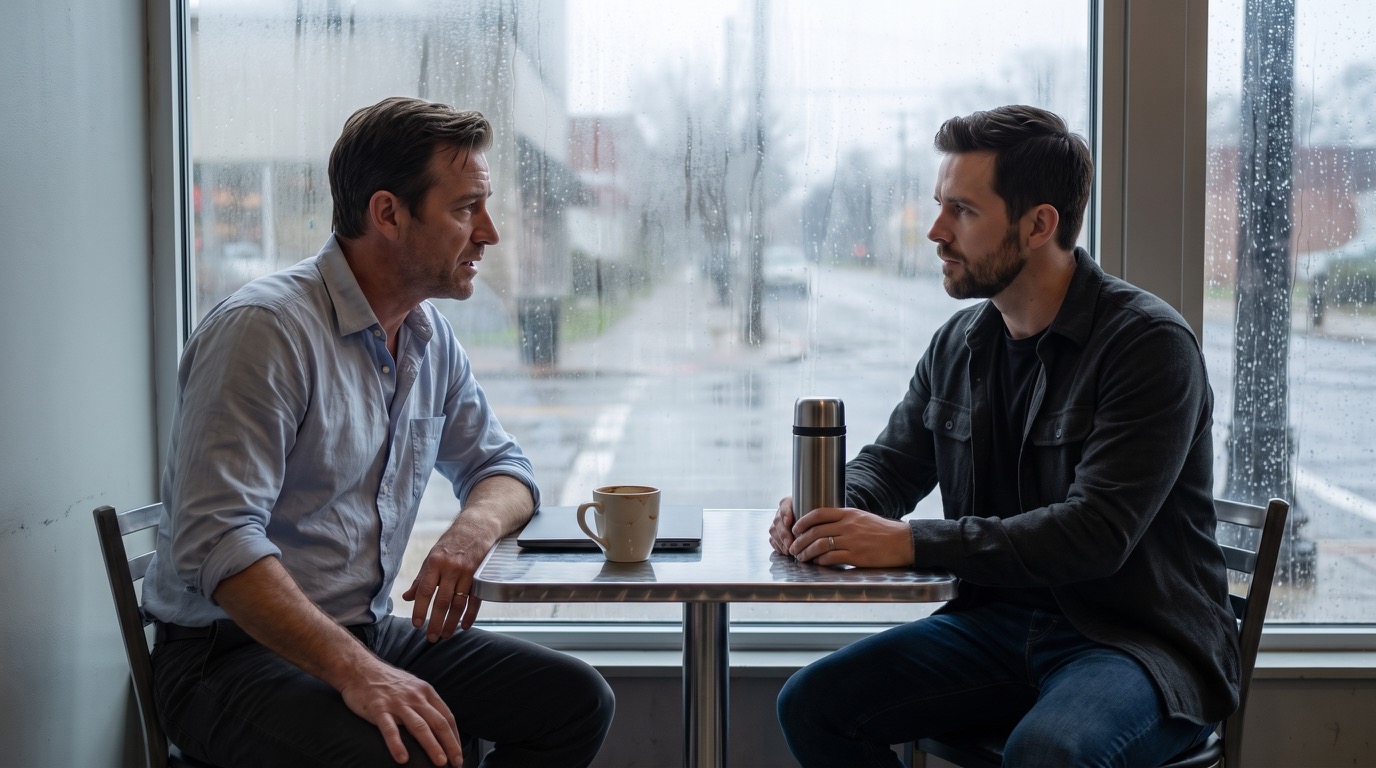
Marley’s opened early for the courthouse crowd and the payroll clerks who wanted coffee stronger than the office sludge and anonymity stronger than both.
Ethan had taken the outside table because he could not stomach being indoors while his own access to a building across the street was being discussed somewhere in air-conditioned euphemism.
He sat with the packet on the table, one hand resting over it as if someone might come snatch it away. His thermos stood untouched. The waitress had brought him coffee he had not asked for refills on. Across the street Whitaker Payroll looked exactly as it always had: brick facade the color of damp cardboard, flags by the door hanging limp, windows reflecting low cloud and nothing else.
Nathan came across the street fast enough to look younger from a distance and older up close.
He had not shaved properly. His shirt was buttoned wrong at the cuff. The car keys in his hand clicked against each other because he had not realized he was squeezing them.
He sat without taking off his rain-damp jacket.
For a moment neither of them spoke.
The humiliation of the setting did the talking first.
Not a conference room. Not even a parking-lot argument. A little cafe table in public, two men talking about a firing one of them had discovered from a dead badge and the other had failed to decode in time.
Nathan put both hands flat on the table as if he were steadying it.
“It wasn’t a mix-up,” he said.
Ethan looked at him.
“No,” he said. “I gathered that around the second red light.”
Nathan nodded once, absorbing the hit because he had earned it.
“Derek removed your budget line yesterday after the meeting. Melissa confirmed they told security overnight. He wrote it in that email so I could miss it and still be the one left explaining it.”
Ethan leaned back in the metal chair and looked across the street at the building.
“Did he expect you to tell me before I got there?”
“I think he expected the problem to happen in the abstract.” Nathan swallowed. “Or he expected me to understand him without forcing him to say it. Which I should have. That’s the part I can’t let myself off on.”
The waitress came with another cup for Nathan. He thanked her automatically. His voice sounded bizarrely polite to his own ears.
When she left, Ethan asked, “So what was the offense?”
Nathan gave a laugh with no humor in it.
“Officially? There isn’t one. Unofficially you told him the number was wrong without dressing the sentence up enough to preserve his dignity.”
Ethan stared at him for a second, then shook his head once.
“That’s insane.”
“Yes.”
“And you know it’s insane.”
“Yes.”
“And Derek knows the number is wrong.”
Nathan looked down into the coffee he had no intention of drinking.
“Yes.”
The flatness of that answer made something move across Ethan’s face that was not surprise and not anger exactly. A more exhausted kind of injury. The injury of finding out, again, that clear evidence did not actually purchase clear action in a room full of adults.
He rubbed a thumb along the edge of the packet.
“I didn’t grandstand,” he said. “I walked him through a bounded fix. I gave him every off-ramp a sane organization could want.”
“I know.”
“Then what the hell am I doing outside with a security guard like I tried to steal office chairs?”
Nathan looked up.
Because he had known Ethan only months rather than years, he could still feel the obscenity of the question instead of metabolizing it into routine. That made him useful and unbearable at the same time.
“You’re there,” Nathan said carefully, “because competence stopped being helpful the second it made their moral dodge harder to maintain.”
The words landed and stayed.
Traffic moved past. Someone inside the cafe dropped a spoon. A county clerk in a tan trench coat hurried by with a file box hugged to her ribs.
Ethan let out a long breath.
“So that’s it?” he asked. “They can turn me off overnight because I wasn’t deferential enough about harm?”
Nathan shook his head.
“They can try. I’m not accepting it as done.”
Ethan studied him.
Nathan could feel the doubt coming off him, and worse than doubt, the reasonable calculation. Nathan had no formal title big enough to stop this. He knew the architecture, the budgets, the batch schedules, the soft underbelly of every ritual at Whitaker Payroll. None of that put his name on the org chart in a way Derek feared.
“What does fighting it even look like?” Ethan asked.
Nathan’s mouth tightened.
“It looks like me making the argument in the only language Derek and Graham can tolerate. Not ethics. Operational risk. Client exposure. Continuity. The fact that killing your access the morning after Detroit is negligent even by their own standards.”
“So you have to protect the truth by flattering the people punishing it.”
Nathan held his gaze.
“I have to get you back inside. After that we can decide what form of dignity is still available.”
Ethan laughed once, bitter and brief.
“You say that like it’s a quantity on a spreadsheet.”
“Today it might be.”
That seemed to sober them both.
Nathan leaned forward.
“Listen to me. This is the part you need to understand about Derek if I’m going to move him. He doesn’t experience himself as cruel. He experiences himself as the last adult in the room every time evidence threatens to outrun his control. If I tell him he humiliated you, he’ll retreat into tone and fit and process. If I tell him removing you right now increases client risk and leaves Detroit half-contained, he has a face-saving path to reverse himself temporarily.”
Ethan listened, jaw set, because he knew Nathan was not defending Derek. He was describing the tolerances of a damaged machine.
“And Graham?” Ethan asked.
Nathan looked over Ethan’s shoulder at the building and then away again.
“Graham wants to feel like whatever happens still honors his father’s world. He’ll protect Linda and the others if he thinks the alternative makes his father look obsolete. But he also hates visible disorder. If I can make your absence sound like immediate disorder, he may let Derek walk it back.”
Ethan folded his arms.
“May.”
“Yes.”
The waitress returned with a refill pot and hesitated, sensing that whatever sat at the table was larger than coffee but not her business.
“You boys okay?” she asked.
Nathan answered before Ethan could.
“Working through an office problem.”
The phrase tasted like ash. Ethan heard it too and almost smiled, but the smile died quickly.
When the waitress left, Nathan said, “I’m sorry. Not in the reflex way. Not in the let’s all be humane while the floor drops out way. I mean I should have caught the email last night and called you before you ever got in the car.”
Ethan held his eyes for a long moment.
“I know,” he said.
It was harsher than absolution and kinder than accusation.
Nathan accepted that too.
“If I can get this reversed,” he said, “it won’t be because they understood what they did. It’ll be because they decide the operational cost of pretending is briefly higher than the social comfort of it.”
“Temporary success,” Ethan said.
“Probably.”
Ethan drummed his fingers once on the packet, then stopped.
“You know what the really stupid part is?” he asked. “I still want to fix Detroit. I still want the comparison runs. I still want the feature flag path. I still want those numbers off the screen because they’re hurting people, not because Derek is offended by visibility.”
Nathan gave a tired, broken little nod.
“That’s why you’re dangerous here. You keep acting like the problem is the problem.”
For the first time that morning Ethan smiled for real, though the smile was thin.
“All right,” he said. “Go do your diplomatic plumbing.”
Nathan almost corrected the phrase, then let it stand. It was too accurate.
He rose, leaving cash under his cup though he had barely touched the coffee.
“Stay here,” he said. “If your phone rings from anyone but me, don’t answer unless you feel like hearing fresh euphemisms.”
Ethan lifted the packet slightly.
“You want this?”
Nathan looked at it and then shook his head.
“Keep it with you. If I have to remind them what exactly they’re throwing away, I know where to find it.”
He started toward the curb, then stopped and turned back.
“If I bring you back in,” he said, “they’re going to want the return to look administrative too. Something like temporary access while scope is clarified. They won’t give us the decency of admitting the reversal either.”
Ethan looked across the street at the glass doors.
“I don’t need decency from them,” he said. “I need the door open long enough to keep the work alive.”
Nathan crossed the street on that sentence like a man carrying a small and breakable thing he had no legal claim to protect.
Thursday, 08:06 — Temporary Access
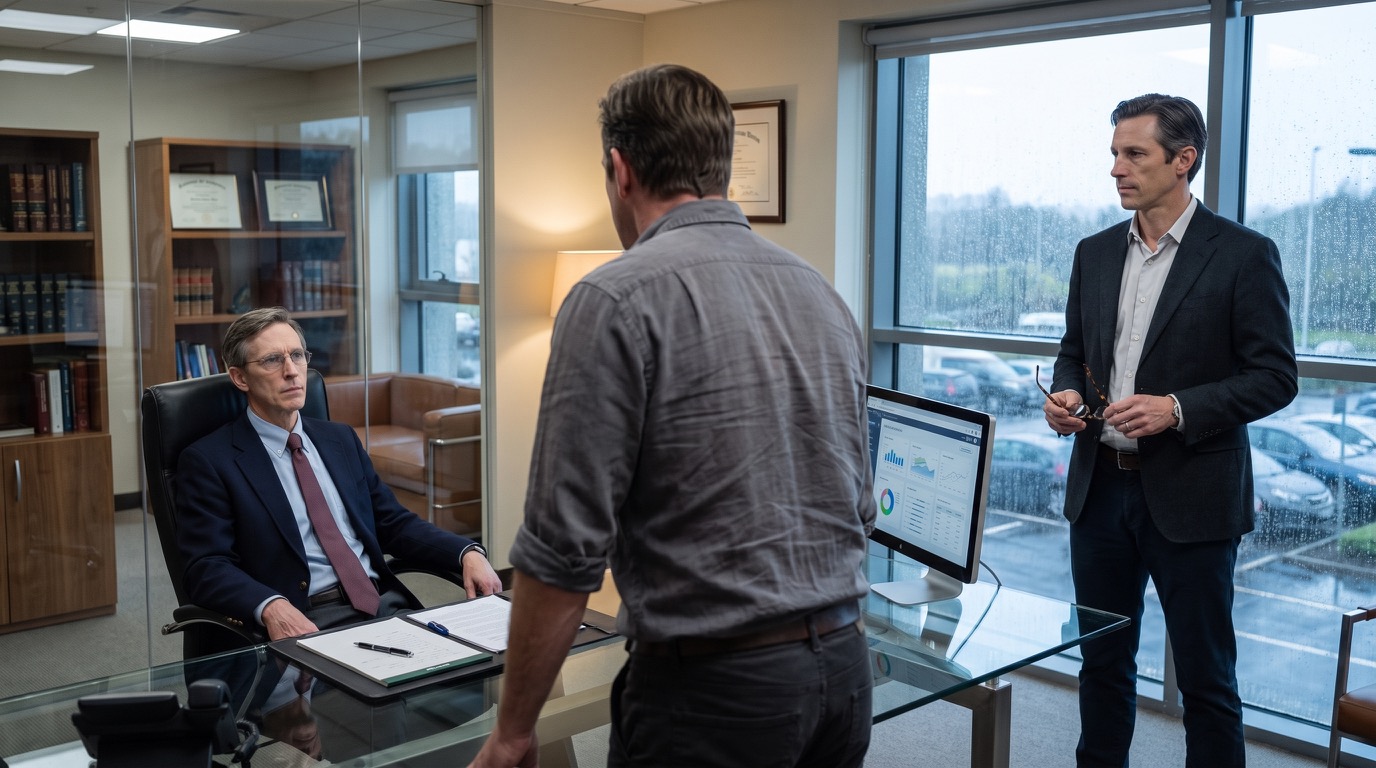
Melissa let Nathan through with the brittle look of a woman who had already spent the morning regretting someone else’s choices.
Derek’s office door was half closed. Graham was inside too, standing at the window with his glasses in hand and the posture of a man who wanted proximity to conflict without the stain of participating too directly in it.
Nathan did not knock.
Derek looked up first.
“Nathan,” he said. “We were just going to circle back with you.”
“Save the circle,” Nathan said. “You killed Ethan’s badge overnight and left me to find out from security.”
The sentence altered the air. Not because it was loud. Nathan had learned long ago that raising his voice around Derek only gifted him a tone argument. He said it plainly, which in this office carried its own violence.
Graham turned from the window.
His expression was controlled concern, the expensive version.
“Let’s lower the temperature,” he said. “No one is trying to create unnecessary distress here.”
Nathan laughed once.
“Then you failed before eight a.m.”
Derek folded his hands on the desk.
“I sent you the budget note yesterday,” he said. “I understood that as sufficient advance on a contractor scope decision.”
Nathan looked at him and felt something settle into hard clarity.
This was the part that always made him feel most insane. Derek could stand inside a cruelty, narrate it as process, and genuinely expect gratitude for the notice.
“You understood it as deniable,” Nathan said. “That’s different.”
A faint line appeared between Graham’s brows.
He hated that kind of sentence because it made motive visible and therefore forced him to decide whether elegance mattered more than reality.
“Nathan,” Graham said, “whatever the communication issue was, I need you to appreciate that contractor relationships do require boundaries. Derek’s concern, as I understand it, is not technical competence. It’s role confusion, visibility, confidence management.”
There it was again. The soft upholstery over a knife.
Nathan stepped closer to the desk.
“Then let me translate the technical competence part since that’s apparently still optional in this room. Ethan is the reason staging now behaves like a real environment instead of a haunted attic. He built the feature-flag path for Detroit. He mapped the rule-pattern risk. He is the fastest route to reducing live client exposure we currently have. Killing his access the morning after that meeting is not a boundary adjustment. It is an operational self-inflicted wound.”
Derek’s gaze sharpened.
“What is operationally destabilizing,” he said, “is a contractor acting as if discovery itself authorizes broader organizational signaling.”
Nathan did not take the bait.
He could feel the old instinct in himself, the one that wanted to argue morality, loyalty, the childish obscenity of letting a badge do the firing. All of that was true. All of it would bounce off Derek and land as proof Nathan was emotional.
So he kept going in the colder language.
“You want to restrict channels? Fine. Route findings through me. Route them through you. Make Ethan incapable of sending a client note without sign-off if that helps you sleep. But if you remove him entirely right now, Detroit slows, the comparison run slows, the C# service work slows, and every person in this building who can still tell the difference between visible risk and managed appearance learns the same lesson before lunch.”
Graham shifted his glasses from one hand to the other.
“Which lesson is that?” he asked.
Nathan turned to him.
“That plain competence gets punished the second it threatens anyone’s comfort. And if that becomes the rule openly enough, the only people who stay are the ones least capable of telling you the truth when it matters.”
Graham’s face changed at that, but not in the way Nathan wanted. The change was pain first, pride second. His father’s company. Loyal women who had been there for decades. A son hearing, yet again, that what had sustained the business might also be what was rotting it. He would never process that cleanly. It offended grief too deeply.
“No one is punishing competence,” Graham said. “We are trying to preserve coherence. This business supports families. We cannot have people feeling destabilized by technical signals they don’t fully understand.”
Nathan thought of Ethan outside with the dead badge. Of Ray. Of Donna stepping through the door and protecting herself with the phrase mix-up.
“People are already destabilized,” Nathan said. “They just prefer to call it caution because the other word would require a decision.”
Derek sat back slightly, and Nathan saw him measuring the distance between losing face and losing leverage.
That was the opening. Tiny, but real.
Nathan took it.
“I’m not asking you to apologize,” he said, because he knew better than to waste oxygen on impossible luxuries. “I’m asking for immediate reinstatement under whatever temporary language you need. Limited scope. Direct reporting through me. No broader visibility changes until we resolve Detroit. Call it a sixty-day contractor review if your spreadsheet needs ceremony. But if Ethan stays outside, the risk belongs to you, not to some abstract governance concern.”
Silence filled the office.
Outside the glass wall, someone passed too slowly, listening.
Graham looked toward Derek.
That glance was the whole company in miniature. Graham had the ownership and wanted someone else to absorb the judgment. Derek had the administrative power and wanted someone else to bless it. Each man’s hesitation fed the other’s. It was never certainty that kept bad decisions alive here. It was the mutual relief of not being the first to name what was already visible.
At last Derek spoke.
“Temporary access,” he said, eyes on Nathan, not Graham. “A narrowed remit. Detroit remediation only, routed through you. No independent client-facing communication, no broader visibility changes, and no assumptions that technical discovery confers process authority. We revisit in two weeks.”
Nathan knew a trap when he heard one. He also knew when refusing the trap meant abandoning the only moving plank above the water.
“Fine,” he said.
Graham exhaled as though agreement itself had restored moral balance.
“That seems responsible,” he said.
Nathan looked at him and understood, with the old sick familiarity, that Graham would remember this moment as evidence of thoughtful leadership. He would not remember the dead badge or the cafe or the part where everyone had let a system do their speaking until the speaking became too inconvenient to sustain.
Derek turned to his laptop.
“I’ll have access restore now,” he said. “Melissa can tell security to expect him.”
Nathan did not move.
“Now,” he repeated.
Derek’s mouth tightened by a fraction.
He typed.
The room held still around the soft clack of keys.
A minute later Derek looked up.
“Done.”
Nathan gave one short nod and left before either man could convert the reversal into one more lesson about professionalism.
Thursday, 08:31 — Back Through the Door
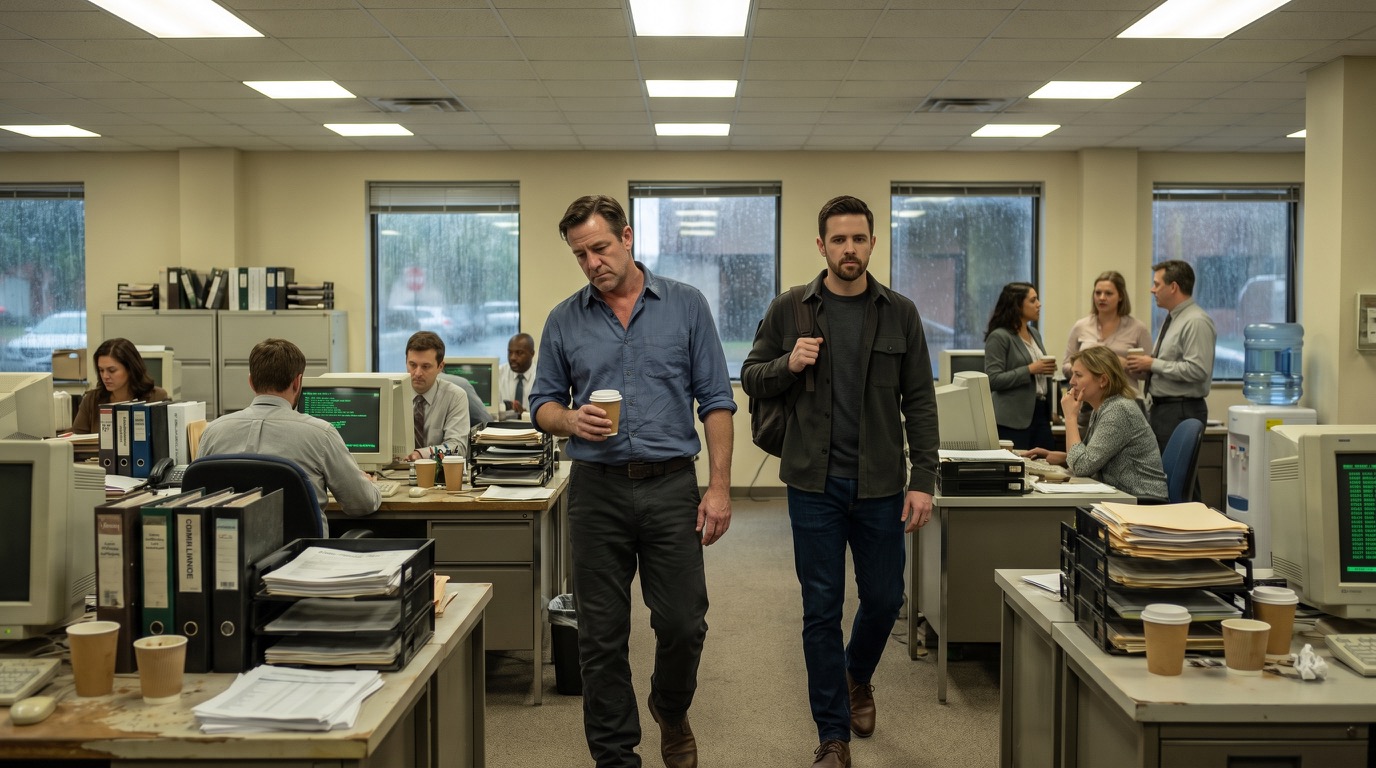
When Nathan came back across the street, Ethan was already standing up.
He did not ask the question immediately. Nathan’s face had answered enough of it.
“Temporary,” Nathan said.
Ethan let out a breath that could have meant relief or contempt. It sounded like both.
“Of course it is,” he said.
They crossed together.
Ray saw them coming and straightened before Nathan was even on the walkway. He had the posture of a man grateful for any outcome that let him stop being the instrument.
“Mr. Carter,” he said when Ethan held up the badge again.
The panel flashed green this time.
The small click of the door sounded indecently normal.
Ray opened it wide.
“Looks like they sorted it out.”
Nobody answered that.
Ethan stepped over the threshold with Nathan just behind him. The cold lobby air wrapped around the sweat drying under his overshirt. For one absurd second he had the animal sense that buildings remembered when they had rejected you, that the carpet itself had a changed opinion now.
Donna was near reception with a folder she had clearly stopped needing thirty seconds earlier. Linda stood farther down the hall with Sharon beside her, all three of them arranged in versions of occupied concern.
Nathan could almost hear the interpretations building themselves in real time.
Temporary access. Clarified scope. Sensitivity around contractor visibility. Everyone would have a phrase by lunch that allowed them to tell the story without having to call it what it had been.
Ethan clipped the badge back to his belt, slower than necessary.
“What’s the official fiction?” he asked quietly.
Nathan did not bother lowering his voice much.
“Detroit only. Through me. Two-week review.”
“So I got fired for being too visible and rehired for being too useful.”
Nathan looked at him.
“Yes.”
The honesty of it passed between them like something almost clean.
Ethan adjusted the strap on his bag. He could feel eyes on him from reception, from the copy room, from the half-open doors of offices where people were already deciding how much of their own unease to outsource upward. Nobody looked openly hostile. That would have been simpler. They looked careful. Concerned. A little relieved that the contradiction had been patched over before anyone was forced to speak too plainly about it.
Nathan recognized the feeling in the room because he had spent years breathing it. The collective wish that reality would please remain technically present but socially softened.
Donna stepped forward first.
“I’m glad that got resolved,” she said.
Her voice held genuine relief. Also something smaller and more compromised: relief that the event had retreated enough for her not to have to decide what she believed about it.
Ethan gave her a brief nod.
“Did it?” he asked.
Donna’s fingers shifted on the folder edge.
“You know what I mean,” she said.
He did. That was the problem.
Linda approached more slowly, binder in hand like a shield she had been issued decades ago and now wore as part of her skeleton.
“Nathan,” she said, directing the sentence at him while looking at Ethan, “if we could all just be thoughtful about how much tension this morning created, I think people would appreciate some steadiness.”
Nathan felt a pulse jump in his jaw.
This was how the building repaired itself. Not by confronting the wound. By asking the wounded to manage the room on behalf of the people who had made it.
Before he could answer, Ethan spoke.
“The steadiest thing available,” he said, “would be fixing Detroit.”
Linda’s mouth tightened almost imperceptibly.
“Of course,” she said. “I only mean that not everyone has the same context for abrupt changes.”
There it was again, the hedged consensus in miniature. Everyone uneasy. No one licensed, somehow, to let the unease become a conclusion.
Nathan stepped between the sentence and whatever came next.
“Then let’s give them context by doing the work,” he said.
He touched Ethan’s elbow, not intimately, not even warmly, just enough to redirect him away from the lobby before the place could stage another lesson.
They moved down the hall toward the development room.
Ryan stood as they entered. Olivia, already on a call in the corner, muted herself long enough to look up. Caleb spun halfway around in his chair, eyes wide with unprocessed outrage. Marcus looked from Nathan to Ethan and back down to his screen, not indifferent but frightened in the deep domestic way of a man whose silence had bills tied to it.
No one asked what happened first.
Instead Ryan said, “Do we still have Detroit?”
It was the right question. Ethan felt something in his chest loosen by a degree.
“We still have Detroit,” he said.
Olivia unmuted just long enough to tell whoever was on the phone, “I need ten minutes,” then killed the call entirely.
Caleb swore under his breath.
Marcus kept his eyes on the monitor. “Badge problem?” he asked.
Nathan answered for Ethan.
“Budget euphemism problem. Badge was just how it surfaced.”
Marcus nodded once, understanding more than he wanted to.
Nathan set his keys on the desk and finally let himself feel the cost of the morning. His body buzzed with adrenaline already curdling into fatigue. He had won nothing stable. He had dragged one competent man back inside on a leash labeled temporary while Graham and Derek preserved their own self-image intact. The dashboard was still dark. The office had learned the lesson anyway.
Speak plainly, and administration will try to make the punishment look procedural.
Across the room Ethan took out the packet and laid it on the desk between them.
The pages were still in order.
Bounded fix. Feature flag. Compare outputs. The sane path had survived the morning even if nobody in power had become saner.
Nathan looked at the top page and felt the shame settle into something he could use.
Not redemption. Nothing that grand.
Only clarity.
He had seen, again, what this company would do to preserve its internal story. He had also seen how little formal authority all his knowledge bought him when set against men who preferred tasteful language to exposed motive.
Still, Ethan was inside. Detroit still existed as work instead of rumor. For one more day, maybe longer, the thread had not been cut.
“All right,” Nathan said, voice rough but steady. “Let’s get the comparison run ready before they find another elegant way to call delay responsibility.”
No one smiled.
They turned toward their screens anyway.
Outside the development room the office resumed its softened noises: printers, phones, binder rings, footsteps made careful by people who wanted to believe the morning had only been a momentary misunderstanding. But beneath that surface Nathan could feel the deeper thing now, clearer than before.
The company had not corrected itself.
It had merely been forced, briefly, to tolerate competence again.
And across the hall, in the cubicles where Linda and Sharon and Donna still sorted paper into the shapes of caution, another fear was already forming. If Ethan could come back through a door once closed, then maybe the screens would light again. Maybe the old code would go on yielding its hidden rules. Maybe the numbers would stop being loyal to the stories people told about them.
That possibility frightened them almost as much as the red light had frightened Ethan.
Which meant the real fight had only moved rooms.