Software Will Fail. Recovery Is the Real Metric
MTBF can reward inactivity. DORA shows whether your organization changes software safely and recovers when reality di...
7 min read
03.07.2026, By Stephan Schwab

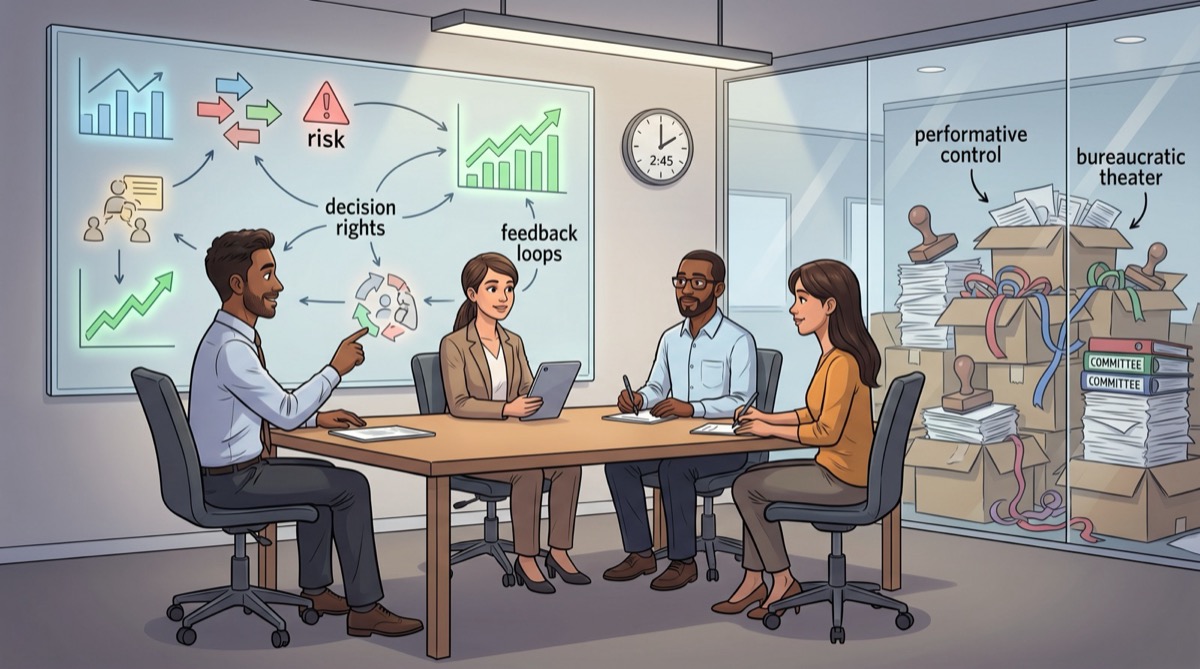
"Governance" is one of those executive words that sounds responsible the moment it enters the room. People say it when they want to signal seriousness, oversight, and adult supervision. Then they attach it to approval chains, steering committees, extra reporting, and documents nobody reads after the meeting. That is not governance. That is administrative perfume sprayed over uncertainty. Real governance is simpler and harder. It is how leadership decides, what leadership pays attention to, who owns which risks, and how reality is allowed to correct decisions before the organization does something expensive and stupid.
This distinction matters because leaders are often handed a false choice.
Either you control the work tightly, or the teams run wild.
That is nonsense.
Control is about direct intervention. More approvals. More mandatory steps. More exceptions that require a higher title in the room. More mechanisms for stopping motion.
Governance is about decision quality under uncertainty. It answers questions like these:
That is governance.
It does not require leaders to hover over every team. It requires leaders to define what must be true, what must be visible, and what must happen when reality disagrees with the plan.
If you strip away the corporate wallpaper, governance has three jobs.
Leadership decides which constraints are real.
Budget limits. Legal obligations. Safety requirements. Security posture. Strategic priorities. Service commitments. Risk tolerance. Those are governance questions because they define the edges inside which teams operate.
Good governance is clear about those edges.
Bad governance keeps them vague until something goes wrong, then suddenly declares that everyone should have known.
Not every decision belongs at the top. In fact, most do not.
Governance decides who gets to decide what. Which product choices belong to product people. Which technical choices belong to developers and architects. Which legal issues require counsel. Which spending thresholds require executive approval. Which exceptions can be handled locally and which ones must escalate.
This is one of the least glamorous and most important parts of leadership. If decision rights are fuzzy, organizations waste time negotiating authority in every crisis.
A governed organization does not wait for quarterly slides to discover that its assumptions were nonsense.
It decides in advance which signals matter and how often they are reviewed. That might mean uptime, lead time, escaped defects, customer retention, audit findings, margin movement, cash exposure, or regulatory exceptions. The specific signals differ by business. The principle does not.
Governance means deciding how truth enters the room.
Without that, the loudest person, the highest title, or the prettiest slide deck wins.
A lot of things get called governance because the label makes them sound respectable.
They are still bad ideas.
Governance is not:
This is where many organizations drift into self-inflicted stupidity.
They create a structure that produces visible oversight but weaker decisions. They feel safer because more people touched the process. Meanwhile nobody owns the outcome clearly, nobody sees the real signal early enough, and teams learn that surviving the process matters more than solving the problem.
That is not governance.
That is bureaucracy wearing a tie.
This happens constantly in software and technology-heavy businesses.
Senior leaders know they are accountable for risk, cost, timing, and reputation. Fair enough. But because they often cannot directly evaluate the underlying technical decisions, they look for visible substitutes.
Documents feel safer than code. Steering committees feel safer than developer judgment. Phase gates feel safer than short feedback loops. Status colors feel safer than operational evidence.
The problem is not that leaders want visibility. The problem is that they often choose the wrong kind.
Software work is often invisible in the wrong places and painfully visible in the wrong moments. That makes symbolic oversight very seductive.
A team can satisfy a governance ritual and still be heading straight into a production disaster. Another team can look noisy, adaptive, and slightly uncomfortable while being governed far better because the real signals are alive and the real owners are paying attention.
Good governance does not eliminate uncertainty. It stops uncertainty from hiding behind polished presentation artifacts.
For leadership, the practical test is not whether the organization feels controlled. The practical test is whether the right people can make the right decisions with the right evidence at the right time.
Good governance usually has a few boring characteristics:
Notice what is missing from that list.
No worship of forms. No universal pre-approval. No fantasy that a committee can replace expertise. No assumption that adding layers automatically reduces risk.
In software, good governance often means leadership agrees on service expectations, security requirements, compliance constraints, budget boundaries, and delivery signals, then lets competent teams work within them. The point is not to free teams from accountability. The point is to connect accountability to reality instead of ceremony.
That can look less orderly from the outside than traditional management theater. It is usually much safer.
That is a solvable problem, but only if the question becomes more precise.
Instead of saying “we need more governance,” ask:
Those questions lead somewhere useful.
The vague demand for “more governance” usually leads to another committee.
And committees are wonderful if your goal is to spread accountability thin enough that nobody can be blamed cleanly.
Real governance is not what happens after leadership has finished thinking.
Real governance is part of leadership thinking itself.
It is the discipline of deciding what matters, naming who owns what, demanding evidence instead of reassurance, and correcting course when the facts change.
That is why governance cannot be outsourced to process alone. Process can support it. Reporting can support it. Automation can support it. Internal controls can support it. None of those things are governance by themselves.
Governance is judgment expressed as structure.
And that means the quality of governance depends on the quality of the people designing it.
If leaders are vague, frightened, performative, or addicted to optics, the governance will reflect that. It will be heavy where it should be light, blind where it should be sharp, and loud where it should be honest.
If leaders are clear, evidence-driven, and willing to let expertise operate inside defined boundaries, governance becomes something much more useful.
It becomes a way for the organization to stay responsible without becoming paralyzed.
That is what governance is.
Everything else is mostly office furniture.
Tell me what is happening. I listen, ask a few practical questions, and reflect back what I see: where the risk may sit, what may be blocking delivery, and what looks worth checking next. No pitch, no obligation. Confidential and direct.
Talk it through. Practical reflection, no pitch.
Start a ConversationTelenovelas show what we can't say in client meetings. The drama is heightened, but the patterns are real.
 QuantumMind Arrives
Three weeks in, Stefan's teams are shipping. Radio plays podcasts. Navigation reads temperature sensors from the CAN bus. Climate control has its f...
 The Scattered — Part Two
After Whitaker Payroll shuts its doors, the damage spreads unevenly. Some former employees find new work quickly. Others discover that decades of l...
Embedded into your team as an active contributor, reducing delivery friction and helping important work move cleanly.
Peer-style technical assessments before far-reaching decisions; reduce architectural and product risk early.
Ship working software to real users earlier. Measure impact and adapt based on evidence rather than assumption.
High quality, maintainable software. Short-term augmentation that leaves lasting capability in your own team.
Visibility and hands-on delivery
Navigator gives your leadership clear insight into patterns, blockers, and capacity. Our Embedded Delivery Partner writes production code with your team and gets delivery moving.