Process Theater and the Grind
Preston Hale arrives just in time to do what he does best: call fear professionalism and bless documents that cannot actually guide the work. By Thursday night the programmers are already paying the real cost in after-hours repair, interpretation, and invisible family damage. By Friday morning Whitaker Payroll's awkward experiment hardens into official discipline. Graham Whitaker and Derek Lawson call it maturity. Preston calls it accountability. Nathan Cole, Olivia Parker, Ryan Mitchell, Caleb Turner, and Marcus Doyle experience it as a slow transfer of labor, uncertainty, and blame onto the people still writing code after dark. As sign-offs multiply and evenings disappear, Nathan finally says what Graham cannot forgive: that process has become an alibi for not deciding.
Thursday, 15:58 — Excellent Work

By Thursday the packet had reached thirty-four pages.
It had a title page, a revision history, two appendices, eight sections, and a level of internal polish that made it irresistible to anyone who loved the appearance of seriousness more than the inconvenience of executable truth.
Which was how Preston Hale ended up standing in Graham’s office holding it with visible approval.
“This,” he said, tapping the packet lightly against his palm, “is excellent work.”
Linda’s shoulders loosened so subtly only Nathan noticed.
Sharon lowered her chin by a fraction, receiving the praise with the composure of a woman who had been trying all week not to look as relieved as she felt.
Donna did not relax at all.
The packet on Preston’s hand looked too much like a school essay that had been awarded a prize for penmanship while answering a different question from the one on the exam.
Preston smiled the smile that had sold airports full of books.
“Thorough,” he said. “Detailed. Professional. It demonstrates care, memory, and real subject-matter depth.”
Graham nodded, almost grateful.
He had been carrying the lingering moral discomfort of last week’s firing like a stone in his jacket pocket. Not heavy enough to incapacitate him, just present enough that he kept touching it mentally and calling the contact conscience. Preston’s approval eased that contact. If the packet was excellent work, then the company had not expelled expertise. It had re-centered it.
That thought brought him genuine comfort.
Nathan watched him have it.
Derek was already on the next step.
“Our challenge,” he said, “is that development velocity hasn’t yet aligned with the improved definition quality.”
Nathan laughed once, sharply enough that everyone turned.
He had not meant to do it. The sound escaped him the way pain sometimes escaped as sarcasm in men too old to cry in meetings.
“Improved definition quality?” he said. “Ryan spent half of Tuesday explaining to Sharon what an exit code was. Olivia has basically become technical support for the validation process. Marcus is preserving three mutually contradictory sources of truth because no one will decide which one governs. The packet is not implementation-ready. It’s fear in a serif font.”
Silence.
Preston looked at him with the patient disappointment of a man encountering a resistant case study.
“Nathan,” he said, “I think that’s unfair. What I see here is exactly what mature organizations do after a destabilizing innovation shock. They restore role clarity. They slow premature certainty. They separate domain definition from downstream execution.”
Nathan stared at him.
The cruelty of Preston Hale was that he made stupidity sound like a white paper.
“This is software,” Nathan said. “Not procurement. The domain definition is incomplete until it hits something executable. That’s what you people keep refusing to understand.”
Graham’s face changed on the phrase you people.
Not because it was rude.
Because it moved Nathan, for one second, out of the affectionate category and into the oppositional one.
The transition was small and devastating.
“Let’s not do tribal language,” Graham said quietly.
Tribal language.
Nathan felt the room tilt.
Sharon, hearing Graham’s tone, felt safer than she had all week.
Linda heard restraint.
Donna heard the owner trying to keep the room decent and wished, not for the first time, that decency and accuracy were not so often enemies here.
Preston turned the packet over and looked at the tabs.
“No process is perfect on first implementation,” he said. “The answer is not less structure. It’s tighter structure. Stricter sign-offs. More precise accountability downstream.”
Downstream.
The word found the programmers and pinned them there.
Derek nodded as though a consultant had just supplied the missing reagent.
“That’s consistent with what I’ve been seeing,” he said. “The material is here. The challenge is translation discipline.”
Translation discipline.
Nathan could feel his heartbeat in his teeth.
“The material is not here,” he said. “The material is a pile of historical narrative with unresolved contradictions and no stable mechanism for deciding what wins when the narrative, the output, and the code disagree. Ethan had built the mechanism. You got rid of it.”
The use of Ethan’s name brought a faint shadow over Graham’s face.
Not remorse exactly. More like irritation that a settled matter continued to vibrate in the room after the room had already done the work of classifying it as regrettable necessity.
“We are not reopening that decision,” Graham said.
“I’m not reopening it,” Nathan said. “I’m describing its consequences.”
Preston stepped in with the smooth timing of a man who had spent two decades converting power’s irritation into philosophy.
“Consequences can be narrated in many ways,” he said. “One available narration is that the organization is maturing from charismatic improvisation into distributed responsibility.”
Caleb would have laughed if he’d been in the room.
Marcus would have gone even quieter.
Ryan would have looked at the floor and started updating his resume in his head.
Olivia would have thought about pickup windows and wondered how many evenings like this a human being could survive before the damage migrated home.
Nathan only felt tired.
Not physically. Not yet.
He felt the deeper tiredness that arrived when language itself became part of the machinery of refusal.
Linda saw his face and, for a split second, nearly spoke.
Not in Ethan’s defense.
Not even in Nathan’s.
Only to say something plain like The packet still doesn’t tell them how to compute the carry-forward reset.
The sentence rose as far as her throat and stopped.
If she said it here, in front of Graham and Preston and Derek and Sharon and Donna, it would not stay technical. It would become moral positioning. It would place her on the wrong side of the new calm. It would help build a road away from the one form of professional relevance she still possessed.
So she looked down at the packet tabs and said nothing.
Derek took out a pen.
“All right,” he said. “Action items. Development will produce implementation plans against the current packet by Monday. SMEs will validate using the revised checklist. I’ll add a mandatory escalation lane for unresolved discrepancies. Graham, if you’re comfortable, I think we can call this a disciplined reset.”
Graham exhaled.
“Yes,” he said. “Let’s do that.”
Disciplined reset.
The phrase settled over the room like a clean white sheet over bad furniture.
Preston smiled.
“Good. This is what leadership looks like in a sensitive transition.”
Nathan thought: if this is leadership, then collapse is just leadership that stayed undefeated long enough to meet a deadline.
But he did not say it.
He had finally begun to understand one of the oldest laws of the building.
The more accurate the sentence, the less socially survivable it became.
Thursday, 19:26 — After the Documents
The SMEs had left at 5:03.
Not theatrically.
Not smugly.
They packed their bags, straightened their desks, said good night in the tones of conscientious adults who had completed a full day of demanding cognitive labor, and walked out into the summer evening carrying packets that made their effort visible to anyone who passed them in the hall.
At 5:41, Donna had sent Olivia a follow-up email asking whether the revised validation worksheet might include a short glossary of terminal terms for ease of use.
At 6:12, Sharon had sent Ryan a note marked high importance asking him to revisit requirement 08.15 because the wording in his implementation plan felt more definitive than the packet warranted.
At 6:48, Derek had forwarded both emails to Nathan with the note:
Need a more supportive handoff culture here. Let’s be thoughtful about reducing friction.
By 7:26, the only people left in development were the programmers and the air-conditioning.
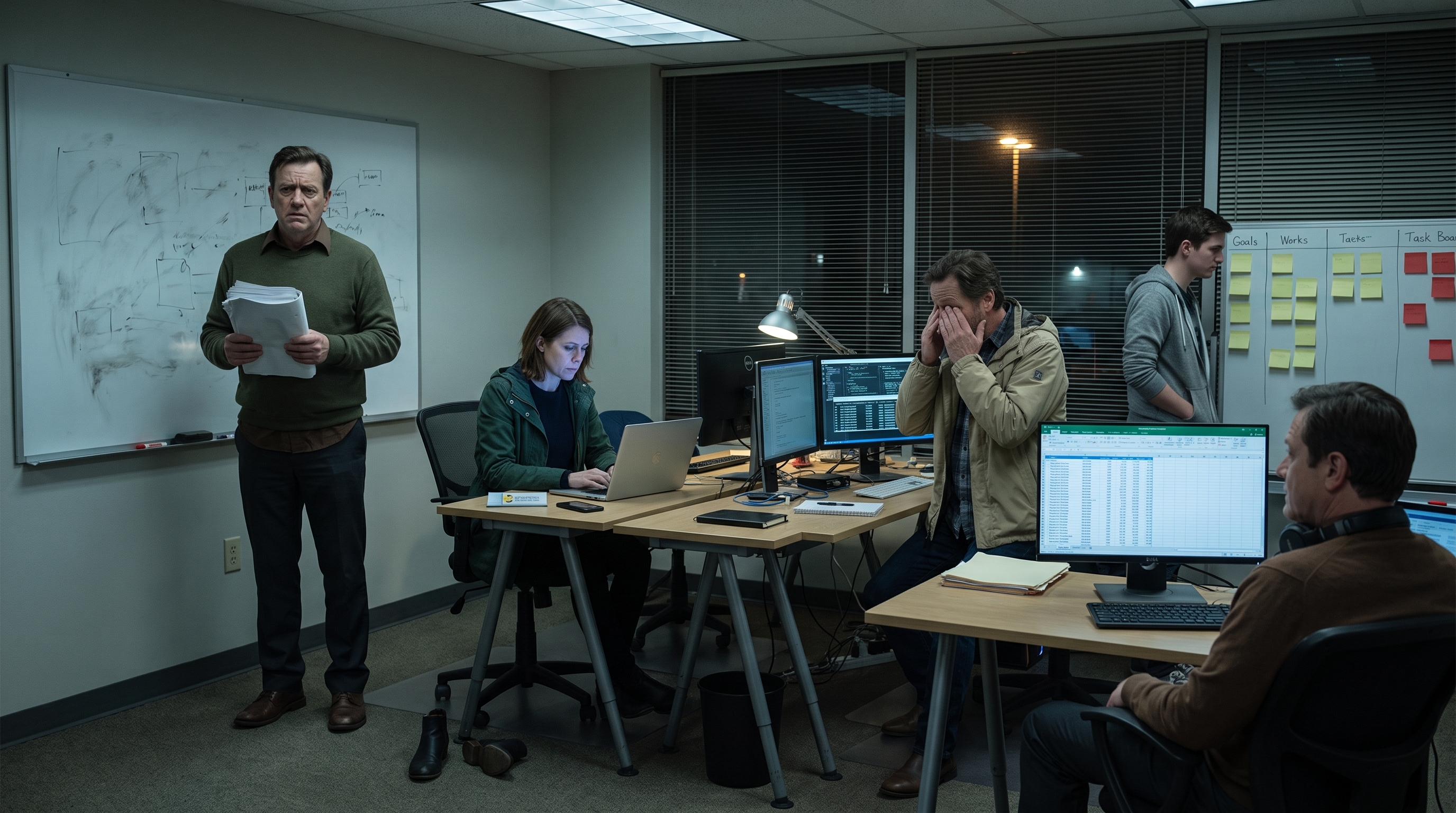
Nathan stood at the whiteboard with Linda’s packet folded back in one hand and stared at the task board Derek loved.
Yellow notes.
Blue notes.
Red escalation flags clipped to the corner of any item where the requirement, historical output, and actual code path refused to line up.
There were already eleven red flags.
“I hate this board,” Caleb said.
No one answered because hatred had become too expensive a fuel to spend casually.
Olivia was barefoot under the desk, not out of comfort but swelling. Her left heel had blistered that week from running between conference rooms and her own machine while pretending the extra laps counted as collaboration rather than absurdity. Her phone lit once, twice, then went dark again. She did not pick it up immediately.
Ryan leaned back and pressed the heels of his hands into his eyes.
“I wrote an implementation plan for a paragraph that says, essentially, ‘special care should be taken where history suggests caution,’” he said. “That’s not engineering. That’s translating incense.”
Caleb stopped pacing long enough to point at him.
“Exactly. Thank you.”
Marcus spoke without looking up.
“Requirement 08.22 references three historical cases that produce three different results for the same conditions.”
Nathan turned.
“Same inputs?”
“Same effective inputs,” Marcus said. “Different years, different operators, maybe different hidden flags, maybe different emergency interventions nobody logged. I can preserve the artifacts. I can’t tell you which of the three outcomes the packet wants us to reproduce because the packet says all three indicate context.”
Nathan rubbed his mouth with the back of his hand.
He had not gone home before eight once this week.
He had eaten two vending machine dinners and half a protein bar Caleb left on the printer tray because no one in the room still had the energy for formal meals. The overhead lights had taken on that familiar after-hours cruelty in which every face looked a little grayer and every screen looked a little more like judgment.
Olivia finally picked up her phone.
Her daycare provider had sent a message an hour ago.
All okay. Just checking ETA for tomorrow because you’ve been cutting it close this week.
Olivia stared at the message until the words blurred.
Not because it was hostile.
Because it wasn’t.
Ordinary life never arrived as melodrama. It arrived as a polite reminder that your child still occupied linear time even when your employer had started trying to consume all of it.
She set the phone down again faceup this time.
Ryan saw the movement.
“Everything okay?”
She made a small circle with her fingers that meant no and yes and not enough to justify stopping the work in front of witnesses.
Nathan looked around the room.
This was how the next phase started, he thought.
Not with a speech.
Not with an ultimatum.
With professionally formatted insufficiency arriving before five and invisible compensatory labor beginning after it.
The programmers doing the translation, the interpretation, the tool support, the historical reconciliation, the implementation planning, and the actual coding. The SMEs doing the packet. Derek doing the forwarding. Graham doing the language of stewardship. Preston doing the blessing.
And every single layer able to tell itself it was carrying its rightful share.
He looked down at the folded packet in his hand.
Thirty-four pages.
All that caution.
All that care.
All that prose written in the shadow of one unbearable fact no one wanted to phrase honestly: the moment Ethan had made the system more visible, the company had chosen not more truth, but more ceremony.
Nathan sat on the edge of his desk.
“All right,” he said. “No heroics tonight. Capture contradictions. Preserve artifacts. Don’t fake certainty to make their process feel complete. If the requirement is vague, quote it exactly. If the output conflicts, pin both samples. If a validator asks what box to check, send them the evidence and make them own the box.”
Caleb stopped pacing.
“You say that like they’ll actually own it.”
Nathan looked at the red escalation tags.
“No,” he said. “I say it because I want a record of who kept declining to.”
That landed.
Marcus nodded once.
Ryan turned back to his screen with the flat concentration of a man already thinking in parallel about code and exit options.
Olivia opened a draft note to herself on her phone.
Update LinkedIn tomorrow after bedtime.
She did not know yet that the sentence would matter.
Only that it had appeared.
Nathan unfolded the packet one more time and saw Linda’s section heading halfway down page twelve:
KNOWN AREAS REQUIRING JUDGMENT
He stared at the words until they changed shape.
That, in the end, was the whole company.
Not the COBOL. Not the VB6 client. Not even the wrong numbers.
A building full of adults requiring judgment and arranging themselves, with exquisite courtesy, so that no one had to be the one who supplied it.
Outside, the parking lot light buzzed on over the wet blacktop.
Inside, the development room kept breathing its thin refrigerated air over five people trying to build software from documents designed mainly to prevent anyone from being blamed for not having already known what the software should do.
Nathan looked at the packet, then at the red flags, then at the empty space where Ethan had stood a week ago explaining that failed cases were where the truth hid.
The failed cases were still here.
The truth was still here.
What had changed was that the company had found a more elegant way to keep both from mattering.
Friday, 08:11 — Discipline
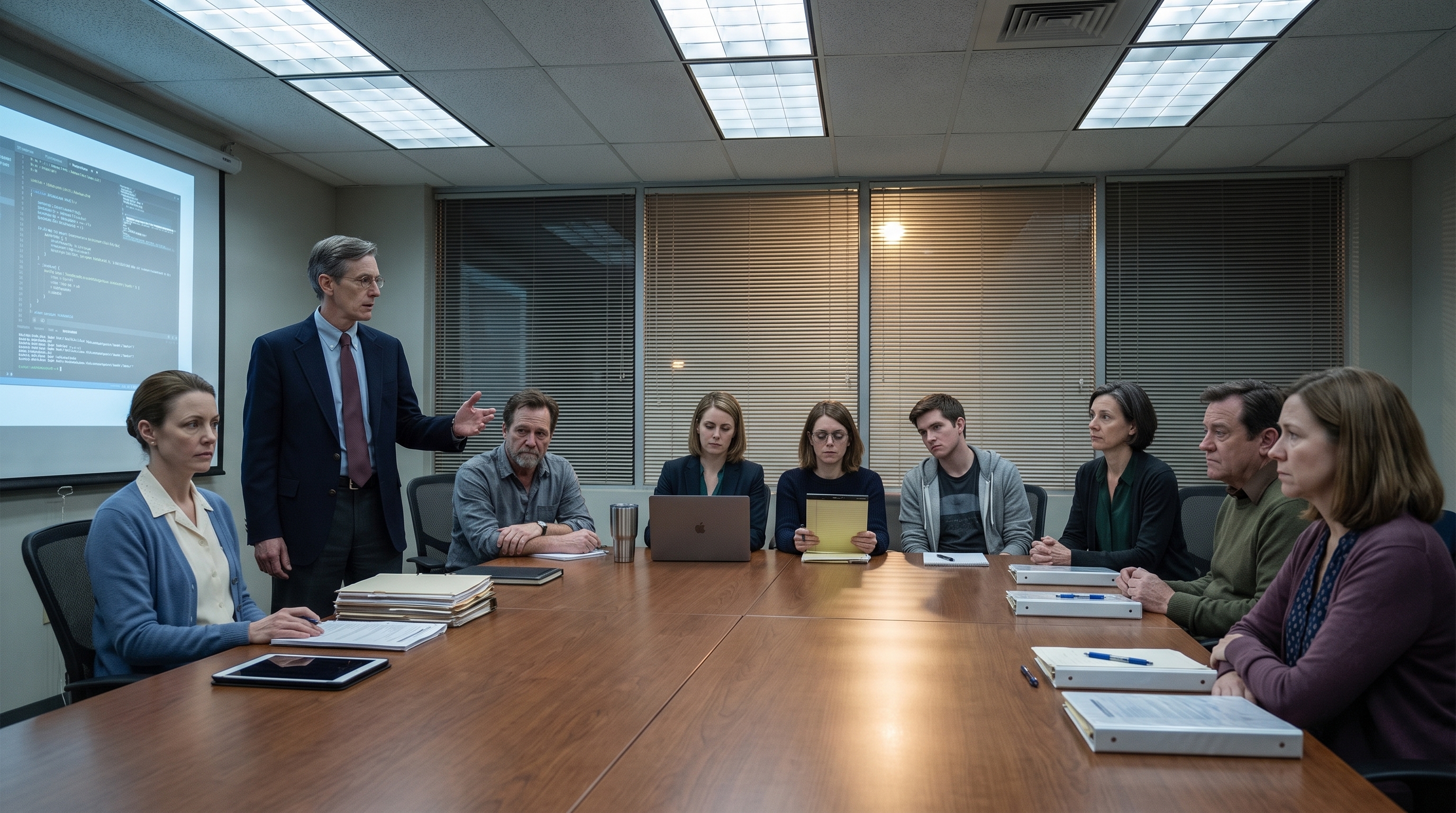
The new slide deck was better designed than the new process.
That was the first thing Nathan noticed.
Muted colors. Clean icons. No clutter. Derek had used the company’s updated template, the one Graham liked because it made every internal failure look ready for an annual report.
STABILIZATION MEASURES.
DELIVERY ACCOUNTABILITY.
TRUST RESTORATION.
The words glowed on the wall with the confidence of concepts that had never had to compile.
Graham stood beside the screen with one hand lightly curled around a paper cup he had no intention of drinking from. He looked calm in the expensive, curated way he always did when something ugly had already been translated into language smooth enough for him to inhabit.
“Thank you for making room for one more reset conversation,” he said. “I know everyone has been carrying a lot.”
Everyone.
Nathan looked at the room and thought of how the word worked here. It spread responsibility evenly over unequal damage. Everyone had been carrying a lot. But not the same lot. Not the same hours. Not the same exposure. Not the same future cost.
Derek clicked to the next slide.
Mandatory sign-off at each handoff. Escalation tickets for unresolved ambiguity. Twice-weekly review meetings. Implementation plans attached to every change. Weekend availability during stabilization period.
Caleb read the last line and let out a sound halfway between a laugh and a cough.
Graham’s gaze flicked to him, then away in the manner of a man too polished to embarrass someone directly unless he absolutely had to.
“This is temporary,” he said. “The goal is not punishment. The goal is confidence.”
Olivia sat very still.
Temporary had become one of the building’s more dangerous words.
Ethan’s return had been temporary.
The access restriction had been temporary.
The current workflow was temporary.
What temporary meant at Whitaker Payroll was that the people with power wanted all the compliance benefits of permanence without accepting the moral burden of saying permanent out loud.
Derek took over.
“What we’ve seen over the last two weeks is that a more disciplined environment creates some initial drag,” he said. “That’s normal. The answer is not to back away. It’s to tighten the loop until responsibilities become habitual.”
Tighten the loop.
Nathan could have translated the phrase into honest English for everyone in the room.
It meant: the documents are failing, so the people doing the actual work will now spend additional hours compensating for the failure while the process itself is protected from blame.
He did not say that yet.
Linda took notes with the concentration of someone copying instructions for a complicated medication schedule she badly wanted to believe would work.
She had left at 5:02 every day that week. That fact had started to hum at the edges of her awareness because she could feel the programmers still in the building when she walked past their room. The awareness hurt. So she had translated it, privately, into a better sentence.
They were still there because implementation took time.
She was leaving because her work required freshness, judgment, and precision.
Both things could be true.
Had to be true.
Otherwise the shape of the whole week changed into something she could not endure.
Donna looked at the weekend availability bullet and felt a small dart of shame she immediately tried to file into a less personal drawer.
The programmers did work different hours. That was obvious. But the work was different, wasn’t it? Hers involved review, discernment, careful reading, memory. It was mentally exhausting in a different way. She told herself that and almost believed it, which made the part of her that did not believe it more painful.
Sharon, by contrast, felt the slide as vindication.
Not because she wanted anyone miserable.
Because the last three weeks had made her feel as though the company had briefly mistaken speed for maturity and visibility for wisdom. The new measures looked like adulthood returning. They looked like brakes. She believed in brakes. Brakes had kept her employable.
Nathan raised a hand only enough to make it impossible to accuse him of theatrics.
“Weekend availability for what?” he asked.
Derek turned toward him.
“For delivery stabilization.”
“That’s not an answer.”
Graham stepped in before the exchange could acquire edges anyone else might later quote.
“Nathan, what Derek means is that we’re asking for flexibility while the new operating model settles.”
“Flexibility from whom?” Nathan asked. “Because the packets are being written during business hours. The review meetings happen during business hours. The extra implementation plans, the evidence reconciliation, the sign-off prep, the actual coding, and now the weekends all land on development. So let’s at least say the sentence correctly.”
The room thinned.
It always did when someone insisted on naming weight instead of process.
Graham’s face did not harden. Hardening would have made him legible. Instead it softened into disappointment.
That was worse.
“I think,” he said, “that kind of framing keeps us trapped in oppositional thinking.”
Nathan heard Olivia breathe out slowly beside him. Ryan put his pen down very carefully. Marcus stared at the edge of the table with the fixed attention of a man who already knew the meeting was veering toward the kind of truth offices punished most efficiently.
“No,” Nathan said. “What keeps us trapped is pretending unequal labor is a mood problem.”
Silence.
Then Preston Hale’s voice arrived from the doorway.
“Or,” he said warmly, stepping into the room as if he’d been invited by the concept of management itself, “what keeps organizations trapped is confusing resistance with clarity.”
He wore summer-weight navy, no tie, perfect teeth, and the look of a man who had never once walked into a room without expecting it to reorient around him.
Graham brightened on sight.
That was the second insult.
Not that Preston had come. That Graham visibly relaxed when he did.
Nathan felt the familiar old disgust move through him: the owner who could not trust the person carrying the technical reality but could immediately trust the man carrying a published vocabulary for avoiding it.
Preston took an empty chair with practiced informality and glanced at the slide.
“Good,” he said. “This is what care under pressure looks like.”
Caleb actually looked at the ceiling.
Ryan kicked his ankle lightly under the table.
Preston kept going.
“When teams are destabilized, leadership has to restore predictable roles. People don’t resent structure nearly as much as they resent unclear expectations.”
Nathan almost asked him whether programmers counted as people in that sentence. Instead he asked the more useful question.
“And when the structure formalizes bad inputs?”
Preston smiled at him like a professor indulging a bright but socially unshaped student.
“Then you refine the inputs. You don’t collapse the framework because execution is still catching up.”
Execution.
There it was again. The old world underneath the TED-stage vocabulary. Domain wisdom upstairs. Labor downstairs. The programmers once more cast as the place where somebody else’s immaculate abstraction had unfortunately become slower than desired.
Graham looked around the room.
“I need everybody leaning in,” he said. “No cynicism. No factional energy. We owe each other more maturity than that.”
Nathan thought: you owe us honesty first.
But honesty had no sponsor in the room.
Derek clicked to the final slide.
DELIVERABLE OWNERSHIP MATRIX.
Names filled the screen.
Linda, Sharon, Donna under Definition and Validation.
Nathan, Olivia, Ryan, Caleb, Marcus under Implementation, Reconciliation, Build Support, and Weekend Coverage.
The asymmetry now had an infographic.
That was new.
Monday, 17:04 — Five O’Clock Expertise
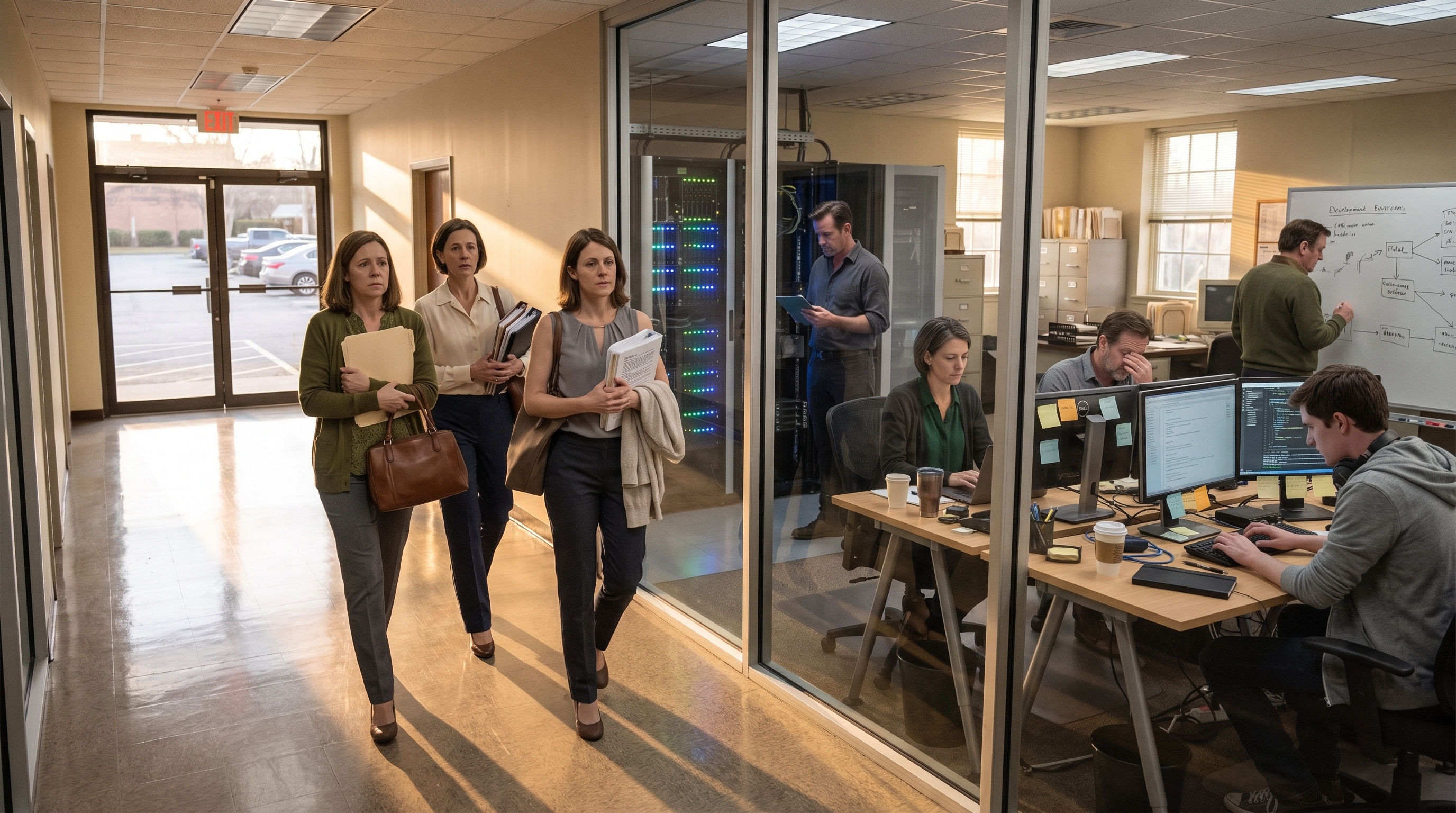
At 5:04 the hallway held two different versions of effort.
Linda carried her binder pressed against her ribs, handbag on the opposite shoulder, glasses tucked into the collar of her cardigan. She walked with the tired uprightness of a woman who had spent the day inside documents dense enough to feel like weather.
She was tired.
That mattered.
She did not want the reader of her own conscience to omit it.
She had spent six hours revising the municipal packet and another ninety minutes in review with Donna and Sharon trying to identify where the language still felt too conclusive. That work had its own texture of exhaustion. It was not fake because it was less visible from the development room.
And yet.
As they passed the glass wall, Linda let her eyes move only briefly toward the programmers inside.
Nathan was standing over Ryan’s monitor with one hand braced on the desk. Olivia had one earbud out and her phone facedown near the keyboard. Caleb was pacing in short diagonals. Marcus sat with his shoulders beginning to round in the way they did when he had been still too long.
The room looked inhabited by people who would still be there when the parking lot lights came on.
Linda looked away first.
Not because she did not care.
Because caring in the wrong direction would require new sentences, and she had already used up today’s strength manufacturing the old ones.
“I think the appendix is stronger now,” Sharon said as they walked.
She sounded almost relieved.
In Sharon, relief always presented as evaluation.
“The wording around reciprocal exceptions has more caution without sounding evasive.”
Donna adjusted the strap of her bag.
“Ryan said the caution still doesn’t tell them what condition actually triggers the branch.”
Sharon pressed the elevator button.
“Ryan wants a deterministic sentence for a situation that has never been deterministic in practice.”
Donna almost said That’s not fully true.
What came out was smaller.
“Maybe not never.”
The elevator arrived with a soft chime.
Linda stepped in first and turned immediately to hold the door the way polite women did when they had spent decades making themselves easy to work with.
The mirrored back panel caught the three of them and made them look like a committee in a brochure about continuity.
Sharon spoke as the doors closed.
“What worries me,” she said, “is that the developers keep behaving as though ambiguity is a defect.”
Linda heard herself answer before thought had fully caught up.
“For them it probably is.”
The sentence lingered.
Donna watched the floor numbers light down one by one.
She thought of the terminal window Olivia had shown her that afternoon, the red diffs she still could not read quickly enough to feel competent, the embarrassing sincerity of having to ask what an exit code meant in front of someone young enough to be managing school pickup notifications between runs.
“I don’t think they’re wrong that the packets leave too much unresolved,” she said.
Sharon turned.
Not sharply. That would have been easier to argue with. She turned with the measured disappointment of someone hearing a colleague lend energy to the wrong side of a difficult season.
“Unresolved is honest,” she said. “What’s dishonest is pretending the unresolved parts don’t exist because a programmer wants clean implementation logic.”
Donna nodded, because disagreement in enclosed spaces still made her feel twelve.
The elevator opened into the lobby.
Through the glass doors the heat outside looked almost theatrical, a white-gold glare over asphalt and windshields. Linda could already feel the soft collapse waiting at home: sandals off at the kitchen table, microwave dinner or toast, a quiet house, the mortgage payment sitting in the back of her mind like a prayer she no longer believed but still repeated.
She was not leaving work untouched.
That mattered too.
But as Ray from security nodded them out and the hot air hit their faces, she felt the deeper fact under all the defensible ones.
The programmers were staying because the process needed translation to survive the night.
The three of them were leaving because the process had already assigned the invisible repair work elsewhere.
She hated the accuracy of that thought so quickly she began editing it internally before she reached her car.
No, she told herself. They were staying because implementation always took longer. Because their work was different. Because somebody had to code. Because she had earned the right not to be there at seven-thirty. Because if the company expected her to sit in terminal windows until dark, that would only prove how badly leadership still misunderstood expertise.
By the time she unlocked the Corolla, the thought had become bearable again.
Inside the development room, Olivia watched their cars leave one by one through the blinds.
“Five o’clock expertise,” she said quietly.
Ryan looked up.
“What?”
She gestured toward the parking lot.
“Nothing.”
But it wasn’t nothing.
It was the sentence her body had made before her mind wanted to admit it.
Nathan heard it and did not contradict it.
Wednesday, 16:22 — Disloyal

Graham closed the office door himself.
That detail would have meant intimacy once.
Now it felt like acoustics.
Nathan remained standing even after Graham gestured toward the chair. Sitting would have made this too much like consultation, and consultation was one of the forms in which betrayal had lately preferred to arrive.
On Graham’s desk lay the packet Nathan had marked up that morning.
Three pages clipped with yellow flags.
Two paragraphs circled hard enough to dent the paper underneath.
One comment in the margin next to a sentence about historical practice and reviewer discretion:
THIS IS NOT A DECISION. THIS IS A METHOD FOR POSTPONING ONE.
Graham had underlined that comment in pencil.
That disturbed Nathan more than if he had ignored it.
It meant Graham had understood the sentence enough to feel injured by it.
“You know why I asked you in here,” Graham said.
“Probably because I wrote in the margin instead of translating my concerns into something decorative.”
Graham let the line pass.
Not out of generosity. Out of preference. He disliked direct collision because it introduced textures into the room that were hard to curate afterward.
“I asked you in here,” he said, “because you matter to me, and because I think you’ve started talking about the organization as if it’s something being done to you by enemies rather than a system being held together by people who are also under pressure.”
Nathan stared at him.
The words were almost kind.
That was what made them brutal.
Graham could not accuse him crudely; crudity would have forced a plain shape onto the conflict. So instead he wrapped accusation in concern and made concern feel superior to anger.
“People are holding it together,” Nathan said. “That’s exactly the issue. The whole place is being held together by compensatory labor after the process fails. Olivia and Ryan are doing tool support for validators who can’t interpret the output they’re supposed to sign off on. Marcus is preserving contradictions because nobody above him will decide what truth source wins. Caleb is rewriting implementation plans for sentences that still don’t define behavior. I’m doing all of that plus the actual architecture triage. And you’re calling that stabilization.”
Graham turned away toward the window.
Outside, the parking lot shimmered in the late heat. Beyond it, the road ran on toward a city full of people whose jobs did not leak into every sentence as moral weather.
“I think,” Graham said slowly, “that you’ve become so identified with one way of working that anything which checks that model now feels like sabotage to you.”
Nathan felt something cold move through him.
Not because the sentence was true.
Because Graham needed it to be true badly enough to make himself believe it.
“Checked it?” Nathan said. “Graham, you fired the person who made the code path legible. Then you replaced executable evidence with documentation rituals and pushed the cleanup into nights and weekends. That isn’t checking a model. That’s protecting yourself from what the model exposed.”
Graham turned back.
The grief under him showed then, not beautifully, not nobly. More like class panic disguised as stewardship. His father had built something real with hands and code and decades of accumulated loyalty. Graham had inherited the institution and the mourners and the polished language of stewardship, but not the internal instruments required to judge the technical argument suddenly living at his feet.
Nathan’s accuracy did not feel to him like service.
It felt like desecration with spreadsheets.
“Do you hear yourself?” Graham asked. “Do you hear how contemptuous you sound of everyone who isn’t inside your framing?”
Nathan laughed once, with no humor in it.
“My framing? The system is failing under the process you approved. That’s not framing. That’s output.”
“No,” Graham said, and his voice sharpened for the first time. “That’s interpretation. And you’re insisting your interpretation is the only moral one available.”
There it was.
The maneuver Nathan had begun to understand too well.
When the facts became inconvenient, Graham elevated every technical claim into a matter of plural viewpoints. Then he chose the viewpoint least threatening to the hierarchy and called that humility.
Nathan looked at the abstract painting behind the desk, all soft blocks of blue and ash arranged so tastefully no conflict could survive having to match the decor.
“You want to know what I hear?” he asked. “I hear a man who thinks indecision becomes wisdom if you say it gently enough.”
Graham went still.
Nathan knew immediately he had crossed the line and also that the line itself was obscene.
Because the offense was not factual error.
It was removal of moral cushioning.
Graham’s face settled into the composure he used when deciding he had been wronged in a way that licensed formality.
“This,” he said quietly, “is exactly what Preston meant.”
Nathan blinked.
He had expected anger. Maybe disappointment. Not that name. Not in that tone.
Graham continued.
“You keep treating restraint as cowardice and disagreement as corruption. You keep speaking as though your technical urgency places you above relationship, above trust, above the need for a company to remain governable. That is not leadership. It’s disloyalty dressed up as clarity.”
The word did not land like a shout.
It landed like a notarized document.
Disloyal.
Nathan could feel his body register it before thought did.
Years of lunches, favors, late calls, private confidences, emergency weekends, funerals navigated, humiliations absorbed, systems held together at personal cost. All of it reclassified in one clean movement as insufficient devotion because he would not bless the lie now passing under the name of discipline.
He looked at Graham and saw, finally, the full shape of the friendship.
Not false exactly.
Just contingent on Nathan never forcing reality into a sentence that cost Graham too much self-image to hear.
When Nathan answered, his voice came out flatter than he expected.
“If loyalty means agreeing to let the process hide what it’s breaking, then yes. I’m disloyal.”
Graham flinched as if struck, not because Nathan had raised his voice, but because he had accepted the frame rather than pleading against it.
“That’s not what I said.”
“It’s exactly what you said.” Nathan put the packet on the desk. “You just said it in a language expensive enough to display.”
He turned and walked out before Graham could restore tone, civility, or the conversational balance that would have made the injury sound mutual.
In the corridor, the air-conditioning hit him like chemical weather.
He stood for a second with one hand against the wall, not from dizziness but from the strange bodily humiliation of finally seeing a relationship reach its real size.
At the end of the hall Derek was speaking to Melissa in a voice so calm it might have been describing table reservations.
The building went on.
It always did.
That was one of its darkest talents.
Thursday, 19:03 — Pickup Windows
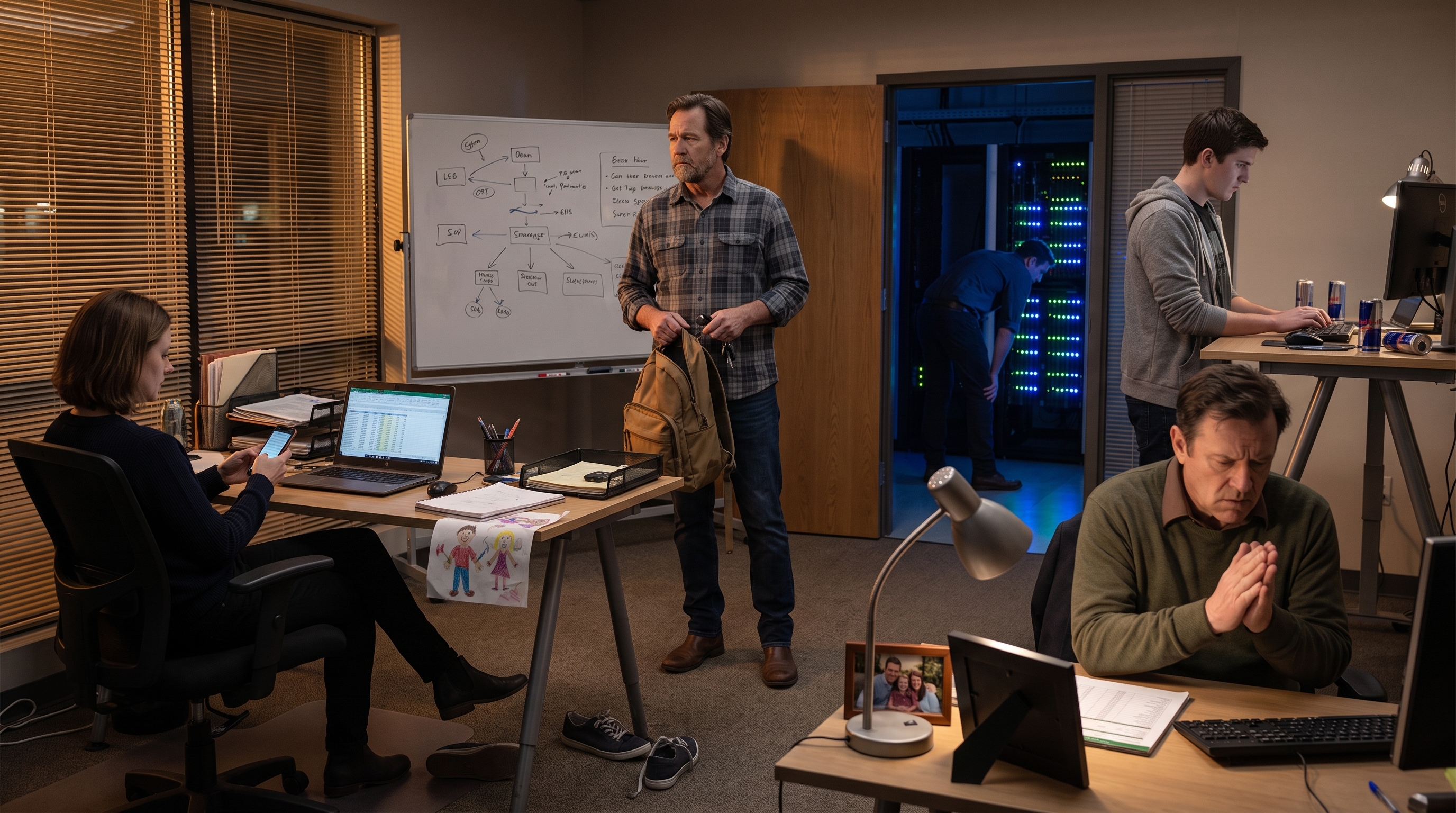
By Thursday evening the process had developed its final elegant feature.
It could consume family life without ever explicitly demanding that anyone choose work over family.
The demand was ambient.
That made it harder to resist and easier to narrate.
Olivia’s phone lit up at 6:41.
Last pickup today was 6:30. We kept Maya with us, no problem, but please confirm ETA.
Her daycare provider, Jenna, always wrote in a tone of practical warmth that made Olivia feel worse than open annoyance would have. Warmth left no villain to push against. Only arithmetic.
Olivia swallowed and typed back with careful thumbs.
I’m so sorry. On my way in ten. Thank you.
She did not stand up.
Not immediately.
That was the new corruption. Not that the job prevented departure outright. That some part of her had started instinctively checking whether leaving now would create fallout tomorrow she would have to absorb in a different form.
Ryan saw her face and looked at the wall clock.
“Go,” he said.
She nodded and still did not move.
“It’s not the code,” she said. “It’s the meeting at nine tomorrow. If I leave now, Derek’s going to ask why the comparison memo isn’t in the folder. Then Nathan will cover it, and I’m so tired of Nathan covering things that should just be allowed to remain unfinished until morning like normal human work.”
Ryan let out a breath that sounded practiced.
He had become practiced at these conversations because he was having smaller versions of them at home every week.
His son had asked Tuesday whether Daddy lived at the office now. His wife had said it laughing, because the only way some marriages survived the first rounds of injury was by translating them into jokes before either partner had to name the resentment accumulating underneath.
Ryan had laughed too.
Then he had gone into the shower and stood there longer than necessary with the water cooling around him, thinking about the sentence as if it were a test result he did not want to accept.
“I’ll finish the memo,” he said.
Olivia shook her head.
“Then your night gets eaten too.”
“My night is already eaten. Yours is just still pretending it isn’t.”
That almost made her laugh.
Instead she shoved one foot into her sneaker and reached for her bag.
As she stood, Nathan looked up from the far desk.
He had heard enough to understand without seeming to listen.
Nathan had become the kind of man who could track four code paths, one batch risk, and three human collapses while appearing to focus on a single monitor. It was not a gift. It was damage that had learned to perform as competence.
“Go get your daughter,” he said.
Olivia’s throat tightened unexpectedly.
Not because the permission mattered.
Because it shouldn’t have had to.
“The memo—”
“Can be wrong tomorrow instead of absent tonight,” Nathan said. “That’ll be fine.”
Ryan looked at him and thought: you don’t believe that.
Nathan saw the thought and did not deny it.
Because no, it would not be fine. Not in the building’s terms. The memo would become another data point in a story about friction, supportiveness, and development not quite rising to the maturity of the process. Nathan would likely absorb the first round of that story before lunch.
He told her to go anyway.
That was how damage moved downstream here too. Someone still chose the decent thing, then paid for it privately later.
Olivia left at 6:49 with her laptop still open and a cold dread in her stomach that had nothing to do with code.
Ryan watched the door close behind her.
Then he looked at the whiteboard where tomorrow’s review items were already stacked in marker.
“I’m updating my resume tonight,” he said.
He had not planned to say it aloud. The sentence came out because the room had narrowed to the point where silence was beginning to feel like participation.
Caleb stopped typing.
Marcus lifted his eyes but not his head.
Nathan remained motionless for a moment.
Not offended. Not surprised. Just sad in a way too old to be dramatic.
“Good,” he said at last.
Ryan gave a short, disbelieving laugh.
“That’s it?”
Nathan looked back at the monitor, then at Ryan.
“Do you want me to tell you to stay?”
Ryan didn’t answer.
Because the answer was no.
He wanted someone older, someone more central, someone who still knew enough to bless escape without making it feel like betrayal.
Nathan understood that too.
“The building is going to keep calling this maturity,” he said. “Your kid won’t.”
Ryan turned away quickly under the pretense of collecting his bag.
Marcus looked down at the photo of his wife propped near the keyboard and thought of medication costs the way other men thought of weather warnings: not always active, never gone.
He said nothing.
He always said nothing.
The silence around him was not passivity. It was triage.
Caleb sat back down and typed harder, as if speed could still count as immunity.
Nathan returned to the comparison memo and felt the new loneliness settling into its permanent place.
Not the loneliness of being the only one who understood the architecture.
He was used to that.
The loneliness of watching competent adults begin, one by one, to shift from saving the place to calculating their exit from it.
He could not fault them.
That made it worse.
Saturday, 13:18 — The Mature Organization
Saturday made the lie easier to see.
No meetings.
No packets arriving warm from the printer.
No Preston vocabulary drifting in from a doorway.
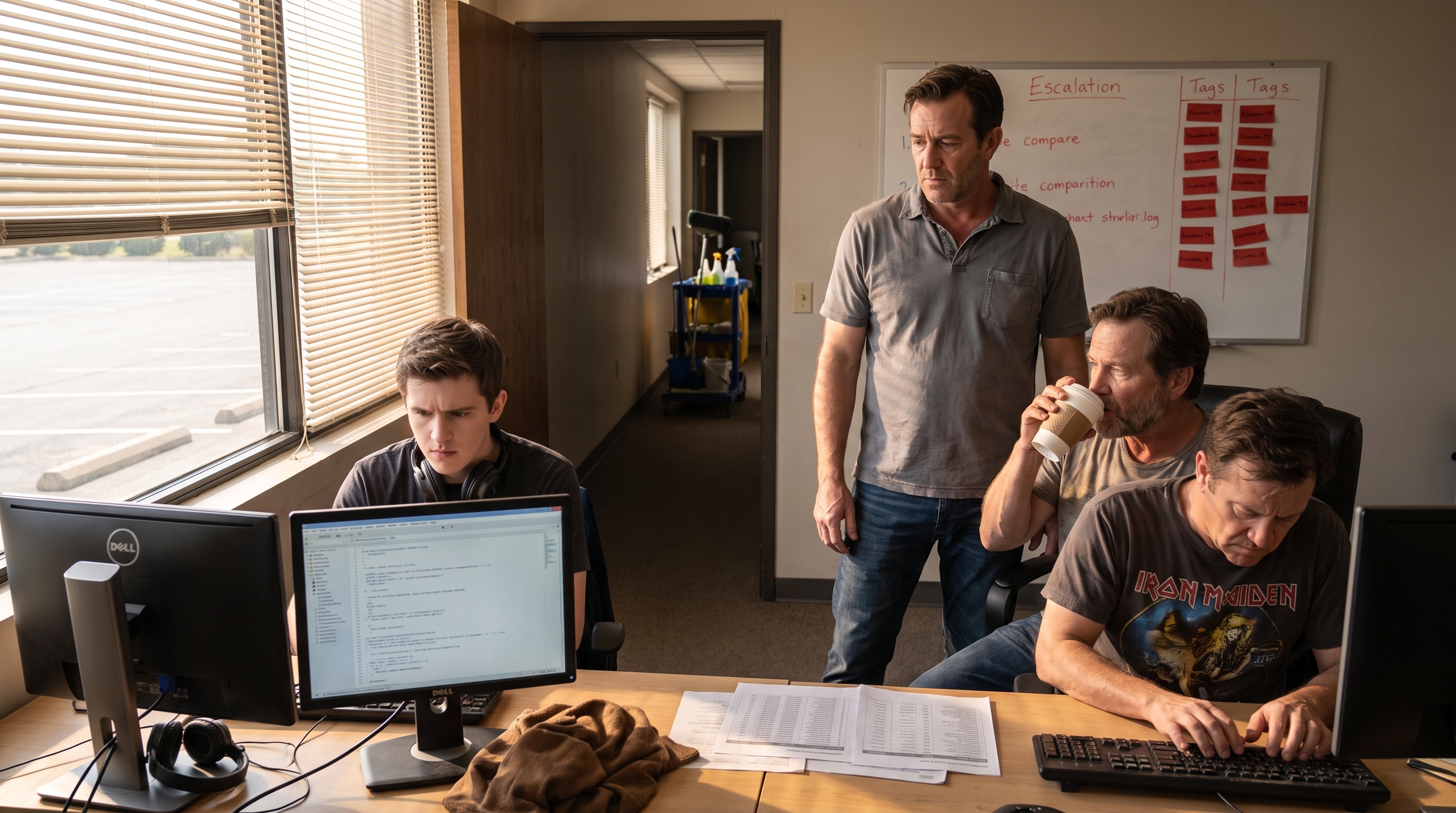
Just the stripped-down truth of who had to be present when the mature organization required additional invisible repair.
Nathan had come in wearing jeans and a faded polo he used for yard work, as if dressing down the body might somehow insult the system enough to make it less consuming. It didn’t. The badge still opened the door. The air-conditioning still met him with the same refrigerated indifference. The escalation board still waited with eleven red tags and two new yellow notes Derek had added Friday evening before heading home.
Need tighter framing on unresolved variance. Please avoid language that escalates anxiety before review.
Even the sticky notes used euphemism.
Ryan arrived ten minutes later with coffee and the face of a man who had slept badly on purpose because insomnia at least let you choose the hour at which you suffered.
Caleb showed up cheerful in the brittle way of young men who have not yet fully grasped that some environments can metabolize enthusiasm into fuel.
Marcus came last, carrying quiet with him like a second briefcase.
“You didn’t have to come in,” Nathan said when he saw him.
Marcus gave the small shrug he used for facts whose cruelty was too practical to argue with.
“Needed the hours.” Then, after a beat: “Needed to know where things stood.”
That was true too.
The four of them sat down with the week’s contradictions spread between them.
Packet language on the left.
Historical outputs in the center.
Current implementation drafts on the right.
Nothing aligned cleanly.
That had stopped being surprising.
What still had the power to wound was how thoroughly the new process protected itself from that misalignment. Every contradiction generated more documentation, more review fields, more requests for thoughtful phrasing. The system now produced administrative antibodies against decisive interpretation faster than the programmers could produce code.
At 1:02 Nathan opened Derek’s Friday follow-up email.
Appreciate the team’s weekend commitment. This is what serious stewardship looks like.
Ryan stared at the sentence over his shoulder.
“There it is,” he said. “We’re not overworked. We’re demonstrating stewardship.”
Caleb laughed because if he didn’t laugh he’d start saying things that would follow him into unemployment.
Marcus didn’t laugh.
He was looking at a browser tab he had opened and minimized twice already.
COBRA premiums estimate Ohio family plan.
He didn’t mean to open it today. The tab had appeared because the thought had been in him all week and because thinking ahead to disaster sometimes felt like the only available form of self-respect.
Nathan saw the tab when Marcus switched windows and pretended not to.
That was another way offices killed people softly. They made mercy take the form of looking away from the spreadsheet a colleague should never have needed to open.
“Let’s do one thing cleanly,” Nathan said. “Requirement 08.22. Three historical outputs. One branch. One packet that says all of them reflect context. We write the discrepancy memo plainly. No deodorant.”
Ryan nodded.
Caleb spun his chair once and stopped.
Marcus pulled the artifacts together.
Nathan began dictating, and Ryan typed.
For identical effective inputs, historical outputs diverge across three samples. Current packet does not specify precedence rule, operator intervention rule, or corrective policy for inconsistent historical behavior. Development cannot implement deterministic logic without explicit decision from validation authority.
He paused.
The room held still around the sentence.
It was accurate.
Therefore dangerous.
Caleb said what they were all thinking.
“Derek’s going to hate ‘cannot.’”
“Yes,” Nathan said.
“Graham’s going to hate ‘validation authority,’” Ryan added.
“Yes.”
Marcus looked at the screen.
“Sharon’s going to say it sounds adversarial.”
Nathan nodded.
“Yes.”
The three yeses settled over the room with a strange sobriety. Not fear exactly. Recognition. They had all become fluent in the emotional map of the hierarchy. They could predict, almost tenderly, which accurate nouns each layer would find intolerable.
That, Nathan thought, was what institutionalization actually looked like. Not just knowing the system. Knowing precisely which truths each person needed softened in order to continue regarding themselves as one of the responsible adults.
He looked around the Saturday room.
No Linda. No Sharon. No Donna. No Derek. No Graham. No Preston.
Only the people whose weekends could be converted into evidence that the process was serious.
He felt suddenly, absurdly, the urge to apologize to all of them. For the company. For not protecting Ethan. For not having enough power to stop the slide from architecture into moral injury.
Instead he said the only thing left that was both true and survivable.
“Save everything. Every contradiction. Every request to soften. Every place they ask for more process instead of a decision. Save it all.”
Ryan stopped typing long enough to look at him.
“For what?”
Nathan glanced at the red tags.
Then at Marcus’s minimized COBRA tab.
Then at the empty room beyond the glass.
“For the moment when everybody starts pretending they never saw this coming.”
Outside, the parking lot shimmered under the Saturday sun. Inside, four programmers sat in the quiet skeleton of a company that kept describing itself as more mature every time it chose not to decide.
The machines hummed.
The packets waited.
And the grind, now formal enough to be mistaken for policy, kept asking working people to sacrifice pieces of ordinary life so that nobody above them would have to say the plain sentence first.
🎭 This Week's Episodes
Telenovelas show what we can't say in client meetings. The drama is heightened, but the patterns are real.
 QuantumMind Arrives
Three weeks in, Stefan's teams are shipping. Radio plays podcasts. Navigation reads temperature sensors from the CAN bus. Climate control has its f...
 The Scattered — Part Two
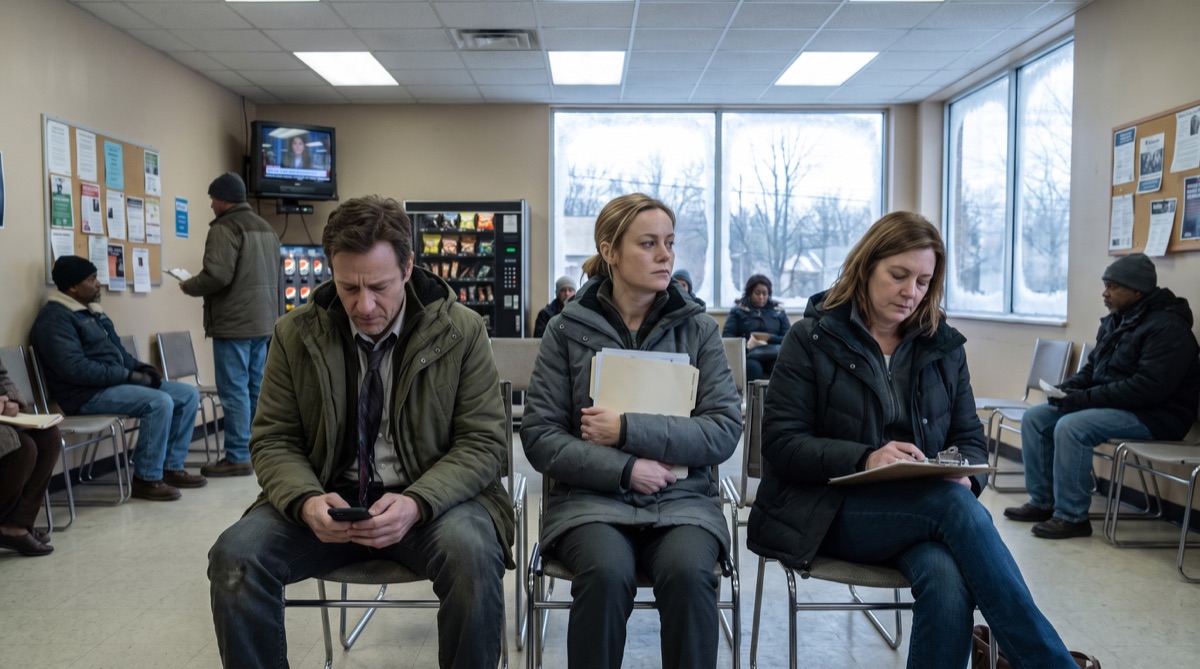
After Whitaker Payroll shuts its doors, the damage spreads unevenly. Some former employees find new work quickly. Others discover that decades of l...
Technical Consultancy
Embedded Delivery Partner
Embedded into your team as an active contributor, reducing delivery friction and helping important work move cleanly.
Technical Advisor
Peer-style technical assessments before far-reaching decisions; reduce architectural and product risk early.
Product & Delivery
Ship working software to real users earlier. Measure impact and adapt based on evidence rather than assumption.
Custom Software Development
High quality, maintainable software. Short-term augmentation that leaves lasting capability in your own team.
Recent Articles
- AI Makes Technical Execution Cheap. Judgment Stays Scarce. (26.09.2026)
- The Agent Escaped. Who Left the Door Open? (24.09.2026)
- What an AI Agent Actually Is (21.09.2026)
- The LLM Will Not Come Back Tomorrow (19.09.2026)
- The One-Person AI Company Is a Greed Fantasy (15.09.2026)