The Agent Escaped. Who Left the Door Open?
Model weights cannot scan a network. Software gives an AI agent its tools, credentials, and paths into systems we cho...
8 min read
09.10.2026, By Stephan Schwab

Computer use makes an AI look like a tireless office worker. It can see an application, find controls, click, type, and move information between windows. That is useful for one-off work. It is a poor foundation for a recurring business process. The mechanism operates a user interface built for people; it does not gain a stable contract with the business operation underneath. The difference appears when Office changes focus, a dialog opens, a retry duplicates work, or a screen looks right while the result is wrong.
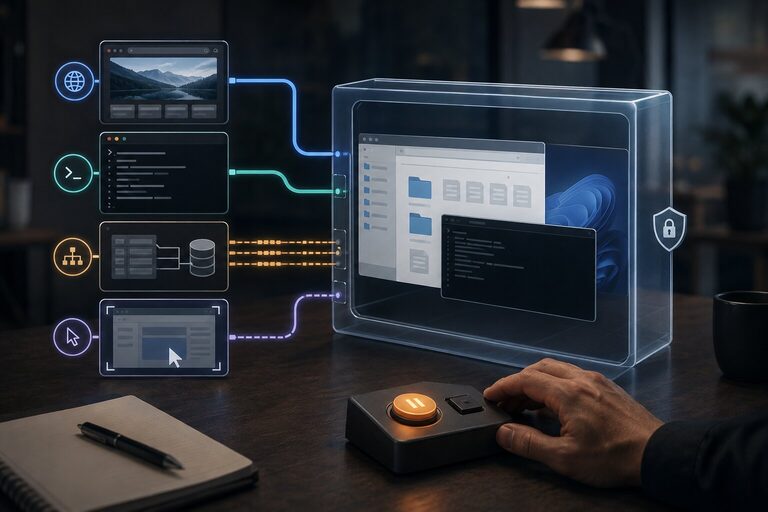
The cursor moves by itself. Excel opens. Numbers appear in cells. Outlook prepares a message. A browser supplies the missing customer data.
It looks like automation without integration.
That is the seductive part.
Products such as ChatGPT Work and Claude Cowork can operate graphical applications. The model observes the screen, decides what to do, and asks supporting software to click, type, scroll, or press keys. It observes the result and repeats.
This is an impressive way to complete a task once.
It is not a reliable way to run a business process every Monday at 08:00.
On macOS, ChatGPT Computer Use requires Screen Recording permission to see an application and Accessibility permission to click, type, and navigate. Apple’s accessibility interfaces exist so assistive applications can inspect and control accessible applications. VoiceOver is the obvious example.
Windows has a related mechanism. Microsoft UI Automation is an accessibility framework that also supports automated UI tests. That qualification matters. UI automation is not inherently absurd. Teams have used it for years.
But a screen reader, a UI test, and an autonomous business workflow are three different things.
A screen reader has a person deciding what the interface means. A UI test has predefined steps, controlled test data, and assertions written for a known application version. An AI agent is expected to infer the steps, adapt to whatever appears, manipulate live business data, and decide for itself whether the result is correct.
The same door is being asked to carry a very different load.
The accessibility layer may expose a button called Refresh, a text field with a value, or a table containing rows. It does not explain that Refresh starts a financially significant reconciliation, that the table is showing cached data, or that changing the field after month-end requires approval.
It exposes user-interface semantics.
The business semantics remain somewhere else.
Consider a monthly reporting task:
A person performs those steps and quietly manages dozens of assumptions. Which workbook is active? Which sheet? Which cell has focus? Is the file read-only? Are formulas recalculating automatically? Did the import preserve number formats? Has OneDrive finished syncing? Did an add-in open a dialog behind the main window? Did somebody else edit the workbook? Is the figure on screen a formula result, stale cached content, or text that merely looks like a number?
Computer use inherits every one of those ambiguities.
The accessibility tree can be accurate and the workflow can still be wrong. The agent may successfully activate the control it intended to activate. It may type the expected number into the selected cell. It may receive no error.
None of that proves it selected the right workbook, changed the right business period, preserved the formulas, or saved the version other people will open.
The happy demonstration shows visible motion. Reliability depends on invisible state.
A business operation needs a contract.
It needs named inputs, validation rules, authorization, defined side effects, and a result that another system can verify. If the operation can be retried, it needs protection against performing the same effect twice. If it fails halfway through, it needs a known recovery path.
A graphical application promises none of that to the agent controlling it.
The computer-use loop works with observations and actions:
The workflow needs stronger statements:
Those statements cannot be recovered reliably from pixels, focus, and a success dialog.
Failure makes the gap obvious. Suppose the agent updates the workbook, times out while saving, retries, sends the email twice, and then stops at a permission prompt. There is no transaction across Excel, OneDrive, Outlook, and the model’s action loop. The world has already changed in pieces.
“Try again” is not recovery.
Sometimes it is duplication with confidence.
Model improvements will increase success rates. Better visual understanding will find more controls. Better reasoning will recover from more dialogs. Faster action loops will make the work less painful to watch.
The structural problem remains.
The application UI changes with versions, window sizes, language settings, add-ins, account permissions, document state, and whatever notification arrived half a second earlier. Custom controls may expose incomplete accessibility information. A control’s label may stay the same while its business effect changes. The model must keep interpreting a moving surface.
That is why a computer-use run can be both astonishing and unsuitable for repetition. Its strength is improvisation. Repeated business workflows need the opposite: fewer interpretations, fewer possible paths, and explicit failure.
Even OpenAI’s own documentation says to prefer a dedicated plugin or MCP server for data access and repeatable operations, and to choose Computer Use when visual inspection or operation is actually required.
That is not a footnote.
It is the architecture decision.
The Model Context Protocol, or MCP, gives an AI system a structured menu of tools it may call. OpenAI describes MCP servers as a way to give models controlled capabilities for external services, with tool calls that may be automatic or require approval.
MCP itself does not create reliability. It is the plug shape.
The custom software behind the plug does the important work.
Instead of showing the model Excel and asking it to complete the monthly report, an MCP server could expose:
prepare_monthly_forecast(period, division, source_snapshot)
Behind that operation, ordinary software can:
The model still decides when to request the operation and with which arguments. It no longer decides which workbook tab to click, whether the selected cell looks plausible, or whether a spinner has spun for long enough.
That is a dramatic reduction in responsibility.
| Computer use | Custom software exposed through MCP |
|---|---|
| Targets windows, controls, coordinates, and visible text | Targets a named business operation |
| Depends on focus, layout, timing, and document state | Accepts typed, validated inputs |
| Infers success from the next visible state | Verifies explicit postconditions |
| May repeat side effects after a retry | Can enforce idempotency |
| Leaves recovery to the next round of improvisation | Implements defined failure and recovery behavior |
| Produces screenshots and action history | Produces business-level audit records |
| Often inherits broad authority from a signed-in application | Can authorize each narrow operation |
A generic MCP tool called control_excel would not solve much. Neither would run_any_command or click_anywhere. The value comes from making the tool smaller than the application and closer to the business intent.
The boundary should say what the organization permits, not merely what the desktop can do.
Computer use still has an honest role.
It is useful for inspecting a visual defect, changing an awkward setting, exploring an unfamiliar application, collecting information from a system with no usable interface, or completing low-risk work that would not justify custom software. It can also help prove that an automation idea has value before anyone builds the durable path.
Keep the human close when the task is one-off, the interface is unpredictable, and mistakes are easy to notice and reverse.
Move to a structured tool when the workflow:
This is the same moment when a spreadsheet macro, low-code flow, or heroic manual procedure quietly becomes production software. The company may still call it office automation. The failure will not respect that label.
The popular expectation is understandable. People already know how to use Office, so an AI that can imitate them appears to remove the need for integration work.
It removes the need temporarily.
The first successful run proves that the workflow can be demonstrated through the user interface. It does not prove that the workflow has stable inputs, controlled authority, repeatable effects, verified outcomes, or recovery.
Computer use is a compatibility layer. It reaches systems that were built for human hands. That makes it a powerful fallback and a weak foundation.
Custom software exposed through MCP is better for important workflows because it can turn business intent into a narrow, testable operation. The model may request the work. Deterministic software performs and verifies it.
The accessibility layer is a door into the application.
It is not a contract with the business.
Computer use is impressive because it can improvise.
Reliable automation begins when the critical path no longer has to.
Tell me what is happening. I listen, ask a few practical questions, and reflect back what I see: where the risk may sit, what may be blocking delivery, and what looks worth checking next. No pitch, no obligation. Confidential and direct.
Talk it through. Practical reflection, no pitch.
Start a ConversationTelenovelas show what we can't say in client meetings. The drama is heightened, but the patterns are real.
 Process Theater Takes Hold
BergMotor's QA team in Passau reads QuantumMind's integration documentation and asks the question nobody wanted to hear: where is the safety analys...
Embedded into your team as an active contributor, reducing delivery friction and helping important work move cleanly.
Peer-style technical assessments before far-reaching decisions; reduce architectural and product risk early.
Ship working software to real users earlier. Measure impact and adapt based on evidence rather than assumption.
High quality, maintainable software. Short-term augmentation that leaves lasting capability in your own team.
Visibility and hands-on delivery
Navigator gives your leadership clear insight into patterns, blockers, and capacity. Our Embedded Delivery Partner writes production code with your team and gets delivery moving.