Where Roads Give Up
Mateo announces a drive into the forest. Nobody asks where or for how long. The road becomes a track, the track becomes mud, and the mud becomes a waterfall. On the ride back they encounter Emberá fishermen on the creek — two men and a dugout canoe moving through the forest like something from a world Sophie didn't know existed. That evening she tries to describe all of it and writes, in her notebook: *more layers than I can see at once.*
Mateo says vamos and that is the entire itinerary. The road runs out. Sophie jumps anyway.
Vamos
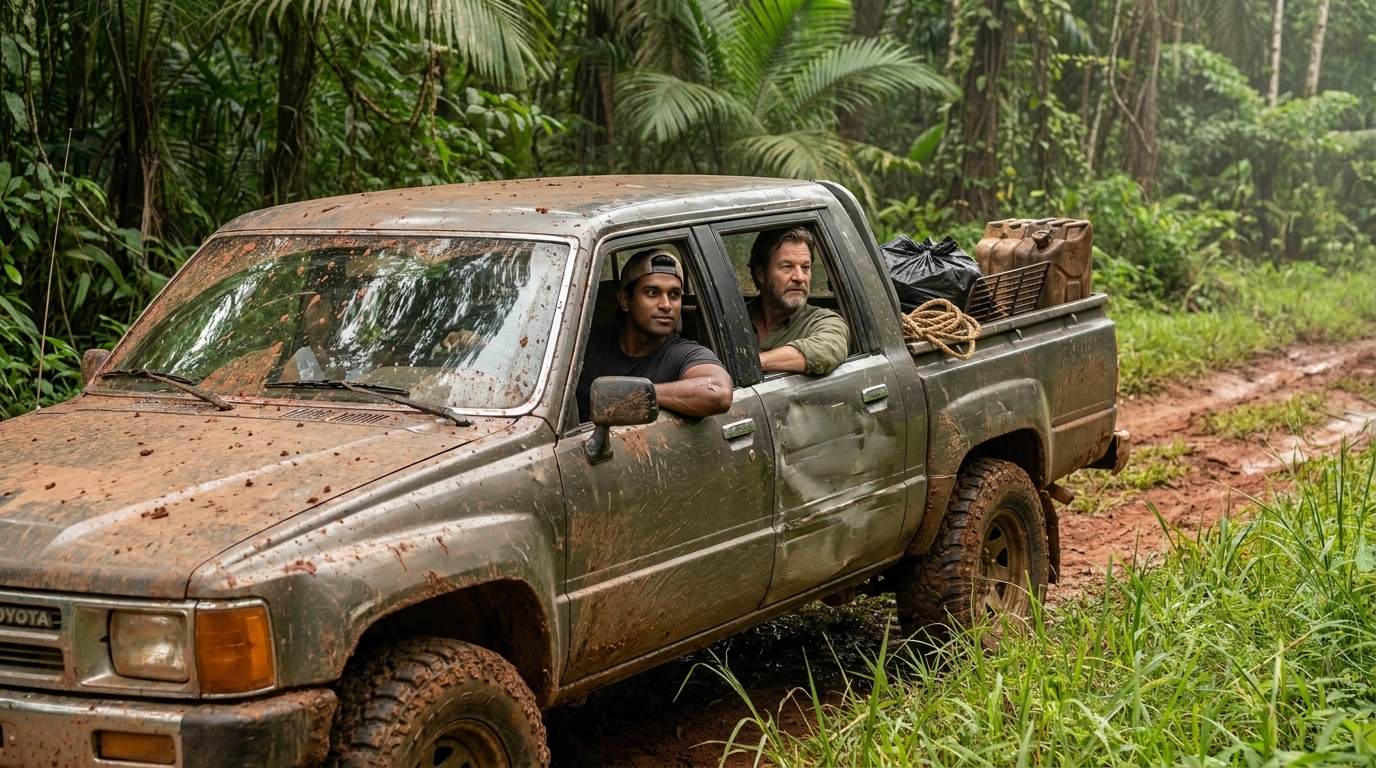
Mateo arrived at the finca on a Saturday morning in the middle of breakfast, walked through the front door without knocking, poured himself a coffee, and said: “Vamos.”
That was the itinerary.
“Where?” I asked.
He made a gesture with the coffee cup that meant: does it matter.
Papa looked at Valentina. Valentina was already rinsing her plate. “Get a change of clothes,” she said to me. “And water. Two liters minimum.”
“What shoes?” I asked.
“Ones you don’t care about.”
I looked at my worn Converse. They were the only shoes I had. “Okay,” I said.
Mateo’s truck was parked half on the road, half on the grass, engine running. It looked exactly like what it was: a vehicle that had been driven hard through things vehicles aren’t supposed to go through. There were dents on the passenger side that corresponded to no visible accident. The truck bed held, among other things: two extra fuel canisters, a coil of rope, a cast-iron grill grate wrapped in a trash bag, and a machete whose handle was held together with electrical tape. This was not reassuring. This was also, I was learning, what preparedness looked like in this country.
Papa took the passenger seat. Valentina and I climbed in the back. There were no seatbelts in the back. I did not mention this.
“How far?” Papa asked.
Mateo considered this with genuine thought, as if the question were philosophical. “Depends on the mud.”
We left.
What the Road Becomes
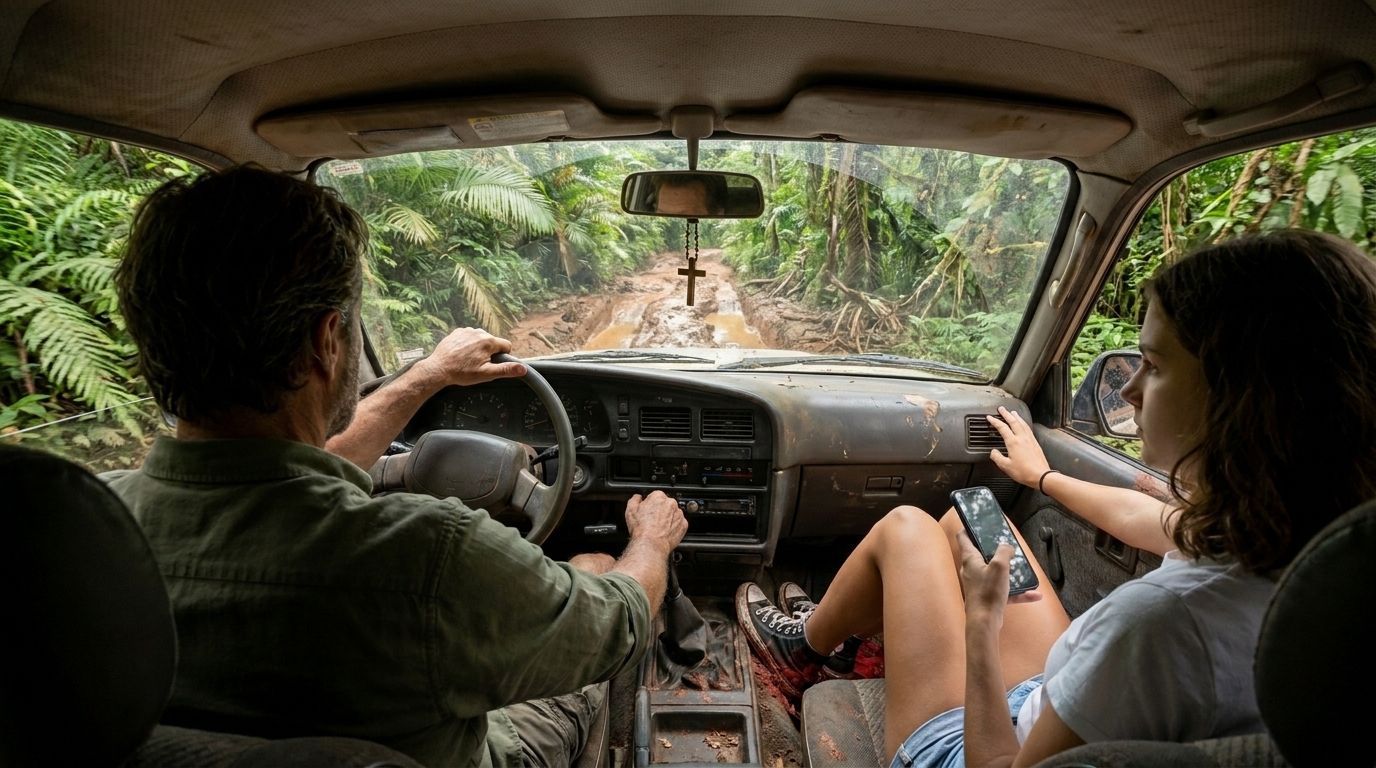
The road started as pavement, which lasted about ten minutes. Then it became packed gravel. Then it became a dirt track. Then it became something that the word “track” flatters.
The jungle forest did not gradually close in — it closed in all at once, the way things happen here. One moment we had roadside and sky. The next: green walls from door to door, canopy overhead, light coming through at angles that made it feel like late afternoon even at nine in the morning. Ferns the size of my torso. Roots crossing the track like the knuckles of a buried hand.
The truck bounced. Heavily and continuously. My teeth clicked together. My head hit the roof once. Valentina, beside me, was reading something on her phone with the calm of a person on the U2 heading to Alexanderplatz.
“Does this get worse?” I asked her.
She looked up. “A little.”
Mateo was humming. Something I recognized as cumbia but played too fast, or maybe the road was playing it that way. He drove with the precise, unhurried attention of someone who has done this particular calculation a thousand times: this rut, take it at this angle, that root, slow to twenty, that mud, full speed or you lose momentum. His hands were relaxed on the wheel. One thumb tapping the rhythm of the song.
A howler monkey screamed from somewhere in the canopy. I could not see it. It screamed again. Mateo did not look up.
“Howler?” I said.
“Mono aullador,” Mateo confirmed. “They’re always angry. It’s not about you.”
Papa turned in his seat to look at me. Checking. I gave him a thumbs-up. He turned back.
We crossed a river. The water rose to the doors. Mateo didn’t slow down — he maintained momentum, the truck cutting a bow wave, brown water sloshing against the windows. On the far bank, the track continued as if rivers were just a feature of roads and not a reason to stop.
“That was fine,” I said, not entirely believing it.
“That was the small one,” Valentina said, without looking up from her phone.
The Waterfall
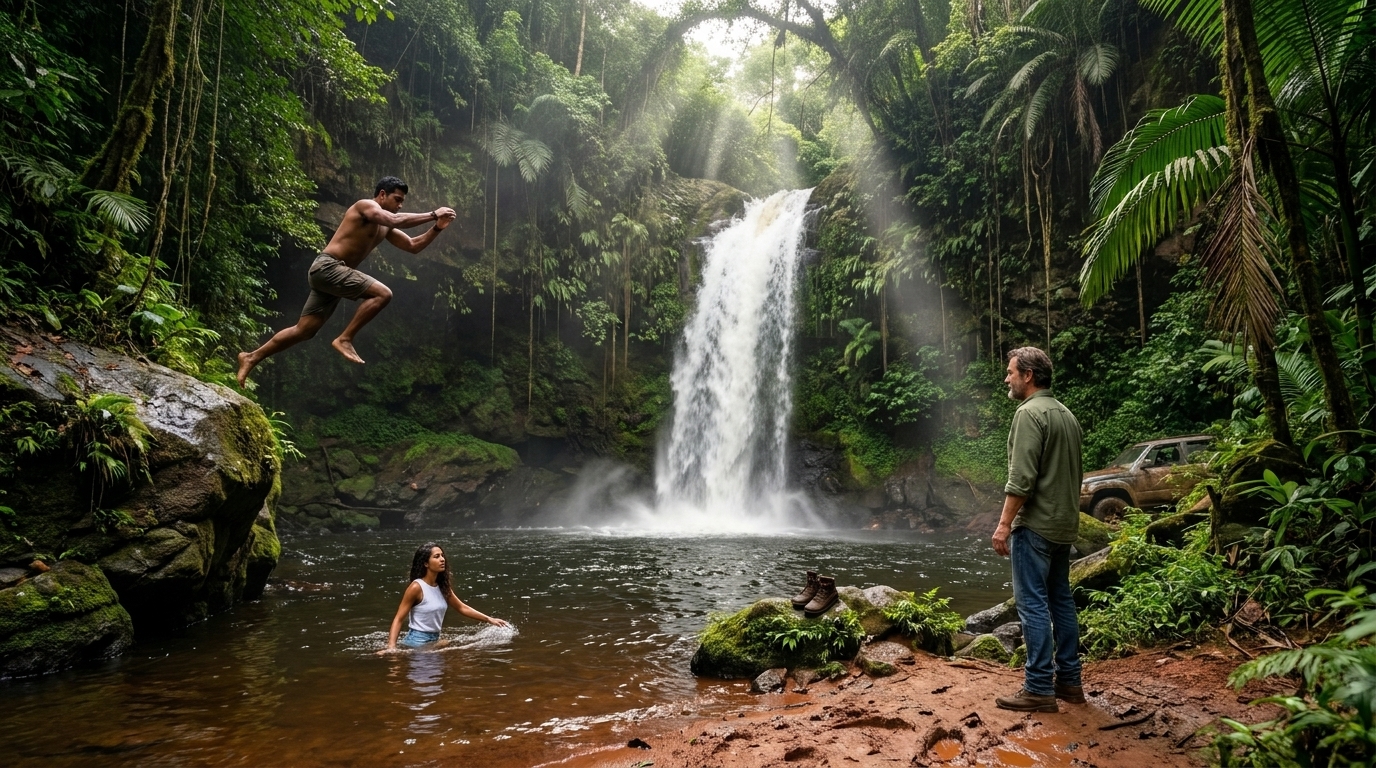
The clearing appeared without warning. The track ended at a flat space between trees and there was the waterfall — I heard it before I saw it, a deep continuous roar underneath the truck noise. Then Mateo cut the engine and the roar filled everything.
It was not a tourist waterfall. There was no sign, no parking lot, no railing, no laminated safety notice. There was a vertical drop of maybe ten meters into a pool the color of black tea, surrounded on all sides by moss and fern and rock worn smooth by water. The pool was dark. I could not see the bottom. The falls threw spray that hit my face from ten meters away.
Mateo was already out of the truck pulling his shirt over his head.
He climbed to a ledge partway up the rock, stood there for a half-second in the practiced way of someone who has done this before and is not afraid of it, and jumped. The water took him. He surfaced immediately, shaking his head, laughing.
“Is it cold?” I called.
“Completely,” he said. He did not sound bothered.
Valentina had already removed her boots and was wading in at the edge. She went under without drama, surfaced, and started swimming with the efficiency of a person for whom this is normal.
Papa stood at the edge with his hands in his pockets looking at the water. He looked at me. “You don’t have to,” he said.
This is the thing he says when he thinks I might want to but am afraid to. He has learned, in three weeks, exactly when to say it.
I didn’t have anything to say back. I was standing at the edge of a pool I couldn’t see the bottom of in a jungle in Panama with my worn Converse already ruined by the mud and it was either: jump, or watch three people swim while I stood on the bank being careful.
I jumped.
The cold was not temperature. It was a physical event. It hit my chest like a fist, drove the air out of my lungs, seized every muscle I had. I went under and the dark water closed over me and for one half-second I was in a place that was entirely not Berlin, not Wilmersdorf, not the hallway outside any hospital, not anywhere I had ever been.
I surfaced.
I screamed. Not from fear — from the pure involuntary shock of it.
Mateo cheered. Valentina laughed. Papa, still standing on the bank, had his hand over his mouth. He was hiding a smile. I could tell.
“Again,” I said.
Mateo showed me the ledge.
I climbed up. It was higher from up here than it had looked from below. The water was very far down. The ledge was wet and not quite wide enough.
I jumped again. This time I went in feet-first and straight and the cold was a friend rather than an ambush. I stayed under a moment longer. Felt the weight of the water over me. Felt my body working — real work, not gym-class work, not the supervised work of physio appointments, but the work of a body that has jumped into a jungle waterfall and is swimming back to the surface in the dark.
I surfaced and looked up at the circle of sky through the canopy.
I thought: I am going to remember this one.
On the Way Back
We drove back on a different track — longer, Mateo said, but better after rain — that followed a creek through the forest. The light was lower now, afternoon turning the canopy amber at the tips. Everything dripped. I was dry in my clothes but my hair was still wet and I had mud in my shoes and I had never felt better in my life.
Mateo slowed the truck.
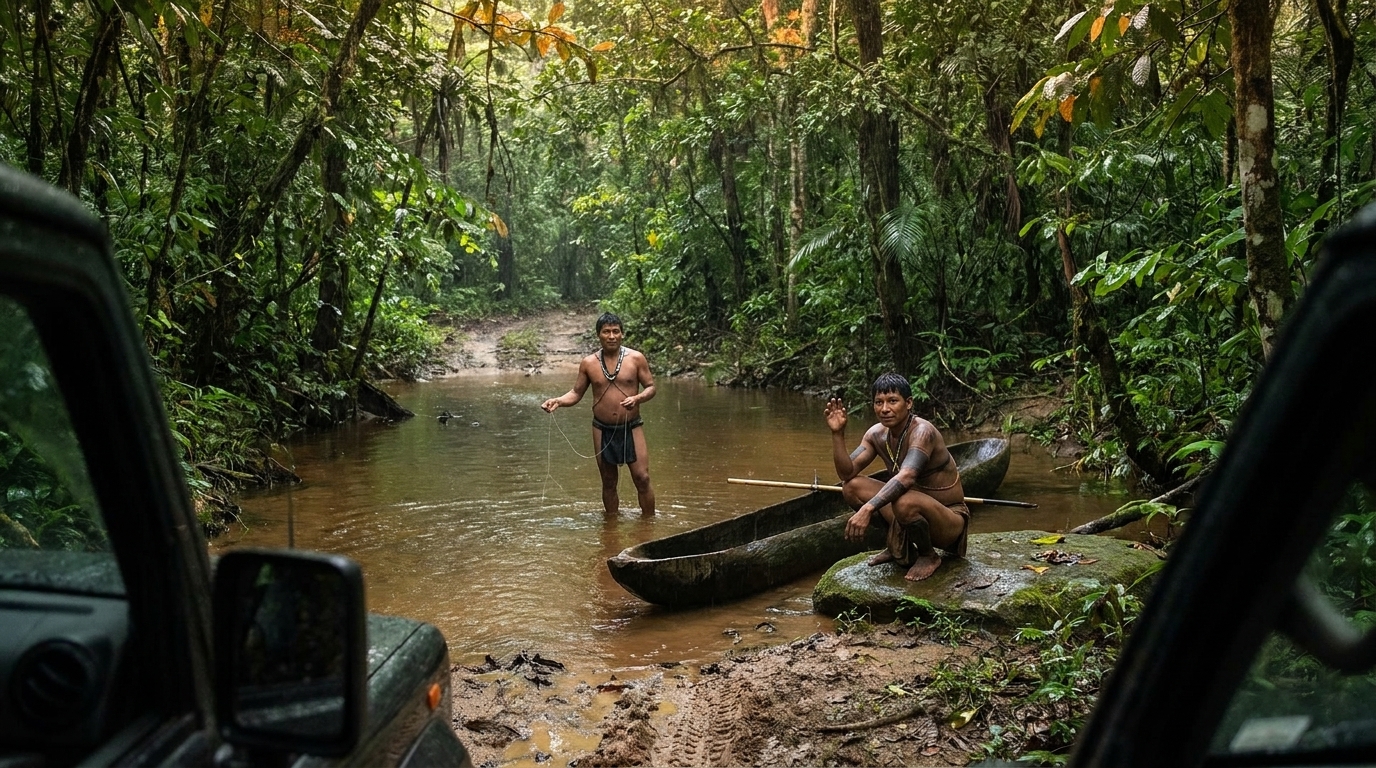
There were two men on the creek bank. One was standing knee-deep in the water with a fishing line loose in his hand, unhurried about it. The other was crouched on a flat rock beside a dugout canoe — long, narrow, the wood dark with water, a pole laid across it. They had the look of people who were exactly where they intended to be.
One of them looked up as the truck slowed. He and Mateo exchanged a raised hand — not a wave exactly, more like an acknowledgment. Mateo said something out the window in Spanish. The man answered. Mateo laughed quietly at something. They spoke briefly. Then Mateo drove on slowly, giving them the track.
Through the rear window I watched them for as long as I could see them.
The man standing in the creek — I registered what he was wearing before I registered anything else. Not clothes. A loincloth. Just that, and bare skin from the waist up, standing knee-deep in a forest creek in the middle of Panama as if this were an entirely ordinary thing, which for him it obviously was. I had grown up in Wilmersdorf. I had never in my life seen a person dressed like that outside of a museum or a textbook photograph. And here was a real person, in actual water, with a fishing line, completely unbothered.
The man crouching by the canoe was the same. Bare-chested, dark geometric markings covering his forearms and part of his chest — lines and shapes I could see even from the truck window, as precise as if drawn with a fine brush. Not a tattoo. Something else. Applied. Deliberate.
I did not look away. I also did not know where to put my eyes. Then I thought: they are fishing. They are not performing anything. Look at them the way you’d look at anyone doing something competent in their own environment. So I did.
They did not look like Yariela. They did not look like the people in the market in Chepo or the men I’d seen in town. Something in the features, the build, the whole way they occupied the creek bank — different, entirely, from everything I had seen in Panama up to this moment. I had not understood until now that “indigenous Panama” was not one thing.
“Who were they?” I asked.
“Emberá,” Valentina said. From the front, Mateo nodded. “They fish this creek in August. The fishing is good after the rains push the fish down from the upper part.”
“The marks on his arm,” I said.
“Jagua.” Valentina half-turned toward me. “From the jagua fruit. The juice is colorless when it goes on, then it turns blue-black on the skin over a day or two. It lasts a few weeks. The patterns are — they’re not random. They mean things. Geometric. Traditional designs.”
I thought about that. A dye that appears after. Color that develops in the dark.
“They’re not from here?” I meant: not from near Chepo.
“The Emberá are from the east. The Darién, mostly — the rivers, the deep forest. Some live closer to Panama City. This area is the edge of where you start to find them.” She paused. “Very different people from the Ngäbe. Different language, different everything. You saw Yariela’s dress. The Emberá don’t dress like that. The women wear — a short wrapped skirt, bright colors, and a lot of beaded jewelry. Not a nagua. Their whole aesthetic is different.” She thought for a moment. “Their craft is baskets. Woven tagua fiber. You can find them selling on the Cinta Costera in the city — the baskets are extraordinary, geometric, like the jagua patterns. And they make wooden animals from cocobolo wood. But here, on this creek in August, they’re just fishing.”
I looked out the back window again. They were gone — the track had curved. Just the forest and the creek and the green light.
I didn’t try to photograph them. I noticed myself not trying to photograph them. This felt like the right decision and also like something I would not have thought to decide a month ago.
I got out my notebook instead and wrote: jagua. color appears after. lasts a few weeks. geometric.
Mateo, from the front: “What are you writing?”
“Things,” I said.
He nodded, apparently satisfied with this.
What I Understand
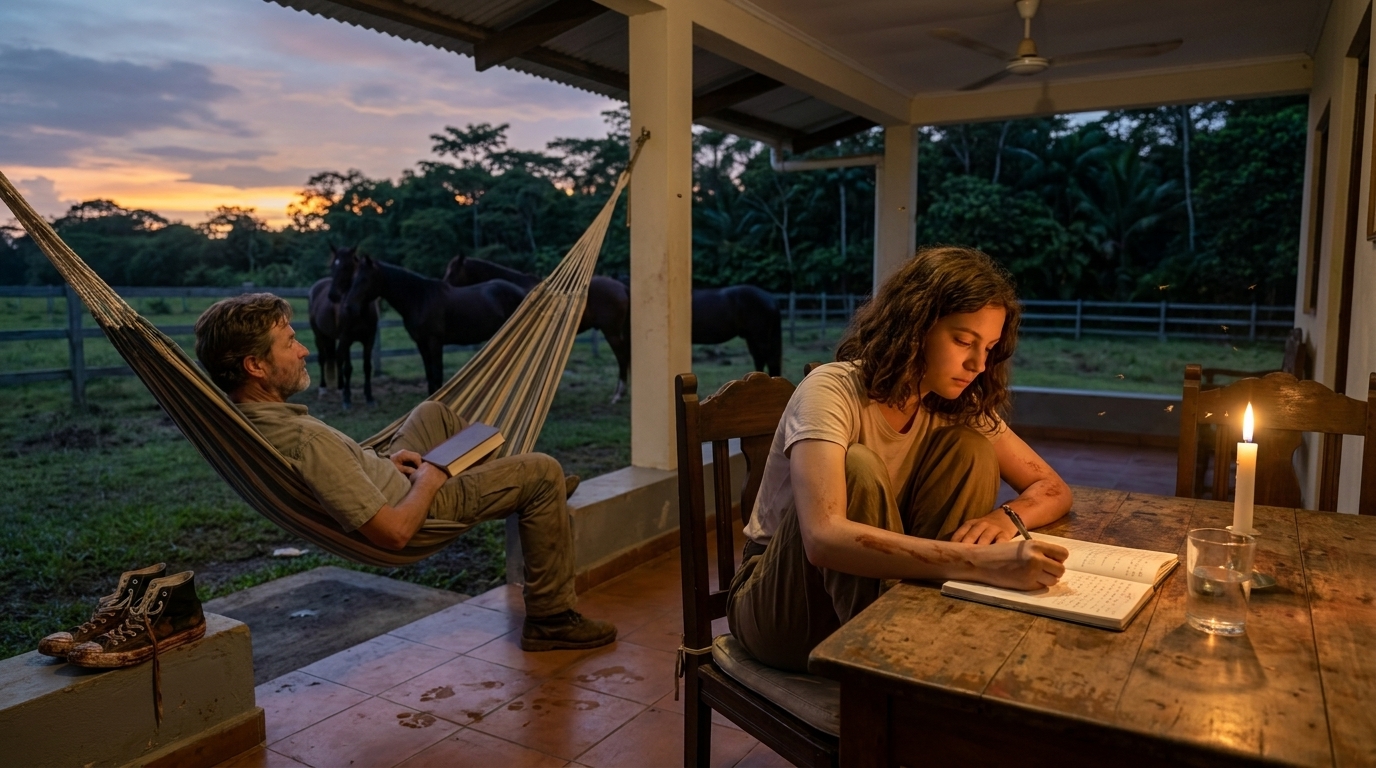
We got back to the finca as the light was going. I showered. I ate what Rosa had left — rice, black beans, sliced tomatoes with lime, a plate of hojaldras. I ate on the terrace because the inside of the house felt small after the day.
Papa was in the hammock. He had a book on his chest but he wasn’t reading it. He was looking at the horses in the pasture. They were doing what they do at dusk: standing in a loose group near the far fence, not moving much, one of them — Reina, I knew her now — occasionally shifting her weight from hoof to hoof.
I opened my notebook.
I tried to write what the day had been. The road. The river crossing. The waterfall — the cold, the ledge, the second jump. The Emberá men on the creek with the dugout canoe. Valentina explaining the jagua.
I kept coming back to the jagua. The idea of a dye you can’t see going on. It looks like nothing — water on skin. And then it develops, slowly, over a day, into something that was always there waiting.
I had been in Panama for twelve days. Things were developing in me the same way. I couldn’t see them going in. But I could look at the last twelve days and see: something is there that was not there before.
I don’t know how to name it cleanly. I know I am not the same person who stepped off the plane in a denim jacket with her earbuds in, already defending against Panama by cataloguing everything that was unfamiliar and therefore suspicious.
The things I had now that I didn’t have then: the knowledge of how a horse breathes when it trusts you. The knowledge of how to let a road get worse and not panic. The knowledge of who Valentina Sánchez is — someone who is twenty-three and fully herself in a way that does not look like effort, which is something I have not managed at sixteen and now have a model for. The knowledge of who my father is, which is not the same as knowing someone from phone calls and holiday weeks. The waterfall. The waterfall twice.
I wrote in the notebook: Panama is more layers than I can see at once.
I looked at that for a while. It was not a sophisticated observation for someone who wants to study computer science. It would not impress anyone. But it was true in a way that felt like I had earned it: by riding into the forest, by jumping when I was afraid, by watching two men on a creek bank in a country I didn’t know three weeks ago.
Papa turned in the hammock. “How are your feet?”
“Okay,” I said.
“Mud in the boots?”
“Shoes. Yes.” I pulled them off and held them. They were wet through, heavy, the canvas dark with creek mud and waterfall spray. The sensible thing seemed obvious: leave them on the step to dry overnight. I set them down on the top step, toe-out, the way you’d leave muddy boots in Germany outside an apartment door.
Esteban appeared from around the corner of the house with a bucket and stopped. He looked at the shoes. Then he looked at me. Then he said something in Spanish, briefly and flatly.
I looked at Papa.
“He says don’t leave your shoes outside,” Papa said. He was already sitting up in the hammock. His voice had changed — not alarmed, but focused, the way it gets when something requires attention. “Not overnight. Not here.”
“Why?”
“Scorpions.”
A pause.
“Scorpions,” I said.
“There are two kinds you need to know.” He swung his legs off the hammock. “The brown one — Centruroides. Tan, maybe eight centimeters. Likes dry, dark spaces. Painful sting, bad day, you’ll live. The black one is different.” He said it without drama, which made it worse. “Black one is Tityus pachyurus. Bigger. It likes wet and warm. Wet shoes on a step outside in the rainforest at night — that is exactly what it is looking for. The sting can cause cardiac problems. Children have died.”
I looked at my shoes.
They were sitting on the step. Wet. Warm. In the dark.
“Were they — “
“Probably not. But that’s the point. Probably is not good enough.” He nodded at Esteban, who picked up the shoes by the heels, shook each one firmly over the ground — nothing fell out — and set them inside the doorway on the tile. Esteban looked at me once, not unkindly, and went back around the corner.
“You shake them before you put them on,” Papa said. “Every time. Not just after leaving them outside. Every time, even inside. They come in. Scorpions find their way in.”
“Every time,” I repeated.
“Every time. It becomes automatic. You’ll do it without thinking by the end of the week.”
I went back to the notebook. The candle on the table bent in a breath of wind and recovered. My shoes were just inside the door, on the tile, next to Papa’s boots. I looked at them for a moment. Then I wrote, underneath Panama is more layers than I can see at once: scorpions. brown one and black one. shake your shoes. every time.
The potoo screamed from the forest — I knew it now, didn’t startle anymore. The horses shifted at the far fence.
The day had been the best day of my life.
I didn’t write that. Some things you don’t write because writing them makes them smaller.
🎭 This Week's Episodes
Telenovelas show what we can't say in client meetings. The drama is heightened, but the patterns are real.
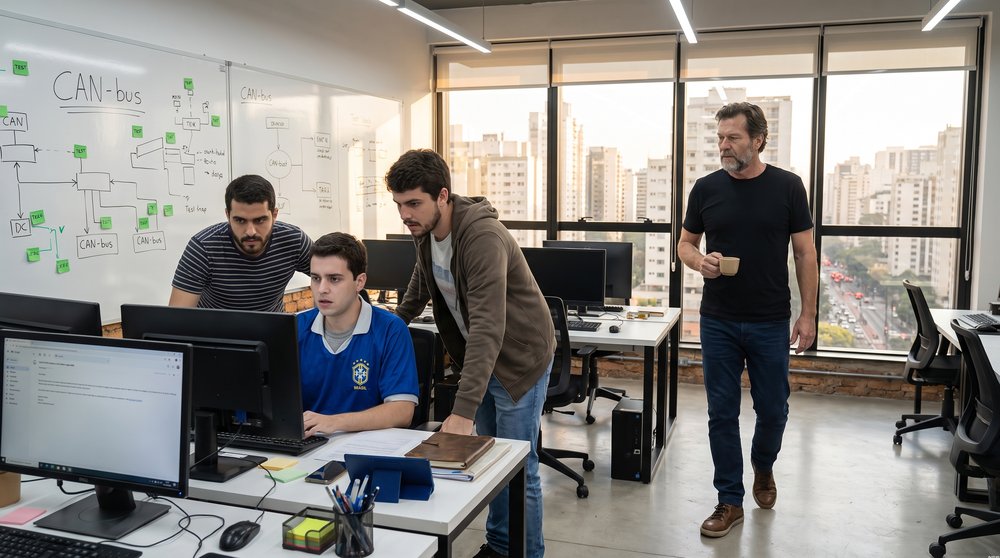 Process Theater Takes Hold
BergMotor's QA team in Passau reads QuantumMind's integration documentation and asks the question nobody wanted to hear: where is the safety analys...
Technical Consultancy
Embedded Delivery Partner
Embedded into your team as an active contributor, reducing delivery friction and helping important work move cleanly.
Technical Advisor
Peer-style technical assessments before far-reaching decisions; reduce architectural and product risk early.
Product & Delivery
Ship working software to real users earlier. Measure impact and adapt based on evidence rather than assumption.
Custom Software Development
High quality, maintainable software. Short-term augmentation that leaves lasting capability in your own team.
Recent Articles
- When Everything Is Finally Under Control (05.10.2026)
- AI Makes Technical Execution Cheap. Judgment Stays Scarce. (26.09.2026)
- The Agent Escaped. Who Left the Door Open? (24.09.2026)
- What an AI Agent Actually Is (21.09.2026)
- The LLM Will Not Come Back Tomorrow (19.09.2026)