Three Ways to Understand a Country
Stefan drives Sophie to the Pacific for two days. The beach is big enough to make her feel appropriately small. Back at the finca the rain keeps them in for three days running, and Sophie discovers that her father works the way she works — the same silence, the same occasional swearing, the same refusal to stop until something is right. Then Valentina arrives with an invitation: the festival at Las Tablas. Sophie sees a pollera for the first time and has no words for it.
Three things teach her something she couldn’t have read. The Pacific. Three days of rain. A dress.
The Pacific Is Not the Caribbean
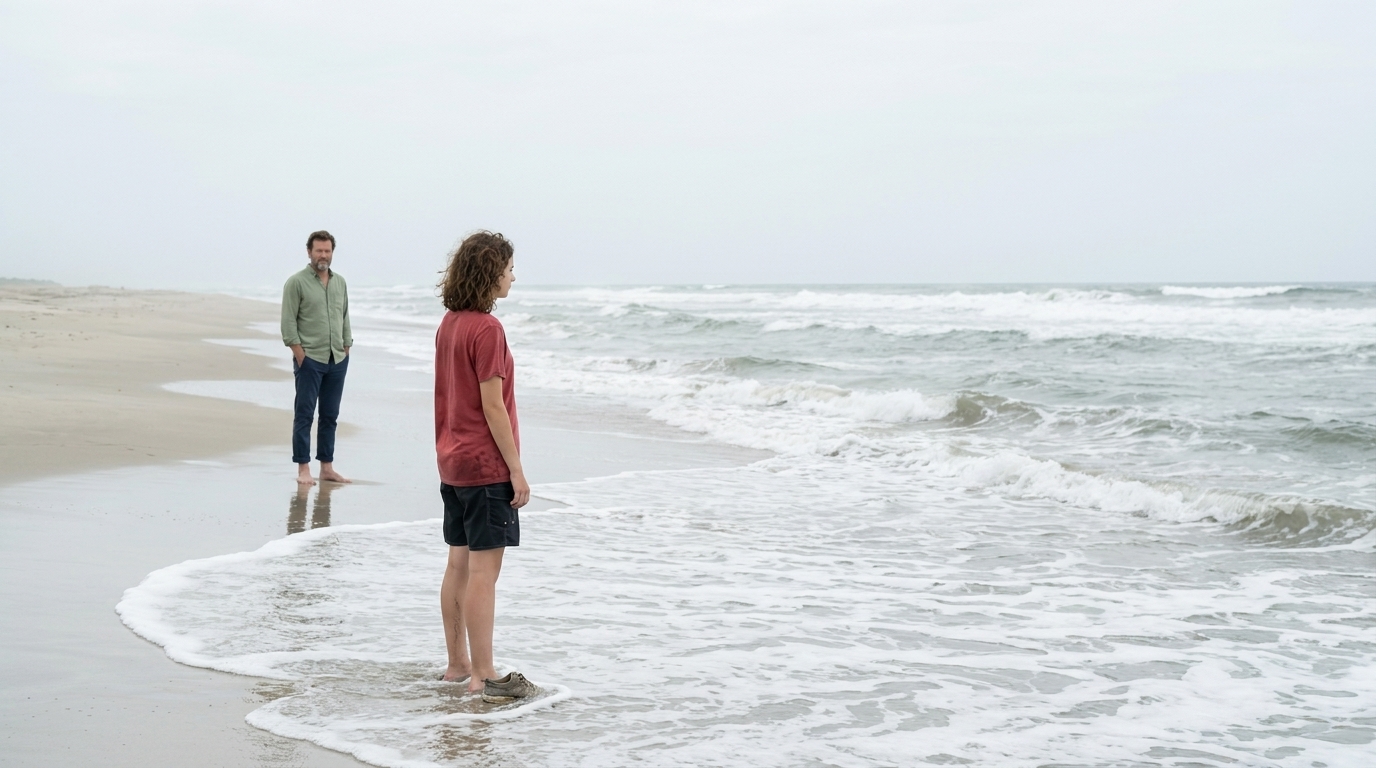
The Pacific is not the Caribbean.
I had not understood that there were two different oceans on either side of one country. Papa said it, back at the beginning, and I filed it the way you file things that don’t mean anything yet. Two oceans. Like a geography fact. Like something that would appear on a test.
I thought I had already understood what Panama’s water was. The finca river, the creek crossings, the waterfall — cold, fast, brown with tannins. Rain that falls with a decision behind it. I had catalogued all of that as: this is what tropical means. I had thought: okay. I have seen this now.
The Pacific has nothing to do with any of that.
The wave that hit me was not particularly large — maybe chest height — and it still put me face-down in the sand and took my left shoe. The undertow pulled in a different direction than I expected. I stood up, found the shoe ten meters to the right, and looked at Papa, who was watching from back up the beach with his hands in his pockets.
“The Pacific has a different personality,” he said.
“That’s an understatement.”
“I’ve been coming here for seven years. I still don’t turn my back on it.”
We stayed for two days. Papa had found a posada run by a woman named Señora Aquilina, four rooms around a courtyard with a mango tree and chickens, ten minutes from the beach. She fed us twice a day and ignored us completely the rest of the time, which was the right amount of attention.
I woke both mornings before Papa and walked to the beach while it was still cool enough that the sand didn’t burn. I sat above the tide line. I watched the surf — how far it reached, how far it pulled back, the timing you couldn’t quite learn no matter how long you watched. There was nobody. A frigate bird hung in the air over the water for fifteen minutes without moving its wings.
I had not sat still like that in years. In Berlin there is always something to hear — trams, construction, the neighbour’s podcast through the wall. Here there was only the Pacific repeating itself, and something that could have been the sound of my own head finally quieting down.
I didn’t write anything those two mornings. I sat. That was enough.
On the drive back to the finca Papa asked what I was thinking about.
“Whether I could live somewhere like this.”
He didn’t say anything immediately.
“Could you?” I asked.
“I do,” he said.
I had forgotten that was true.
Three Days of Rain
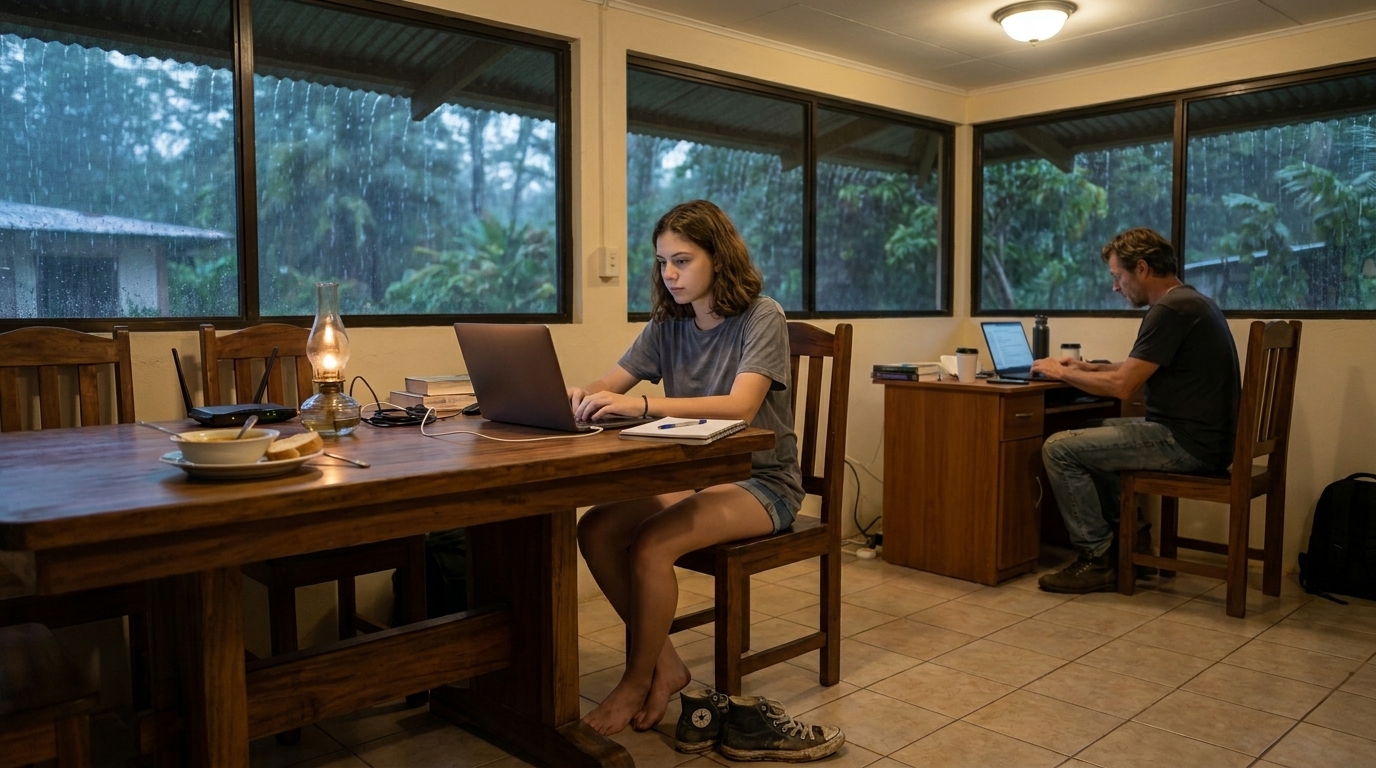
The rain started on Thursday and did not stop until Sunday.
Not German rain. Not the kind that hesitates, that you wait out, that is apologetic about itself. Panama rain in the wet season falls with a decision behind it. It turned the finca road into a river in twenty minutes. The horses stood in the field and looked unbothered, which I noted as something to learn from.
We stayed in. Papa worked. I worked.
He had code to review — something for a client, an audit trail problem, the kind of thing I didn’t understand in detail but could see was genuinely difficult from the way he read and re-read the same file. I had my laptop. I had a problem set from the summer course I was supposed to be doing, which I had abandoned three weeks ago and which was now very behind.
We sat on opposite sides of the table and worked.
An hour passed. Two. Rosa had left soup and bread before the rain got bad, so we ate without stopping, reading between bites, the kind of meal where neither person speaks because they are both somewhere else in their heads.
Papa swore once, quietly, at something on his screen. I looked up.
“Interesting problem?” I asked.
“Disgusting problem. The previous developer thought comments were optional and variable names were suggestions.”
“What did they name the variables?”
“temp2, temp3, and finalTemp.”
“finalTemp.”
“finalTemp.”
We went back to our screens.
I noticed things about him in those three days that I wouldn’t have seen otherwise. The way he worked in deep silence and then suddenly needed to move — stood up, walked to the window, came back. The way he read code by moving his lips very slightly. The way he set his coffee down somewhere and then couldn’t find it. Three cups, that first day. Cold. Never finished.
My mother had warned me, gently, before I left: he goes somewhere inside his head when he works. Don’t take it personally. She had said it without bitterness — just as information. Something she’d learned and was passing on.
I found I recognized it. I disappear too. I had not known that was something I got from him.
On the second afternoon I finished the problem set. I was stuck on the last question — a recursive function that kept running in a direction I hadn’t intended — and I had been at it for an hour. I didn’t ask for help. I didn’t want to yet. But I said, not quite to him: “Recursion makes me want to burn things.”
“Base case wrong or infinite loop?” he said, without looking up.
“Infinite loop.”
“What’s your termination condition?”
I told him.
A pause. He was still looking at his screen.
“What happens if the input is zero?”
I looked at my code.
“Oh,” I said.
“That one takes everyone a while,” he said, and went back to his problem.
I fixed it. It ran. I sat back.
I thought: we work the same way. I thought: nobody ever told me that.
Valentina Has an Invitation
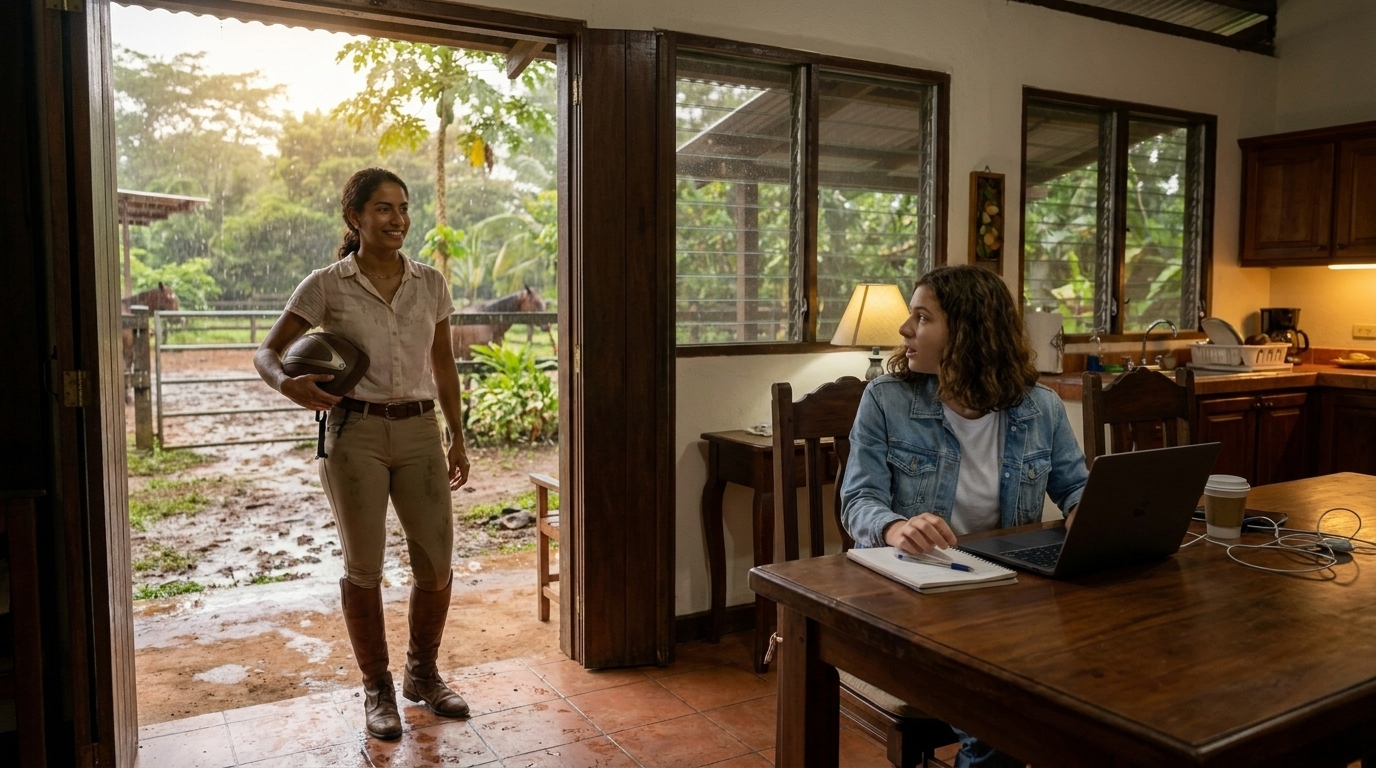
The rain stopped on Sunday afternoon and Valentina appeared on horseback an hour later, which suggested she had been waiting.
She came to the finca, left her horse at the paddock rail, and knocked on the door with the authority of someone who had been knocking on this door since before Sophie was a complication anyone had considered. Papa let her in. She accepted coffee, refused a seat, and stood in the kitchen looking at me.
“There is a festival,” she said. “In Las Tablas. This weekend.”
“What kind of festival?”
“The pollera kind.” She said it as though that answered everything. When she saw my face: “The national dress. The real one — the one from the interior. You have not seen one.”
“I’ve seen pictures.”
“You have not seen one,” she said again, firmly.
Papa looked at me. I looked at Valentina.
“Are we invited?” I asked.
“I am inviting you now. Do you need more of an invitation?”
We left Friday morning.
Las Tablas
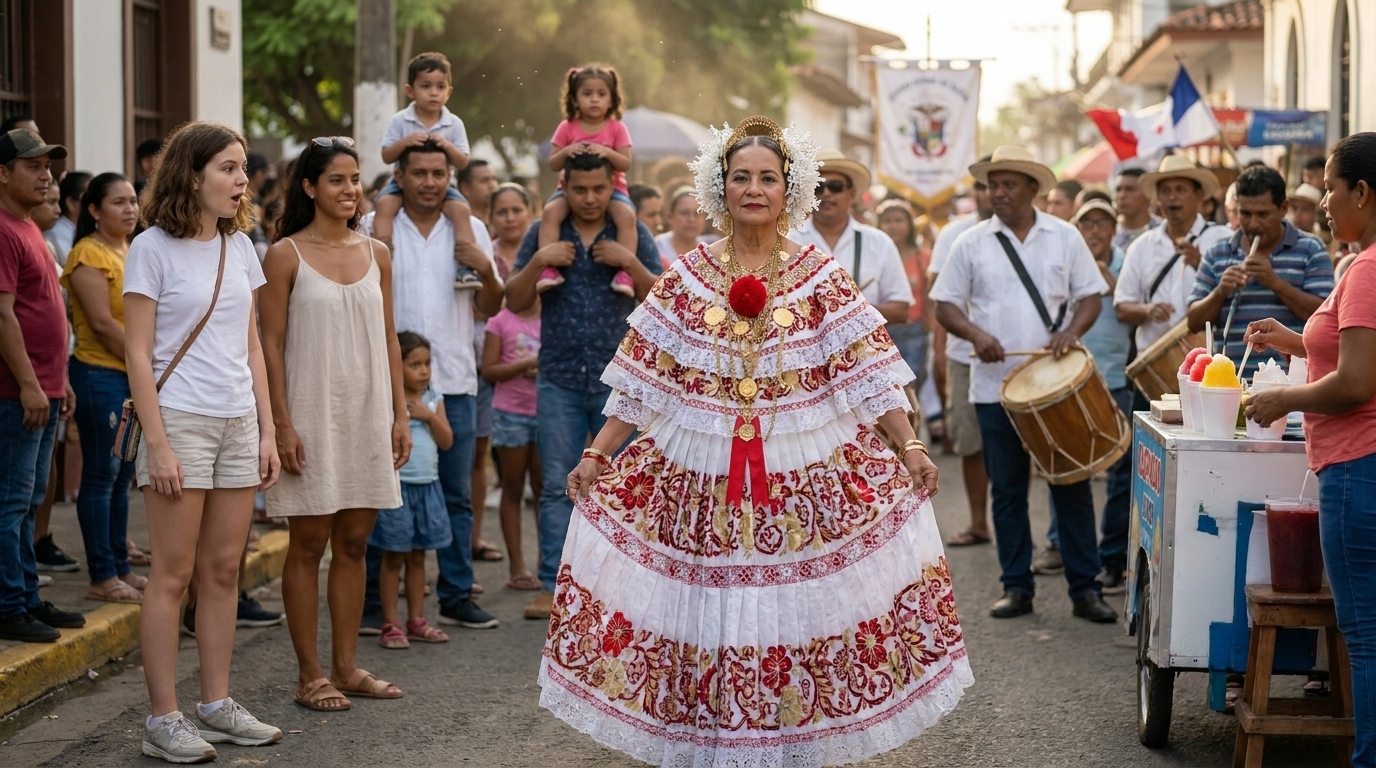
I heard the music first.
Tamboritos — Valentina had explained them on the drive, before I could ask, because she had clearly done this before with people who had never seen Panama, who needed the briefing before they walked into something and embarrassed themselves. Drums and singing. A call-and-response pattern. She said: you will feel it before you understand it.
She was right. I felt it in my sternum.
The street was full. Not city-full — not the underground at rush hour, not Alexanderplatz in December, not the kind of full where you lose the person next to you and it is nobody’s fault. This was a manageable fullness, people who knew each other, who moved around each other with the ease of long practice. Children on shoulders. Old men in montuno shirts. Vendors. Flowers.
And then I saw the dress.
I stopped walking. Valentina walked two steps further and turned around.
I don’t have the vocabulary for it. I am going to try.
White. The whole dress was white — but not plain, not simple. Embroidery on every surface. Flowers. Geometric borders. Red and gold thread worked into the fabric in patterns that were not random, that had names, that had histories I didn’t know. The skirt was layered, heavy, round at the hem in a way that moved differently from any skirt I had ever seen — not swinging but floating, with its own momentum. The blouse had a neckline that sat at the shoulders, covered in the same dense embroidery. And at the top: the tembleque. A headdress of tiny flowers made from fish scales, painted and wired, that trembled slightly with every movement and caught the light.
The woman wearing it was perhaps sixty. She moved through the crowd with the ease of someone who had worn this dress for decades, who knew how much space it needed, who was not performing anything. She was simply dressed. Simply attending a festival. The dress was not a costume. It was clothes.
I stood on the street with my mouth open.
Valentina waited.
“How long does it take?” I finally said. “To embroider — one of those.”
“Years. Some take five years. Some take longer.”
“Five years.”
“You make pieces at a time. A blouse. A skirt panel. You pass it between women — mothers, daughters, cousins. A girl starts learning the stitches at eight or nine. The dress she wears at her quince has maybe ten women’s work in it.”
I looked at the dress moving through the crowd.
Ten women. Years. Every stitch done by hand. And the woman wearing it walked through a street festival and got coffee from a vendor and laughed at something her companion said, and the dress was just what she was wearing.
“The blouse pattern,” I said. “Do the patterns have names?”
Valentina looked at me with something that was not quite surprise but was adjacent to it.
“You remember about the patterns.”
“You told me about the nagua. That the Ngäbe patterns have names.”
“Yes. The pollera patterns also have names. Different tradition — this is from the interior, from the campesino culture, not indigenous. But yes. The patterns have names and families and some of them are very old.” She paused. “I’m glad you asked that.”
I took one photograph, from far away, asking no one’s permission, of the street, not of the woman. I put the phone in my pocket.
Valentina bought us raspados from a cart and we watched the tamborito from the shade of a doorway for an hour. I did not talk much. She didn’t push me to.
Walking back to the car, I said: “Is the pollera the third thing?”
She looked at me. “What was the first and second?”
“The Pacific. And — something about rain days.”
She didn’t know about the rain days. I explained.
“You and Stefan working in silence,” she said.
“Yes.”
She thought about it. “That’s a good three things.” She paused. “I think the pollera is the third thing, yes. I think that’s right.”
What I Wrote in the Notebook That Night
The drive back was long. I slept most of it, which I hadn’t planned.
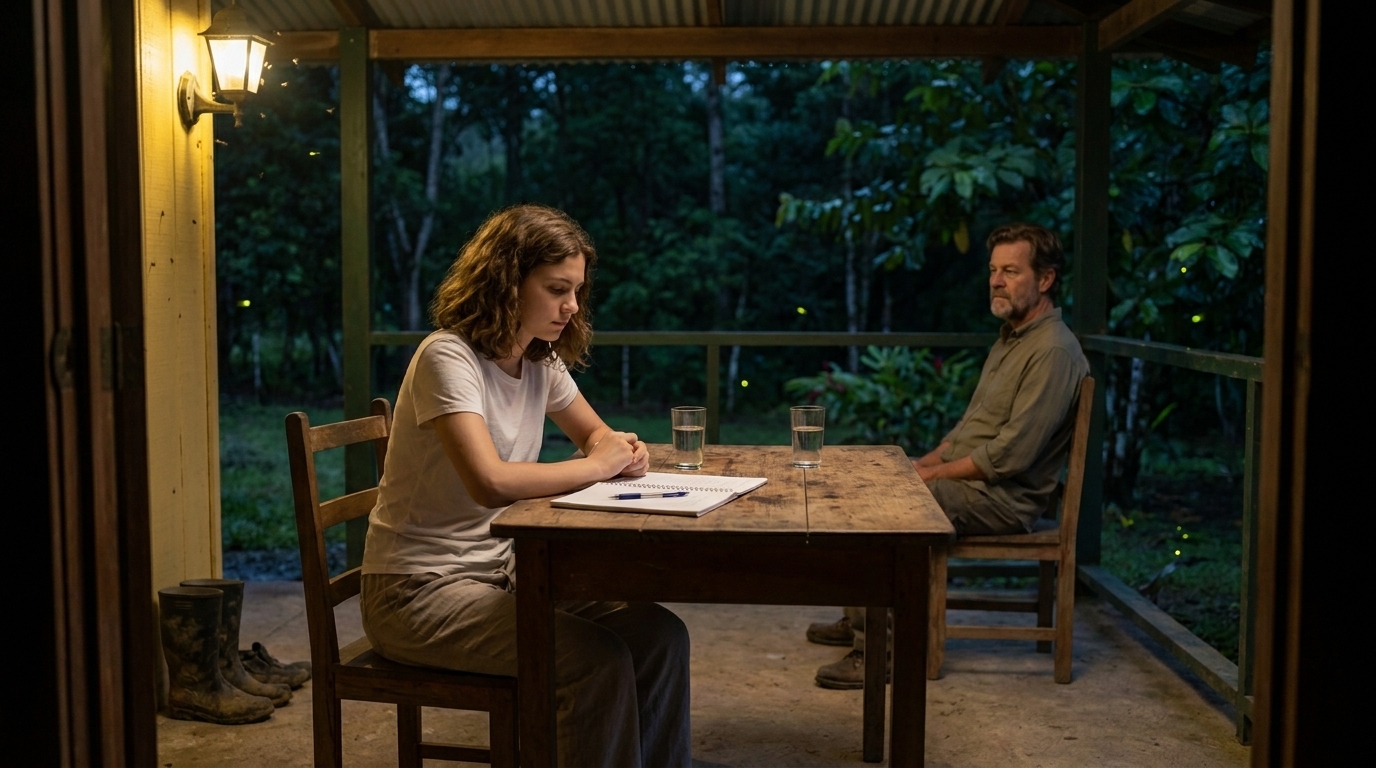
When I woke up it was dark and we were on the finca road and the fireflies were out, which still surprised me — I had not known you could have fireflies in a rainforest, I had thought they were a meadow thing, a childhood-in-stories thing. But here they were, threading between the trees in irregular pulses, not performing anything, just doing what they do.
I sat on the terrace and opened the notebook.
I had written, over the past weeks: the paso llano. more layers than I can see at once. scorpions — brown and black, shake your shoes. jagua: color appears after.
Underneath all of that I wrote:
Three ways to understand a country: go to its ocean and let it knock you down. watch someone you love work until you recognize yourself in how they do it. stand on a street and see something that took five years and ten women to make, and understand that it is not made for you to see — it was already there, it will still be there, and you are just lucky to be standing in the right place at the right moment.
I looked at that for a while.
It was the longest thing I had written in the notebook. It was also, I thought, more or less true.
Papa came out onto the terrace with two glasses of water and set one in front of me without comment. He saw the notebook. He didn’t read it — he never read my notebook, I had understood that about him early, that whatever I wrote there was mine. He just sat down in the other chair.
The potoo screamed from the forest. I didn’t startle. I had stopped startling at it five days ago.
“Valentina asked me today,” I said. “Whether you’ll stay another year.”
“What did you tell her?”
“I said I didn’t know.”
Papa looked at the forest. “That’s the right answer,” he said. “I don’t know either.”
I thought about asking him more. Whether he was staying because of the finca, because of the project, because Panama had simply become home in a way that Berlin no longer was. Whether seven years meant the question of going back had quietly closed.
I didn’t ask. I drank the water. The fireflies kept going.
I had three more days in Panama.
Seventeen days seemed, for the first time since I arrived, like not quite enough.
🎭 This Week's Episodes
Telenovelas show what we can't say in client meetings. The drama is heightened, but the patterns are real.
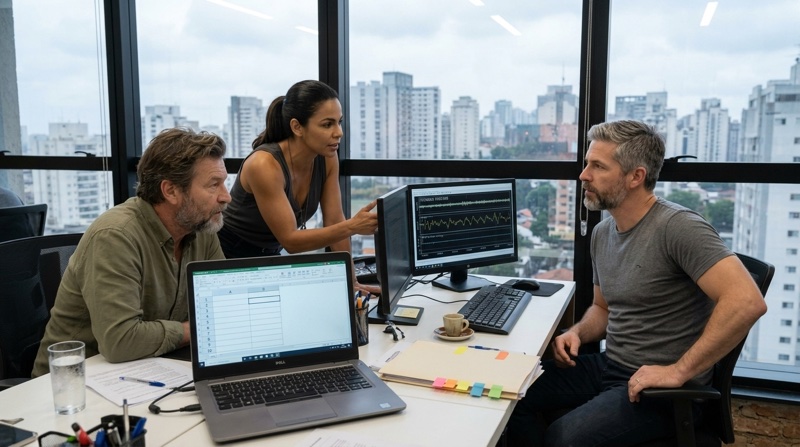 Documentation Avalanche
The forty-seven questions from Passau become a daily occupation. Stefan finds a gap the navigation team cannot investigate without Marcus's approva...
Technical Consultancy
Embedded Delivery Partner
Embedded into your team as an active contributor, reducing delivery friction and helping important work move cleanly.
Technical Advisor
Peer-style technical assessments before far-reaching decisions; reduce architectural and product risk early.
Product & Delivery
Ship working software to real users earlier. Measure impact and adapt based on evidence rather than assumption.
Custom Software Development
High quality, maintainable software. Short-term augmentation that leaves lasting capability in your own team.
Recent Articles
- AI Computer Use Is Not a Business Contract (09.10.2026)
- When Everything Is Finally Under Control (05.10.2026)
- AI Makes Technical Execution Cheap. Judgment Stays Scarce. (26.09.2026)
- The Agent Escaped. Who Left the Door Open? (24.09.2026)
- What an AI Agent Actually Is (21.09.2026)