Documentation Avalanche
The forty-seven questions from Passau become a daily occupation. Stefan finds a gap the navigation team cannot investigate without Marcus's approval, while radio still puts small changes onto real hardware. Júlia chooses a relationship with Stefan and leaves one question unasked. Klaus and Thaís discover how easily dinner can become something more. Natalia makes her relationship with Dandara visible, then takes its useful parts back to Marcus. By Friday, Bernardo has a green report and the integration teams have nothing new to flash.
The Space for an Answer
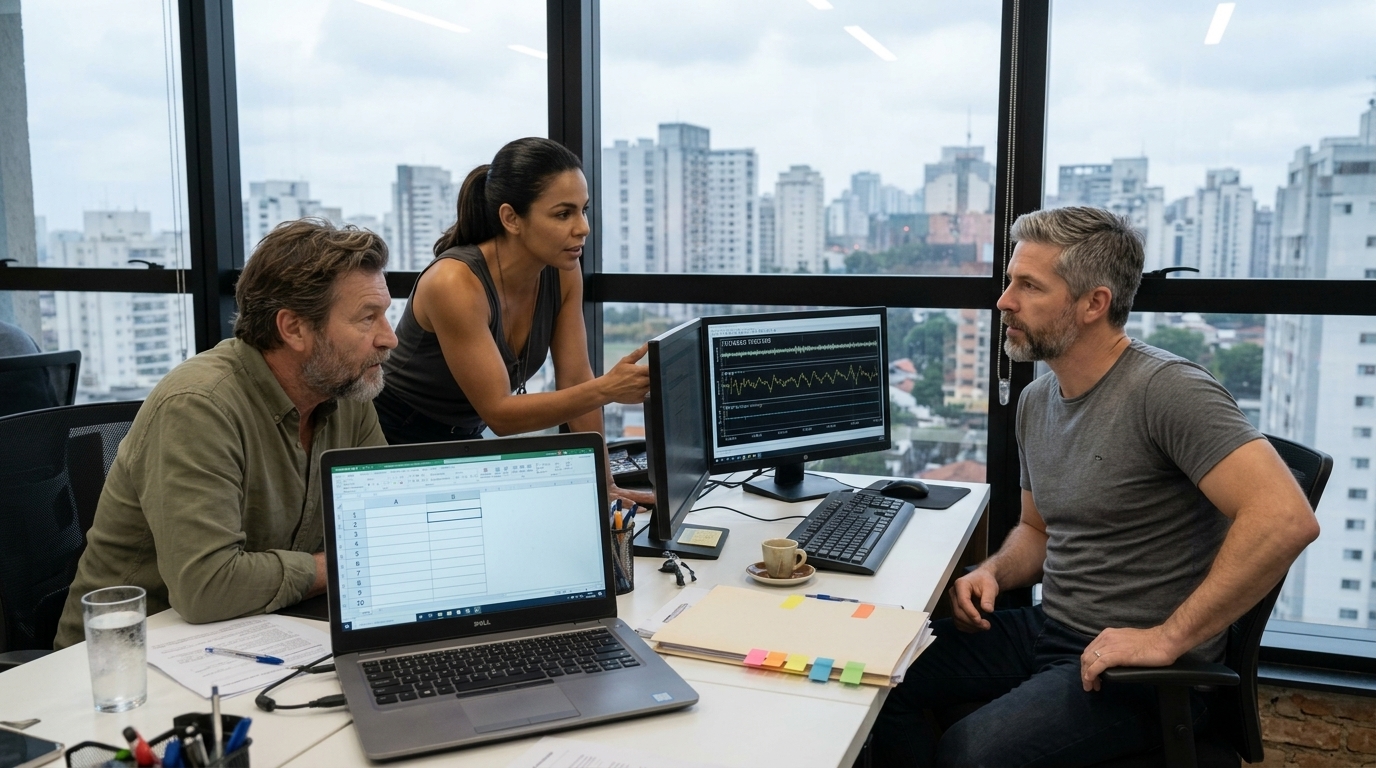
By Tuesday, Rodrigo had learned to hate the word provide. It sat at the beginning of Question 14 with the bland confidence of somebody who had never missed the last bus home. Provide an analysis. Provide a reference. Provide confirmation. His shirt was still damp between the shoulder blades from the journey in; the air-conditioning had turned the sweat cold without drying it, and every time he leaned toward the screen the cloth pulled against his skin.
He selected the word. The cursor made it blue. He wanted to delete it, close the laptop, and go downstairs before anybody could ask him for anything else. The desire frightened him more than the question. Two weeks ago he had stayed late because he wanted to see a fix run. Now he counted the minutes until he could stop pretending to work.
Stefan put an espresso beside his keyboard and dragged over a chair. “Show me where you’re stuck.”
Rodrigo turned the screen, then kept his hand on its edge as if he could still prevent Stefan from reading. His response claimed that the automated acceptance suite verified missing temperature messages under all relevant operating conditions. The sentence looked finished. He had spent forty minutes making it look finished, replacing hesitant verbs with stronger ones, and there was a sick little relief in that achievement. Nobody could call it an empty answer.
“I have a paragraph,” he said. “I don’t believe it.”
The admission scraped on the way out. Stefan’s eyes moved over the sentence without changing expression, and Rodrigo hated him briefly for being able to stay calm. He wanted somebody to tell him it was good enough. Not Marcus, whose approval would mean nothing. Stefan. The man who had sat beside him when the sensor value finally reached the display, who knew he wasn’t lazy or stupid.
“Open the test,” Stefan said, and Rodrigo did. They stopped the temperature frames; after five hundred milliseconds the display marked the old reading stale and showed Sensor Unavailable. That passed. Rodrigo pointed at the setup with a fingernail bitten below the quick. “Dieter asked about simultaneous climate and navigation traffic. This doesn’t do that. I wrote ‘all relevant operating conditions’ because the template wanted coverage, and then I sat here looking at it.”
“Take those words out.” Stefan said it gently, but the gentleness made Rodrigo’s face burn. He rubbed his eye with the heel of his hand, buying a second in which not to look at either the test or the man beside him. Yesterday’s coffee stood behind the monitor with a skin across it. He could smell it now, sour beneath the fresh espresso.
Deleting the words took less than a second. Without them, the response looked small and frightened. Rodrigo knew that was his own fear on the screen, not a property of the sentence; knowing did nothing to loosen his stomach.
They opened a capture from the previous week’s parking-lot run. Temperature frames came through at regular intervals until navigation traffic rose; farther along, a gap opened between the timestamps reaching the display process. Rodrigo leaned forward despite himself. For a few seconds the old concentration returned, clean and hungry, and he forgot the document.
“It could be the shared handler. Dandara says it drops frames. Could be our queue after it. We don’t have both sides of that run.” His voice steadied as he spoke about what he actually knew. He could picture the rig, the two capture points, the traffic scenario they needed. An afternoon with Dandara. Maybe they would find the fault, maybe they wouldn’t, but by evening the question would at least have changed.
“Then say that,” Stefan told him. “This test doesn’t answer this question. The trace gives us somewhere to look.”
Rodrigo’s fingers curled against the desk. “You want me to send Germany a better description of what we don’t know?”
“I want you to keep the gap visible until we can investigate it.”
“We can investigate it.” He brought up the bench request with more force than the mouse needed. QuantumMind approval pending. Beneath Prerequisite, Natalia had linked his incomplete answer to Question 14. “I asked yesterday. Look at what she wants first.”
Stefan read it twice. Rodrigo watched the small tightening beside his mouth and felt a shameful satisfaction: finally, let it hurt somebody else. The request required the answer before the experiment that would produce the answer. On the task board this was a dependency, a tidy arrow between boxes. At Rodrigo’s desk it was the place his working day went to die.
“Now you understand the workflow,” he said. The laugh that followed sounded ugly in his own ears. He hated sounding bitter at twenty-eight. His mother had been telling relatives he led a team; he could imagine her saying the title with that upward lift in her voice. She did not know how much of leading now consisted of taking humiliation in English and redistributing it among six people.
Adriana arrived with a folder against her ribs. Her curls were flattened where she’d been pushing them away from her face, and she smelled faintly of the coffee she’d spilled on a cover downstairs. Climate had the same restriction, she told them: navigation must establish the common integration procedure first. Marcus had added it in yesterday’s clarification meeting while Stefan was answering Passau.
Three adhesive tabs protruded from the folder. Three teams. Her name appeared as technical reviewer on every cover. She set it down harder than she intended, and the cup jumped in its saucer.
“I didn’t agree to this,” she said. “I told him I couldn’t review every fucking response. He said they need someone they can rely on.”
She pressed the tabs into alignment while she spoke. Then she caught herself doing it and stopped. That little movement almost undid her. Twelve years of finding the missing cable, the wrong estimate, the person crying in a stairwell, and she was still straightening the paperwork someone else had made her responsible for. She had been proud of being the person who could hold a floor together. She was proud of it even now, which made the resentment feel like something shameful she ought to hide.
Stefan wanted to offer to take the folder. He could hear the promise before he made it: I’ll handle Germany. I’ll carry this part. He had said that on Monday. Rodrigo had believed him. Adriana had looked at him as if she knew exactly how much such a promise weighed after the visitor went home. He left his hands where they were.
Dieter’s reply had arrived that morning: send the coverage mapping, identify the required investigations, then arrange a call. Stefan read it aloud without the courteous beginning. There was something usable in it, something he could do; he clung to that harder than he wanted either of them to see.
“I’ll send the missing coverage separately,” he said. “Ask him to distinguish this test setup from a manufacturing candidate.”
“Send Marcus the distinction too.” Adriana’s voice was flat now. Stefan told her Marcus already had it, and she looked at him until the silence became unbearable. She wasn’t asking him to explain the rule. She was asking whether he understood the people who could keep a rule from mattering.
Rodrigo turned back to the empty cell. His fingertips were damp enough to leave marks on the keys. Coverage not established for simultaneous traffic. Controlled investigation required. He typed it without polishing, and the response stayed amber.
Adriana rested a hand briefly on the back of his chair. It was a small kindness, warm and ordinary, and Rodrigo had to swallow before he could thank her. He could bear the question. He could even bear not knowing. What he could no longer bear was being made to feel that admitting either meant he had failed the people depending on him.
Four Fingers on a Button
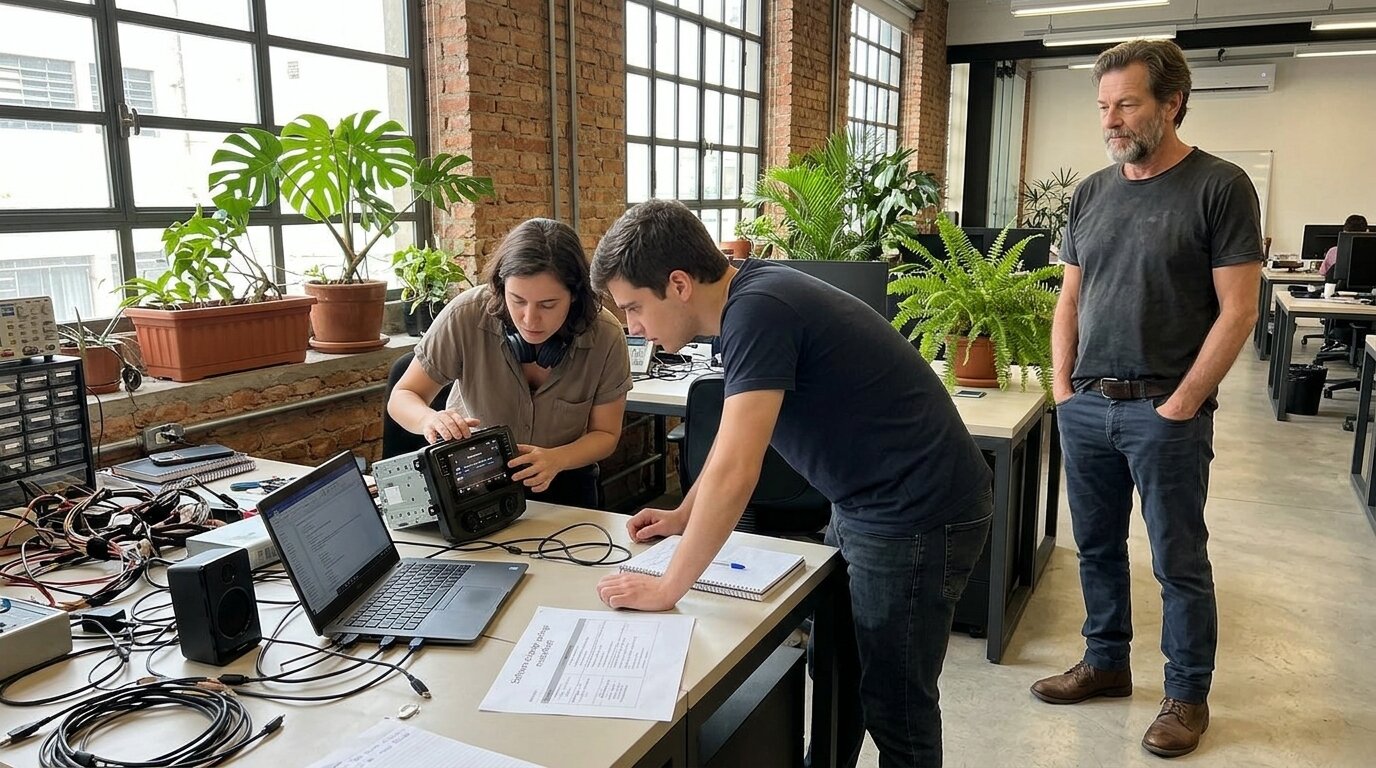
On Thursday, the woman with the painted nails paused a podcast at four minutes and seventeen seconds, switched to FM, and came back. The opening music started again. She let her head drop forward until her forehead almost touched the head unit.
“Filho da puta. We already fixed the switching.”
The shaved-head developer pushed his chair alongside hers, one caster catching in a cable. His annoyance dissolved into interest when she repeated the sequence: while the podcast played, switching away and back preserved the position; pausing first lost it. She kept four fingers braced on the unit, tapping each step with her thumb. Sweat had collected under the band of her headphones, and she lifted them off her neck before going through it a third time.
Stefan had come across the floor looking for a cable. He stayed behind their chairs, grateful for a fault nobody needed permission to name. The developer made a test for the paused position surviving a source change; it failed, and the woman let out a pleased, vicious little “There.” They had found where the source-change code cleared state it should have kept.
The correction was small. They ran the suite, checked the package manifest against the target build, and connected the bench unit. She started the flash herself, watching the progress bar while the developer pulled yesterday’s sandwich wrapper out from under the cable. She drummed her nails against the desk, stopped, and began again. He leaned forward when the bar reached ninety percent. Both had forgotten Stefan was there.
When the unit rebooted, she went through the sequence once more. Four minutes and seventeen seconds. The voice resumed in the middle of a sentence. She held her breath for another beat, waiting for it to betray her, then grinned so suddenly that the shaved-head developer laughed.
“Clean,” she said, and knocked her fist against his. The delight was childish and entirely deserved. Stefan felt it in his own body, that quick lift under the ribs; then he looked back across the floor and felt it sour. He’d made promises to people over there. Over here, people could still keep theirs.
Rodrigo stood behind him holding the cable he’d borrowed before lunch. He had meant to return it and go, but he couldn’t tear himself away from the small screen. The woman’s grin hurt worse than another question from Passau. He was happy for her. That was the humiliating part: he could be happy and envious at once, could want to join their laughter and want to smash the printer waiting beside his own desk.
“That’s what I miss,” he said. She turned, still smiling, and asked whether he meant podcasts. He tried to smile back. It failed halfway. “Knowing whether I made something better.”
She moved her chair without a word and slid the unit toward him. Rodrigo put down the cable and pressed pause. Changed source. Came back. The voice continued, careless of him, and for a moment his hand remembered how simple work had felt before every result required a defence.
His eyes stung. He bent closer to the display so nobody would see; there was nothing here worth crying over, no disaster, just an audio player behaving correctly. That made it worse. He had once done this all day without recognizing it as something he could lose.
Stefan waited beside him. “It doesn’t answer the CAN question,” he said quietly, unwilling to turn the little success into a lie.
“I know.” Rodrigo lifted his head, blinking too hard. “It answers this one. We used to be allowed to do that.”
The woman took her hand off the unit. Her pleasure had not vanished, but she no longer knew where to put it. Across the floor, the printer began feeding pages into its tray, and Rodrigo picked up his cable again, murmured a thanks too low to carry, and went back before anyone could ask where he was.
Dinner Without a Notebook

On Thursday, Klaus found the receipt folded inside his notebook. A tiny volume knob, drawn in Thaís’s quick, assured strokes, sat above the words NOT LINEAR. He ran his thumb over the ink. At the next desk someone was asking for a revised cost forecast, but for a moment he heard Saturday’s waiter, the scrape of a chair, her laugh spilling out through the restaurant window.
She had rejected the hotel restaurant before he finished suggesting it. “Klaus, I said food. Come.” She had caught his hand and pulled him past the polished entrance, and he had followed with the ridiculous happiness of a man being taken somewhere he had not researched. At the small restaurant she knew the waiter; they argued affectionately about what was left in the kitchen. Klaus understood nothing. When she turned to translate, he was watching her face instead of the menu.
“What?” she asked, suddenly conscious of his attention.
“Nothing. I like hearing you.” He felt his face warm at how plainly he had said it, then decided not to take it back.
The answer pleased her more than she wanted to show. She took a drink, buying a moment. All week people had interrupted her, asked her to make an interface prettier, repeated her conclusions as if they had discovered them. Here was a man who could not understand a word and still knew she was worth listening to. She wanted to trust that pleasure. She also wanted to stop examining it long enough to eat.
He placed his notebook beside his plate. She looked at it, then at him. “Should I invoice you for dinner?” His face reddened; he moved the notebook onto the spare chair so quickly that she regretted the sharpness of the joke. She touched his wrist. “I’m teasing you. Eat before it gets cold.”
He smiled, but his embarrassment remained. Without the notebook he did not know what to do with his hands. Numbers gave him a place to stand: there was an error or there wasn’t, a source to check, a total that ought to reconcile. Wanting someone offered none of that protection. He was forty-two and could still make himself feel fourteen by wondering whether a woman had touched his wrist out of kindness.
Thaís asked what he listened to at home. His answer involved a Brazilian playlist from an airport lounge. She stared at him, then laughed so hard that the waiter glanced over. “Give me that phone. Meu Deus, we have work to do.” She built him a playlist while he protested that the lounge had been very comfortable, and this time he made her laugh deliberately. The success loosened something under his ribs.
Outside, a motorcycle hissed through the wet street. Warm air carried the smell of cooking into the room; a bead of sweat slipped down behind her ear. He passed her a napkin without interrupting what she was saying. She accepted it, finished her argument about a singer, and only then noticed how easy the small movement had been. No performance of taking care of her. No speech. She was beginning to imagine more evenings like this, and the thought made her quiet.
He mistook the silence for boredom and began talking about Stuttgart. Buying vegetables for one. Calculating the portion so precisely that there would be no leftovers, then eating it over the sink because setting a table seemed absurd. He regretted the confession before he finished. He had made solitude sound pitiful. Now she would have to be kind.
“So every Tuesday you eat the same thing?”
“Not every Tuesday.”
“Every second Tuesday.” She leaned toward him, delighted by his offended expression. “And you stand in the same spot?”
He laughed, and the laugh hurt a little. She had heard the loneliness and given him a way to remain a man she might want, rather than a problem she ought to soothe. For a few moments he could not look at her without smiling.
When she told him about a supervisor who had called her work pretty without reading the observations behind it, Klaus almost offered the harmless intention of the compliment. He had used that excuse himself. Something in the tired way she pushed rice around her plate stopped him.
“He didn’t read it,” she said. “Three days of watching people use that thing. I could have put flowers around the buttons and got the same answer.”
Klaus set his fork down. “I have read a number and ignored how someone had to produce it. More often than I like to admit.”
She studied him. He wanted her to tell him that at least he was different; he could feel the request forming in his face. Instead she said, “Then next time read it.” The bluntness stung. After a moment he nodded, and her foot nudged his under the table. She had not withdrawn the warmth. That almost undid him.
After dinner he suggested coffee somewhere else. Thaís asked whether his hotel had a view. His hand jerked toward his jacket; the notebook fell from the chair with a thud, and he bent to retrieve it while heat climbed into his cheeks. She pressed her lips together, trying not to laugh. He looked up and caught her failing.
“Please don’t submit an application,” she said, taking the notebook from him while he put on the jacket. Her own pulse had quickened. She had asked because she wanted another hour with him, because she wanted to know how his mouth would feel, because leaving at the restaurant suddenly seemed too soon. She would have preferred to make that look effortless. His clumsiness made room for hers.
In the elevator their reflections stood side by side, awkwardly still. Thaís turned toward him and touched his sleeve. His gaze fell to her mouth and fled again. “Klaus. Look at me.” When he did, she smiled, but her fingers tightened on the cotton. She was nervous too; she wanted him to see that much.
“I’d like to kiss you,” he said.
“Then kiss me.” She tugged his sleeve, tired of waiting, smiling despite the nervous flutter beneath her ribs.
She rose toward him before he could find another careful sentence. His breath caught against her cheek; his hand settled on her back, warm and uncertain, and she drew him closer. The first kiss was almost tentative. She broke it to look at him, saw the wonder he had failed to hide, and kissed him again. Somewhere above them the elevator chimed. He had forgotten to watch the numbers.
At his floor she kept hold of his hand. “Coffee,” she said, still a little breathless. “Then I go home.” She wanted that hour, and she wanted to wake in her own bed without having to explain either wish. Klaus nodded too earnestly, and she squeezed his fingers. “You can stop looking terrified. I want to be here.”
On Thursday, his phone lit up beside the receipt.
Did you listen to track three?
Twice. Alone in the hotel, where he had set a cup down on the other side of the table before realizing what he had done. He nearly wrote that. His thumb hovered, then he smiled at his own cowardice and sent: Twice. Dinner again? You choose.
Thaís read it at her desk. The warmth rose into her face before she could stop it. She turned the phone over, waited until the colleague beside her looked away, and turned it back.
The Question She Kept
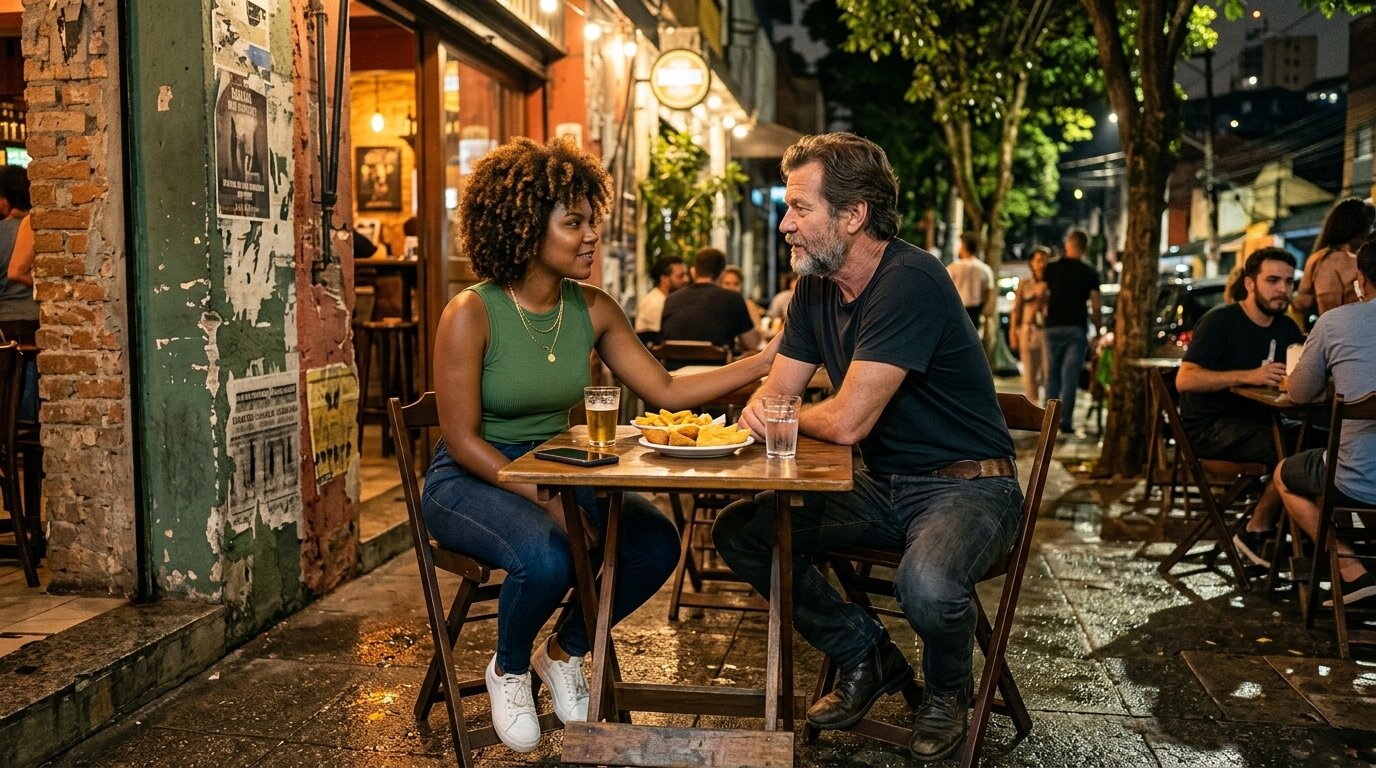
Júlia chose a bar with plastic chairs, greasy paper napkins, and a waiter who shouted her name from halfway down the pavement. Friday’s rain had left the street shining. By the time Stefan arrived, the heat had returned; she could feel sweat beneath the chain at her neck.
He came toward her with the office still in his shoulders. She had spent the afternoon being furious at the same people who had exhausted him, yet the sight of him made her stomach tighten with pleasure. Porra. Even now. She had wanted a carefree evening and already wanted to put her hands on the man who might ruin it by talking about work.
He kissed her cheek and started pulling out the chair opposite. She caught his wrist. “Here, Stefan. Beside me.” His knee brushed hers as he sat. She let it stay there and watched him finally breathe out.
A friend at the next table called to her in Portuguese. Júlia answered, laughing at his terrible imitation of the percussionist who had arrived late at rehearsal and then played as though everyone else had the tempo wrong. Stefan smiled without asking her to explain every word. She liked him for that. She told him the story anyway because she wanted to share it, and when he began, “That sounds like—” she put a finger against his mouth.
“Don’t turn him into Marcus. You are not bringing that man to my table.”
His laugh startled her. It was fuller than the polite noise he made in meetings. She wanted to hear it again. She ordered food, stole an olive from his plate, and felt him looking at her; the attention warmed her bare shoulder as surely as a hand.
Then his phone vibrated.
He read the message, and she watched him leave. His body remained beside hers, but the eyes that had been on her mouth were already searching something she could not see. She knew that face from the bench. At work she trusted it. Here she wanted to slap the phone out of his hand.
“Someone dying?” Her tone made him look up.
“No. Rodrigo is asking about—”
“Then why am I sitting here alone?”
He glanced at their knees, still touching, and understood too late. She pulled hers away. Anger was easier than saying how quickly the absence had hurt, how stupid she felt for being hurt by a screen. She took a long drink and felt the cold glass against her lower lip.
“I’m sorry.” He put the phone facedown, but his fingers lingered at its edge. She stared at them until he removed his hand.
“I invited you because I wanted you. Not because the whole fucking floor needs somewhere to come and cry.” Her voice was low now. At the next table her friend burst into another joke; the laughter made her own silence feel exposed. “I like those people too. I work with them all day. I need something left at the end of it.”
Stefan’s first impulse was to explain Rodrigo, the trace, the unanswered question. Being needed had been pulling him forward since morning; he did not know how to stop without feeling that someone would fall. Then he saw her jaw tighten. He had arrived at a woman who wanted him and begun asking her to make room for everyone else.
“I can leave it until tomorrow,” he said.
“Then leave it.”
He did. The effort remained visible. Júlia wanted to be angrier with him, but she could see the man struggling behind the habit, and she reached for his hand. He turned it over beneath hers, relief too quick in his face. She felt tenderness and irritation together. That was the trouble: she could be right and still want to kiss him.
“At work, you can tear my code apart when it’s wrong,” she said. “Don’t start being nice to it because of this.”
“Your code doesn’t need that kind of kindness.”
“Good. Neither do I.” Her mouth softened despite herself. She slid the plate between them, and for a while they ate. He moved his glass to make room for her elbow; she warned him that the food was hot just as he burned his tongue. His startled curse made her laugh. She brushed sauce from the corner of his mouth with her thumb and left her hand against his face a moment longer than necessary.
He caught her wrist gently. “I’m forty-seven, Júlia. I have a daughter in Berlin. There is a whole life—”
“I know how old you are.” The sharpness returned before she could decide whether she wanted it. “I’m twenty-six, not twelve. You don’t have to stand here announcing the danger to the poor Brazilian girl.”
He flinched. She hated that she had made him flinch, hated more the little part of her that was glad. She wanted him to take her seriously. She also wanted him to stop placing the end of their evening on the table before they had finished the food.
“That isn’t how I see you.”
“Then talk to me. Don’t give me a warning label.”
For a moment he looked down at their hands. Sophie would call on Sunday, and he would answer, as he always did. The thought of his daughter steadied him and made him ashamed of how badly he wanted the rest of Berlin to disappear. He could tell Júlia facts. He could not yet tell her what he had been hoping her laughter would do for him.
“I don’t know what happens after this assignment,” he said. “I can tell you the truth as I know it. I can stop pretending I know more.”
She nodded. It was a decent answer. She wanted a decent answer to be enough.
“I didn’t ask you for forever.”
She meant it when she said it. She wanted his hand at her waist, another evening, the ease of reaching for a person who reached back. She did not want a marriage or a ticket out of Brazil. But under those wants another had begun to grow, small and humiliatingly specific: to know whether there would be a next Friday, and how many Fridays remained.
When do you go back?
The question was right there. She could have said it in either language. Her throat tightened as though she were about to ask for money. She had been so pleased with herself for wanting this without demanding anything; she could already hear her own voice becoming the woman she swore she wasn’t. Counting. Waiting. Needing reassurance.
Stefan stroked the inside of her wrist. She looked at his hand and let the question go unsaid. He was relieved that she had not asked him for more. She could see it. For one hot instant she resented him for benefiting from a bargain she had just made alone.
Then she caught his shirt and pulled him toward her.
The kiss was fierce enough to surprise them both. His fingers spread against her waist; she leaned into him, eyes shut, the noise of the street rushing back when they parted. She had wanted to kiss him. That was true too. She would not make every pleasure false because something beneath it hurt.
Across the street a friend raised a hand. Júlia waved without moving away from Stefan. He laughed against her cheek, and she held him there for another breath, enjoying the warmth, the food, the night she had chosen.
When he asked what she was smiling at, she said, “You.”
The word cost less than the question. She told herself that meant she was still in control.
A Table with Witnesses

The following Thursday, Natalia arrived early enough to choose the chairs. She wanted Dandara beside her, where hearing a sentence would mean leaning close. The lamp would catch her face; the mirror behind the bottles would give her Marcus without requiring a turn of the head. She checked the reflection, settled the cream blouse at her shoulder, and let one arm rest along the back of the empty chair.
When Dandara appeared in the doorway, Natalia watched the tiredness leave her face. There. That first unguarded pleasure. She had wanted exactly that and felt a small, sharp satisfaction at producing it.
Dandara paused just inside, suddenly aware of her damp T-shirt and the stubborn curl she had been pushing away from her forehead all afternoon. Natalia looked as if the day had never touched her. For a second Dandara wanted to retreat to the toilet and make herself presentable. Then Natalia lifted her hand, smiling at her with such unmistakable welcome that the foolishness passed. She crossed the room and kissed her cheek.
“You look tired.”
“We had a meeting to prepare for another meeting.” Dandara dropped into the chair. Her knee touched Natalia’s beneath the table; she did not move it away. “Someone wrote an action item to clarify who owns another action item. I’m not making this shit up.”
Natalia laughed, head tipped toward her, and Dandara felt the day loosening its grip. At work she had to be right before anyone would let her be angry. Here she could say it was absurd and be believed. She had not known how hungry she was for that until she heard herself talking.
Natalia touched her forearm. “And that problem you found? Did Stefan finally look at it with you?”
The question sounded like remembering. Dandara warmed to it. Natalia had stayed interested in the diagrams last time, asking questions instead of glancing past her for someone more important. She could have spent the evening talking about herself; she had asked about Dandara’s work.
“Not properly. He’s carrying half the floor. Rodrigo has one of the captures.” Dandara drew a shape on the wet tabletop with one fingertip. “There is a gap downstream. We think the shared handler could be losing it under combined traffic, but thinking isn’t knowing. We need input and output from the same run.”
Natalia followed the movement. She was interested now in a way Dandara would have recognized if she had seen where it led: Marcus wanted to know whether Stefan had a demonstrable failure he could put in front of the Germans, or a suspicion he could keep inside a review. She needed the distance between those things measured precisely.
“So Rodrigo can show the gap, but not where it happens?”
“Exactly.” Dandara’s face brightened. Being understood was almost indecently gratifying after a day of repeating herself. “Give me the rig and someone from navigation for an afternoon. We can capture both sides under the same traffic. An afternoon, Natalia. Instead I’m explaining why we need to find out what we don’t know.”
Her voice had risen. She stopped, breath still running ahead of her, and looked toward the bar. She had taken her phone out without noticing. One movement and the diagram would be there; she could show it, make the afternoon real for someone, finally finish a sentence.
Natalia waited with her hand still on Dandara’s arm.
A small unease passed through Dandara. She had come because she wanted this woman. Already she was reaching for work, the thing she knew how to be impressive at. Was she going to spend every evening proving she was clever? Was she afraid that without the laptop, the drawings, the certainty, there would be nothing Natalia wanted to stay for?
She turned the phone facedown. “No more architecture tonight. I’ve had enough.”
Natalia allowed herself a brief pause. Enough for Dandara to see a reaction, not enough to make her doubt it. “Good. I came out to hear you, not your presentation.”
The relief was physical. Dandara’s shoulders dropped; she leaned back, then toward Natalia again of her own accord. She had asked for something and got it. No sulking, no persuasion, no suggestion that she had spoiled the evening. She looked at Natalia’s hand on her arm and covered it with hers.
They talked about the journey from Cidade Tiradentes to Dandara’s first job: the buses, the heat, arriving with the smell of the road in her clothes while people joked about how hard it was to park. At the time she had laughed with them. It had seemed easier than describing the hours she had already spent awake. Now she could tell the story and be furious and funny in the same breath.
Natalia listened, remembering which parts to ask about. She was good at this. When Dandara imitated her little cousin negotiating for access to the laptop—”I’m learning, Danda, you said learning was important”—Natalia laughed because the imitation was funny. That pleasure did not trouble her. She could enjoy a person without forgetting what she had come to take.
Dandara was laughing so hard that she caught Natalia’s shoulder. Natalia turned toward the touch and guided Dandara’s hand to her waist. The movement was deliberate, visible from the door. She watched the laughter falter, watched Dandara’s gaze drop to their hands and return to her face, dark and intent.
“You do that and I forget what I was saying,” Dandara murmured.
“Then come closer.”
Dandara did. She had spent so much of the day containing herself: her impatience, the volume of her voice, the conviction everyone admired until she used it against a bad decision. Here she wanted to be obvious. She wanted the woman beside her to know how much.
Natalia met the kiss without haste. Dandara’s fingers tightened at her waist; the table pressed against Dandara’s hip, a glass rattled, and she broke away laughing, breathless, to move it before it fell. “Stay a little longer,” Natalia murmured, arranging a trace of need in her voice. “I don’t want to go back alone yet.” Dandara touched her face, suddenly tender. Two colleagues had just come in from the street. One called her name. She raised her hand, smiling, and turned straight back to Natalia.
No shame. No apology. The happiness made her almost reckless.
Natalia caught Marcus in the mirror over Dandara’s shoulder. He lifted his glass a fraction. Her pulse quickened with a pleasure that had nothing to do with the woman holding her. She let Dandara draw her close again, enjoying the public shape of the kiss, the skill with which she had made the next invitation seem inevitable.
Dandara rested her forehead briefly against Natalia’s. For once she did not need to say anything intelligent. The thought made her eyes sting, absurdly. She laughed to disguise it and touched Natalia’s cheek.
Later, walking toward the taxis, she kept their fingers intertwined. “Next time, somewhere without people from work. I want you to myself.”
Natalia squeezed her hand. “Your choice.”
Dandara began suggesting places. Natalia listened, already thinking about which one would give them time alone. Behind them Marcus’s reflection vanished as the door swung shut.
The Room on His Card
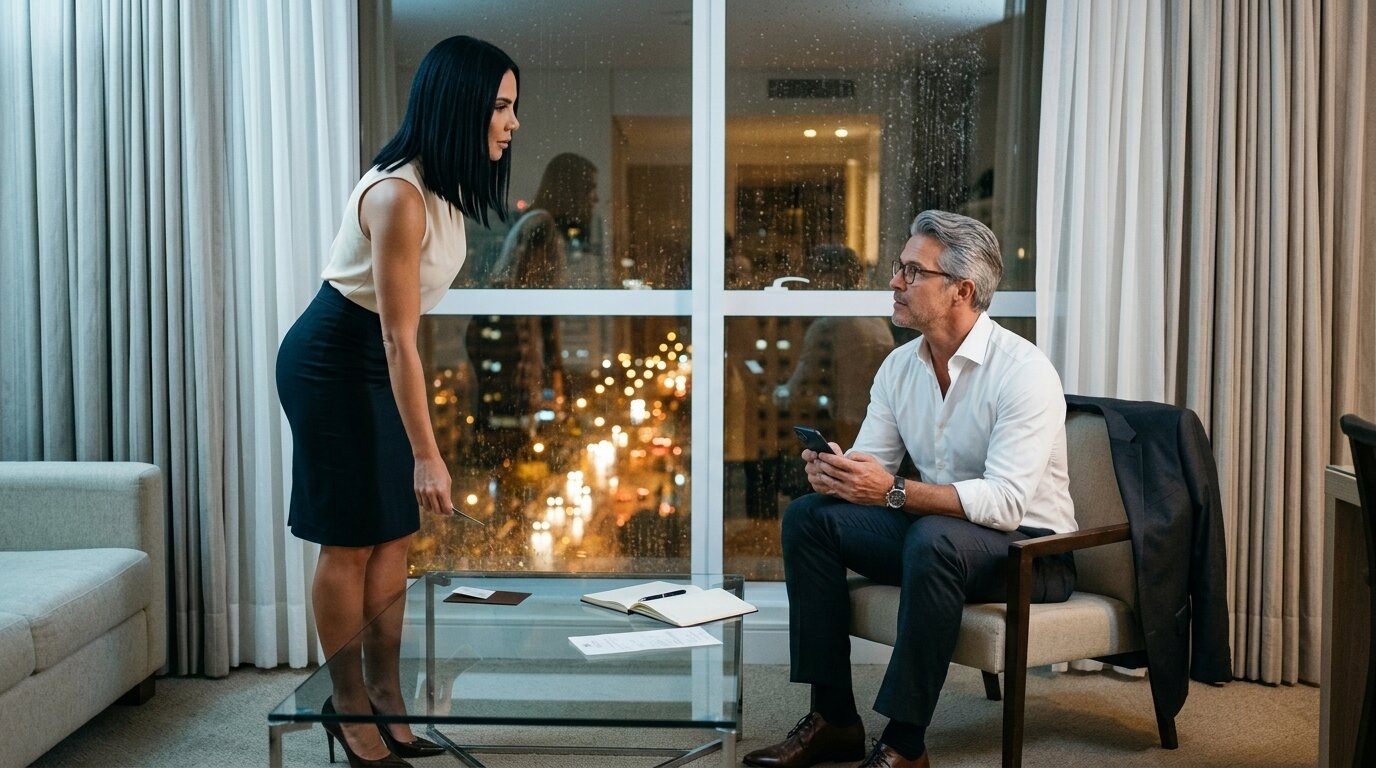
At reception, Natalia was still smiling when the clerk asked whether the extension should go on Mr. Delacroix’s card again. “Yes.” She signed beneath his name. The pen caught on the paper, and she pressed harder than she needed to. All evening she had arranged where people sat, what they saw, what they would remember. Here, one courteous question put the money back in his hands.
She slipped the room-key sleeve into her bag and went upstairs.
Marcus was waiting beside the glass table. He had taken off his jacket, but his phone remained in his hand. She wanted him to put it down before she began. She wanted the look she had caught in the mirror, this time with no target between them.
“You got her to put the phone away,” he said.
“She chose to.”
“And you let her.” His smile invited her to enjoy the distinction with him.
Natalia set the key sleeve on the table, slowly. “She told me what we needed first. There’s a gap in the capture. They haven’t observed both sides of the handler in the same run. Rodrigo knows about it; Stefan hasn’t worked through the whole diagnosis with her.”
Marcus’s thumb stopped moving on the screen.
He had been thinking about Stefan standing in front of the wrong audience with a clean trace, a short explanation, something that did not need QuantumMind to interpret it. A failure captured on real hardware would be harder to bury in a review. Now he could feel the danger shrinking back to a question. Questions needed schedules, owners, responses. He knew what to do with those.
“And access?”
“Diagrams. Her explanations. Two people from her floor saw us together tonight.” Natalia moved around the table and stood where he would have to look up at her. “Internal channels come later. When she asks me in.”
“When?”
“Not by squeezing her for everything the minute she starts trusting me.” The impatience escaped before she could polish it. She saw him notice and lifted her chin. “Do you want access, Marcus, or do you want me to frighten her off because you couldn’t wait?”
He let the silence lengthen. She hated how quickly she began calculating whether she had pushed too far. She was right. She knew she was right. Still, her hand had found the edge of the table, and she made herself release it.
Then he smiled. “I know. That’s why I sent you.”
The words reached her before her suspicion could stop them. Her chest warmed; she stepped closer, giving him the smile she had wanted to give him when she came through the door. She liked being chosen for something difficult. She liked that he knew the kiss had been a performance and admired her for making it look like the only honest thing in the room.
“They didn’t pretend not to see,” she said. “Dandara was happy they saw. She didn’t pull away.”
He held out his hand. Natalia put hers in it. His thumb pressed over her knuckles, and the familiar pleasure ran up her arm. With Dandara she had watched every movement for what it would produce. Here she wanted, for a moment, to stop choosing the next one.
Marcus drew her nearer. “Good girl.”
She closed her eyes briefly, enjoying the words because she wanted them, because he knew how to say them. The rain struck the window behind her. She could still feel Dandara’s fingers at her waist and took satisfaction in the evening’s result without feeling obliged to mistake it for love.
Then the phone vibrated. His hand loosened around hers.
“Bernardo wants the progress pack by tomorrow,” he said, reading. “You’ll review the integration responses. All three teams.”
Natalia stared at the top of his bowed head. The disappointment was childish and immediate; the anger followed it. She had come back with exactly what he wanted. Now her reward was another day bent over documents that people with actual technical knowledge would resent her for judging.
“Adriana can do the technical pass,” he continued. “You approve the structure.”
“I need time with Dandara tomorrow.”
“After the pack.”
She withdrew her hand. He looked up.
“I had an evening arranged.” She could hear herself defending it as necessary to the job because that was the argument he would hear. It was necessary. That wasn’t all she wanted from it. She wanted to choose the place and arrive without looking at the clock, to be wanted for hours without being summoned halfway through. She did not love Dandara. She enjoyed the power of being wanted, and tonight she had wanted to keep some of the pleasure for herself.
“That’s not the order I’d use,” she said.
Marcus placed the phone faceup on the table. “Bernardo needs something he can show tomorrow. He pays for the access you’re building. Give him the report, then use the evening.”
The calm made her want to throw the key sleeve at him. He could say use the evening as if time were a drawer he had assigned her, as if the appointments she made became hers only after his were satisfied. He watched her, waiting. The hotel room hummed around them, cold air against the skin that had been warm in the bar.
For a second she imagined saying no. Not a persuasive objection. No. Let him find someone else who could get this close to Dandara and bring back what he needed.
The thought pleased her until she followed it one step further. The room extension, the car, the next booking: she could not simply rearrange them because she had decided to rearrange Friday. She would have to ask. The realization burned more than the demand. She had spent the night being certain that no one could do what she did, and here she was considering how much of her life required his card.
Marcus was impatient now, though only the movement of his thumb betrayed it. He wanted her sharp with the target and supple with him. If she began treating every preference as a negotiation, the work would become expensive in ways Bernardo’s contracts did not cover.
Natalia picked up the notebook. “I’ll keep it short.”
She meant the review. She was already shortening tomorrow’s evening in her head, finding a story she could tell Dandara about the delay. A good story. She would make it work. She always made it work, and she grasped that familiar certainty before the other thought could settle.
Marcus rose and caught her hand again. She let him, still angry. He touched her chin, bringing her gaze back to his. “That’s my girl.”
Her throat tightened with the answering pleasure. She hated that it came so readily after she had been angry; then she resented having to hate any pleasure she had chosen. She leaned into him and put the notebook down.
Over his shoulder she could see the room-key sleeve. Her signature sat beneath his. She looked away before the sight could spoil what she wanted to feel.
Green by Friday
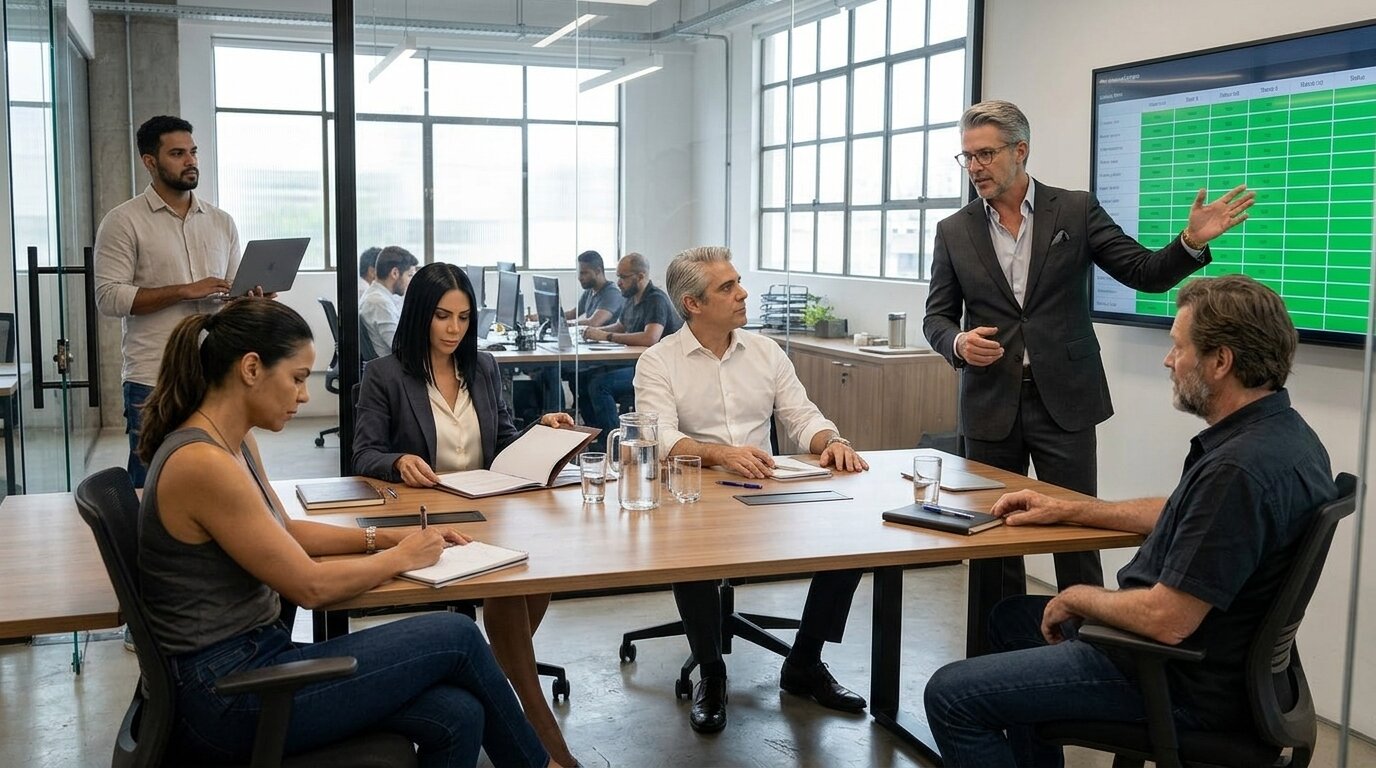
By the following Friday, Rodrigo could remember every version of Question 14 more clearly than the last navigation build he had flashed.
The first answer had claimed they verified all relevant conditions. The second had admitted they did not. The third had named the investigation they needed. The fourth had moved it into an appendix to satisfy Natalia’s format. He stood by the meeting-room door holding a laptop full of things no one had let him find out. There were not enough chairs. Somehow this embarrassed him more than the unfinished work.
Marcus’s screen was green.
“All review questions now have accountable owners. Response structure complete. Integration planning aligned across teams.” He paused where the slide invited him to pause. “We’ve established a repeatable assurance workflow.”
Bernardo leaned back, the leather creaking beneath him. The green cells eased the pressure behind his eyes. He could show these in a call, speak about progress without inviting anyone to follow a payment through its supporting documents. Klaus had a way of asking for the source that made a perfectly ordinary request feel like fingers closing around his throat. Planning gave Bernardo another week in which to answer with a plan.
“Good,” he said. “That’s the visibility we needed.”
Stefan stared at the heading. Progress. Across the table Adriana had stopped moving her pen. He knew the stillness: she was holding the first answer inside herself until she could trust its tone. He was tired of watching her do that.
“What does green mean?”
Marcus turned with mild surprise. “The planning deliverable is complete.”
“Not the evidence.”
“Nobody said the evidence was complete.” Marcus gave him the patient smile he used for someone making a point the room ought to have outgrown. Stefan’s ears grew hot. He wanted to wipe the smile from the man’s face with a sentence so exact that no one could wriggle away from it. The desire was almost childish. Marcus saw it and let him sit in it.
Bernardo looked toward the door. “Rodrigo. Are we still waiting on Germany?”
Rodrigo shifted the laptop against his chest. Saying yes would let the meeting move on. It would also make the last nine working days somebody else’s fault, safely far away. His mouth was dry. He could see Adriana looking at him, not urging, just waiting.
“Partly. On Question 14, we’re waiting for permission to run the investigation.”
Natalia drew a page from her folder. She had been reading responses since morning; the crease between her eyebrows was real, and so was the resentment she kept out of her voice. “The response needs the full technical review first.”
“It had my review,” Adriana said. “I marked it incomplete because the evidence is missing.”
“Then it’s not ready.”
Adriana looked at the folder. Her notes were in it. Her name was on the cover. There was something obscene about seeing her work used to keep her from doing it.
“It won’t become ready sitting in your fucking folder.”
The silence came fast. Rodrigo stopped shifting his weight. Natalia’s fingers flattened the page. Stefan saw the pulse in Adriana’s neck and wanted to put a hand over hers; she would have hated him for trying to calm her now.
Bernardo lifted his palm. “What specifically do you need?” He had heard the anger, but turning it into a request he could consider restored his place at the head of the table. Adriana sat back without apologizing. Her heart was hammering so hard she could feel it in her teeth.
Stefan laid one sheet in front of him. One, because his last eight pages had become forty-seven questions. “A controlled investigation on existing bench hardware. Navigation and the protocol specialist together. Capture both sides of the shared handler under the same traffic. Then we can establish whether the loss happens there or later in our software.”
Bernardo did not touch the sheet. “Is Germany authorizing this?”
“Dieter asked us to identify the missing evidence. His restriction is on manufacturing approval and production-candidate flashes. This is neither.”
Marcus stepped closer to the table. “Integration work follows the approval workflow. We can’t make exceptions whenever someone prefers a different method.”
Stefan gripped the edge of his chair. “I am trying to answer their question.”
“And assurance requires controlled activity.”
“I have just described the control.” His voice had risen. He felt the room taking note of the rise instead of the words, felt himself becoming the difficult consultant while Marcus stood there looking almost sorry for him. “Read the page, Bernardo. Please.”
The plea slipped out before he could remove it. He hated it. Bernardo glanced at the sheet and then at Marcus, who was already explaining how changing the workflow before its first complete review would undermine what they had established.
Marcus could feel the meeting narrowing to the decision he needed. Stefan wanted an afternoon because he believed an afternoon could produce an answer. If Bernardo allowed that and it worked, the next request would come without QuantumMind in the middle. Marcus kept his voice quiet and his hands open. He had no intention of letting one good experiment teach the room it could do without him.
Outside the glass, a developer passed carrying a radio head unit and a cable. Rodrigo followed the movement until it disappeared. The ease of it was unbearable.
“Finish the documentation properly,” Bernardo said. “Then we approve the test work. I don’t want another complaint from Passau.”
“We can’t finish the answer properly without doing the work.” Stefan heard himself repeating the same words, and something in his chest began to sink. He had imagined that better evidence, better phrasing, one less page would eventually reach a part of this man that wanted the car to work. Bernardo was looking at him as though the explanation had become an inconvenience.
“Then explain the dependency in the plan.”
Rodrigo made a sound, half laugh, half breath. Natalia glanced toward him. He looked down before she could ask what it meant.
Adriana placed her pen on the table. Her hand was shaking. She pressed the fingers flat, furious at the betrayal of her own body. Twelve years, three restructurings, all those frightened faces looking at her while she promised to find a way. If she could keep her voice steady, people believed there was still a way. She had learned to make that steadiness out of whatever remained after everyone else had taken their share.
“My review will continue to say evidence missing.”
Natalia’s jaw tightened. “That may delay the pack.”
“Then it’s delayed.”
Bernardo leaned forward. “Adriana, we all need to be constructive. Everyone knows how much this team relies on you.”
The praise struck exactly where it was meant to. Her first impulse was to pick up the pen. Find a sentence everyone could sign, get Rodrigo out of the room, spare the others another round. She could finish after Beatriz slept. She had done worse. She was strong; she had made people believe it for so long that refusing the weight felt like confessing a fraud.
She thought of her daughter asking a question and waiting while Adriana finished an email. Not a catastrophe. Just waiting. Again. Something hot climbed behind her eyes.
“Don’t do that.”
Bernardo’s expression changed. “Do what?”
“Tell me how much they need me while you stop me helping them.” Her voice cracked on helping. She bit the inside of her cheek, tasted blood, and let the crack remain. “You want my name on this? Put my answer beside it. Evidence missing. I will sign what I reviewed. I won’t sign what you wish we had.”
For a moment Bernardo could see the room through her eyes, and it frightened him. Not because he had suddenly understood the bench, but because she had said aloud what everyone else had been accommodating. He needed her angry in private, loyal in the room. “Watch your tone,” he said.
Adriana looked straight at him. She wanted to shout until the people outside heard, until he could no longer pretend the glass kept everything orderly. She also wanted her salary next month, her daughter safe, her team spared the punishment of her rage. The wanting tore in both directions. She left her hand on the table and said nothing more.
Marcus clicked to the next slide.
Her name remained in the green cell. Underneath, smaller: Technical confirmation pending.
“There,” Bernardo said, with the warmth of someone offering a solution. “The distinction is recorded.”
Adriana stared at the screen. The tear escaped before she could stop it; she wiped it with the heel of her hand, hard enough to hurt. Nobody remarked on it. Natalia looked down at the folder. Stefan could not bear the discretion of the room, the polite mercy that would let them remember a difficult woman instead of the answer she had given.
Rodrigo shifted the laptop under his arm. He had not opened it once.
The First Blank Page
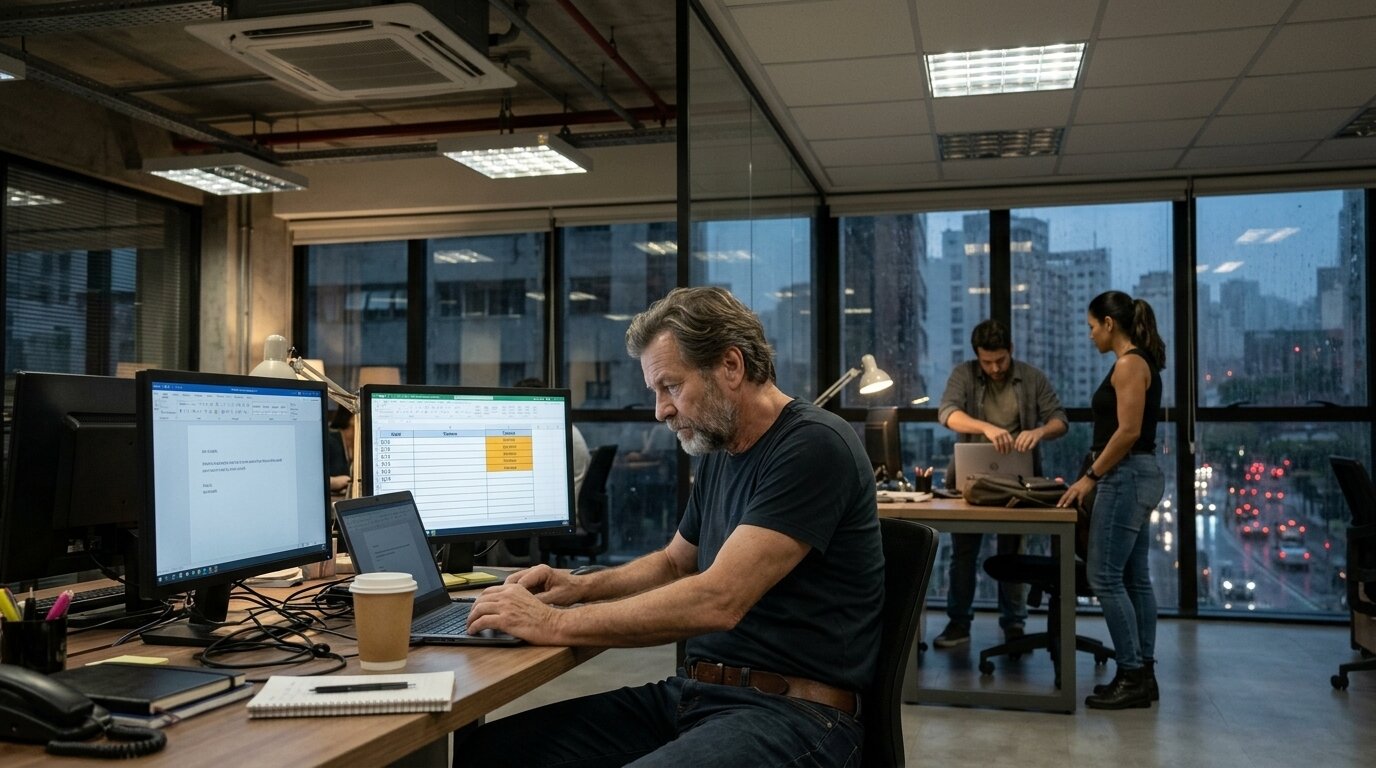
After the meeting, Rodrigo came to Stefan’s desk with his bag hanging from one hand. He stood there until Stefan looked up. The room was quieter now, the afternoon’s voices thinning toward the lifts; somewhere a chair squeaked again and again as a tired person rocked without noticing.
“Should I change the answer?”
Stefan rubbed his face. “Has anything changed?”
“The format.”
“Then don’t change the facts.”
Rodrigo nodded but did not leave. Stefan knew the waiting. He had encouraged it when there was a failing test to look at, a trace to open, a next step he could make small enough for someone to try. Now the young man was waiting for him to be the person he had advertised himself as.
“We were getting something onto hardware every week,” Rodrigo said. “I was going home with something finished. Even something small.” He twisted the bag’s strap around his fingers. “Now my mother asks how work is going, and I say busy. She thinks busy is good.”
A laugh came out of him and collapsed halfway. He looked toward the window. Rain was running through the dust on the glass; he concentrated on one thin track until it blurred.
“She tells people I’m leading a team.” He swallowed. “If I explain what I actually do all day, she’ll think I’m complaining about a good job. And I am lucky. I know that. There’s always someone who would kill to have this salary.” His voice roughened. “So what the fuck is wrong with me that I hate coming here?”
Stefan stood, but Rodrigo shook his head before he could move closer. He wanted comfort and could not bear being seen needing it. He had imagined saying this cleanly, a fact about a blocked team. Now he was talking about his mother to a man he wanted to respect him.
“Nothing is wrong with you,” Stefan said.
Rodrigo wiped his face with his wrist, angry at the wetness. “That’s nice. Does it get us the rig?”
Stefan had no answer. He could feel the silence hurting them both, yet every useful sentence he reached for was a smaller version of the promise he had already failed to keep.
“You didn’t lie in the response,” he said at last.
“No.” Rodrigo loosened the strap from his fingers; red marks remained across them. “But that doesn’t put anything in the car.”
He left before Stefan could make it sound like consolation.
Adriana was waiting near his desk. Stefan saw her touch Rodrigo’s shoulder, then fall into step with him toward the lifts. The folder remained under her arm. She had cried in front of Bernardo and still had the three reviews to finish, still had to decide what to tell people who would hear she had lost her temper. She wanted to throw the folder into the lift and let the doors crush it.
Rodrigo asked, quietly, “Are they going to make trouble for you?”
The question nearly broke what she had held together since the meeting. Even now he was frightened for her. She squeezed his shoulder. “Go home. We’ll see on Monday.”
He would hear the steadiness and believe she had some plan. She let him. Then, as the lift opened, she hated herself a little for needing to remain the woman who knew.
Stefan sat down again. Nearly two working weeks. Three teams. No new integration build on test hardware.
Júlia had sent a photograph: rain making little rivers between the pavement tables outside the bar. A friend’s hand was reaching into the edge of the frame for a glass. He stared at the picture until he could almost hear the street. The longing hit low in his stomach, sharp enough to make him lean forward. He wanted her laugh, her touch, the blunt way she could drag him out of a sentence and back into his body.
He also wanted the office gone. He could not quite separate the two wants, and that frightened him.
In Berlin there had been evenings when he stayed with a problem long after he could have gone home. He remembered the relief of being able to say what was wrong with the code, and Emma’s face when he tried to use that certainty at the dinner table. After the illness he had come back, been there for Sophie, answered the calls. He held those facts tightly. They were true. They did not erase the other evenings.
Now he was reaching for Júlia with the same hunger he once brought to a problem that could be solved. She had made no promise to take the rest of his life away.
He typed something light, a joke about the weather. Deleted it.
Today was bad. I’d like to see you, if you want company. I don’t have much conversation in me yet.
He sent it and immediately wished he could make the truth more attractive. The wish embarrassed him. He set the phone beyond his reach.
Dieter’s email was still open. The questions were real: a temperature value that might be stale, the missing observation across the handler, a rollback they had not demonstrated. Stefan read them slowly. He wanted someone to be entirely wrong so that he could put all his strength into fighting them. Dieter would not give him that relief. There were things they did not know, things a driver would discover with no knowledge of this room or the people trapped in it.
He opened a new message and attached the single page Bernardo had left untouched. He listed the investigations blocked by QuantumMind’s approval loop. Controlled bench work. Missing paired capture. The distinction between that work and manufacturing approval. He wrote directly to Dieter, carefully enough that nothing in the message could be mistaken for evidence they already possessed.
Then he stopped.
He could hear himself on the first day, making the next steps sound possible because he knew how to do them. He had liked the way people looked at him afterward. Their relief had felt like proof. His book, his talks, all those rooms where he described a way out: somewhere underneath the love of the work was a need to be the man who could find one.
For three weeks they had made progress. He was clinging to those weeks now, turning them over like receipts. See? It worked. It wasn’t a lie.
Rodrigo’s wet face would not leave him.
Stefan hit the desk with the heel of his hand. The coffee jumped in its cup, cold drops spattering the desk. “Fuck.” He said it again, louder, then pressed both hands over his eyes.
The tears came while he was still angry. He tried to swallow them back and failed; his chest jerked once, hard, and the sound that escaped made him glad the floor was almost empty. He was ashamed of the relief in it. People were afraid of losing their livelihoods, and he was sitting here wounded because they had stopped looking at him as if he could save them.
He remembered Rodrigo’s grin the first time the sensor value reached the display, Adriana shoving a chair toward him when there was room at the bench. He had been happy with them before anyone called the work a success. He held on to that memory, breathing hard. He wanted the software to work, wanted Rodrigo to go home proud, wanted Adriana’s name to mean her actual judgment. He wanted to be the one who made it possible. The wants would not come apart, however fiercely he tried.
He wiped his face with his T-shirt and looked again at the amber cell. There would be another plan he could write, another appeal, another night he could stay until the cleaners had gone. None of those thoughts had the old certainty beneath them.
I might not be able to save this.
He let the words remain. They made him feel sick.
The phone lit up.
Come. You don’t have to be useful tonight.
Júlia. He read the message twice, throat tightening again. He wanted to surrender to the kindness so completely that he almost missed the danger of making it another job for her. She had offered tonight. He could go to her tonight.
He sent the email to Dieter. On the second monitor Question 14 was still amber; his careful account of the blockage had changed nothing on the bench.
He closed the laptop, picked up the cold coffee, and took it to the bin. At the lifts he stopped to wipe his face once more. Then he went down into the warm, wet city, wanting Júlia so badly that he could no longer pretend wanting was simple.
🎭 This Week's Episodes
Telenovelas show what we can't say in client meetings. The drama is heightened, but the patterns are real.
 Documentation Avalanche
The forty-seven questions from Passau become a daily occupation. Stefan finds a gap the navigation team cannot investigate without Marcus's approva...
Technical Consultancy
Embedded Delivery Partner
Embedded into your team as an active contributor, reducing delivery friction and helping important work move cleanly.
Technical Advisor
Peer-style technical assessments before far-reaching decisions; reduce architectural and product risk early.
Product & Delivery
Ship working software to real users earlier. Measure impact and adapt based on evidence rather than assumption.
Custom Software Development
High quality, maintainable software. Short-term augmentation that leaves lasting capability in your own team.
Recent Articles
- AI Computer Use Is Not a Business Contract (09.10.2026)
- When Everything Is Finally Under Control (05.10.2026)
- AI Makes Technical Execution Cheap. Judgment Stays Scarce. (26.09.2026)
- The Agent Escaped. Who Left the Door Open? (24.09.2026)
- What an AI Agent Actually Is (21.09.2026)