What an AI Agent Actually Is
An AI agent is a model inside a software loop with tools, permissions, memory, and a stop condition. The machinery is...
7 min read
22.06.2026, By Stephan Schwab

Both OpenClaw and Nilo Assistant talk to you through chat and both run AI models underneath. That is where the similarity ends, and mixing them up is expensive. Nilo is a paid service we operate so that SMEs can get practical operational help without running a server, picking models, or hiring an IT department. OpenClaw is a free, open-source toolkit that a technically capable person installs and runs themselves. I built Nilo and I genuinely like OpenClaw, which is exactly why I want to be blunt: choosing the wrong one does not mean you picked the weaker tool. It means you picked a tool designed for someone else's situation. The fastest selector is one question: do you want to use a service, or do you want to build and run your own setup? If you hesitate on that question, you almost certainly want the service.
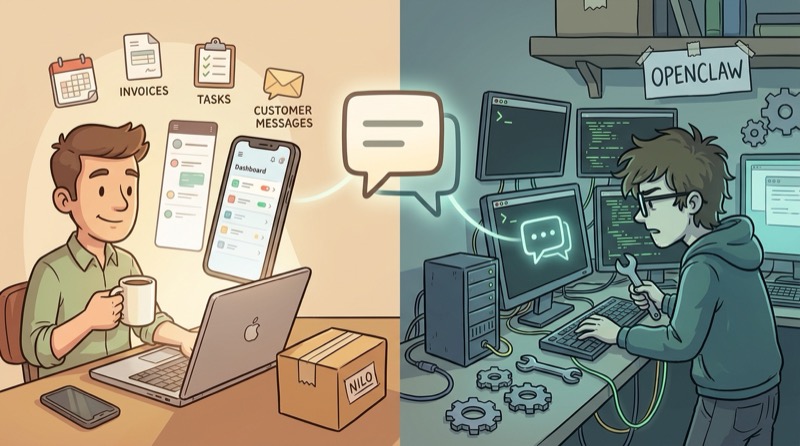
It is easy to see why someone would put OpenClaw and Nilo in the same mental folder. They both have a chat window. They both use modern AI models. They both promise to help you get things done. From a quick glance, they can look like two competing versions of the same idea.
They are not. Once you ask the simple question “who runs it, who pays for it, and who is it for,” the two move into different categories.
I am the creator of Nilo, so I am clearly not neutral. Both projects are doing something useful in their own world, and the worst thing you can do is pick one based on the other one’s job description.
Nilo is a paid service. We run it. You use it.
It is built for SMEs, the kind of companies that may have a handful of people or up to around a hundred, where the day is full of communication, follow-ups, content to prepare, decisions to track, and small things that quietly fall through the cracks. Nilo’s job is to help that kind of company keep its operations coherent without turning it into an IT project.
You sign up, you start with a low monthly price, and you talk to it like you would talk to an assistant. You tell it what is going on in plain business language. You do not configure runtimes. You do not install software. You do not pick AI models. You do not maintain a server. We take care of that part so you can stay focused on your work.
The idea behind Nilo rhymes a little with what big companies get from large enterprise systems like SAP: a place where the business actually lives, instead of a pile of disconnected tools. The difference is that those big systems assume you have a budget, an IT department, and a multi-year rollout. Most SMEs do not. Nilo is built for the SMEs that cannot or do not want to absorb that kind of overhead.
Nilo is not a developer tool. It is not something you self-host. It is not a generic AI you bolt onto your laptop. It is not a replacement for your full software stack on day one.
It is also not a one-size-fits-all answer for every kind of organization. The people we have in mind are running a real business and want help with the day-to-day work, not a software project.
OpenClaw is a free, open-source project. There is nothing to buy. You download it, install it, and run it on your own machine.
It is built for people who enjoy that kind of thing. Programmers, tinkerers, technically curious users, people who like to configure their own software and decide how it behaves. With OpenClaw, that kind of user can set up a personal AI assistant that lives on their own computer, talks to them through chat apps they already use, and connects to tools, files, and websites under their control.
It is, in plain language, a do-it-yourself toolkit. The whole point is that it is open. You can extend it, change it, plug it into different AI models, and decide where your data goes.
OpenClaw is built around a single trusted operator, but it has grown features for cooperative use: separate sessions per sender, several agents on one gateway, per-agent sandboxes and tool policies, separate gateways per role. Some teams now run it as a shared assistant inside one trust boundary, and a community of plugin and skill authors is forming around it, with a few people starting to offer setup and maintenance services. None of that turns OpenClaw into a managed product. Someone still has to install it, host it, lock it down, and keep it running.
OpenClaw is not a finished product for a non-technical user. It is not a service that someone else operates for you. It is not built for a company that wants to “just use it” without thinking about installation, setup, or maintenance.
It is also not a business operations system. It does not pretend to be one. The project’s own materials describe it as a personal AI assistant you run on your own devices. That is exactly what it is, and it is honest about it.
If you give OpenClaw to someone who does not enjoy software, they will be lost very quickly. That is not a flaw. It is simply who the project is for.
Both projects talk through chat apps, but the work behind that varies enormously. Telegram and WhatsApp are the clearest example.
Telegram is the easy case. You create a bot in BotFather, copy a token, and you are done. No phone number, no verification, no fees, no Meta paperwork. A developer can wire it up in minutes.
WhatsApp is a different story. With OpenClaw, the WhatsApp channel pairs with a real WhatsApp account by scanning a QR code, the same way WhatsApp Web works in a browser. That means a dedicated phone number, a real WhatsApp account on it, and a linked-device session that someone has to keep alive. It is not the official WhatsApp Business Platform. It is an unofficial library pairing as a linked device. It works, and many enthusiasts use it, but it is not what Meta calls a WhatsApp Business integration.
The people who do try to run OpenClaw against the official WhatsApp Business Platform end up doing it through a personal Facebook developer app in testing mode. That is fine for tinkering. It is not a basis for a real business presence: testing-mode apps are limited, not publicly published, and not what Meta expects a commercial WhatsApp deployment to look like.
This is exactly where Nilo plays a different game. We are putting together a Meta integration where Nilo acts as a technical provider on Meta’s side. An SME can connect its own WhatsApp Business Account, use its own number, run its own ads, and have leads land directly inside Nilo. The customer does not need to publish a Facebook app, configure tokens, manage webhooks, or pass platform reviews. We are the technical layer; the business identity stays with the customer.
That is the deeper difference between the two on this point. With OpenClaw, you can connect WhatsApp the unofficial way today, but the official path requires you to become a Meta developer yourself. With Nilo, the official path is the one we are building, and from the customer’s side it should feel like click, connect, done.
The fastest way to choose between them is to answer one question: do you want to use a service, or do you want to build your own setup?
If you run an SME and want practical help with daily operations without taking on an IT project, Nilo is the right shape. You pay a monthly fee, we run it, you talk to it, and the goal is to give you back time and clarity.
If you are technically capable, enjoy configuring your own tools, and want a personal AI assistant that you fully control, OpenClaw is the right shape. There is no fee. You also accept that you are the one running it.
Both are reasonable choices. They are simply not choices for the same kind of person.
I like OpenClaw. I am the creator of Nilo. Those two statements do not contradict each other, because the two projects are not competing for the same user. The mistake to avoid is judging one of them by what the other one is trying to do.
If you would like more context on what AI in business is actually for, see why a chatbot is not an AI strategy.
Tell me what is happening. I listen, ask a few practical questions, and reflect back what I see: where the risk may sit, what may be blocking delivery, and what looks worth checking next. No pitch, no obligation. Confidential and direct.
Talk it through. Practical reflection, no pitch.
Start a ConversationTelenovelas show what we can't say in client meetings. The drama is heightened, but the patterns are real.
 The Scattered — Part One
The collapse of Whitaker Payroll means something different in every household it touches. Olivia Parker and Ryan Mitchell step into sane new jobs w...
 Arrival
Stefan Richter arrives in São Paulo with a 90-day contract to fix delivery at AutoConnect Brasil. He finds 90 developers, 18 months of chaos, and a...
 What Is Offered First
The day before Sophie flies back to Berlin, Mateo takes them to Kuna Yala. The road climbs from the Chepo side into the mountains, the Caribbean ap...
Embedded into your team as an active contributor, reducing delivery friction and helping important work move cleanly.
Peer-style technical assessments before far-reaching decisions; reduce architectural and product risk early.
Ship working software to real users earlier. Measure impact and adapt based on evidence rather than assumption.
High quality, maintainable software. Short-term augmentation that leaves lasting capability in your own team.
A senior developer for your team
Our Embedded Delivery Partner writes production code with your team, improves the pipeline, and accelerates delivery. 60-70% coding, 30-40% coaching. A temporary teammate who ships from day one.