The AI Extraction
Back inside on temporary access, Ethan Carter goes after the oldest part of Whitaker Payroll: the COBOL itself. With Nathan Cole beside him, he uses AI to extract business rules from the nightly batches and turn them into C# tests by the thousand. Over two weeks the impossible becomes visible, measurable, and therefore terrifying. For the programmers, the system is finally becoming legible. For Linda Pritchard, Sharon Mills, and Donna Reeves, the moat around their survival is draining day by day. Derek Lawson sees enough evidence to worry but not enough courage to stand behind it. Graham Whitaker, who has barely paid attention until now, finally looks closely and sees loyal employees and his father's memory under threat. Visible proof has become more frightening to leadership than wrong numbers ever were.
Friday, 09:14 — The Museum Exhibit
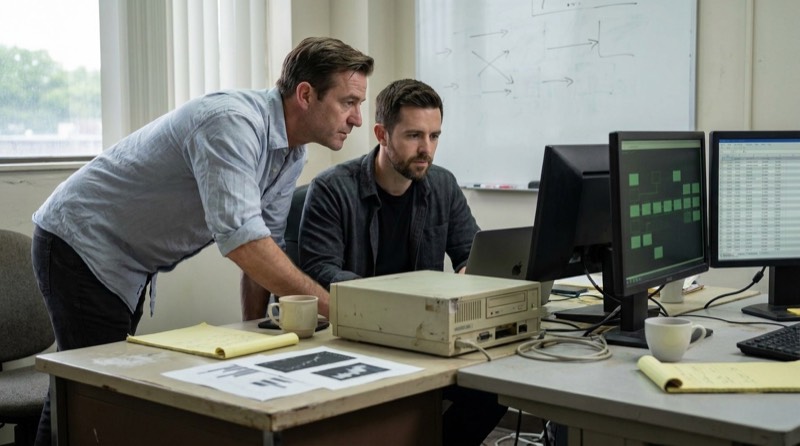
Nathan’s Micro Focus machine always made Ethan think of a museum exhibit that had somehow kept drawing power after closing.
Beige tower. Scuffed keyboard. An old monitor connector nobody under thirty should have recognized on sight. The thing sat under Nathan’s side desk with a small institutional hum, like a refrigerated archive trying to preserve the last physically intact copy of a dead language.
Nathan dropped into the chair beside it and pulled the keyboard into place with both hands.
“If this goes sideways,” he said, “I want the first sideways in here, not on staging.”
Ethan stood behind him for a moment with his coffee in one hand, watching the COBOL listing come up on the screen line by line.
“That’s the whole point,” he said. “We make the weirdness visible before anybody can call it tradition.”
Nathan gave him a glance over one shoulder.
“You keep saying sentences like that in this building and they’ll build a third firing method just for variety.”
Ethan almost smiled.
He had slept badly. Not because of the badge anymore. That humiliation had already settled into the permanent layer where experience went when there was no strategic value in reliving it. What remained useful was the fact that he was back inside with a bounded window and an old machine full of rules nobody could articulate cleanly in ordinary English.
That was enough.
He set his coffee down and opened the notebook where he had sketched the approach before dawn.
No magic. No mythology. Just disciplined theft from the past.
Take a narrow slice of COBOL tax logic. Feed it, with context, into a constrained prompt. Ask for candidate business rules and edge cases, not executable trust. Generate C# test scaffolds. Run those tests against known historical outputs. Keep the ones that held. Throw away the ones that didn’t. Repeat until the hidden shape of the thing stopped pretending to be mysterious.
The AI was not the authority. The running system was.
That distinction mattered to Ethan with almost moral force.
Nathan logged into the old environment and pulled up the federal-state withholding section tied to the Detroit path. Paragraph numbers marched down the screen in narrow white letters over blue.
To anyone who had not lived with it, the code looked like a legal transcript translated by a haunted adding machine.
Ethan leaned in.
“There,” he said, pointing. “That branch. The override path falls through into the municipal table instead of resetting after validation. That’s why Detroit poisoned the next pass.”
Nathan’s fingers hovered over the keys without touching them.
He had the look he always got when deep system knowledge turned from burden into temporary relief. His face lost ten years when the machine stopped being a social battlefield and became, briefly, a machine again.
“I can see what it’s doing,” he murmured. “I just couldn’t ever prove it fast enough in a language they’d believe.”
Ethan sat beside him and opened the AI workspace on the second monitor.
“Then we stop arguing from explanation and start arguing from examples.”
He pasted in the COBOL block, the related table definitions, and a stripped description of the relevant inputs. Then he typed the instructions with the severity of a man loading a weapon carefully enough to blame himself if it misfired.
Not prose. Not vibes. Extract candidate business rules. Produce explicit scenarios. Include edge cases. State uncertainty. Do not invent missing tax law. Label assumptions.
Nathan watched the prompt take shape.
“You trust this thing?” he asked.
“No,” Ethan said. “I trust it to make legibility cheaper. That’s different.”
He hit Enter.
The response began to stream: likely rule branches, override precedence, municipal carry-forward risk, candidate parameter combinations, a first cut at C# unit tests with clear placeholders where the model lacked confidence.
Nathan let out a sound that was almost a laugh and almost grief.
Not because the output was perfect. It wasn’t. Three of the first ten scenarios were obviously wrong. One had invented a county dependency that did not exist. Another misunderstood how a grandfathered municipal exemption interacted with union deductions.
But the wrongness arrived honestly, flagged, separable, correctable.
That was what made Nathan sit back hard in his chair.
For years, the company had lived inside a different kind of opacity. Oral certainty from people who softened every sentence as soon as it threatened to become falsifiable. Defects padded with history until they sounded too old to challenge. Wrong numbers wrapped in so much institutional reverence that by the time anyone touched them, the moral energy had leaked out.
This, by contrast, was crude and usable.
Wrong where it was wrong. Explicit where it was uncertain. Fast enough to matter.
“Again,” Nathan said quietly.
So they did it again.
Another block. Another extraction. Another set of candidate tests. Nathan rejected what didn’t match his understanding. Ethan adjusted the prompt. Ryan drifted over first, then Olivia, then Caleb with the unembarrassed curiosity of the young.
On the whiteboard Ethan wrote three columns:
| COBOL branch | Proposed rule | Verified test |
By 9:52, the board had started to fill.
Caleb stared at it with open delight.
“This is insane,” he said. “I mean that positively. This is like turning cave drawings into a CI pipeline.”
Olivia snorted despite herself.
Ryan folded his arms and leaned against the doorframe.
“Can it hold beyond Detroit?” he asked.
Nathan answered before Ethan could.
“If we keep the scope disciplined, yes. The trick is not treating the first good result like revelation.”
Ethan nodded.
“We use the model for candidate structure, not truth. Truth is the comparison run. Truth is whether history and output line up when we pin the logic down.”
Olivia looked from the old COBOL screen to the new tests appearing on the other monitor.
There were new shadows under her eyes today. She had been on at least one late call with a daycare provider before nine. She still carried herself like a competent adult making room for three crises at once and refusing to call that skill a personality.
“If this works,” she said, “it means the knowledge isn’t trapped in whoever can sound most certain anymore.”
The room went quiet for half a beat.
Not because anybody disagreed.
Because the sentence named the larger thing.
Nathan looked at the whiteboard and felt a strange cold brightness move through him. Vindication, probably, but damaged by history. He had tried for years to tell Derek, and through Derek the layers above him that only looked closely once something broke publicly, that the problem was not just old code. It was old code plus an organization that confused custody with comprehension.
Now Ethan was doing in a morning what Nathan had never had enough uninterrupted political oxygen to complete.
He should have felt only gratitude.
Under that gratitude lived something sharper and more humiliating: evidence that the graveyard behind him had not been composed entirely of impossible work. Some of it had been composed of him, exhausted and alone and repeatedly dragged away before method could take root.
Ethan seemed to read enough of that from his face to spare him any cheerful talk.
“This isn’t proving you were wrong before,” he said, eyes still on the screen. “It’s proving what protected the mess wasn’t technical depth. It was interruption.”
Nathan looked down at his hands.
“That’s somehow worse.”
“Yes,” Ethan said.
And because honesty between them had become the only humane thing in the building, they left it there.
The following Wednesday, 12:48 — The First Thousand
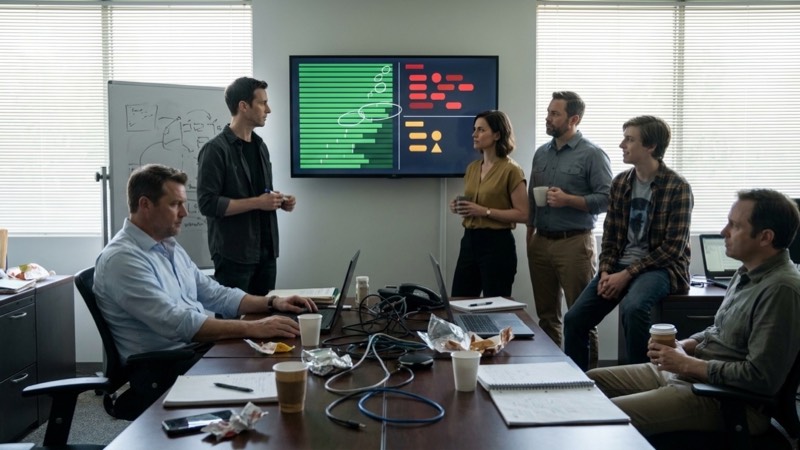
The first thousand tests were ugly.
That was why Nathan trusted them more than anything the company had called knowledge in years.
Four hundred and eighteen failed immediately. Some because the AI had inferred a rule too broadly. Some because the historical data itself revealed old emergency workarounds that had never been formally retired. Some because the COBOL path depended on input conditions nobody had documented since the Clinton administration.
But each failure was a failure with edges.
Ethan stood by the wall monitor with a marker in his hand, circling clusters instead of individual results. He moved like a mechanic listening to an engine by pattern rather than by single complaint.
“Don’t worship the green,” he said. “The red is where the hidden decisions are.”
Caleb, who had been grinning on and off for an hour as if someone had finally turned software back into a contact sport, pointed at the lower pane.
“This one keeps recurring. Municipal override survives a correction cycle if the prior run had a manual flag and the employee crosses a locality boundary inside the same pay period.”
Ryan looked up from his own machine.
“So the run isn’t just wrong sometimes. It’s sticky wrong.”
“Exactly,” Ethan said.
He wrote STICKY WRONG on the whiteboard and underlined it once.
Olivia laughed under her breath.
“That’s the clearest requirements document this place has ever had.”
Nathan should have laughed too. Instead he felt his pulse pick up with the uneasy thrill of watching a dead landscape start to answer back.
Every passing minute made the old certainty weaker.
Not the certainty of the code. The certainty of the people who had survived by narrating that code as irreducibly human, irreducibly oral, irreducibly theirs.
He looked at Marcus, who sat slightly turned in toward the group, one hand wrapped around a paper cup he had forgotten to drink from.
Marcus never performed enthusiasm. Even his good moods came out looking like temporary reductions in alarm.
“You okay?” Nathan asked.
Marcus nodded once, then reconsidered the lie halfway through.
“This is good,” he said. “That’s not the problem.”
Ethan waited.
Marcus looked at the wall monitor where the counts kept climbing.
“The problem is if this works, they won’t experience it as good. They’ll experience it as exposure.”
Nobody answered right away because Marcus had named something each of them had already felt and hoped, maybe stupidly, not to say aloud.
He kept his eyes on the screen.
“I’m not saying stop,” he added quickly. “Jesus, don’t stop. I’m saying people don’t like finding out the mystery wasn’t sacred. Especially if the mystery paid their mortgage.”
Caleb opened his mouth, probably to say something about truth or modernization or not living in 1998 forever. Olivia touched two fingers lightly to his sleeve without even looking at him. He closed his mouth again.
She understood the moral geometry better than he did.
So did Ryan.
“Then we keep it concrete,” Ryan said. “Not ‘AI understands the payroll system.’ That’s how they panic. We say we built a faster way to verify scenarios against known output. Which is true.”
Ethan nodded.
“And we show our misses too.”
Nathan turned to him.
“Why?”
“Because if we pretend this thing is perfect, they’ll be right to call it reckless. We don’t need the model to be magic. We need the method to be disciplined.”
That answer relieved Nathan and frightened him at the same time.
Relieved him because it was technically right.
Frightened him because technically right had not been an adequate shield even once in the past two weeks.
By 1:10, the first thousand had become 1,640 candidate tests, 913 validated, 211 corrected and rerun, 516 still under review. The numbers on the wall monitor did not feel theatrical. They felt municipal, tax-year, deduction-code, filing-status specific. The kind of boring exactness that either saved people or got them hurt.
Ethan exported a subset tied to Detroit, another to two Ohio municipalities Sharon had cited six months earlier as examples of why modernization was allegedly impossible, and a third tied to a strange multistate edge case Nathan remembered from a Friday night support call in 2018.
When the reruns came back, two of Sharon’s long-protected “that’s just how it works” branches failed cleanly against the comparison cases.
Nathan stared at the result until he became aware Ryan had stopped moving in the chair beside him.
“That can’t be right,” Caleb said automatically.
No bravado in it. Just the oldest possible reflex when institutional myth first hits hard evidence.
Ethan didn’t correct him. He only said, “Let’s see why.”
They dug.
Not glamorous work. Pulling historical sample files. Checking the input conditions. Verifying year-specific exemptions. Replaying the outputs in a controlled comparison run.
Twenty-one minutes later the red line held.
Sharon’s branch was not a sacred impossibility. It was an old workaround that had metastasized into oral doctrine because nobody had ever had the spare time, political cover, or tooling to interrogate it properly.
Olivia sat back hard in her chair.
“So they’ve been preserving errors with extremely competent office voices.”
“Not always errors,” Nathan said automatically.
Then he stopped himself.
He could feel his own old habit trying to soften the thing so it would be more livable. More respectable. Less like a verdict against years of tolerated harm.
Ethan glanced at him but said nothing.
Nathan looked back at the screen.
“No,” he said. “That’s wrong. Sometimes errors. Sometimes fossilized emergency choices. Sometimes just inherited caution that outlived the conditions that made it necessary. But yes. They’ve been treating unverified continuity as authority.”
Ryan rubbed a hand over his mouth.
“You realize if Derek sees this, he won’t know whether to be excited or terrified.”
Nathan answered before Ethan could.
“He’ll borrow the fear of whoever sounds most injured by it.”
That was the real danger.
Not the tests. Not the AI. Not the code.
The social choreography around who got to look legitimately alarmed.
Outside the development room, binder rings snapped shut. Phones rang. Support people moved with practiced urgency. The office still looked like an office. Inside, the wall monitor kept turning hidden rules into counts.
Measurable progress was the filthiest thing Whitaker Payroll had seen in years.
The following Monday, 14:26 — Concern, Properly Framed
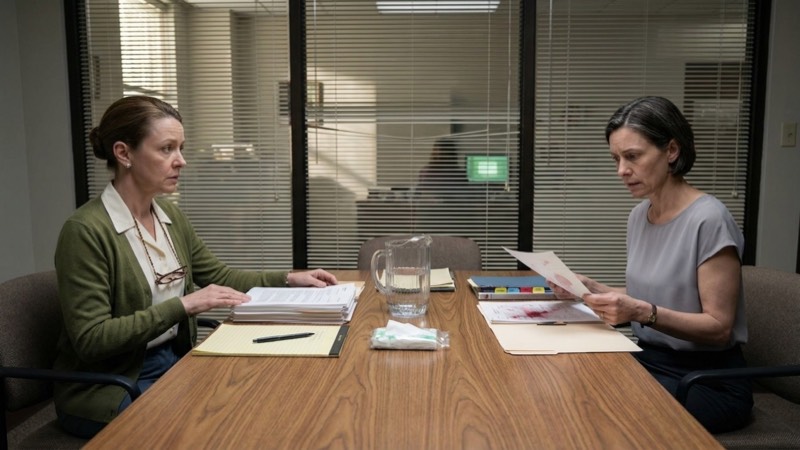
Linda had always believed that panic announced itself loudly in other people and quietly in herself.
In herself, it arrived as neatness.
Straightened stacks. Reordered tabs. A more careful voice. Hands kept flat on the table so nobody would see the tremor in the fingers until it passed.
She sat in the conference room with Sharon and Donna and looked at the printout Ethan had left in what he probably considered an act of transparency.
Verified scenarios.
Candidate rules.
Historical mismatches.
Nothing about the pages was flamboyant. That was what made them obscene.
If he had come in making mystical claims about artificial intelligence replacing experience, Linda could have dismissed him cleanly. If he had sounded like a consultant in love with his own novelty, she could have hated him without self-doubt.
Instead the packet looked like disciplined accounting. Footnotes where uncertainty remained. Failed candidate tests preserved instead of hidden. Notes on historical output patterns. A short line beside one branch Sharon had defended for years:
Likely legacy workaround, now behaving as de facto rule.
Sharon kept reading that line as though enough repeated exposure might make it less insulting.
“Likely,” she said at last, with tight contempt. “He doesn’t know enough to write likely there.”
Donna was looking at a different page, one that showed an old municipal exception failing against a scenario Donna herself had once walked Nathan through over the phone. She could still remember the call. Her younger son had a fever. She had been standing in her kitchen barefoot with the refrigerator open, reading from a binder while Nathan typed on the other end. She had felt useful then. Necessary in the best sense.
Now the test case sat on paper with a red X beside the output they had all treated as settled.
“Maybe not that exact word,” Donna said carefully. “But the branch does look narrower than we’ve been describing it.”
Sharon looked at her sharply.
“Based on what?”
Donna hated that question because she never knew whether it was asking for evidence or for permission to continue having a thought.
“Based on the scenario set,” she said. “And the rerun notes.”
Sharon exhaled.
“The rerun notes Ethan generated with a machine.”
“The reruns were checked against output,” Linda said quietly, before the exchange could harden into anything too plain.
She was trying to calm the room, but she heard herself too. The softness. The way each sentence arrived padded, reversible. This was how they always talked when the stakes got close enough to burn.
Not because they were stupid.
Because stupidity would have been easier to outgrow than terror.
Linda had spent twenty-two years making herself indispensable in a company that never would have hired her for a modern software job and certainly would not hire her for one now. She was fifty-one, divorced, with a mortgage whose monthly number lived under every opinion she voiced at work. Payroll had not just been a paycheck. It had been the proof that precision could still protect a life.
If Ethan could pull rule structure out of COBOL with an AI model and some discipline, then what exactly had her precision been buying all these years besides delay?
The thought felt disloyal, not only to Thomas Whitaker’s company but to the self she had built inside it.
Donna shifted in her chair.
“I don’t think anyone is saying our knowledge doesn’t matter.”
Sharon gave a short laugh.
“That’s exactly what this is saying. It just says it with enough footnotes to sound respectful.”
Linda looked down at her own annotated copy. Three red circles. Two question marks. One place where she had written CHECK 2009 UNION EXCEPTION and immediately afterward drawn a line through it because if she went back far enough in the binders she could always find another historical reason not to trust what was in front of her.
That was the trap.
There was always another old edge case. Another almost-memory. Another institutionally inherited reason to delay letting a conclusion harden.
She could feel herself reaching for it now, the familiar relief of indefinite complexity.
Maybe the model had overfit the examples. Maybe Nathan had remembered the context wrong. Maybe the old output only looked wrong because the client file used a grandfathered local arrangement nobody under forty would even know how to name. Maybe Derek should decide whether the evidence was mature enough to matter. Maybe Graham needed to hear it framed more carefully. Maybe if Sharon wasn’t saying the branch was plainly wrong, Linda was being reckless even thinking it.
Donna touched the corner of one page.
“What if it’s not replacement?” she asked, and even she sounded unconvinced by her own hope. “What if it’s just another verification layer?”
Sharon turned to her.
“And when the verification layer starts telling them our judgment can’t be trusted? What do you think happens next? A celebration of our institutional wisdom?”
Donna said nothing.
Linda stared at the page until the numbers blurred for a second.
That was the thing she could not say aloud because saying it would split her in two.
The tests did not feel fake.
That was the real problem.
If they had felt obviously sloppy, she would have marched them straight to Derek with righteous confidence. Instead they felt careful enough to threaten her and imperfect enough to be deniable. The worst possible combination. She could sense the floor moving and still could not bear to be the first person to shout that it was moving.
She reached for the safest version of courage available.
“We need to raise concern,” she said. “Not about innovation. About risk. About over-reliance on non-deterministic tooling in a regulated environment. About the possibility of people becoming overconfident before validation is complete.”
Sharon’s shoulders loosened slightly. Donna nodded, relieved by the available script.
There it was again, the company’s true genius: translating fear of exposure into the language of responsibility.
Linda hated herself a little for how quickly the phrasing comforted her.
But comfort won.
“And we should be clear,” Sharon added, recovering force now that the moral footing had been reframed, “that Thomas never would have allowed payroll judgment to be outsourced to a machine.”
That landed.
Not because anyone could prove it.
Because invoking the dead made the living bolder.
Linda gathered the papers into a neat stack.
“Let’s speak to Derek together,” she said. “Carefully.”
Carefully meant they could still imagine themselves as protectors when they walked into the office to defend the blur.
Wednesday, two weeks after reinstatement, 16:03 — Authority Loop

By four o’clock the room contained enough evidence to force action in any healthy company.
Whitaker Payroll was not a healthy company.
It was a company full of professionally dressed adults waiting for someone else’s certainty to rescue them from their own eyes.
Ethan stood beside Nathan with the verified scenario packet in hand and watched the loop form almost immediately.
Derek opened with the tone he reserved for meetings where he wanted to sound generous before narrowing the available reality.
“We’ve all seen the early outputs,” he said. “There’s clearly interesting work happening. The question is how to distinguish useful acceleration from risk-producing overreach.”
Interesting work.
As if the thing on the table were a museum installation and not a path to catching real payroll harm faster.
Nathan kept his voice flat.
“We extracted candidate rules from narrow COBOL segments, validated against historical output, and generated explicit tests for the branches we could verify. We’re not replacing review. We’re making review falsifiable.”
Graham’s expression tightened at that last word.
He disliked language that made hidden moral obligations feel mechanical. It threatened the tasteful vagueness in which he preferred to reside.
Linda spoke before he had to.
“No one is opposed to verification,” she said. “What concerns us is the pace at which something probabilistic is being granted the aura of settled judgment.”
Ethan looked at her.
He could see she believed enough of what she was saying to make it dangerous. Her voice had the sincere tremor of a person mistaking self-protection for stewardship.
“The model isn’t the judgment,” he said. “The comparison run is. The failed tests are preserved. The uncertain cases are flagged. That’s the opposite of overconfidence.”
Sharon opened her binder and slid one page forward with two fingers.
“And yet this branch here,” she said, tapping the municipal exception result, “would have labeled a historically accepted outcome as wrong. Which tells me the system still lacks business context.”
Nathan answered.
“It labeled it as inconsistent with the branch behavior once we replayed the inputs. We checked the output twice.”
“Against today’s framing,” Sharon said.
There it was. The endless escape hatch.
Today. Context. Framing. Terms soft enough to dissolve any contradiction that got too sharp.
Donna sat very still, hands folded over her folder. Ethan could tell she was frightened not only of him or of AI or of change, but of making the wrong move inside her own social bloc. Every time her eyes landed on a red-marked discrepancy, they flicked sideways toward Linda and Sharon as if borrowing permission to feel uncertain.
Derek turned to Graham.
“This is where my concern sits,” he said. “Not with disciplined experimentation as such, but with the possibility that a machine-generated intermediary starts outrunning the lived judgment of the people who have guarded these edge cases for decades.”
Ethan almost said Then stop making it an intermediary and let it be a test harness.
Nathan beat him to the move, though softer.
“Guarded is the wrong word if the output is wrong and we can show it’s wrong.”
That sentence changed Graham’s face more than any technical explanation had all week.
Not because he suddenly understood the extraction method.
Because he understood insult.
His father had trusted Linda and the others. His father had built the company with people like them beside him. To say their judgment could be superseded by something new, measurable, and partially machine-assisted felt to Graham less like process improvement than filial desecration.
He moved to the window and then back again, a small orbit of expensive distress.
“You keep talking as though visibility itself settles the matter,” he said. “It doesn’t. In a business like this, certainty has to be earned relationally, not just computationally.”
Nathan actually closed his eyes for a second.
Ethan felt it beside him like a pulse of pain.
Linda heard the sentence and straightened slightly, relieved by its elegance. Sharon heard permission. Donna heard the owner sounding unsettled and translated that into a reason not to trust her own earlier flickers of doubt.
And Derek, seeing their relief, read it as corroboration.
There it was. The authority loop in living form.
Nobody sure enough to own the truth.
Everybody using everyone else’s hesitation as evidence.
Ethan spoke carefully, because even now some stupid humane part of him wanted one more try.
“This isn’t relational against computational,” he said. “It’s explicit against implicit. We can keep your review. We can keep Nathan in the loop. We can keep SMEs reviewing edge cases. But once the branch behavior is visible and repeatable, we don’t have to keep pretending uncertainty is the same thing as wisdom.”
He should not have said pretending.
The word landed like a slap.
Not because he was wrong.
Because it deprived everyone in the room of the moral cushion they had built around their own evasions.
Graham turned fully toward him.
“That is exactly the kind of tone problem Derek has been trying to manage,” he said, voice controlled enough to sound principled. “You do not get to walk in here on temporary accommodation and tell loyal people that their judgment is pretense because you’ve produced a thousand machine-assisted scenarios in two weeks.”
Nathan stepped in.
“He said uncertainty isn’t wisdom when the branch is repeatable and wrong. That’s not contempt. That’s the work.”
Derek didn’t look at Nathan. He was watching Graham, measuring where wounded inheritance might become executable authority.
Linda folded her hands tighter.
This was the terrible part Ethan could see on her face now. She knew enough to fear he might be right. But the possibility of his rightness had already become socially unlivable. If she sided with the tests plainly, she would be helping build the mechanism that could erase the only domain in which her life had remained professionally defensible.
So she chose the version of conscience that still left her a future.
“No one is trying to stop progress,” she said quietly. “We’re trying to prevent false confidence from harming clients.”
Donna nodded. Sharon nodded. Derek inclined his head as if the sentence had clarified something rather than anesthetized it.
Nathan looked at them all and saw, maybe more clearly than ever, how organizations died long before any legal dissolution paperwork got filed. They died here. In rooms where everyone could feel the numbers changing shape and still chose the sentence that best preserved the self.
He spoke to Graham, not because Graham deserved the directness, but because this was the last place formal power still had a face.
“The tests catch harm faster,” he said. “The extraction gives us a way to verify what the COBOL is actually doing instead of worshipping oral tradition. If you shut this down because it makes people feel replaceable, you are choosing emotional comfort over payroll accuracy.”
For one second Graham’s expression opened enough for Ethan to see the raw thing under the polish.
Grief.
Not noble grief. Not redemptive grief. Possessive grief.
His father gone. His father’s world exposed as partial. His father’s loyal keepers frightened in front of him. A machine and two programmers making fifty years of inherited mystique look contingent.
He could not bear the thought that honoring the past might require admitting the past had also been preserving error.
When he answered, he sounded calmer than before.
That was how Ethan knew the decision had already hardened.
“We can’t take this risk,” Graham said.
Nathan stared at him.
“The risk is already in production.”
Graham shook his head.
“The risk is introducing a non-human interpretive layer into payroll judgment and destabilizing the people who have held this business together. My father trusted them. I trust them. We are not replacing experienced judgment with a machine because a contractor finds ambiguity aesthetically offensive.”
Ethan felt Nathan tense beside him.
Derek finally looked up from his notes, face composed into administrative regret.
The room had given him what he needed: an owner in pain, SMEs in careful distress, a contractor whose clarity could be reclassified as recklessness.
Now the violence could become tasteful again.
Wednesday, 16:37 — The Second Time
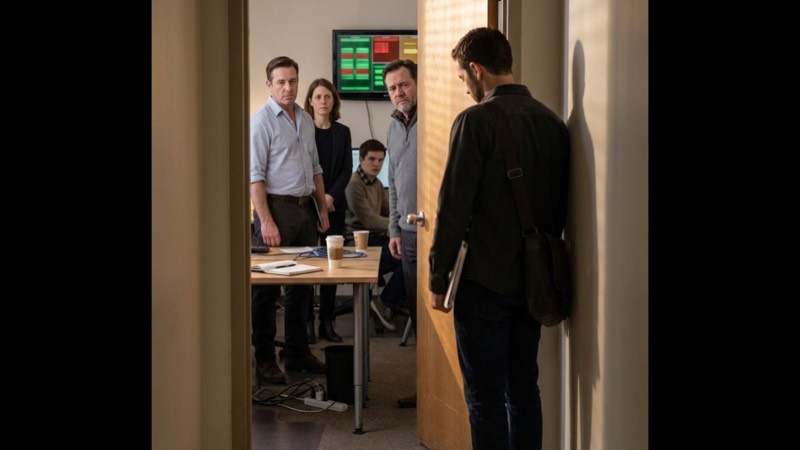
Derek did not escort them back to the development room.
That would have required too much ownership.
He sent Melissa instead with a face so pale it seemed cruel to resent her for carrying the message.
“Graham would like Ethan’s system access concluded effective immediately,” she said from the doorway, voice already apologizing for an institution that paid her to help it avoid verbs. “Nathan, he asked that you manage the transition of any materials needed for internal continuity.”
Silence followed.
Not dramatic silence. Office silence. The kind that arrived when everyone in the room understood at once that the official sentence would be cleaner than the lived event and that no appeal, if it came, would be granted in a language worth respecting.
Caleb stood up too fast.
“Are you kidding me?”
Ryan was already on his feet, chair shoved back. Olivia’s hand had gone to her mouth before she seemed aware of it.
Marcus looked at Ethan the way men look at the edge of a cliff they have privately been measuring for months.
Nathan took one step toward Melissa and stopped himself so violently Ethan could almost hear the restraint scrape through him.
“On what grounds?” Nathan asked.
Melissa swallowed.
“On risk grounds,” she said. “And role fit. I’m sorry. That’s the instruction I was given.”
Ethan set the printed tests down on the desk.
The pages were still warm from the printer.
That detail offended him more than the wording. Proof fresh enough to bend at the corners and already politically obsolete.
Nathan turned to him.
There were moments when Nathan’s age showed less in his face than in the quality of defeat he was fighting not to reveal. This was one of them. He looked like a man who could see, all at once, the whole future cost of the room and still had to remain functional inside the current minute.
“I can still push this,” Nathan said. “Not today maybe, but I can keep pushing.”
Ethan looked at him and knew the answer before he formed it.
This was not the first firing anymore. The first had still lived in ambiguity. This one had been reached after evidence. After verified tests. After Graham had seen enough to know what he was choosing.
That made the choice cleaner and dirtier at once.
“No,” Ethan said quietly. “This is the one they mean.”
Olivia lowered her hand.
“They didn’t even look at the whole packet,” she said.
Ryan gave a short laugh with no amusement in it.
“They looked at exactly enough to feel threatened.”
Caleb swore again, this time louder.
Marcus said nothing. His silence was not agreement. It was calculation under terror, the kind that happened when each new managerial absurdity had to be translated instantly into its possible effect on insurance coverage, rent, medicine, tomorrow.
Nathan’s voice roughened.
“Ethan.”
It held more than the name. Gratitude. Shame. Anger. A plea not to let this moment become the whole story.
Ethan began putting things into his bag.
Not much. Laptop. Notebook. The packet. The latest verified scenario set. He left the coffee mug because pettiness would have required energy he no longer respected in himself.
“Keep the repo state exactly where it is,” he said to Ryan and Olivia. “Don’t romanticize this and go broad. Narrow slices, verified outputs, preserve failed candidates, document assumptions. The method matters more than me standing next to it.”
Nathan shut his eyes once.
That sentence hurt more than if Ethan had lashed out. It implied continuation. Survival beyond the personal insult. A future in which the work might still deserve discipline even after the company proved itself unworthy of it.
“They don’t deserve you talking like that on the way out,” Caleb muttered.
Ethan swung the bag closed.
“This isn’t for them.”
Melissa was still standing there, miserable in the doorway.
He softened his tone toward her without meaning to. She was another human pressed into administrative theater because someone above her preferred clean hands.
“Do I get to leave with my own notes, or has governance escalated to intellectual kidnapping?”
Color rose in her face.
“Your own materials are fine,” she said. “Nathan can confirm what stays with the company.”
Nathan almost laughed at the obscenity of that arrangement. As if he were now custodian over the wreckage with no standing over the decision itself.
From the hall came the softened office noises of people pretending not to listen. Binder rings. Printer feed. A phone transferred too quickly. Somewhere, Linda’s shoes crossed and recrossed a patch of carpet. Ethan could feel the whole building arranging the event into stories that would let its inhabitants keep functioning tomorrow.
Necessary caution.
A regrettable fit issue.
The company choosing stability.
Anything but the plain sentence: we saw a better way to verify harm and killed it because it frightened the people whose identities depended on blur.
Nathan stepped closer.
“I’m sorry,” he said.
This time the words were not tactical. They came out damaged and bare.
Ethan nodded once.
“I know.”
Same words as the cafe. A different weight now.
Nathan looked at the bag, the tests, the empty space that would be left behind in the room fifteen seconds after Ethan crossed the threshold.
He wanted, absurdly, to promise something. A reversal. A later justice. A future in which competence would shame these people into honesty.
He had lived too long in this company to make promises that stupid.
So he said the truest thing left.
“You were right about the work.”
Ethan’s face changed at that, not into relief but into the kind of sadness reserved for vindication that arrives too late to save anything immediate.
“Yeah,” he said. “That’s usually when places like this get rid of you.”
He slung the bag over his shoulder and headed for the door.
Olivia stepped aside, eyes bright with furious helplessness. Ryan held the door frame with one hand so hard his knuckles whitened. Caleb looked ready to burn the building down with sarcasm if not fire. Marcus stared at his keyboard because looking directly at departure felt too close to imagining his own.
Ethan paused only once, at the threshold, and turned back toward the wall monitor.
The latest run results were still there. Green, red, amber. Explicit. Imperfect. Honest.
A better moral document than anyone above them had managed all month.
“Save the failed cases,” he said. “Those are where the truth is hiding.”
Then he left.
Nathan stood where he was until the corridor swallowed the sound of Ethan’s steps.
Across the room, the air-conditioning kicked on with a low mechanical rush. The wall monitor kept glowing. The tests did not stop being true because the man who had made them legible was no longer employed.
That was the unbearable part. For Nathan. For Olivia and Ryan. Even, somewhere under their careful language, for Linda and Donna and maybe Sharon too.
Reality had not been defeated.
It had only been expelled from the room again.
And because Whitaker Payroll had chosen that expulsion after seeing enough to know better, everyone left inside now understood something they would never be able to unknow.
This company would rather preserve the emotional dignity of its hierarchy than let explicit evidence correct inherited harm.
Nathan looked at the empty space beside the old Micro Focus machine and felt the future narrow.
Not all at once. Not apocalyptically.
More quietly than that.
In the way a bridge begins to fail long before anyone hears the collapse.
🎭 This Week's Episodes
Telenovelas show what we can't say in client meetings. The drama is heightened, but the patterns are real.
 Arrival
Stefan Richter arrives in São Paulo with a 90-day contract to fix delivery at AutoConnect Brasil. He finds 90 developers, 18 months of chaos, and a...
 What Is Offered First
The day before Sophie flies back to Berlin, Mateo takes them to Kuna Yala. The road climbs from the Chepo side into the mountains, the Caribbean ap...
 Collapse
Year-end arrives with the force of something everyone has been preparing not to name. A critical COBOL tax-calculation path fails on an undocumente...
Technical Consultancy
Embedded Delivery Partner
Embedded into your team as an active contributor, reducing delivery friction and helping important work move cleanly.
Technical Advisor
Peer-style technical assessments before far-reaching decisions; reduce architectural and product risk early.
Product & Delivery
Ship working software to real users earlier. Measure impact and adapt based on evidence rather than assumption.
Custom Software Development
High quality, maintainable software. Short-term augmentation that leaves lasting capability in your own team.
Recent Articles
- The One-Person AI Company Is a Greed Fantasy (15.09.2026)
- Test Production Without Leaving a Mess (10.09.2026)
- Software Will Fail. Recovery Is the Real Metric (05.09.2026)
- Stop Outsourcing Your Product Language (01.09.2026)
- Software Has Always Moved Up the Stack (29.08.2026)