The Horse With Brio
Valentina Sánchez Herrera rides onto Stefan's finca to check on her father's Peruvian Pasos and finds Sophie watching from the fence. Within an hour, Sophie is on a horse for the first time. The next four days belong to Valentina, the rainforest trails, and the slow discovery that brio — that particular Peruvian quality of willing, focused energy — is something a horse can teach a sixteen-year-old from Berlin.
A stranger on horseback, a breed unlike any other, a first lesson in the mud, and the word brio — which turns out to explain more than just horses.
The Woman Who Arrived Like a Verdict
I heard her before I saw her.
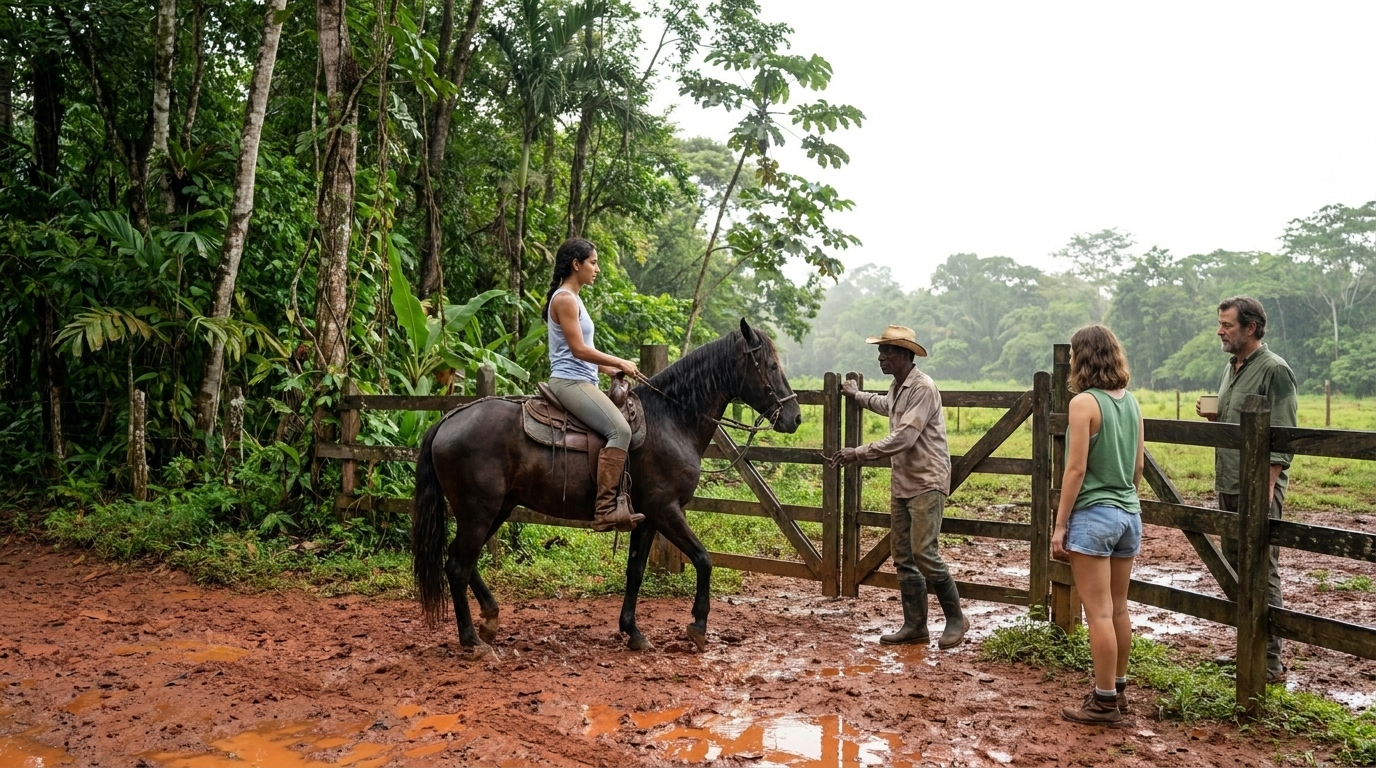
Not hoofbeats exactly — more like a presence that displaced the air in front of it. Then the horse came around the bend in the red-mud track, and on it a woman who rode the way very few people do anything: without thinking about it at all.
She was not showing off. That was the thing. Showing off is a performance for an audience. She was just riding, the way you walk to your own kitchen, like the horse was simply the way she moved through the world at this particular speed.
Papa straightened. Even Esteban turned.
“Valentina,” he said, and walked to meet her.
She dismounted in one long, unhurried swing and landed with both feet flat in the mud, reins loose in her hand. The horse — a Peruvian Paso named Reina, the same mare I had been circling cautiously for five days — stood absolutely still for her the way it had never quite stood still for me.
“Don Stefan.” Two kisses, one each cheek, full Latin style, no hesitation. Then she turned to me.
Her eyes were dark and quick and she looked at me the way a vet looks at an animal: direct, curious, not unkind, taking a reading.
“Tu hija?” She glanced at Papa. “No se parece a ti.” Your daughter? She doesn’t look like you.
He translated.
“Gracias,” I said, and meant it. I have heard this my whole life and I have always taken it as a compliment.
Valentina laughed, surprising me. A full laugh, unguarded. “Good Spanish,” she said, in English, deadpan.
This was going to be an unusual week.
Open Hand, Low Voice
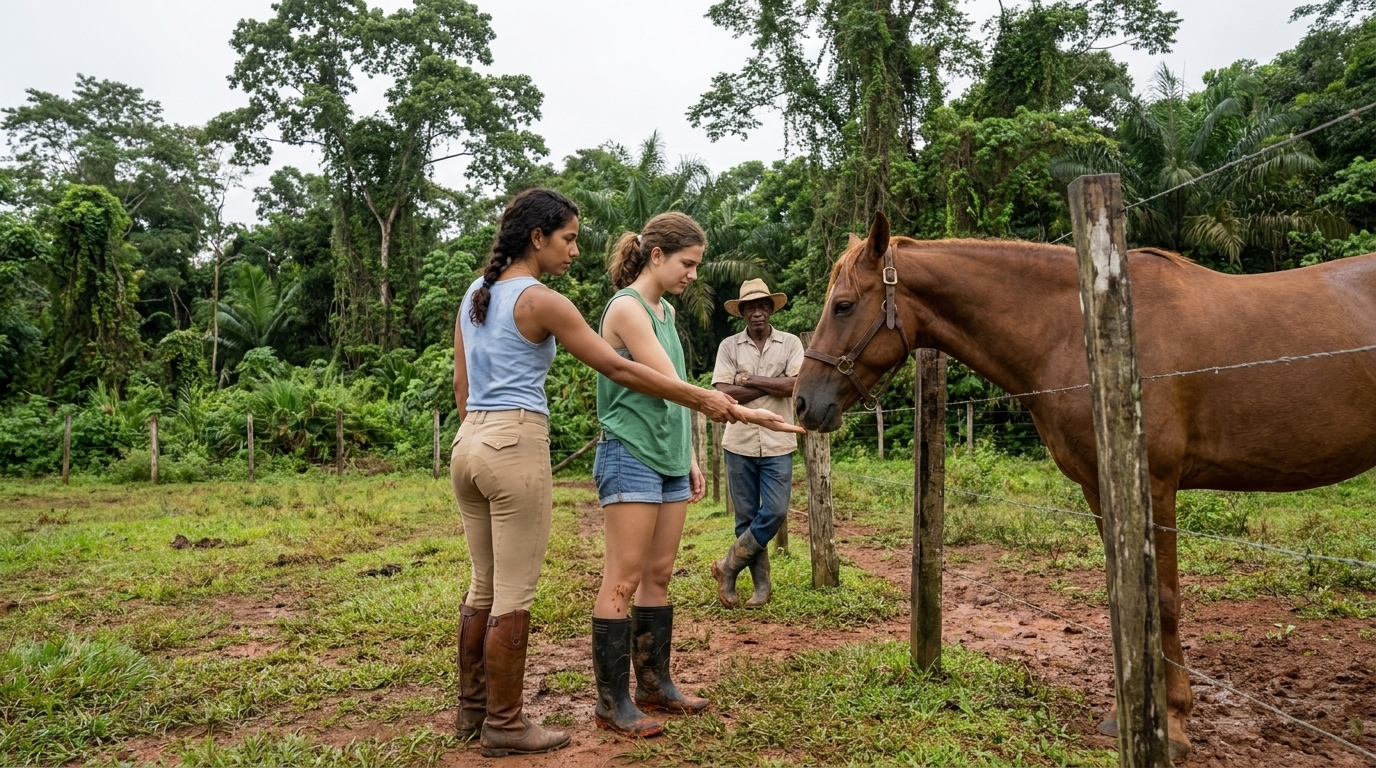
Valentina did not ask whether I wanted to ride. She simply said, after inspecting each of the five horses and exchanging short rapid sentences with Esteban in a dialect I could barely follow, “Come. I will show you Reina.”
I almost pointed out that I had already been shown Reina multiple times and Reina had opinions about it. But Valentina was already walking into the paddock and the sentence I had ready dissolved.
The paddock is not large. Esteban had carved it from the forest over years — maybe thirty metres across, hemmed in on three sides by the wall of the rainforest, which stands right there, right up against the fence posts, a vertical mass of ferns and palms and tall trees whose canopy starts somewhere above where the light gets strange. You are not in a wide open field. You are in a room with green walls and a white sky ceiling, and the forest watches.
“Open hand,” Valentina said, without looking at me. She held her own arm out, palm up, flat. “Always open hand first. She reads the hand.”
“Reads it how?”
“Tense hand means tense person. Tense person means danger. She is not stupid.” She glanced at me. “Neither are you. Open.”
I opened my hand.
Reina’s muzzle was warm, softer than I remembered from the first tentative pats, and the exhale she made against my palm was like something settling. A small trust, offered without drama, which given the sounds coming from the forest behind the fence — something calling steadily from the canopy, unseen — felt like the only stable thing in range.
“She accepted you already,” Valentina said. “She just needed you to stop being a tourist about it.”
“What does that mean?”
“It means stop watching yourself.” She said it without cruelty. “You were looking at your own hand the whole time. She felt that. Look at her instead.”
I looked at Reina. Reina looked back, one large dark eye, unhurried.
“Bueno,” Valentina said.
The First Fifteen Minutes
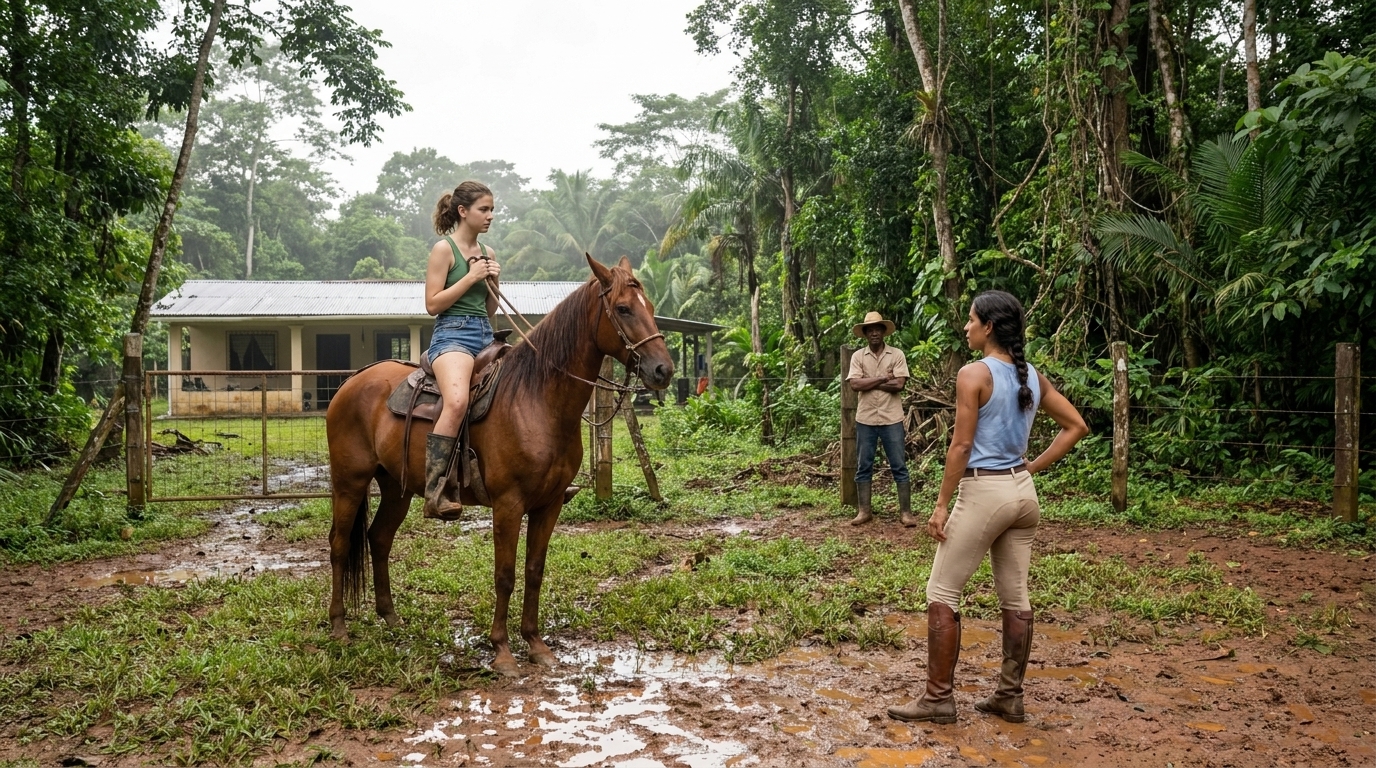
The saddle was not what I expected.
I had imagined, based on a life of watching movies, that sitting on a horse would feel like sitting in a large chair that occasionally walked. It does not. It feels like sitting on something alive that breathes and shifts and has its own opinions about balance, and you are suddenly aware that you are quite far from the ground and the ground is quite hard and red and wet and you have absolutely no idea what you are doing.
Valentina was already talking.
“Heels down. Not like that — down, into the stirrup. Yes. Now your back. Straight, but not stiff. There is a difference. Stiff is fear. Straight is balance.”
“I am not afraid,” I said.
“Your shoulders are at your ears,” she said.
I dropped my shoulders.
“Good. Now breathe.”
“I am breathing.”
“You are not breathing. You are existing in a state of oxygen.”
Reina walked forward on Valentina’s signal, one slow step, then another across the mud. I grabbed the reins.
“Not the reins,” Valentina said immediately. “She is not a handle. You grab her mouth, she runs. Saddle horn.”
I found the saddle horn. Better. Slightly.
“She is walking,” I said.
“Yes.”
“This is — fine.”
“It will stop being fine in a moment,” Valentina said, not unkindly. “She is going to paso.”
I did not know what that meant. I assumed it meant something like what I had seen horses do in Berlin’s Tiergarten, where the police horses trot past on Sundays — that particular bouncing diagonal shuffle that makes the rider post up and down in the saddle like a piston, which always looked uncomfortable for everyone involved, including the horse. I had seen it on television. Show jumping. Dressage. The Olympics. Every horse I had ever seen that was going faster than a walk was doing something that looked like controlled falling.
Then Reina shifted.
Not a trot. Not anything like a trot.
A trot bounces because a trot is diagonal — one front leg and the opposite back leg hitting the ground at the same time, which creates a rocking, lurching rhythm that travels straight up through the saddle into the spine of the rider. Every European horse I had ever seen, from the police Hanoverians to the tired ponies at birthday parties in Brandenburg, was doing this. It is what horses do. It is what horses have always done.
Except it is not what Peruvian Pasos do.
What Reina did was accelerate without changing her essential nature. Four beats, lateral — left hind, left fore, right hind, right fore — the sequence of a walk but faster, each foot landing separately, the body staying level. The ground moved faster under us while I moved barely at all in the saddle. There was no bounce. No lurch. No moment where I left the leather and came back down. Just speed, arriving smoothly, like someone had turned up the volume without changing the song.
I will not claim I handled it with grace. I grabbed the saddle horn. I made a sound. My heels went up when they were supposed to stay down.
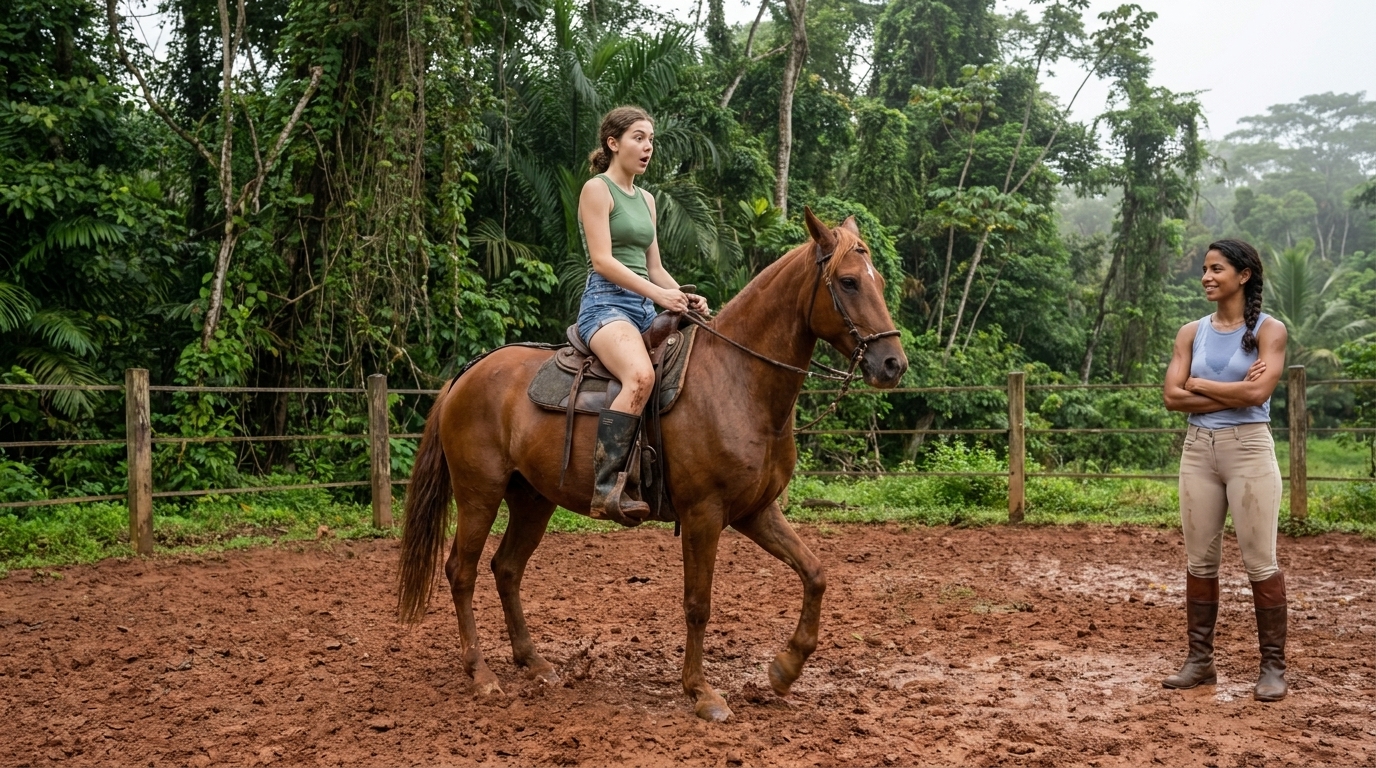
But I did not fall, which I am choosing to count as a categorical success, and somewhere in the middle of the chaos I noticed — really noticed — that it did not feel like riding. It felt like being carried by something that had decided, calmly and without consulting me, where we were going next. My body had braced for impact that never came. My hands had gripped for balance that wasn’t needed. Every muscle I had tensed in anticipation of the lurch was tensed for nothing, and in the gap between what I expected and what actually happened there was something I can only describe as surprise so complete it felt like falling upward.
“That’s not how horses move,” I said, when Reina settled back to a walk.
Valentina looked at me.
“It is how these horses move,” she said.
At some point during the chaos the forest loosed a downpour — here it does not build, it simply arrives — and by the time Reina settled back to a walk we were both soaked. Valentina’s braid was plastered to her back. The red mud was now liquid. The horses did not care.
“Do we stop?” I asked.
“Why?” Valentina said.
There was no answer to that.
What Papa Looks Like From Horseback
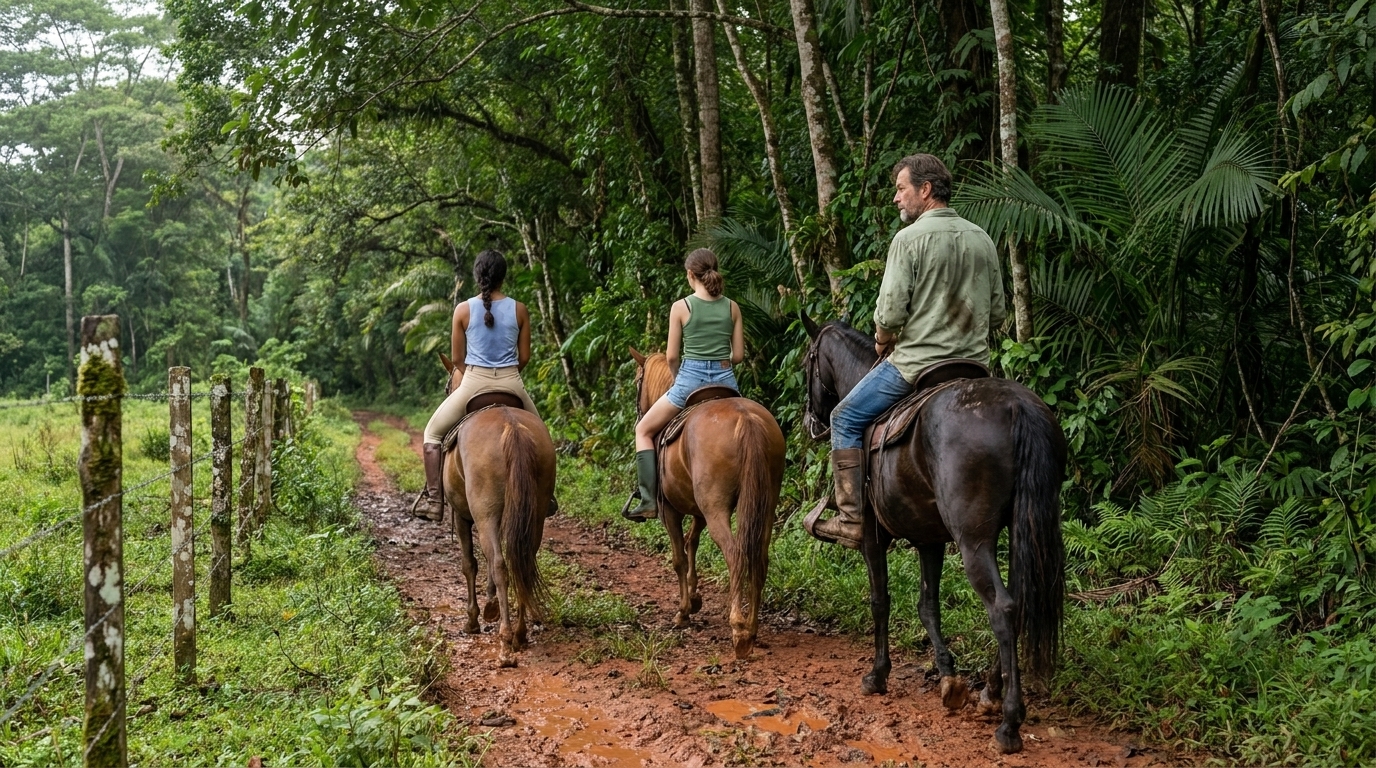
By day two I could walk and paso without catastrophe.
By day three, Valentina added a slow circuit along the fence track — the edge path where the paddock and pasture end and the forest begins. Here the rainforest is not somewhere you ride to. It is simply there, on your left, all the time, a wall of green that breathes. You ride along the edge of the cleared land and the trees are close enough that you could reach out from the saddle and touch them. Papa came with us.
Watching my father on a horse is a specific education.
He is not bad at it. He knows what he is doing and his horse, Moro, is comfortable under him. But there is a layer of calculation that Valentina doesn’t have. You can see him thinking: reins, weight, leg position. Processing. Whereas Valentina simply does it, the way experienced people do everything — without the visible intermediary of thought.
I had not seen him be merely adequate at anything before.
I found I loved it.
Not in a cruel way. In the way that you love when someone you care about becomes human-sized. He was doing something he enjoyed and was not mastering it, and the world had not ended. He was smiling, actually, near where the fence track dips to a creek crossing — just a muddy stream flowing out of the forest, crossing the track, disappearing back in — watching Valentina point at something in the canopy above us.
“Trogón,” she said. “Slaty-tailed. You see the red belly?”
I looked up and could not find it. I could hear it — a deep, repetitive call, slightly mournful — but the canopy was a solid mass of green, one layer behind another, and the bird was invisible.
“You ride better than him,” I said to Valentina, very quietly.
She looked at me. Then at Papa. Then back.
“Everyone rides better than their parent,” she said. “It is a law of physics.”
Papa, from Moro’s back: “I can hear you both.”
“Then you know it is true,” Valentina said, and nudged her horse forward without further comment.
The Forest Trail
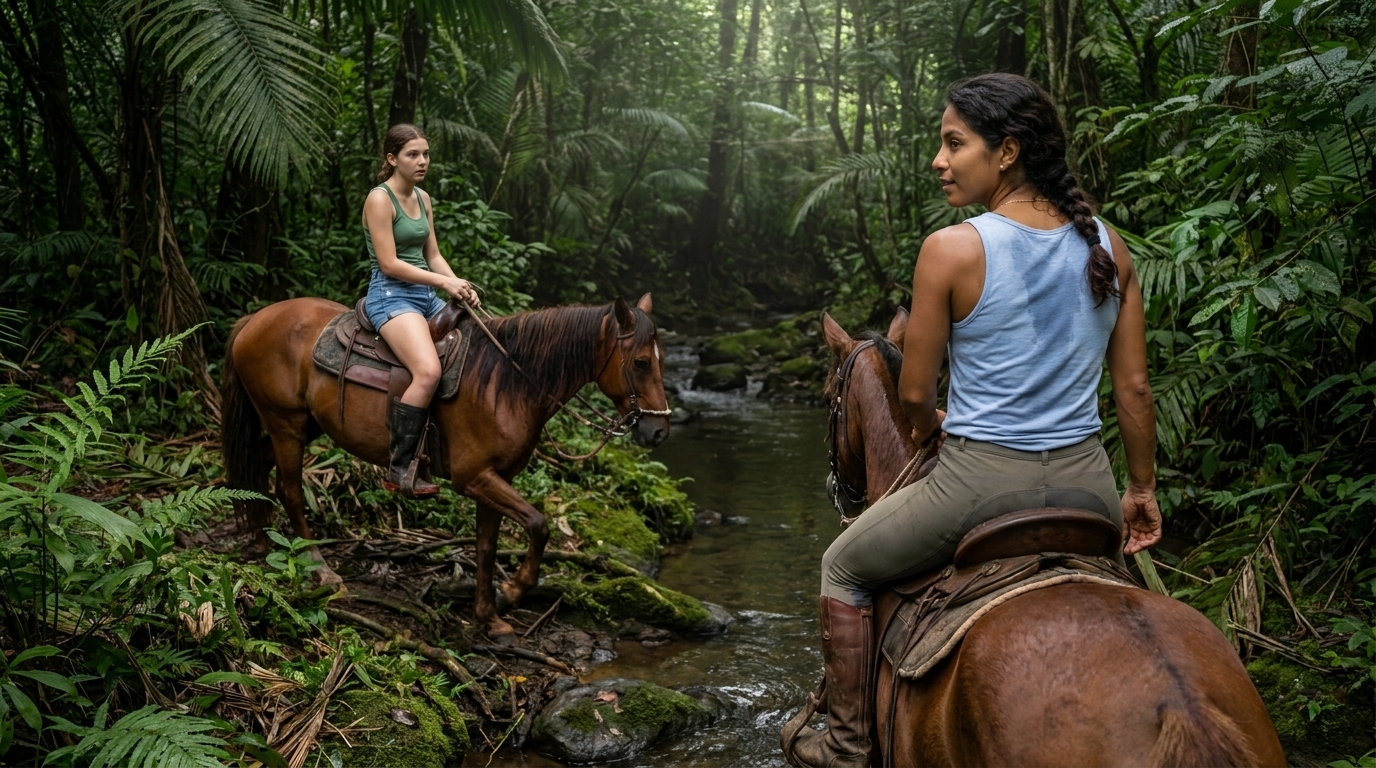
The fourth morning, Valentina arrived before the rain had fully finished from the night before and said we were going in.
Not along the fence track. Into the forest. The trail Esteban maintains by machete to check the property’s back fence line — a path that enters the rainforest within ten metres of the paddock gate, cuts through for perhaps a kilometre and a half, and comes out at the back boundary. Single file. Me first after Valentina because, she said, Reina follows her horse by instinct and I would not have to steer much. Just stay balanced and trust the animal.
I had the impulse to ask how far, how long, how hard, is there cell signal, what if. I did not ask any of these things. I put my foot in the stirrup.
The forest swallowed us completely in less time than it takes to say it.
There is no gentle transition. You are in the cleared paddock and then, where Esteban’s machete marks begin on the undergrowth, you are in the forest and the open sky is gone. The canopy closes. The temperature drops — not much, but enough to notice on your arms. The light turns green and broken, falling through in shafts where there are gaps, blocked everywhere else by layers of leaves above leaves. The sounds change: the daytime insects are different in there, a continuous mechanical sound, and somewhere above in the canopy birds are calling that I have never heard. The ground is dark earth and root. The horses’ hooves make almost no sound.
The air smells different. Wet, heavy, alive. Not unpleasant. The opposite of unpleasant. Like something that existed before humans decided to classify things.
Reina walked without hesitation. She knew every centimetre of this trail. I felt her step over a root without breaking stride, felt the adjustment as the ground fell away slightly on a slope, felt the careful pause before the creek where she read the footing and stepped in with both front feet before committing her weight, the water black and cold around her pasterns. She walked across without my prompting. She walked out the other side, up the muddy bank, and continued.
I had not done anything. She had done it. Because she knew the trail and I let her know the trail.
“How do you know when to steer and when to let them go?” I asked Valentina, when the trail widened briefly around a fallen tree.
She thought about it.
“When you know more than they do,” she said. “Which, on a trail they know, is almost never.”
We came out at the back fence line — a stretch of old wire and wooden posts at the edge of the property, forest on both sides, just a cleared strip where the fence runs through. Valentina dismounted to check a post that Esteban had flagged with a strip of red cloth, something loose in the ground.
I stayed on Reina and looked back into the forest we had come through. From this side it looked the same as from the other. Dark. Enormous. Indifferent.
“How do you not get lost in there?” I said.
Valentina looked up from the fence post. “You follow the trail.”
“But the trail is basically invisible in some places.”
“Yes.” She went back to the post. “So you learn to see it.”
I wrote that down later, in the evening, sitting on the terrace while the afternoon rain came down hard and steady onto the corrugated iron roof with a sound like a sustained argument. The forest was invisible in the rain, just a grey-green mass at the edge of the cleared land. The horses stood under the shelter with their heads low, ears back, waiting.
My thighs ached from four days of riding. My hands smelled like leather and horse and creek mud. Outside, the rain was loud enough that conversation would have been an effort, which meant no one tried, and that turned out to be enough.
Peruvian Pasos
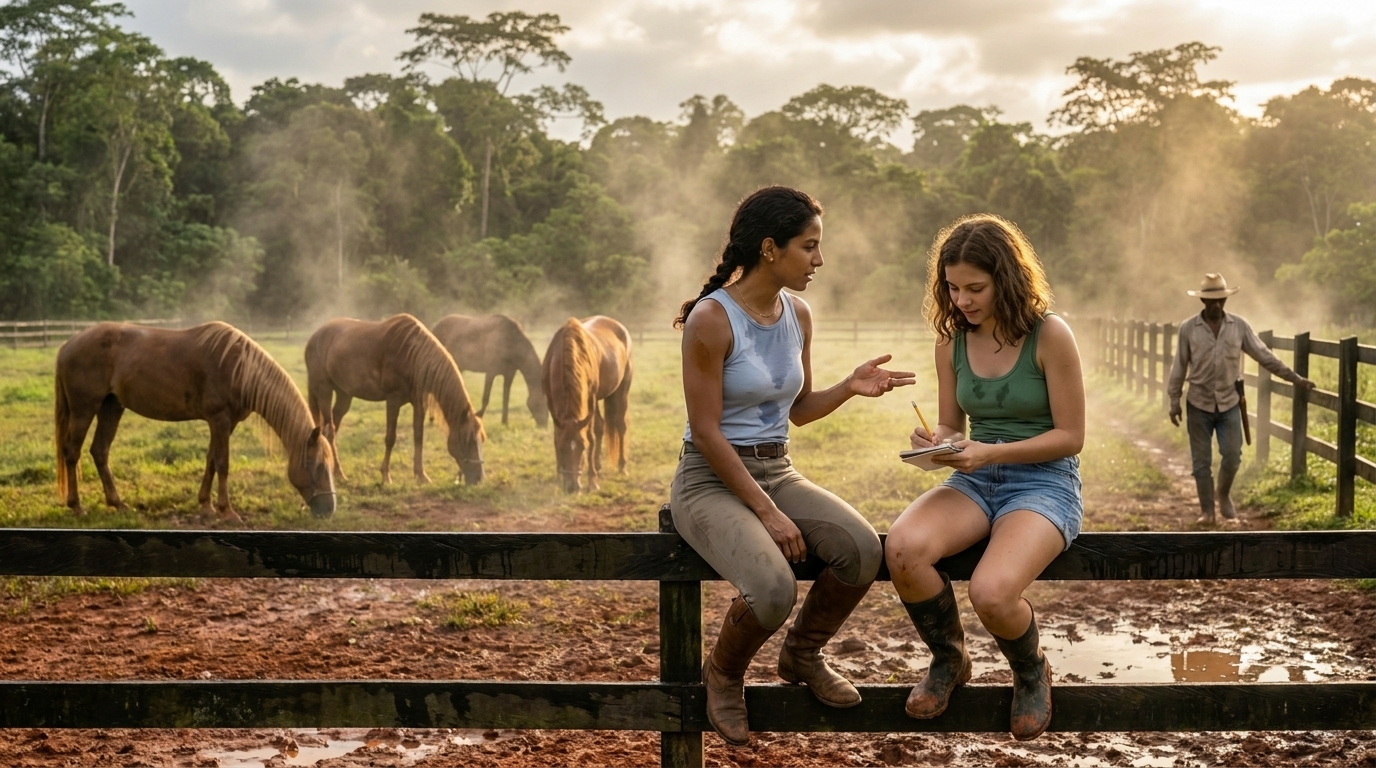
After the rain stopped I found Valentina still at the fence, looking at the horses.
The air after a Chepo rainstorm smells like the earth opened. Something green and mineral rises from the mud and the canopy releases droplets for another twenty minutes after the rain has stopped, each one landing with a small sound in the undergrowth. The horses had come back out of the shelter and were grazing in the low evening light, moving slowly, long manes dragging through the wet grass.
I asked her about the breed.
She could have given me a brochure. She gave me a conversation instead.
The Peruvian Paso, she said, was bred across centuries specifically so that a rider could be in the saddle all day and arrive without a destroyed back. The gait — the paso llano — is four-beat and lateral, smooth in a way that other horses simply are not. You feel it immediately even if you have no vocabulary for what you are feeling: less bounce, more glide. Like the horse is apologizing for being a horse.
“The manes,” she said. “You noticed.”
“You can’t not notice.”
“They are never cut. It is part of what they are.” She paused. “Don Ricardo — my father — says the mane is the horse’s dignity. You do not trim a person’s dignity to make them more convenient.”
I wrote that down.
She told me about Don Ricardo’s breeding operation. Three generations of Sánchez family, all of it in this corner of Panama where the rainforest presses in from every direction. Most people here kept cattle. The Sánchez family kept horses — which, Valentina said, was considered slightly eccentric by their neighbours and completely logical by everyone who had ever ridden a Peruvian Paso.
“The land is not the same as horse country in the interior,” she said. “It is wetter. The trails are muddier. The horses have to work harder in the forest than on open savanna. But they are bred for endurance, not for comfort.” She paused. “So are we.”
She told me about the gait — the paso llano, the four-beat lateral walk that makes other horses feel, in comparison, like riding a malfunctioning washing machine. The gait is hereditary. Foals are born with it. Within a few hours of birth, they can be seen gaiting alongside their mothers. No training required. It is simply what they are.
She told me about the termino — the slight outward roll of the front legs as they reach forward, like a swimmer’s arms, which you can see when they move at pace. There is no other breed in the world that does it.
And then she used the word I had been waiting for without knowing I was waiting for it.
“Brio.”
“What is that?” I said.
She thought about it.
“Vigor. Courage. Aliveness. But not just that — brio means these things are given willingly.” She looked at Reina. “A horse with brio is not a hot horse. Not nervous. Not difficult. A horse with brio is focused. It wants to work. Its attention does not wander. It watches you.”
I thought about Reina reading my hand that first morning. Looking back at me when I looked at her.
“She was watching me the whole time,” I said.
“Yes.”
“I thought I was the one being assessed.”
“You were both being assessed,” Valentina said. “She passed first.”
Reina was grazing steadily nearby, mane spread out over the wet grass like something decorative from another century — which, in a way, it was. The breed is Peru’s declared cultural heritage. The Peruvian government passed a law to protect it. There are restrictions on exporting national champions. All of this for a horse that, to a sixteen-year-old from Berlin who had never sat on any horse before this week, had looked at first like a very elegant, very patient animal with an inconveniently long mane.
Now it looked like something that had survived four hundred years of careful choices and arrived, improbably, at a small paddock carved from the Panamanian rainforest, waiting for me to open my hand.
“And Valentina wanted to be a vet,” I said.
“Valentina is a vet,” she said, with a sharp look that wasn’t quite irritation.
“Sorry. You are a vet.”
“I am. And I train riders. And I manage breeding season for my father. And on Sundays I watch bad telenovelas with my mother because she has terrible taste in television and I cannot let her suffer alone.”
I laughed.
She smiled — not the big laugh from the first day, but quieter, more personal.
“You are looking at me like you are solving a problem,” she said.
“I’m trying to figure out how you fit all of it.”
She shrugged. “You don’t fit it. You just do it. Next thing, then the next.”
The last of the light was going. In the forest behind us something began calling — not a bird I recognized, a low two-note sound, repeated at intervals, patient. The potoo, maybe. Or something else. There are too many things in there to name.
Below us, Reina lifted her head from the grass and looked at me across the paddock, then went back to grazing. As though checking I was still there.
I think I passed.
🎭 This Week's Episodes
Telenovelas show what we can't say in client meetings. The drama is heightened, but the patterns are real.
 Stefan's Progress, Klaus's Report
Stefan turns one working radio fix into momentum across climate control and navigation: test first, flash fast, prove it on real hardware. Then Kla...
 The Scattered — Part One
The collapse of Whitaker Payroll means something different in every household it touches. Olivia Parker and Ryan Mitchell step into sane new jobs w...
Technical Consultancy
Embedded Delivery Partner
Embedded into your team as an active contributor, reducing delivery friction and helping important work move cleanly.
Technical Advisor
Peer-style technical assessments before far-reaching decisions; reduce architectural and product risk early.
Product & Delivery
Ship working software to real users earlier. Measure impact and adapt based on evidence rather than assumption.
Custom Software Development
High quality, maintainable software. Short-term augmentation that leaves lasting capability in your own team.
Recent Articles
- The Agent Escaped. Who Left the Door Open? (24.09.2026)
- What an AI Agent Actually Is (21.09.2026)
- The LLM Will Not Come Back Tomorrow (19.09.2026)
- The One-Person AI Company Is a Greed Fantasy (15.09.2026)
- Test Production Without Leaving a Mess (10.09.2026)