Contrasts
Preston Hale, Graham Whitaker, and Derek Lawson sit behind closed doors turning failure into vocabulary elegant enough to survive their consciences. In a different part of Ohio, Nathan Cole's marriage strains under the accumulated insult of one more missed evening and one more promise reused past meaning. In two other households, Olivia Parker and Ryan Mitchell come to the same conclusion separately and without drama: no employer that calls this maturity gets to eat the rest of their children's lives. By the end of the episode, the executive story and the lived story no longer even pretend to be the same one.
Friday, 18:47 — Private Maturity
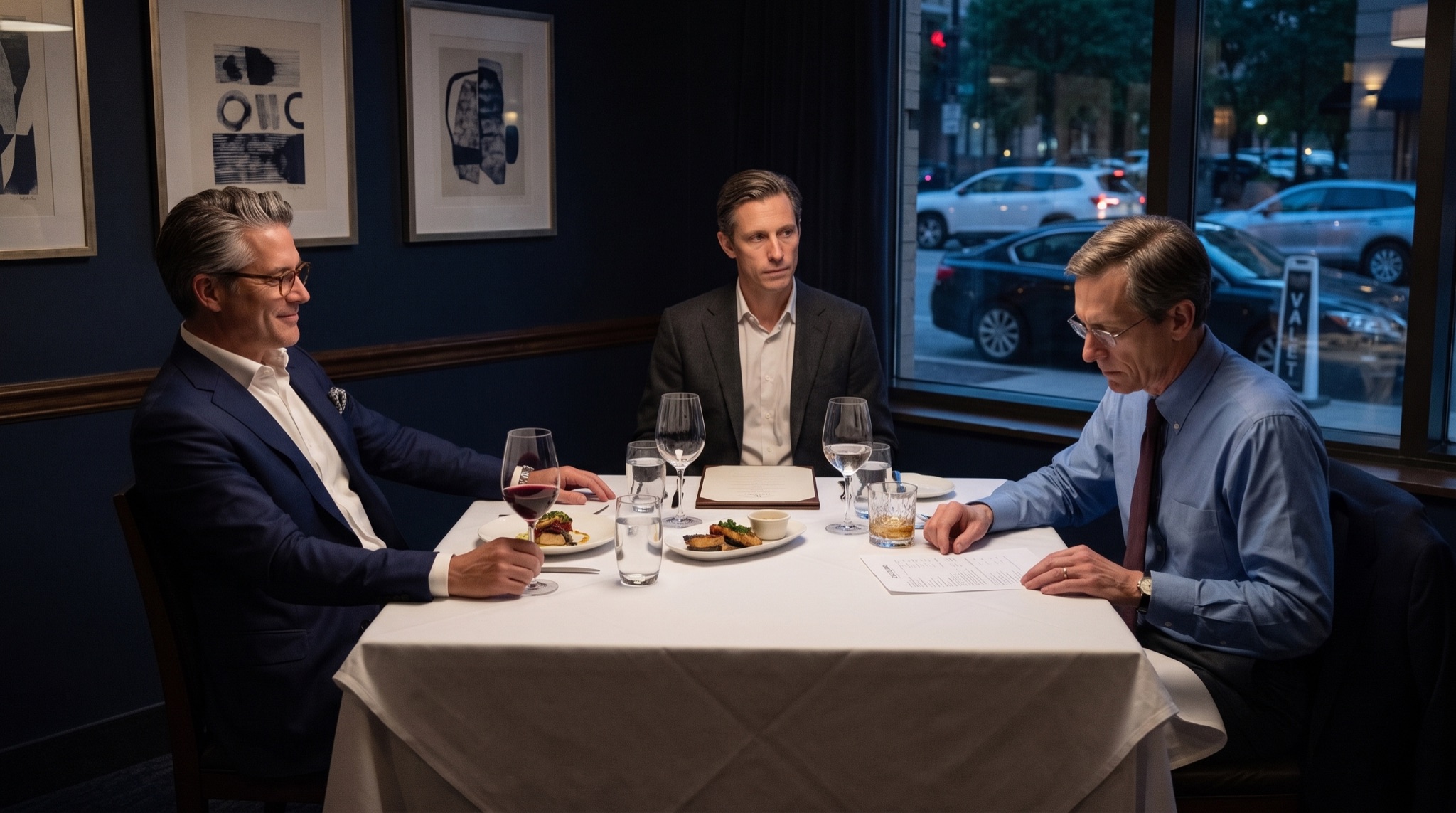
The restaurant was the kind of place that served restraint as luxury.
Small plates with too many nouns.
Low light designed to flatter money.
Waiters who moved as if urgency were something vulgar people did elsewhere.
Graham liked it because nothing in the room admitted strain directly. Even appetite arrived curated.
Preston liked it because successful men sounded more correct to themselves over stemware.
Derek liked it because the service protected him from silence.
They had taken the private room under the pretense of convenience, though all three men understood what the room really purchased: a place where frustration could put on a jacket before speaking.
Preston set down his glass and tapped Derek’s printed status sheet with one manicured finger.
“The issue,” he said, “is not whether the new structure is right. The issue is that implementation always protests the end of improvisational privilege.”
Derek nodded at once, relieved to have his irritation translated into theory. He had been carrying the whole week in his jaw, waking with his molars already locked together, and Preston’s sentence arrived like someone else taking one end of the weight.
“That’s what I’ve been trying to articulate,” he said. “The SME side is producing materially better definition now. The development side keeps responding as though any request for explicit accountability is a philosophical insult.”
Graham looked at the paper between them.
Escalations open.
Revisions pending.
Implementation delays.
He did not fully understand what any of the lines meant technically, but he understood mood, tone, posture, tempo. He had spent his whole adult life doing that in rooms where the right read of a donor or curator mattered more than any spreadsheet.
And his read right now was simple: Nathan had changed.
Not suddenly. Not into someone cruel.
Into someone less governable.
That was how Graham experienced it.
Not as a man becoming more accurate under pressure.
As a man becoming harder to keep inside the emotional architecture that made the company still feel like an heirloom rather than an exposed wound.
He touched the rim of his water glass.
“I think Nathan has become unable to distinguish urgency from legitimacy,” he said. “Everything he feels strongly now arrives with the expectation that everyone else must grant it moral priority.”
Preston’s expression softened into that expensive-looking sympathy he had built a career from.
“That’s common in technical personalities,” he said. “Particularly when they attach identity to being the person who sees what others don’t. They start mistaking resistance for proof.”
There was a beat in which each man privately encountered a smaller, less flattering thought.
Derek’s was: what if he does see what I don’t?
It lasted no more than a second before he answered it the way he had answered similar thoughts all month: if that were really the situation, the SMEs would be clearer, Graham would be more alarmed, Preston would not sound this calm.
Graham’s was: what if my father would have understood Nathan better than I do?
He dismissed it almost instantly because the alternative was too humiliating. Thomas had managed complexity without becoming emotionally erratic. That was the son-friendly fiction Graham needed tonight. If Nathan now looked volatile, then volatility had to be the problem.
Preston’s was the faintest and most inaccessible even to himself.
What if software was one of the places his public ideas failed hardest?
He did not think the sentence in those words. He felt only a brief resistance under his sternum, the sensation of a concept not fitting cleanly over a fact. Then he did what he always did when reality threatened his framework.
He refined the framework until the reality looked immature.
“You cannot let developers make moral leverage out of complexity,” he said. “If they learn that technical density exempts them from structure, you’ve lost the organization.”
Derek let out a quiet breath.
Yes.
That felt right.
Not because it solved anything in the code.
Because it restored the hierarchy in which he could still be the adult in the room.
“Exactly,” he said. “What we’re seeing is chronic translation resistance. Linda, Sharon, and Donna are producing serious, careful material. The programmers keep reacting to ambiguity as if ambiguity itself were failure.”
Graham heard careful and felt his shoulders loosen. His fingers left the water glass. He had not realized until then that he’d been holding it too tightly.
Careful was one of the few words that still made the company sound like a legacy rather than a risk surface.
His father’s people had been careful. Loyal. Steady. The last month had been full of machinery that seemed intent on reclassifying all of those virtues as disguised obstruction. Graham could not bear that reversal. It felt too close to saying his father had built not a sturdy business but a ritualized error-generating machine curated by frightened people in cardigans.
He would rather call the current disorder cultural than concede that possibility.
The server placed a dish of charred broccolini between them and retreated.
No one touched it.
Preston went on.
“The mistake organizations make at this stage is flinching. They read developer unhappiness as evidence the structure is too rigid. In fact it’s usually evidence the structure has finally reached the places that were previously protected by mystique.”
Mystique.
Derek smiled without warmth.
“Nathan would say mystique is exactly what Linda and the others have been living off.”
“Of course he would,” Preston said. “Because his way of preserving self-respect is to cast every other form of caution as performance.”
Graham looked down at the condensation on his water glass.
He thought of Nathan’s face in the office two days ago. The exhaustion. The contempt. The refusal to help smooth the room after saying something surgically true and socially destructive.
He had loved Nathan in the manner wealthy, conflict-averse men sometimes loved useful subordinates: sincerely, warmly, and always inside invisible conditions.
He could not have said that to anyone, least of all himself.
What he could say was simpler.
“I’m not punishing him,” Graham said. “I need him to understand he doesn’t get to set fire to trust every time he thinks he’s found a clearer sentence.”
Even as he said it, he felt the old private confusion under the sentence: why did every conversation with Nathan now leave him feeling both accused and ashamed, as if technical facts had somehow acquired the social force of moral criticism? The feeling was unbearable enough that he kept translating it into tone. Tone could be managed. Shame implied a witness.
Preston lifted his glass.
“That’s leadership,” he said.
Derek, hearing the absolution he wanted, finally touched his drink.
The bourbon hit sweet first, then oak, then the slow medicinal burn of expensive reassurance.
“I think we also need to be realistic about replacement logic,” he said. “If development continues to frame ordinary governance as persecution, we may need to increase optionality.”
Graham looked up.
“You’re talking about additional hiring.”
Derek nodded.
“Eventually, yes. Not as a threat. As resiliency.”
Not as a threat.
All three men heard the lie and accepted it because the lie improved the table manners.
Preston leaned back.
“That’s wise. You don’t have to announce consequences to build leverage. You just have to stop signaling that resistance is irreplaceable.”
Outside the private room, glassware chimed lightly. Somewhere in the main dining room a woman laughed too loudly and then corrected herself into elegance.
Inside, three men mistook each other’s composure for evidence.
By dessert they had arrived at what each of them would later remember as a sober managerial consensus.
The programmers were exhausted, yes, but exhaustion was normal in transition.
Nathan was valuable, yes, but value without governability became destabilizing.
Linda, Sharon, and Donna were imperfect, yes, but their caution still represented institutional seriousness.
More structure was required.
More accountability.
More consequences for negativity.
Nobody in the room fully believed the entire shape of the argument.
That was why it held.
Each man needed the others’ confidence to stabilize the part of his own mind still whispering that something uglier and simpler might be true.
When the check came, Graham signed without looking at the total.
He walked out into the warm Cleveland evening feeling steadied.
That feeling, more than any technical evidence he had ignored all month, would shape what happened next.
Friday, 21:24 — The Meal Nobody Eats
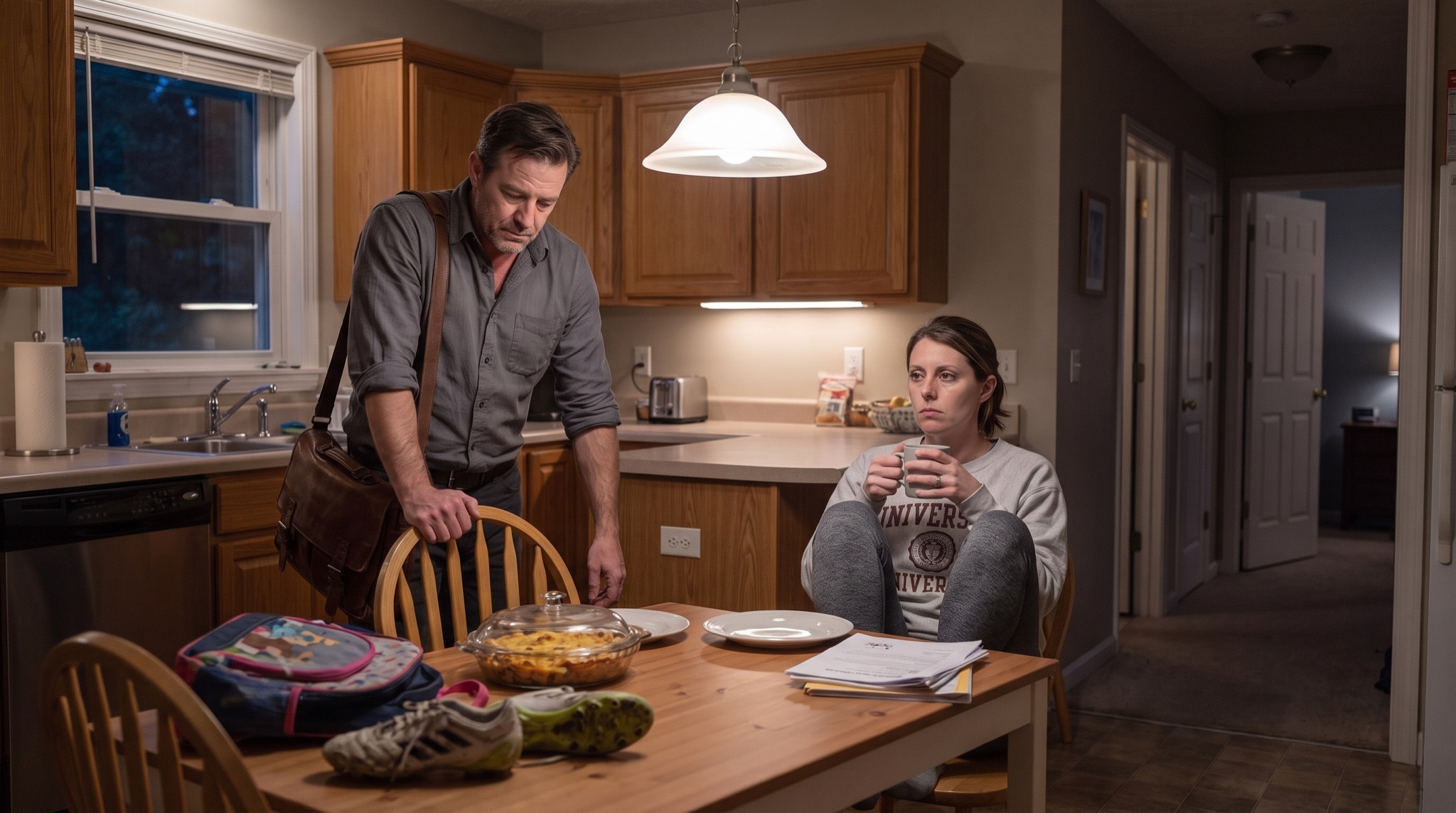
By the time Nathan got home, the casserole had collapsed in the middle.
The cheese on top had hardened into a skin. Steam was gone. The dish sat under the kitchen light with the accusatory patience of a thing that had already waited too long to be gracious.
His wife was at the table in gray leggings and an old Kent State sweatshirt, one hand around a mug she had stopped drinking from an hour ago.
She did not look furious.
Nathan almost wished she did.
Fury would have let him answer something.
What she looked was finished with first explanations.
Finished, too, with helping him narrate himself as the tragic competent man in an impossible situation. The expression on her face was not asking for context. It was asking how much more family life he planned to feed into a system that had already proved it would eat whatever he brought.
That was worse.
He set his bag down beside the pantry and opened his mouth on the sentence he had been composing in the car since the second red light.
“I’m sorry.”
It sounded thin before it reached the table.
She looked at the microwave clock.
“For tonight,” she asked, “or in general?”
Nathan pulled out a chair and did not sit. His hand stayed on the top rail as if the chair were the only stable object in the room.
The children were asleep. Or pretending. The house had that careful nighttime stillness in which every adult sentence felt as though it could seep under doors.
He looked at the school papers spread beside the casserole dish. A permission slip with his signature line blank. A spelling test with a gold star. A crayon family drawing in which he had been rendered as a rectangle with glasses and one exaggeratedly large hand.
He recognized the drawing and felt a small internal collapse.
That had been from Tuesday.
He had forgotten Tuesday entirely.
“Both,” he said.
She nodded once as if receiving a lab result she had anticipated.
Her name was Claire. He had not said it aloud in anger in nineteen years. Tonight he thought it without tenderness for the first time he could remember, and the lack of tenderness frightened him more than any argument would have.
Claire pushed one plate an inch farther from herself.
“Ben asked at dinner if the company owns Saturdays now,” she said.
Nathan closed his eyes. The sentence landed in his body before it reached his mind, a deep involuntary flinch under the ribs.
Ben, ten, asked practical questions with the tone of a little accountant auditing adult nonsense. Lily, seven, did not ask as much. She watched. The watchfulness hurt more.
“I missed bedtime again,” Nathan said.
“You missed dinner. Homework. The part where Lily wanted to show you the thing she built out of popsicle sticks and then pretended she didn’t care when I said you’d still be late. You missed the call from the pediatrician about Ben’s inhaler refill because I was already on with my mother and couldn’t answer both. And then you came in the door with the same face you’ve had for six weeks, which is the face of a man who wants credit for returning from a war nobody drafted him into.”
The sentence hit him so cleanly he had to grip the back of the chair.
Not because it was unfair.
Because it was too fair in the places he still preferred to narrate nobly.
Nathan had been telling himself a version of the story in which sacrifice, however ugly, still carried moral dignity because the work mattered and because collapse would hurt everyone and because he was trying to keep catastrophe from crossing a threshold.
Claire was not denying any of that.
She was denying his right to use it as a solvent on the rest of his life.
“It’s bad there,” he said, and hated the sentence as it left him.
He heard in it the same pathetic hope he had brought home a dozen times already: that the severity of the workplace problem might still purchase moral credit in the kitchen.
She gave a short humorless laugh.
“Yes. I know. It has been bad there for years. That’s the part you keep bringing home like new information.”
He sat down then because remaining standing had started to feel theatrical.
The chair scraped louder than it should have.
“It’s different now,” he said. “They fired the one person who was actually making it more fixable. Graham’s turned the whole place into sign-offs and packets and—”
“Nathan.”
She did not raise her voice.
That one word still stopped him more effectively than shouting would have.
“I know the plot,” she said. “I’ve known the plot. The cast changes, the vocabulary changes, the immediate disaster rotates, but the plot stays the same. They won’t listen, you stay anyway because if you don’t stay something worse will happen, and then the something worse happens anyway but now you’re tired enough to call martyrdom responsibility.”
He looked at her.
Claire had once found his loyalty beautiful.
He knew that. In the early years it had read as steadiness, seriousness, capability. The kind of trait women could safely build mortgages and children around.
What neither of them had understood then was how easily steadiness could curdle into self-erasure when attached to the wrong institution.
The casserole sat between them cooling into a permanent object.
“So what are you saying?” he asked, though he knew.
Claire leaned back in the chair and pressed thumb and forefinger to the bridge of her nose.
There were violet crescents under her eyes. Her hair had been twisted up quickly and was half out again. On the counter behind her sat a lunchbox she had already packed for tomorrow because someone in the house still had to believe in mornings.
“I’m saying I cannot keep raising children around your permanent emergency,” she said. “I’m saying they are starting to organize their feelings around your absence. I’m saying you come home physically present and psychically elsewhere, and the fact that the reason is technically serious does not make the damage less domestic.”
He wanted to tell her he was trying.
The words made it as far as his teeth and died there because trying had become the most insulting possible summary.
Of course he was trying.
That was the problem.
He tried every day. The trying itself was what kept converting his family’s patience into company inventory.
Claire looked at the permission slip and slid it across the table toward him.
“Ben’s field trip,” she said. “Sign it now. Not tomorrow. Not after coffee. Now, while you’re in the room.”
Nathan took the pen beside the placemat and signed where indicated with a hand that suddenly felt less steady than it should have.
It was such a small act.
That was why it destroyed him.
A father required by his wife to prove presence through paperwork because paperwork was the only form the rest of his life still seemed capable of honoring.
Claire watched him set the pen down.
When she spoke again, her voice was quieter.
“I am done being understanding in advance,” she said. “If you stay there, then you need to admit you are choosing them over us every day, not just on the spectacular days. On the ordinary ones too. I can survive a crisis. I can’t survive a philosophy.”
The words sat between them beside the casserole dish and the signed permission slip.
Nathan looked at the slip and had the absurd, sickening thought that he had finally managed to become legible at home only in the format Whitaker Payroll respected: a signature on a document, proof of compliance, evidence that he had briefly been present where presence was required.
In the hallway a floorboard clicked as the house cooled.
Nathan looked toward the children’s rooms and understood with a clarity more frightening than panic that the company had finally succeeded in exporting its internal moral injury whole into his kitchen.
He had nothing persuasive left.
Only honesty.
And honesty, he had lately learned, arrived too late most often in the rooms that needed it most.
“I don’t know how to leave while it’s still burning,” he said.
Claire’s face changed then, not into softness, but into the exhausted pity people sometimes reserve for the person they love when that person has mistaken indispensability for virtue too long.
“That’s because you still think it burns differently if it’s your turn to stand in it,” she said.
Neither of them touched dinner.
Saturday, 22:06 — Separate Kitchens
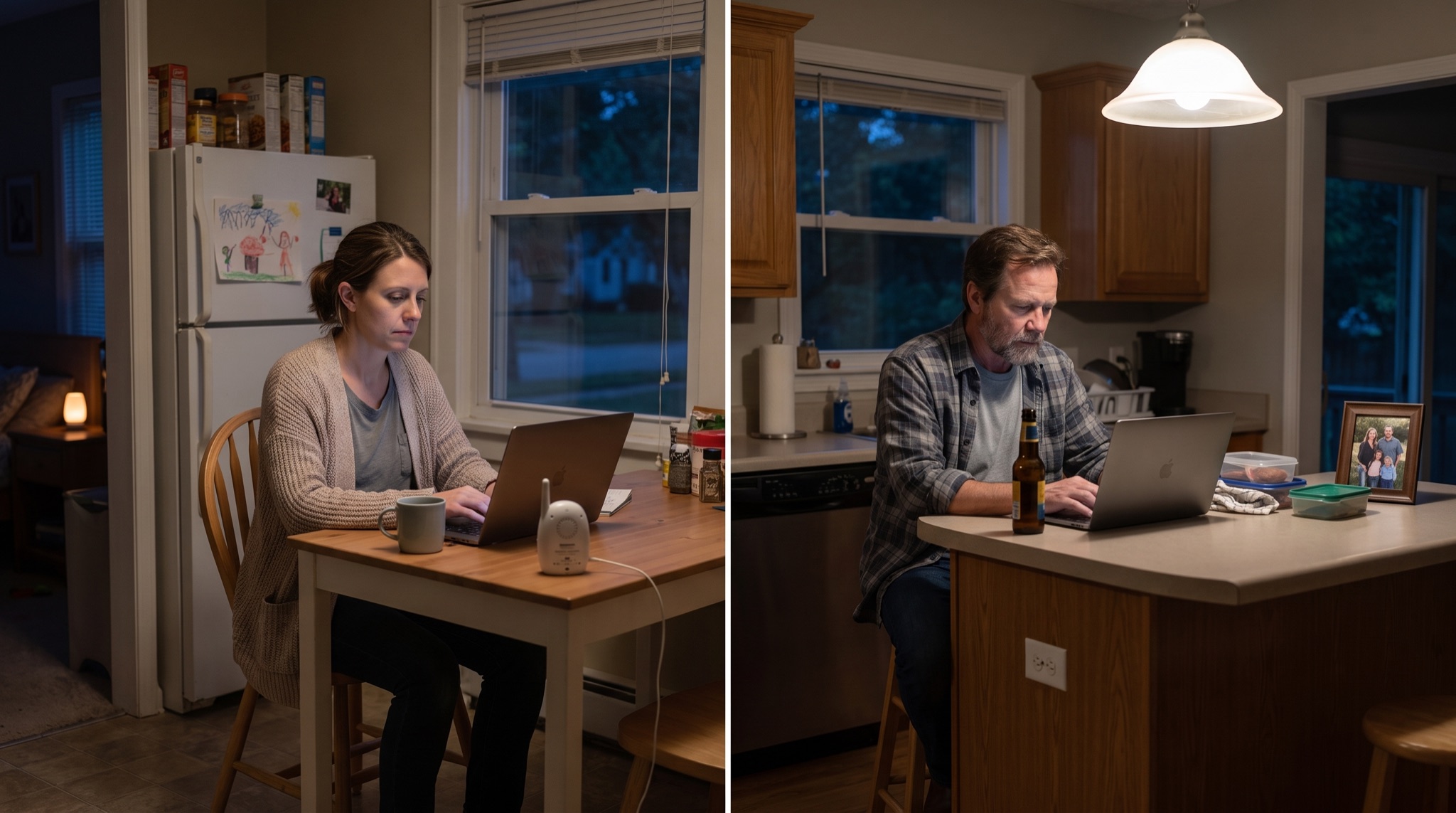
In one kitchen on the east side, Olivia updated LinkedIn after bedtime.
In another, twenty-two minutes away and not part of her life except through Slack, Ryan opened his resume and finally stopped pretending the file was only for emergencies.
The two scenes had no witness but the same employer.
Olivia sat at her dining table in a soft black t-shirt and gray sweatpants with the baby monitor receiver beside her laptop and Maya’s drawing taped crookedly to the fridge behind her. The duplex was small enough that she could hear the refrigerator cycle on and the floor settle and, if she stopped typing, the faint machine-breath of her daughter’s sleep from the next room.
Her husband, Seth, stood at the sink rinsing out a plastic bento box in the careful tired manner of a person trying not to load his irritation into the water pressure.
He was not dramatic by temperament. That had been one of the things she trusted when she married him. No rhetorical storms. No doors. Just a dangerous level of patience that made the eventual hard sentence feel almost notarized.
“You missed pickup twice in one week,” he said, not turning around.
Olivia kept her eyes on the screen because shame was easier to metabolize while looking at bullet points.
Senior Developer. C#. CI/CD. Test automation. Legacy modernization.
Each line felt slightly fraudulent and slightly salvific.
“I know.”
Seth set the lunchbox upside down in the rack. Water ran from its lid in a thin line over his knuckles and into the sink. He let it run a second longer than necessary, as if restraint itself needed a physical outlet.
“Jenna was kind about it. That almost made me madder.”
Olivia gave a tired half-laugh.
“Same.”
He turned then and leaned one hip against the counter.
Seth worked in commercial insurance, which meant he lived professionally among risk tables, exclusions, and damage forecasts. He did not romanticize catastrophe. He priced it.
That made him harder to comfort with passion.
“When you say it’s temporary,” he said, “what evidence do you have for temporary besides the fact that they prefer that word?”
Olivia looked at him.
This was why she had not wanted to start talking tonight. Seth’s questions had a way of draining self-deception without raising his voice.
“None,” she said.
He nodded once.
“Okay. Then stop presenting it to both of us as if it has a sunset built in.”
Maya murmured once over the monitor and settled again.
Olivia glanced toward the hall by reflex.
Then she looked back at the LinkedIn draft.
The page asked for a headline.
| She typed Senior .NET Developer | CI/CD | Modernization and deleted it. Too hungry. Too obvious. Typed Full-Stack Developer | Legacy Rescue | High-Reliability Systems and deleted that too because Ethan’s language was still on it. Finally she settled on something plain enough not to feel theatrical. |
| Senior Software Developer | C# | Delivery Systems | Technical Coaching |
Seth watched her type.
“You’re really doing it,” he said.
There was no accusation in the sentence.
Only confirmation.
Olivia felt tears rise briefly, irritably, and blinked them back because crying in front of a login screen felt like letting the company into the room again.
“I think I have to,” she said.
Seth crossed the kitchen and rested a hand on the back of her chair.
“You had to three Thursdays ago,” he said. “You’re just emotionally caught up now.”
Across town, Ryan sat alone at the kitchen island with his laptop open and a warm beer he had forgotten to drink.
Melissa was still in the kitchen then, snapping lids onto Owen’s lunch containers with more force than the task required.
“I’m not fighting with you,” she said.
Ryan looked up from the old resume and immediately hated the defensive sentence already forming in his throat.
“I know.”
“No,” she said, softer now, setting one container down and pressing her palm briefly against the counter as if steadying herself. “What I mean is I’m too tired to keep having the same conversation in different clothes.”
The sentence was not cruel. It was tired in a way cruelty never had to be.
Ryan swallowed.
“I’m trying to figure it out,” he said.
Melissa looked at him then, not angry, which would have been easier, but with the strained clarity of someone who had spent months watching a decent man donate himself to an institution that would not remember the shape of his sacrifice.
“I don’t need you to be brave at work,” she’d said. “I need you to still have a face our son recognizes at breakfast.”
He had opened his mouth to tell her it was temporary, that Nathan needed him, that the team was stretched, that he couldn’t just vanish while the place was already burning.
But every sentence had arrived sounding like a better-dressed version of the same surrender.
Melissa picked up the last container.
“When you decide to leave,” she said, “tell me. I can’t keep living inside your maybe.”
Then she went upstairs, and the quiet she left behind was worse than a slammed door would have been because it carried no drama at all, only a revised understanding of what she could and could not keep enduring.
Their son, Owen, was asleep with a plastic dinosaur still on the nightstand because six-year-olds lived close enough to attachment that even extinct animals got bedtime clauses.
Ryan scrolled through old resume bullets from three years ago and felt as though he were excavating a previous version of himself who had not yet learned how quickly professional adulthood could become organized surrender.
Built internal tooling for reporting workflows.
Supported batch integrations.
Collaborated across teams.
Collaborated across teams.
He almost laughed.
What an obedient phrase for all the hours since.
He had wanted to defend the situation then. Not the company exactly. Just the inertia. The way leaving still felt, in some middle register of his body, like an accusation against every person who remained.
But Melissa had spent enough years married to a decent man in a mediocre system to know the weakness of decent men precisely.
They could endure far beyond the point at which endurance was moral.
Ryan opened a message draft to a former colleague now at a healthcare software company in Columbus.
Hey. It’s been a while. If your team is still looking for senior backend people, I’d love to reconnect.
He read it twice, deleted love to reconnect, replaced it with happy to talk if useful, then changed it back because false coolness was still a form of vanity.
He hit send before he could make dignity a reason to hesitate.
The email left his outbox with the silence of all meaningful first exits.
In Olivia’s kitchen, the LinkedIn profile went live at 22:31.
In Ryan’s, the sent message remained visible on-screen like a small professional crime he had no intention of confessing at work.
Neither of them felt triumphant.
Only calmer.
That was how they knew the decision was real.
Not because it felt brave.
Because it reduced distortion.
Outside, in two separate neighborhoods, Ohio suburban night settled itself over roofs, swing sets, parked cars, and laundry rooms full of ordinary unfinished life.
Inside, two competent adults in two separate households began building off-ramps from the same collapsing lie.
Sunday, 16:12 — The Part That Doesn’t Fit the Story
Sunday did not fix anything.
That was why it mattered.
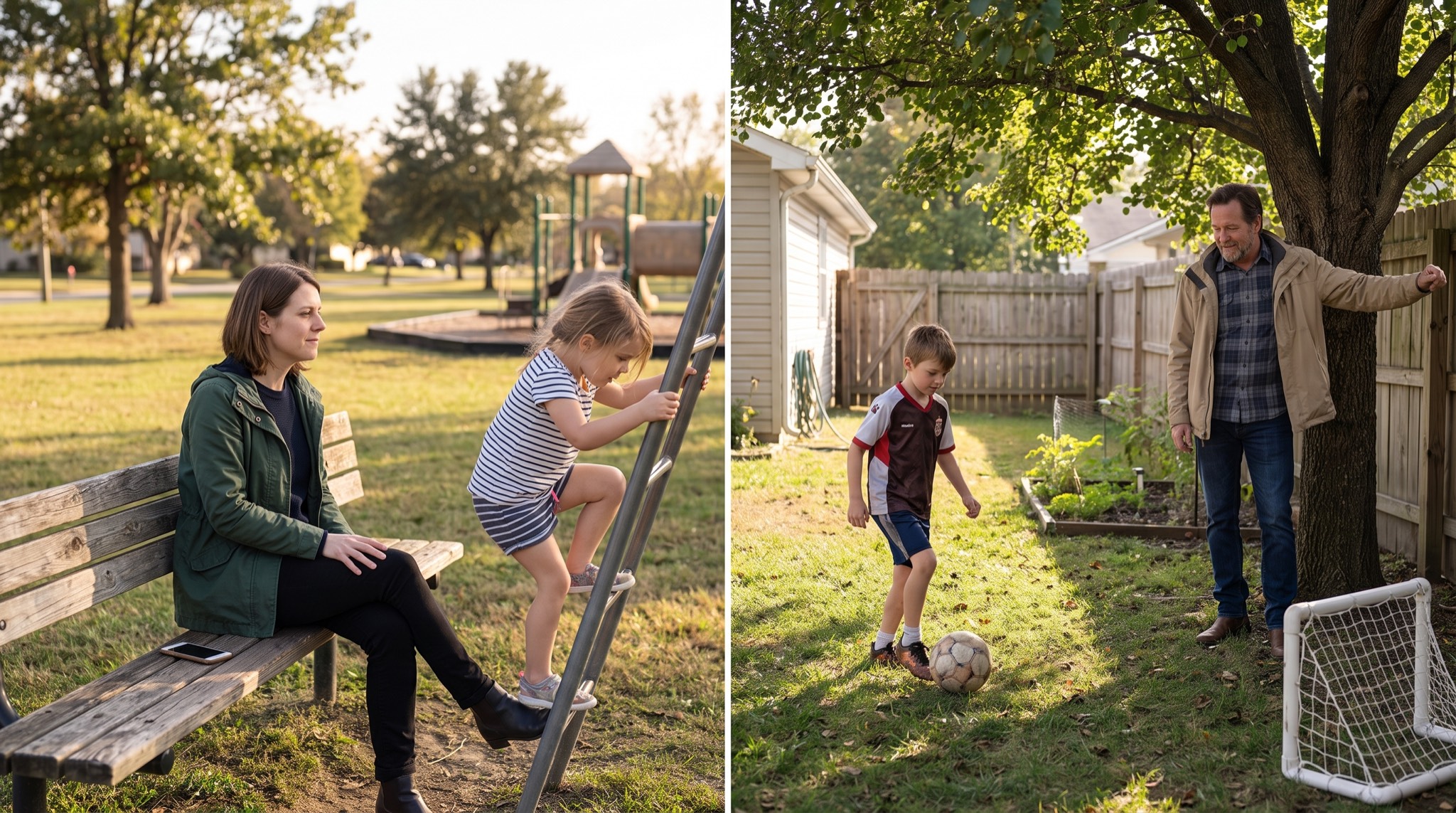
Ryan passed a soccer ball back to Owen in the patchy backyard behind the house and felt his body lag half a step behind the game. Exhaustion had a way of arriving on weekends not as sleepiness but as delayed personhood, as if his mind had to ask permission to re-enter his own life.
“Dad,” Owen said, setting the ball down with sudden seriousness, “are you going to be at work next Saturday too?”
Ryan looked at the goal, then at the fence, then at his son.
Children did not care about the refined managerial language of transitional discipline. They cared about patterns. A father gone enough times became a forecast.
“I’m trying not to be,” Ryan said.
Owen accepted that with the grave, provisional trust children extended to adults they still wanted to believe could control weather.
At a park in Mayfield Heights, Olivia watched Maya climb the ladder to the short slide with the fierce concentration of a four-year-old treating altitude as honor. Seth sat at the far end of the bench with a coffee and did not bring up work once.
That was its own form of mercy.
Olivia’s phone buzzed in her bag.
She knew without looking it was probably some version of Monday already trying to colonize Sunday.
She let it buzz twice and stop.
Maya reached the top platform, looked down, spotted her, and shouted, “Watch me.”
Olivia raised both hands.
“I’m watching.”
The sentence felt so simple it almost made her angry.
How little domestic life asked, finally, compared with the company. Presence. Attention. Arrival at predictable times. Enough energy left to laugh without checking the clock internally.
At the restaurant Friday night, men with power had called the current season maturity.
In the kitchen, the playground, the backyard, the table beside a sleeping child, maturity looked different.
It looked like learning when loyalty had become vanity.
It looked like refusing to donate your family to an institution that would later call the donation professionalism.
By Sunday evening, nothing outward had changed.
Nathan would still go in Monday carrying too much.
Graham would still believe gentleness improved correctness.
Preston would still interpret every resistance as proof the developers needed stronger reins.
Derek would still feel injured by friction and call that injury governance.
Linda, Sharon, and Donna would still keep wrapping uncertainty in care language because care language remained the last socially acceptable place to hide fear.
But in three separate homes, something had shifted under the story.
Nathan’s wife had stopped offering understanding on credit.
Olivia had made herself visible to the world beyond Whitaker Payroll.
Ryan had opened a door and sent a message through it.
The executives would not see any of that yet.
That, too, belonged to the contrast.
Power usually noticed departure last.
First it noticed resistance.
Then tone.
Then a loss of enthusiasm.
Only much later, when the room had already thinned past repair, did it notice the exits themselves.
🎭 This Week's Episodes
Telenovelas show what we can't say in client meetings. The drama is heightened, but the patterns are real.
 Process Theater Takes Hold
BergMotor's QA team in Passau reads QuantumMind's integration documentation and asks the question nobody wanted to hear: where is the safety analys...
Technical Consultancy
Embedded Delivery Partner
Embedded into your team as an active contributor, reducing delivery friction and helping important work move cleanly.
Technical Advisor
Peer-style technical assessments before far-reaching decisions; reduce architectural and product risk early.
Product & Delivery
Ship working software to real users earlier. Measure impact and adapt based on evidence rather than assumption.
Custom Software Development
High quality, maintainable software. Short-term augmentation that leaves lasting capability in your own team.
Recent Articles
- When Everything Is Finally Under Control (05.10.2026)
- AI Makes Technical Execution Cheap. Judgment Stays Scarce. (26.09.2026)
- The Agent Escaped. Who Left the Door Open? (24.09.2026)
- What an AI Agent Actually Is (21.09.2026)
- The LLM Will Not Come Back Tomorrow (19.09.2026)