The Resignations
Nathan Cole resigns on a Monday morning with two sentences and no argument left in his body. By Tuesday his desk is empty and the company's institutional memory is gone with him. Olivia Parker and Ryan Mitchell, already psychologically halfway out the door, begin the quiet mechanics of escape: Zoom calls from parked cars, technical screens after bedtime, code challenges completed under kitchen light while the house sleeps. Within weeks both land new jobs at companies that treat competence as an asset instead of a threat. Their resignations arrive clean, professional, and devastating precisely because they contain no speech. Marcus Doyle watches them go and does the arithmetic that will trap him: COBRA coverage, medication costs, a mortgage, and the brutal fact that any gap in employment means rationing his wife's prescriptions. He stays because staying is certain coverage today versus uncertain coverage tomorrow, and Beth's life does not permit uncertainty. Only Caleb Turner and Marcus remain. Neither understands the whole system. Graham Whitaker and Derek Lawson finally panic — but in the language of governance rather than responsibility, and far too late to change anything that matters.
Monday, 06:14 — Two Sentences
The email was two sentences.
Nathan had written longer grocery lists.
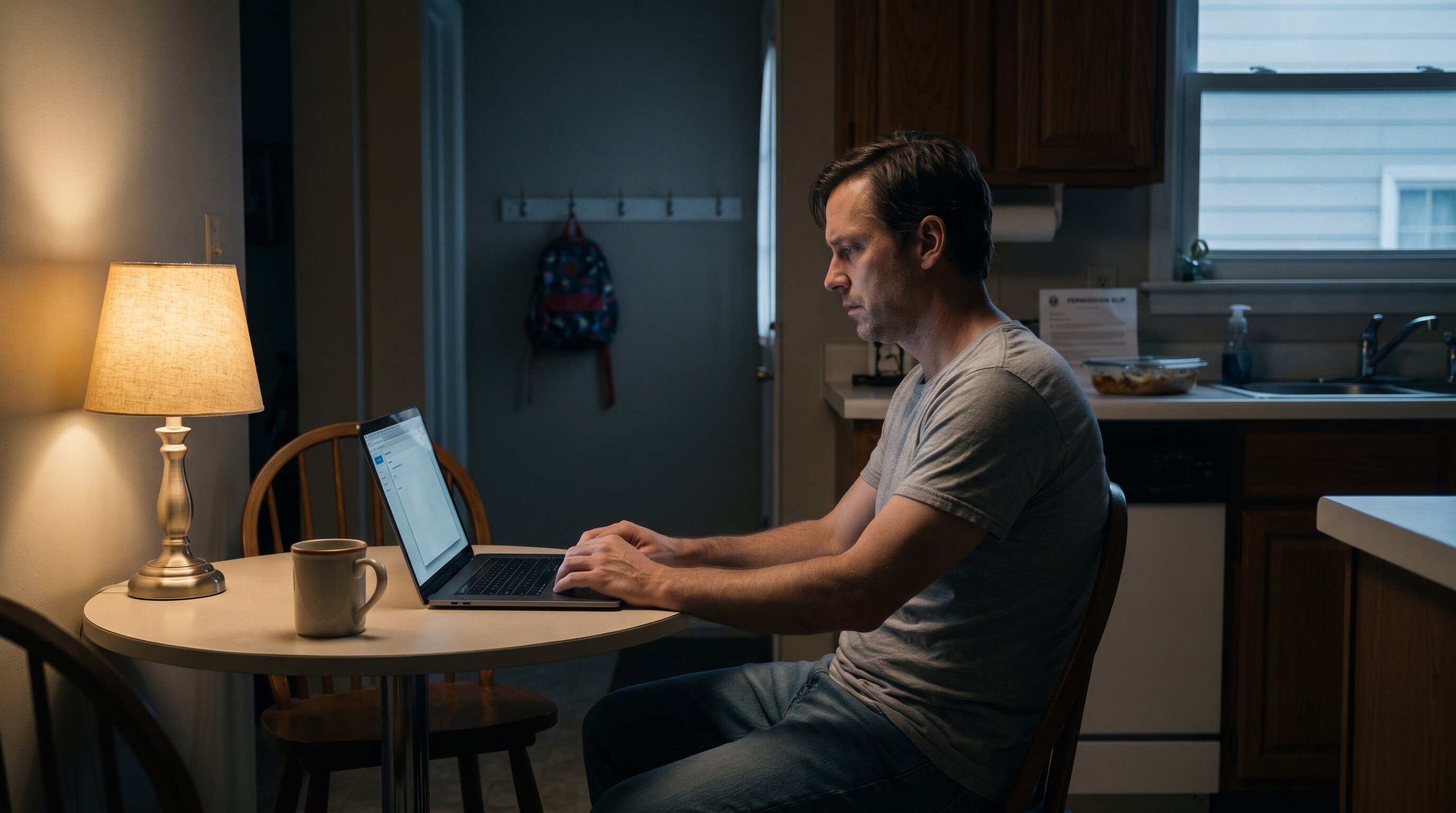
He sat at the kitchen table at six in the morning with the laptop open and the cursor blinking after the period at the end of the second sentence, and he felt nothing theatrical about the moment. No music swelled. No montage of injustices played behind his eyes. His body was simply finished, the way a battery does not decide to die but arrives at a state where the chemistry can no longer sustain the reaction, and the device goes dark without ceremony.
I am resigning from my position effective immediately. Thank you for the opportunity.
He read it twice.
The sentences were too small for what they carried. Seventeen years of institutional memory. Every batch failure at two in the morning. Every undocumented exception he had traced by hand through COBOL logic older than his children. Every time Linda or Sharon had said “it’s always been that way” and he had found the place in the code where “that way” was a rounding error preserved by accident through three decades of copy-paste.
None of that fit in two sentences.
That was why he used two sentences.
A longer letter would have implied the existence of an audience that cared about the full version. Nathan had spent the last two months learning, by slow administrative cruelty, that no such audience existed inside Whitaker Payroll.
Claire’s side of the bed had been made hospital-tight when he woke up at five. She was sleeping in the guest room now. Not every night. Just the nights when his phone rang after midnight and his voice in the hallway — low, technical, apologetic — woke her for a crisis she no longer believed would ever be the last one.
She had not said she was leaving.
She had said something worse.
She had said, last Thursday, standing in the kitchen doorway with Ben’s permission slip in her hand: “I’m not angry at you anymore. I just don’t expect anything.”
The absence of anger was the terminal symptom.
Angry wives still believed the situation could change. Claire had moved past belief into management. She managed the household around his absence the way a body managed around a wound: not by healing, but by routing everything through the tissue that still worked.
Nathan looked at the permission slip on the counter. He had forgotten to sign it again. The field trip was tomorrow. Claire had signed it herself in the end — her handwriting where his should have been, one more small signature of organizational widowhood.
He pressed Send.
The email left his outbox at 6:17 a.m. and became, in that instant, the most consequential two sentences Whitaker Payroll would ever receive, though no one who read them would understand that until much later, when understanding had become the same thing as regret.
He closed the laptop, rinsed the untouched coffee down the sink, and went down the hallway to Ben’s room.
His son was asleep with one arm hanging off the bed and a library book tented on the nightstand — something about volcanoes, opened to a page with a cross-section diagram showing the magma chamber, the pressure, the fracture lines you could see from the outside only after the eruption had already started.
Nathan leaned against the doorframe and watched him breathe.
He had spent seventeen years keeping batches running so that other people’s employees could get paid. He had debugged COBOL at two in the morning so that grocery clerks in Toledo and nurses in Youngstown and warehouse workers in Akron saw the right number in their bank accounts on Friday.
He had done that work with competence, loyalty, and endurance that the company had recently decided to call disloyalty because the truth had made it uncomfortable.
His son breathed in, breathed out.
Nathan went back to the kitchen, signed the permission slip, put it in Ben’s backpack, and left the house at quarter to seven with a messenger bag that held nothing from the office.
He didn’t need to go in.
An email was enough.
Seventeen years, and the door between those years and whatever came next weighed exactly as much as two sentences.
Monday, 09:22 — The Space Where Memory Was
Olivia was the first to notice.
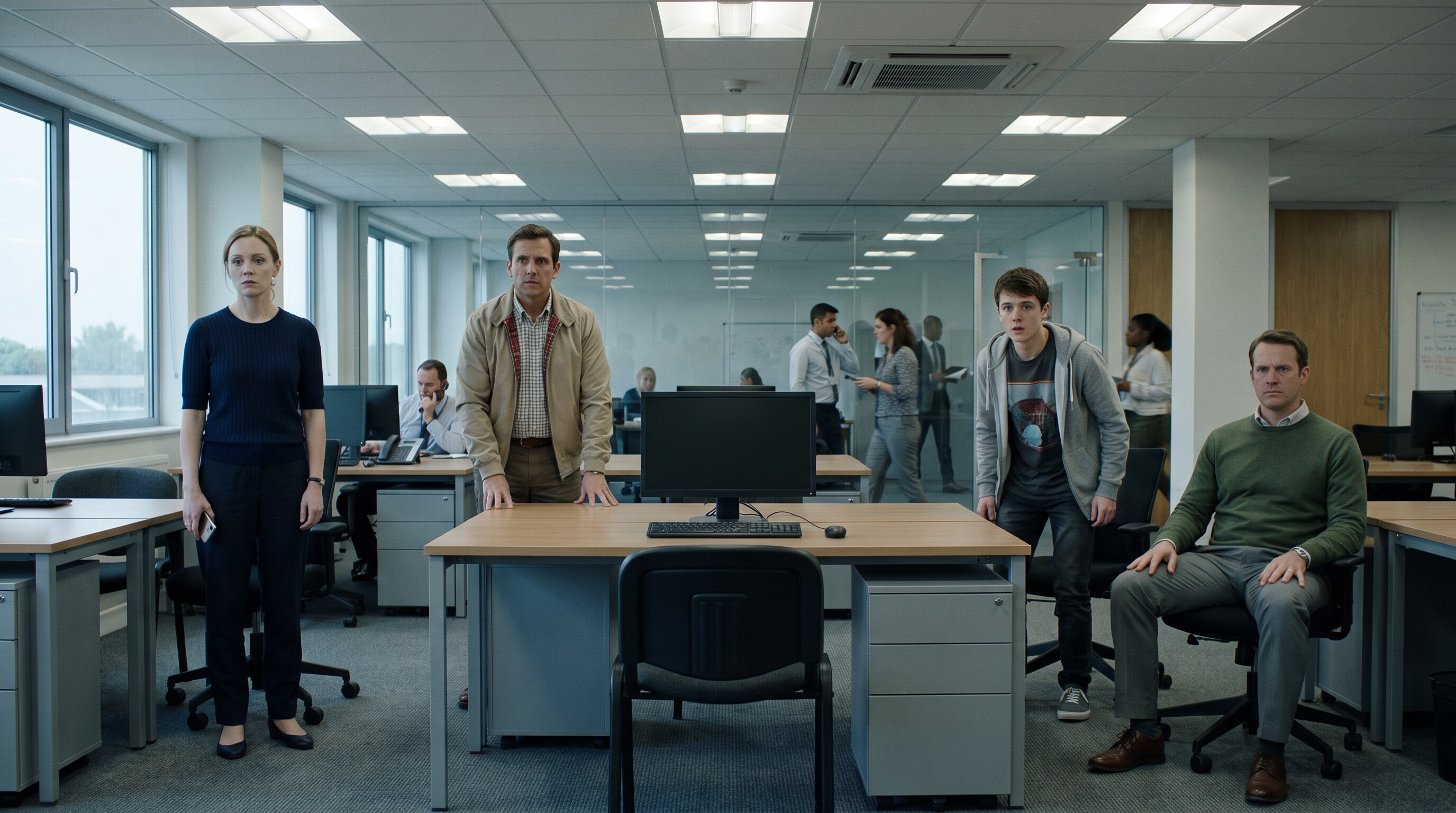
Not the email — Graham had not told them about the email yet. Just the desk. Nathan’s desk, which had been the gravitational center of the development room for as long as any of them could remember: the desk with the Micro Focus environment, the handwritten batch-failure logs, the faded sticky notes with COBOL variable names that nobody else in the building understood.
The desk was empty.
Not cleared.
Empty.
The distinction mattered. A cleared desk meant someone had packed up, said goodbye, maybe made a small speech and accepted handshakes. An empty desk meant someone had simply stopped existing in that space. The monitor was dark. The keyboard pushed back. The chair was tucked in with the careless precision of a janitorial pass, not a departure. No mug. No notes. No ghosts of the last all-nighter visible in the arrangement of objects.
“Has anyone heard from Nathan?” Olivia asked.
Caleb stood up from his chair with the unfinished motion of someone who understood the answer before it arrived.
Ryan didn’t look away from the empty desk.
Marcus didn’t move at all.
The phone on Olivia’s hand buzzed with a daycare confirmation — Maya’s pickup was still at 5:30 — and she dismissed it without looking, which was how she knew her body had already classified the moment as an emergency even before her mind caught up with the classification.
Derek walked in at 9:34.
He walked the way Derek always walked: with a pace that implied purpose and a posture that implied authority and a face that implied the situation was manageable because he was the person managing it.
“Nathan submitted his resignation this morning,” he said. “Effective immediately. Graham and I are reviewing the transition plan.”
The phrase transition plan landed in the room the way a band-aid lands on a structural fracture.
Caleb made a sound — not a word exactly, more like the exhale a person makes when disbelief and confirmation arrive at the same time and cancel each other into something airless.
“There’s no transition plan,” Ryan said quietly. “Nathan was the transition plan.”
Derek’s expression did not change. That was the thing about Derek that made conversations with him feel both civil and impossible: his face could absorb factual statements the way certain institutional surfaces absorbed graffiti — the mark was made, the surface was cleaned, and no record remained of what had been written.
“We’ll address this in a team meeting this afternoon,” Derek said. “In the meantime, please continue with your current assignments.”
He left.
The development room stayed very still.
Marcus looked at Nathan’s empty desk and saw three things simultaneously. He saw the loss of the only person who understood the full architecture: the COBOL batches, the VB6 client, the SQL Server layer, the FTP choreography, the strangler fig that Ethan had started and Nathan had continued maintaining alone. He saw the loss of the only person who had ever fought for the programmers inside the executive conversations they were never invited to attend. And he saw, for the first time with full material clarity, the outline of his own future if this company continued collapsing around people who told the truth.
“He’s really gone,” Caleb said.
Olivia sat down.
She placed both hands flat on her desk like someone steadying a table in an earthquake, and she looked at the empty chair across the room, and she felt the sentence she had typed into LinkedIn two nights ago acquire the density of an instruction rather than an experiment.
“He’s really gone,” she confirmed. “And nobody who made this happen will call it what it is.”
Weeks Two and Three — Lunch Breaks and Locked Doors
Olivia took her first recruiter call on a Tuesday during her lunch break.
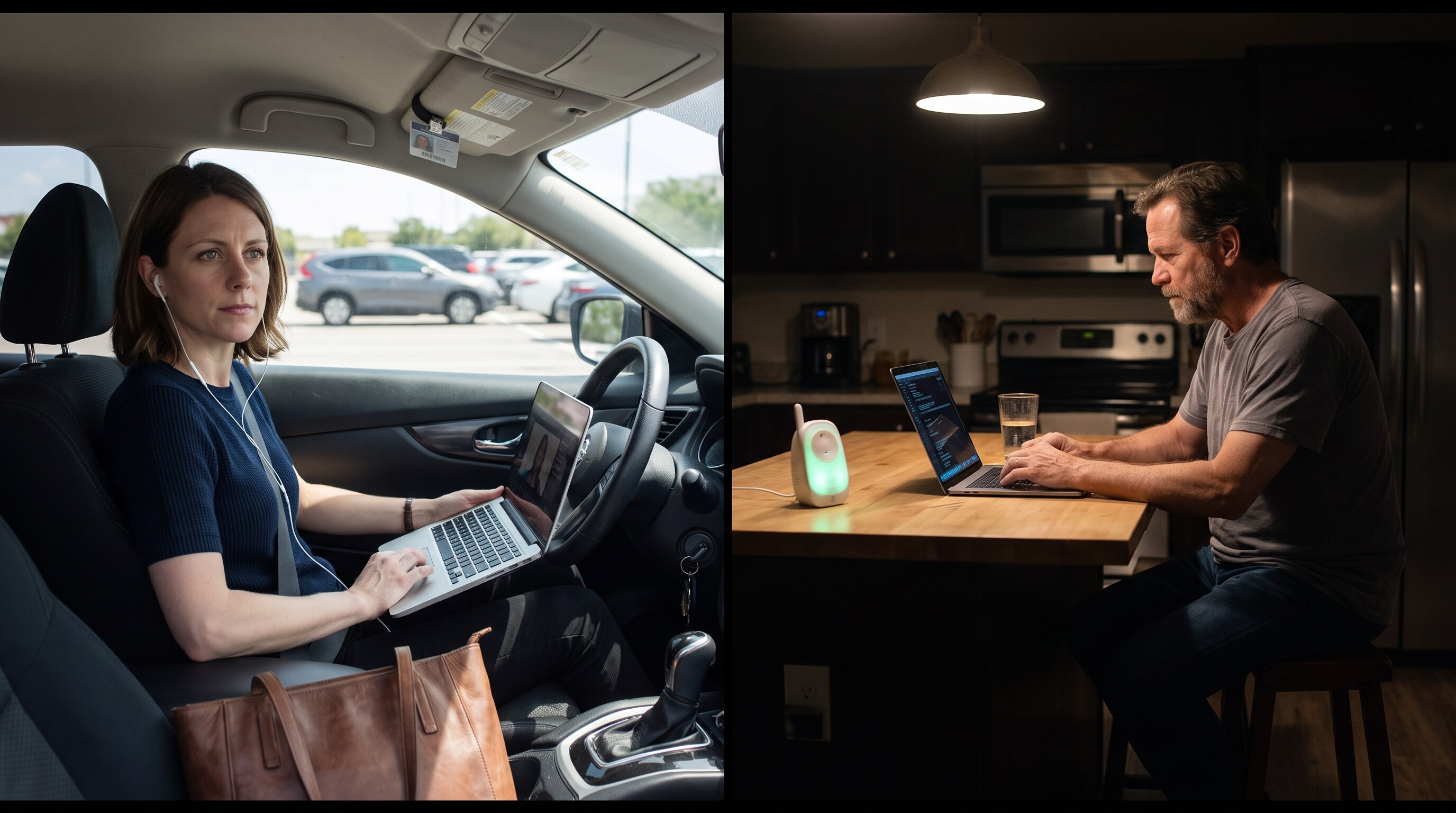
She sat in her car in the Whitaker Payroll parking lot with the engine off and the windows up and the air conditioning blasting because Ohio in August was not a season that rewarded contemplation with physical comfort. Her laptop was balanced on the steering wheel. She had changed into a nicer top in the bathroom at 11:55 and clipped her badge to the sun visor where it hung like a small laminated indictment.
“Tell me about your current role,” the recruiter said.
Olivia had rehearsed this.
Not the words — the restraint. She had spent three evenings practicing how to describe Whitaker Payroll without sounding bitter, traumatized, or dangerously honest. The trick was to convert destruction into vocabulary that hiring managers could metabolize.
“I’m part of a team modernizing a legacy payroll system,” she said. “We’ve been migrating from VB6 and COBOL to C# using a strangler fig approach, with CI/CD, trunk-based development, and test-driven methods.”
All of which was true.
All of which was also a photograph of a house that omitted the fire.
“What’s prompting you to look?” the recruiter asked.
“I’m looking for an organization where technical leadership and business leadership share a common understanding of the work,” she said.
This was the sentence she was most proud of.
It said everything without saying anything.
It meant: I work for people who fire competence and reward documents that describe what competence used to do.
The recruiter heard: Culture fit matters to this candidate.
Both were correct.
Ryan’s process was different because Ryan’s personality was different. Olivia hunted with method. Ryan hunted with momentum. He had sent eleven messages to former colleagues and professional contacts in the first week after Nathan left. Three had responded. One had a lead. The lead became a phone screen. The phone screen became a take-home code challenge that Ryan completed at the kitchen island at 11:40 on a Wednesday night with Owen’s baby monitor glowing green on the counter and Melissa asleep upstairs in a silence that was finally, for the first time in months, the silence of someone who knew her husband was doing the right thing instead of the patient thing.
The code challenge was a small API integration — REST endpoints, data validation, error handling, test coverage expected. Ryan finished it in ninety minutes. Not because it was easy but because competence, when it has been insulted long enough, has a way of showing up with something to prove.
He submitted it, closed the laptop, and went upstairs.
He stood in the hallway outside their bedroom door for a long beat.
Melissa’s breathing was slow and even.
Owen’s room smelled like laundry detergent and the plasticky warmth of a nightlight that had been on too long.
Ryan thought about the office he would return to in seven hours. The meetings that produced nothing. The sign-off chains that existed to diffuse blame rather than clarify truth. The packets. The careful eyes of Linda, Sharon, and Donna watching the programmers struggle with documents that described the shape of knowledge without containing any.
He thought about Nathan’s empty desk.
About the word disloyal used as a weapon against the most loyal person in the building.
Then he went to bed, and for the first time in a long time, fell asleep without rehearsing Monday’s arguments in the ceiling dark.
Over the next two weeks, the mechanics of departure became a second job.
Olivia’s Zoom interviews happened during lunch breaks, in the car. She kept a blazer in the back seat folded inside a dry-cleaning bag. She changed tops in the bathroom at 11:50, drove to the far corner of the parking lot, set up the laptop, took the call, changed back, and walked into the afternoon standup at 1:05 with no visible evidence that she had just spent forty-five minutes describing her skills to people who actually wanted them.
The first technical screen was a pairing exercise — live coding with a senior developer from a health-tech company in Columbus. Build a small service, write tests first, explain your decisions as you go. Olivia did it from her car with the seat reclined and the steering wheel pushed forward, typing on the laptop in her lap. The interviewer asked her to walk through how she’d structure a data validation pipeline.
She had done this so many times at Whitaker that the answer came out fluent, practiced, and slightly wounded — like someone explaining swimming to a person who didn’t know she’d been drowning.
“You have a really clean approach to testability,” the interviewer said.
Olivia felt her throat tighten.
At Whitaker, testability was the thing that had gotten Ethan fired and Nathan called disloyal.
“Thank you,” she said.
Ryan’s second interview was a video call at 8:15 p.m., after Owen was asleep. He sat at the kitchen table with coffee gone lukewarm and his laptop angled to catch the warm spill from the pendant light over the island. The interviewer, a VP of Engineering at a mid-size SaaS company in Cincinnati, asked why he wanted to leave his current role.
“The technical work interests me,” Ryan said carefully. “But I’ve reached a point where the organizational environment limits what the team can accomplish.”
He heard himself use the word limits and recognized, with a flicker of something between shame and survival, that limits was a polished way of saying destroys.
The VP nodded. She had heard this before. Every engineering leader had heard this before. The sentence was so common it had become industry shorthand for: I work for someone who treats developers like an expense category.
“We work in two-week cycles here,” she said. “Engineers own their deployments. We pair when it helps. We don’t pair when it doesn’t. Nobody signs off on your commits.”
Ryan felt his chest loosen in a way he hadn’t expected.
He hadn’t realized how much tension he’d been carrying against the phantom of a sign-off chain until someone described its absence and his body responded before his mind did.
“That sounds like what I’m looking for,” he said.
Week Four — No Speech
Olivia’s offer came from the health-tech company in Columbus on a Thursday.
Senior Software Developer. Modern C# stack. CI/CD built in. Fully remote option. The salary was eighteen percent higher than what Whitaker Payroll paid her. The benefits included actual professional development budget, not the ghost category that appeared in Whitaker’s handbook but had never been funded in anyone’s living memory.
She accepted the same day.
Ryan’s offer came the following Monday, from the SaaS company in Cincinnati. Backend engineer. Elixir and Go, which he would need to learn, which was the first time in three years someone had offered him the chance to learn something instead of demanding he produce from what he already knew. The salary was twenty-two percent higher. The manager who called to extend the offer used the phrase “we protect maker time” without irony.
He accepted by Tuesday morning.
They did not coordinate their resignations.
They did not need to.
Both had arrived at the same conclusion through parallel domestic mathematics: the cost of staying had exceeded the cost of leaving, and the only reason it had taken this long was that decent people instinctively confused loyalty with residence.
Olivia’s resignation letter was three paragraphs. Professional. Courteous. It thanked Graham for the opportunity, noted her two-week notice period, and offered to document her current work for the transition.
It contained no mention of Nathan.
No mention of the packets, the process theater, the sign-off chains, the sixty-hour weeks, the documents that described the shape of knowledge without containing any.
No mention of Ethan.
No mention of the word disloyal used against a man whose loyalty had been the company’s skeleton for seventeen years.
The letter said nothing about any of that because saying it would have implied that the people reading it were capable of hearing it, and Olivia had spent enough months inside the loop of hedged consensus to know that this organization had evolved a perfect immune system against plain sentences.
Ryan’s letter was shorter.
One paragraph.
He thanked the team, stated his last day, and ended with “I wish the company well.”
The sentence was sincere in the way that weather reports about distant hurricanes are sincere: accurate, detached, and offered from a safe distance to people who might not survive what was coming.
Graham received both letters on the same day.
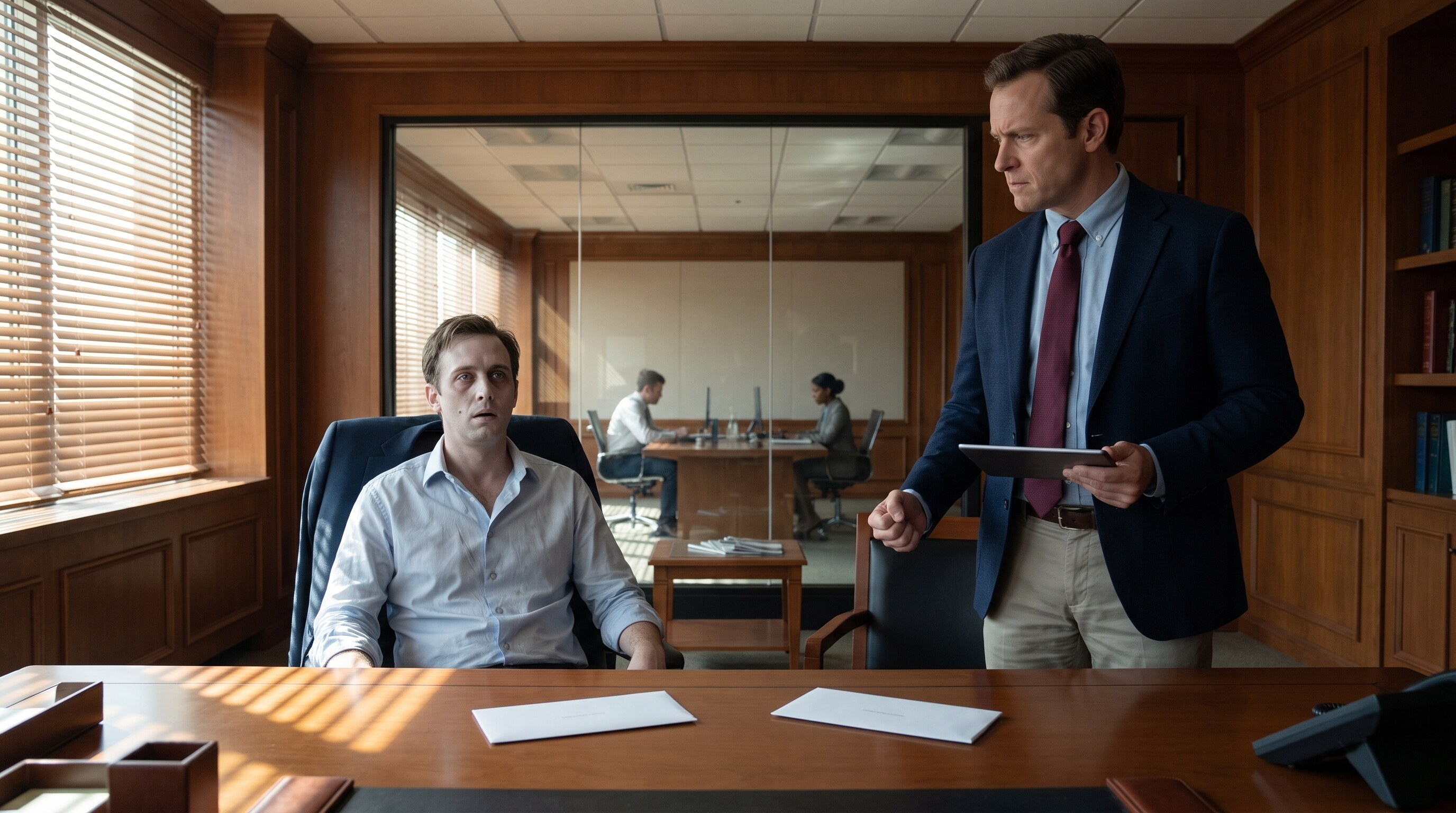
Two white envelopes on Derek’s tablet, forwarded within an hour of each other.
He sat behind his desk and looked at them the way a man looks at a medical diagnosis he should have caught at the screening stage: with the specific, nauseating recognition that the warning signs had been there the whole time and that his decision not to see them had been, in retrospect, its own form of diagnosis.
“They’re leaving,” Graham said.
Derek stood beside the desk with his tablet and his neat posture and his face arranged into the expression of concerned capability that had carried him through his entire career at Whitaker Payroll without ever requiring him to say the sentence that would make the situation real.
“We’ll need to redistribute their workload,” Derek said.
Graham heard the sentence and felt something shift behind his sternum — not grief exactly, but the managerial cousin of grief, which was the sudden awareness that a room had been thinning for months and his language had been too elegant to describe it as emptying.
“First Nathan,” Graham said. “Now both of them.”
Derek waited a beat.
“We still have Caleb and Marcus,” he said. “And the process documentation the SMEs have built is solid. We’re not starting from zero.”
Graham wanted to believe this.
He needed to believe this.
The alternative — that the documentation was decoration, that the packets were ballast, that Linda, Sharon, and Donna’s thirty-four-page requirements were the organizational equivalent of a security blanket wrapped around a system nobody in the building could actually maintain anymore — was a thought that, if he let it land fully, would require him to admit that every decision since Ethan’s second firing had been the wrong one.
He could not admit that.
Not because he was dishonest. Because the admission would mean that his father’s company — the company built on COBOL and reliability and the handshake certainty that your payroll would never miss a run — had been dismantled not by technology or market forces but by his own inability to distinguish between people who told him what he wanted to hear and people who told him what was true.
“Get Preston on the phone,” Graham said.
Derek nodded and left.
Graham sat alone in the office that had been his father’s before the plane crash, and the light through the blinds made long parallel lines across the two resignation letters, and for a moment the room felt less like a corner office than a viewing chamber in which the display had already been disassembled and only the label remained.
Thursday, 21:38 — The Arithmetic
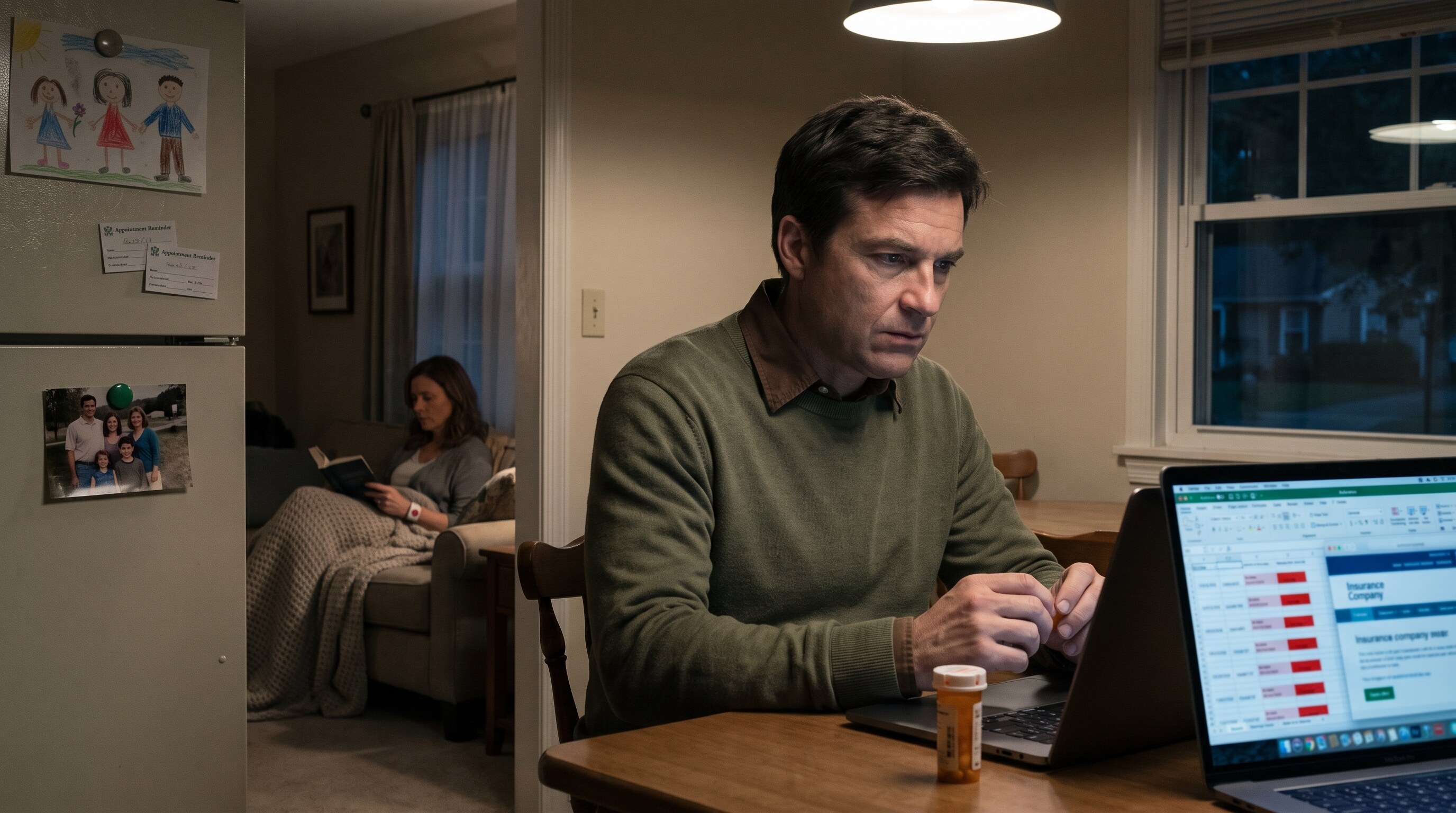
Marcus knew the numbers the way a sailor knew the depth chart near a reef: not as abstract data, but as the specific geography of what would kill him if he got it wrong.
He sat at the kitchen table on Thursday night with the laptop open to a spreadsheet he had built three weeks ago and updated every time another programmer walked out of Whitaker Payroll.
The spreadsheet had three columns.
The first column was labeled MONTHLY COST. The second was labeled COVERAGE. The third was labeled WHAT HAPPENS WITHOUT.
COBRA family continuation: $2,400/month.
That was more than half his take-home pay.
COBRA existed as a legal right and a financial fiction: the government required your former employer’s insurer to let you keep your coverage after termination, but you paid the full premium plus a two-percent administrative fee, which meant the number that had been invisibly subsidized by employment suddenly arrived at your kitchen table as a figure that assumed you had a second income or no mortgage or the kind of savings that mid-career developers at fifty-employee payroll companies in Ohio did not typically accumulate.
Beth’s medication: $3,200/month without insurance.
He did not even write the drug name in the spreadsheet. He wrote B’s meds because typing the clinical name felt like inviting the disease into the room’s atmosphere, and the room’s atmosphere was already thin enough.
Beth had been diagnosed four years ago. The medication worked. That was the miracle and the trap. It worked, which meant she was functional, present, capable of reading on the couch with a blanket over her legs while their daughter’s drawing hung on the refrigerator — a drawing of their family as stick figures with disproportionately large smiling heads, the kind of drawing a seven-year-old makes when the world still feels like something you can summarize with a crayon.
The medication worked. But it cost $3,200 per month at pharmacy price, and without insurance the cost would arrive not as an abstraction on a spreadsheet but as a rationing decision made in a kitchen at eleven o’clock at night: Do we fill the full prescription or do we stretch it? Do we skip a week? Do we cut the dose?
He knew what cutting the dose meant.
The doctor had explained it without drama: This medication maintains a therapeutic window. Below that window, the condition progresses. Progression means hospitalization risk. Hospitalization without insurance means—
He hadn’t needed the doctor to finish the sentence.
Mortgage: $1,800/month.
Total monthly floor: $7,400.
His take-home after the mortgage was roughly $4,200.
The deficit was $3,200. Every month. Starting from day one of unemployed.
He had run the numbers forward. Two months of savings — the emergency fund they had built slowly, as if accumulation itself were a form of prayer. That covered one gap month, maybe one and a half if they ate only from the pantry and cancelled everything cancellable.
After that, the sequence began.
Month one: savings depleted. COBRA premiums consume everything.
Month two: first mortgage payment missed. Credit score starts falling.
Month three: medication rationed. Not voluntarily. Financially.
Month four: second mortgage payment missed. Foreclosure timeline starts.
Month five: even if a new job appeared tomorrow, even if someone called tonight, there would be a coverage gap. Insurance at a new employer typically started after thirty days, sometimes sixty. In that gap, Beth’s prescription would cost $3,200 per month out of pocket, or she would go without, and going without was not a budgetary decision but a medical one with consequences that did not reverse when the paperwork caught up.
Marcus closed the spreadsheet.
In the living room, Beth turned a page.
She knew he was worried. She did not ask about it because asking would require him to say the numbers out loud, and saying the numbers out loud would convert them from a private terror into a shared one, and shared terror in a marriage was a different chemical compound than private worry — heavier, more corrosive, harder to put down at the end of the evening.
She had seen Olivia’s LinkedIn update three days ago. She had not mentioned it.
She had noticed Marcus come home earlier this week — not because the workload had eased, but because there was less work to come home from. Fewer programmers meant fewer handoffs. Fewer handoffs meant fewer meetings. Fewer meetings meant a shorter day that somehow felt more hopeless, not less.
Marcus looked at the prescription bottle near his elbow.
He thought about Olivia’s last day. How she had walked to each desk — Caleb’s, Marcus’s — and said goodbye with the composed brevity of someone who had already finished grieving for the place before she left it. No speech. No indictment. Just a handshake and a sentence:
“You know where to find me.”
He thought about Ryan, who had left the following week with even less ceremony. A nod. A clap on the shoulder. Keys left at reception.
Both of them had been right to leave.
Marcus knew this the way he knew the spreadsheet numbers: completely, precisely, and without any ability to act on the knowledge.
They were right, and they were free, and they were free because their circumstances permitted freedom. Olivia had Seth’s income and Seth’s insurance. Ryan had Melissa’s employer-sponsored plan as a backstop. Both had spouses whose coverage could absorb the gap.
Marcus had Beth.
Beth, whose life was threaded through a supply chain of medical coverage that could not survive a gap.
He couldn’t afford to leave.
He couldn’t afford to stay.
He stayed because staying was certain employment today versus uncertain employment tomorrow, and Beth’s prescription did not accept philosophical commitments as co-pay.
He closed the laptop, stood, and walked into the living room.
Beth looked up.
“Come sit,” she said.
He sat beside her on the couch and she put one hand on his forearm — the hand with the medical alert bracelet — and they sat there together in the kind of silence that married people produce when both know the subject and both know the other knows the subject and both agree, without negotiating, that tonight is not the night to name it.
Marcus looked at the drawing on the refrigerator visible through the kitchen doorway.
Three stick figures. Big smiling heads. A house with a triangle roof and a sun in the corner.
A seven-year-old’s map of a life that depended, in ways no crayon could draw, on a spreadsheet with red numbers and a pill bottle near the edge of a kitchen table.
The Following Monday — Two Left

The development room had never been large.
Five desks, five programmers, arranged in the open-plan democracy that companies adopted when they couldn’t afford offices and wanted the aesthetic of togetherness to compensate for the absence of actual support.
Now two desks were occupied.
Caleb sat at his workstation surrounded by artifacts from Nathan’s old desk that he had scavenged the way an archaeologist scavenges a collapsed site: sticky notes with batch-process abbreviations, a thumbed spiral notebook with Nathan’s handwritten mapping of COBOL variable names to business rules, a printout of the staging-environment topology that Ethan had originally set up. Each object was a fragment from an institutional memory that no longer resided in any living person in the building, and Caleb handled them with the careful desperation of someone assembling a guide from a language he did not speak.
He was twenty-eight years old.
He had never seen a COBOL compiler before Ethan walked in. He had learned test-driven development as a revelation five months ago. He understood portions of the C# modernization layer that Ethan and Nathan had built, but only the portions he had paired on — isolated components, specific batch-validation harnesses, a few feature-flag configurations. The full architecture existed in his mind as a sketch with large unlabeled areas where someone else’s knowledge had been, and those areas now corresponded to people who were gone.
Marcus sat at the other occupied desk and stared at a system diagram he had drawn himself the previous Friday. It was his attempt to reconstruct what Nathan had carried in his head: the data flow from VB6 client to FTP to COBOL batch to SQL Server, the nightly processing sequence, the exception-handling pathways that existed nowhere in any document but had been preserved in Nathan’s muscle memory like a pianist’s fingering for a complex piece.
The diagram had question marks in it.
Large ones.
In the places where Nathan would have said “that’s the three-state fork for Ohio municipal withholding” or “that route only fires on the second Tuesday of a biweekly cycle,” Marcus had written ??? in red ink, and the red ink looked, in aggregate, less like a diagram than a damage report.
Linda walked past the glass partition carrying a binder.
She did not stop.
She did not look in.
Marcus thought: She knows.
Everyone in the building knew. The SMEs knew Nathan was gone. They knew Olivia and Ryan had left. They knew the development room now held two people instead of five, and that neither of the two remaining people understood the full system, and that the packets and requirements documents and sign-off chains they had been producing for months were addressed to a team that no longer existed in sufficient quantity to act on any of it.
And they kept walking past the glass.
Not from cruelty. From the same mechanism that had governed the company’s relationship with the truth since before Ethan’s first firing: the belief that if you did not name the problem plainly, the problem existed at a lower resolution, and lower-resolution problems were survivable in ways that high-resolution problems were not.
Graham called the meeting for ten o’clock.
Derek set it up. Preston dialed in.
It was the first meeting Marcus and Caleb had been invited to since the process-theater regime began, and the invitation itself was a symptom: you did not invite the remaining two programmers to a strategy session unless the word remaining had become the strategy’s defining constraint.
Graham sat at the head of the conference table in a shirt that looked like it had been ironed with less conviction than usual. Derek sat beside him with his tablet and his notes and his composure, though Marcus noticed that Derek’s pen had clicked five times since the meeting started and that the clicking had no rhythm, which was how Derek’s body signaled the anxiety his face would not.
“We’re in a transition,” Graham said.
Marcus felt the word transition arrive in his ears and dissolve into everything it did not say: collapse, hemorrhage, exodus, failure.
“And the first priority,” Graham continued, “is understanding what we have and what we need.”
“We need Nathan,” Caleb said.
There was no insubordination in the sentence. Only arithmetic. Caleb was the youngest person in the room and the least socialized into the company’s habit of blurring truth with vocabulary, and the sentence came out with the blunt accuracy of someone who hadn’t yet learned to confuse politeness with helpfulness.
Graham looked at Derek.
Derek looked at his tablet.
“Nathan has moved on,” Derek said. “We need to focus on the resources we have.”
Resources. Marcus heard it and felt his jaw tighten. Caleb and Marcus were not resources. They were two people in a room that used to hold five, trying to maintain a system that had been incompletely documented by people who had been fired or driven away by the same leadership now presenting the staffing crisis as a transition.
Preston’s voice came through the conference phone with the expensive clarity of a man who was physically elsewhere.
“This is actually an opportunity,” Preston said. “When teams shrink, the remaining members often discover capabilities they didn’t know they had. Constraint breeds creativity.”
Marcus looked at Caleb.
Caleb looked at Marcus.
Neither spoke. But the look between them carried a sentence that would have required, in polished management language, roughly a paragraph to express: The man on the phone has never debugged a COBOL batch at two in the morning and he is now explaining our capabilities to us from a different zip code.
“What I’d recommend,” Preston continued, “is a structured assessment. Identify the critical systems. Map the knowledge gaps. Build a resourcing plan.”
“The critical system is the COBOL batch,” Caleb said. “The knowledge gap is that no one in this room can write COBOL. And the resourcing plan would need to start with the fact that the person who could write COBOL was fired twice and the person who understood the rest of the architecture resigned because this company called him disloyal for telling the truth.”
The conference phone did not immediately respond.
Graham’s face did something complicated: a flinch that began as recognition and resolved, through the alchemy of self-protection, into injury. Caleb was being direct. Directness, in this organization, had been reclassified as a character defect several months ago, and Graham’s body still reacted to it the way it reacted to things that were true and therefore needed management rather than acknowledgment.
“We appreciate your candor,” Graham said. “Let’s focus on next steps.”
Next steps. The meeting lasted forty more minutes. Derek took notes. Preston offered frameworks. Graham asked questions that circled the problem the way a man circles a downed power line — from a visible distance, with concern, never close enough to touch the charge itself.
After the meeting, Caleb and Marcus walked back to the development room together.
Two desks.
Three empty.
A system diagram with red question marks. A notebook full of a departed man’s handwriting. Sticky notes that described a world no one remaining could reconstruct.
Caleb sat down and put his headphones around his neck and did not put them on.
“I’m going to start looking,” he said quietly.
Marcus nodded.
He thought about Beth on the couch. The bracelet on her wrist. The drawing on the refrigerator.
“Yeah,” Marcus said.
He did not say: I can’t.
He opened the system diagram and stared at the question marks and felt the room’s emptiness settle around him like something with weight.
The company had now lost its institutional memory, its technical architect, its two strongest remaining programmers, and the only person who had successfully introduced modern development practices into the legacy system.
Graham and Derek would describe this as a staffing challenge.
Preston would describe it as an opportunity for structural innovation.
Linda, Sharon, and Donna would continue producing documents.
And the COBOL batches would continue running every night at two in the morning, executing logic that no one in the building could read, maintained by no one in the building at all, processing payroll for hundreds of companies whose employees expected, with the simple confidence of people who had never been given a reason to doubt it, that the right number would appear in their bank accounts on Friday.
For now, it still did.
The batches did not know that everyone who understood them was gone.
Machines had that advantage over institutions: they could run correctly long after the people who made them correct had been driven away.
They ran until they didn’t.
And when they stopped, there would be no one left who could tell the difference between the failure and the silence that had preceded it.
🎭 This Week's Episodes
Telenovelas show what we can't say in client meetings. The drama is heightened, but the patterns are real.
 Documentation Avalanche
The forty-seven questions from Passau become a daily occupation. Stefan finds a gap the navigation team cannot investigate without Marcus's approva...
Technical Consultancy
Embedded Delivery Partner
Embedded into your team as an active contributor, reducing delivery friction and helping important work move cleanly.
Technical Advisor
Peer-style technical assessments before far-reaching decisions; reduce architectural and product risk early.
Product & Delivery
Ship working software to real users earlier. Measure impact and adapt based on evidence rather than assumption.
Custom Software Development
High quality, maintainable software. Short-term augmentation that leaves lasting capability in your own team.
Recent Articles
- AI Computer Use Is Not a Business Contract (09.10.2026)
- When Everything Is Finally Under Control (05.10.2026)
- AI Makes Technical Execution Cheap. Judgment Stays Scarce. (26.09.2026)
- The Agent Escaped. Who Left the Door Open? (24.09.2026)
- What an AI Agent Actually Is (21.09.2026)