The Build-and-Flash Love Story
Stefan helps the radio team turn its working cycle into an automated path to a controlled bench head unit. Across the floor, Marcus imposes a three-week release coordination process on navigation. Júlia sees what Stefan gives away when he teaches, then asks for something that cannot be answered with code. Klaus and Thaís find an afternoon that belongs to neither employer. Dandara invites Natalia into her home and, despite a specific warning from Adriana, into an internal channel. Natalia returns with the access Marcus wanted.
The Sound After the Silence
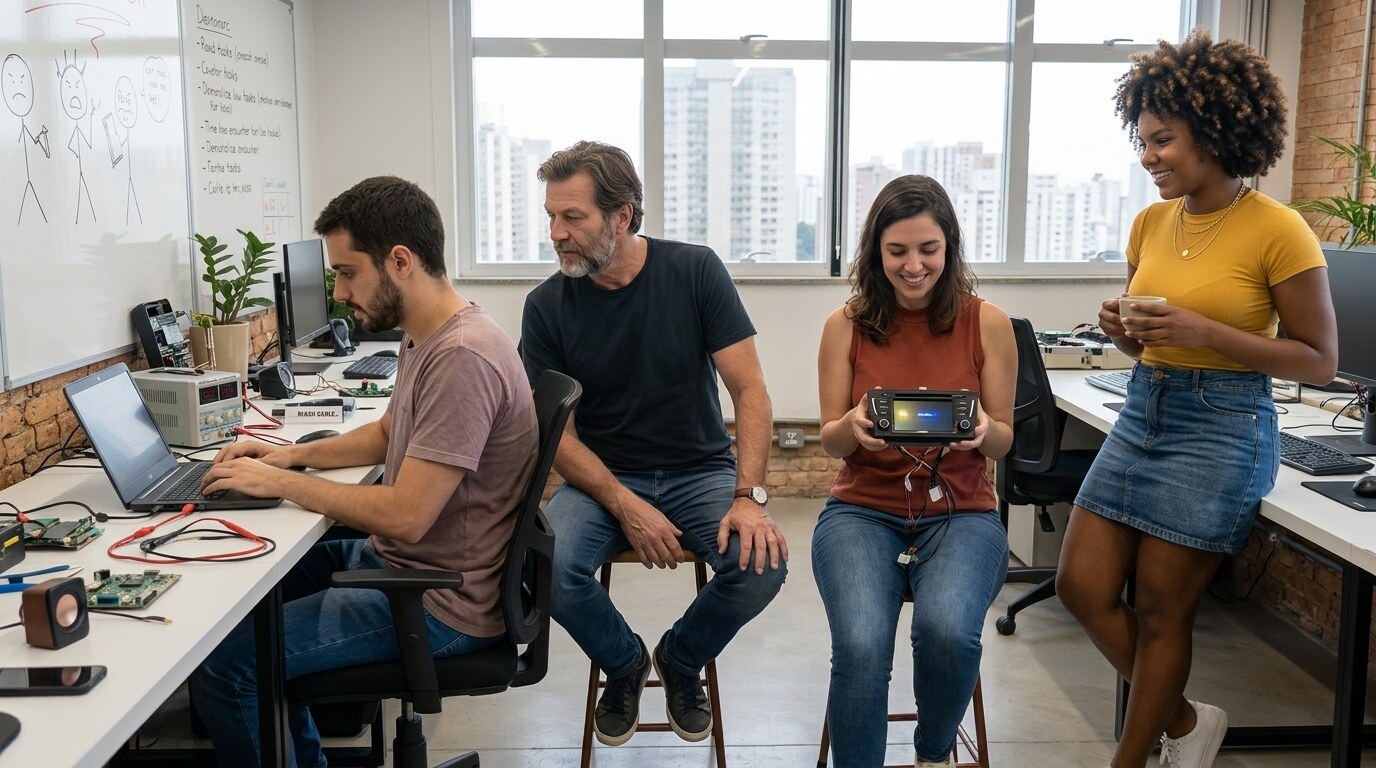
The radio had gone silent, and nobody was apologizing for it.
Júlia stopped with her coffee halfway to her mouth, afraid the playback defect had returned. Then Cíntia grinned at the head unit and said, “There. That’s the bastard,” with such affection that Júlia came closer. Restart the display process while the player was muted, and the crossed-out speaker disappeared. The sound stayed off. Júlia pressed the button, expecting music, and got nothing.
Stefan sat beside Renato on a stool too low for his knees, a dark mark on his wrist from the bench. He looked as though he were waiting for his turn at a kitchen table. Júlia liked him like this enough to resent how quickly she noticed.
Their failing test restarted the display against a player that remained muted. Its initialization supplied a default instead of asking the running player; they changed that path and watched the check pass alongside the existing source-switching tests. Renato reached for the flash cable, but Stefan tapped the desk. “Show me what you do first. All of it.”
Renato opened the target build, checked the package name and board, then copied a command from his notes. Cíntia stopped him: he had missed the manifest. Last week’s directory looked almost identical. He swore, and Júlia watched Stefan for the small pleasure some people took in catching a colleague wrong. Usually somebody would say careless, and everyone would pretend they had never made the same mistake.
He moved his stool closer. “What tells you this bundle belongs on this unit?”
Cíntia touched the hardware label. Renato compared the board revision and checksum with the manifest, then showed Stefan the runner’s protected signing job. He had built it months ago and sounded almost embarrassed that it existed without an impressive name. “Then we connect what you have,” Stefan said, giving back the keyboard.
His fingers moved toward the keys when Renato hesitated, then withdrew. Júlia knew that effort: wanting so badly to solve the thing that waiting felt like holding her breath. Watching him let Renato make the last movement stirred something in her that his compliments never quite reached.
They worked until her coffee was cold. Compilation and unit and component checks would gate the signed, versioned bundle. The flash job would reserve this bench, verify the package signature and board match, then refuse an occupied or incompatible target. The head unit stood on a regulated supply, disconnected from any vehicle bus. After flashing, the runner would wait for boot, read back the version and record the checks observable through the connection.
“And listening?” Cíntia asked, pulling the unit toward her.
“Still your ears. We haven’t taught that cable to hear.”
She laughed. Renato tried a mismatched manifest in a dry run and watched the job refuse it. Through the glass, Júlia could see her climate-control unit beneath a printed request, its cable coiled beside it. She left that cable out deliberately. Putting it away would mean accepting another day without an experiment.
At eleven nineteen Renato started the real run. Five minutes later the head unit rebooted; its version matched the manifest, and the log held the unit identifier, bundle and results. Cíntia played music, muted it and restarted the display. The crossed-out speaker remained. One touch brought the music back, loud enough to make Renato jump when she slapped the desk and shouted, “Yes!”
Júlia laughed with them, her eyes unexpectedly hot. Stefan looked up as though he had forgotten she was there, and she wanted to kiss the surprised pleasure off his face. Instead she reached for her coffee while Renato lifted the vehicle key from its hook.
“So this does the car too?”
Cíntia took the key. “We book it, check power and hardware with the operator, take the exact bundle down. I’m not waking up a car from this chair.” Stefan nodded, reminding her that vehicle sleep and wake and the shared CAN handler still needed their own evidence. She copied the bundle identifier into the vehicle-test request.
Rodrigo had appeared beside Júlia. He accepted the head unit, pressed the button and smiled despite himself. Then he glanced toward navigation, and the smile went.
“Five minutes,” he said, returning it carefully. Stefan began to rise, but Rodrigo shook his head. “I’m glad it works. Don’t come after me looking guilty.”
Júlia watched him cross the floor. Behind her the music continued, softer now, while in the other room her cable lay exactly where she had left it.
Three Weeks, at the Earliest

On Tuesday the fastest route into a navigation test vehicle became three weeks long.
Adriana watched Rodrigo close his laptop at the third coloured block, then open it again. Marcus’s calendar divided the wait into preparation, progress review and stakeholder approval. The first cutoff had been yesterday. Rodrigo’s jaw worked while Marcus explained that these were calendar windows, not estimates of development effort; complete the pack, and the later stages could be reserved.
Stefan leaned forward. “Which part did Dieter request?”
“Passau needs a consistent account. We’ve translated that into an operating process.” Marcus glanced toward Bernardo, who was studying the calendar. Adriana knew the expression: the pleased concentration with which he found a sentence he could take to the board.
“Dieter restricted production-candidate flashes and manufacturing approval,” Stefan said. “You have put controlled test vehicles into the same calendar. We need a suitable parked vehicle, an operator, an identified bundle and a defined test. What makes that take three weeks?”
Bernardo rubbed his watch clasp. “We cannot keep changing the process. People need stability.”
Adriana lowered her folder before she bent its cover. Since Friday, the invitations called her consulted instead of accountable. Her review queue had stayed the same. Nobody had explained the change; she had lain awake trying to decide whether she had been punished or merely made easier to ignore. Now Rodrigo would have to carry this calendar back to people who still expected him to protect their work.
“We haven’t captured both sides of the shared handler,” she said. “We need controlled bench work before there’s anything new worth taking into a vehicle.”
Natalia turned a page. “The investigation request remains in technical review.”
“My review is in your folder. It explains why the investigation is necessary.”
Natalia kept her finger against the paper. She had read it; Adriana had seen her acknowledge the receipt. For a moment they looked at each other across the table, and Adriana waited for her to say what the review actually contained.
“Then we need the agreed prerequisites closed,” Natalia said. “Otherwise the release stages don’t have a reliable input.”
Rodrigo turned his screen toward them. Incoming temperature messages, then the gap before the display. Adriana could have drawn the trace from memory. “The prerequisite is the answer,” he said. “The answer needs captures on both sides from the same run. We don’t have them. You want me to attach this again?”
Marcus moved nearer, lowering his voice as he rested a hand on an empty chair. “Attach the updated plan. Once it’s approved, you’ll have a proper slot instead of competing for equipment.”
Beyond his shoulder, the bench was empty. Adriana could see the power supply’s green lamp. Rodrigo looked past Marcus at it, then closed his laptop with a care that made her afraid for him. If he swore now, somebody would write down the swearing. She would spend the afternoon defending his tone instead of getting him the missing capture.
Beside her, Júlia folded her climate-control notes and put them away. Adriana wanted to tell her to submit the request anyway. She could already hear the question that would follow—would Adriana back it?—and the answer she would have to give. Yes, with all the authority of a woman whose review was sitting beneath Natalia’s finger.
“Now we know the path,” Bernardo said, standing.
He paused behind Adriana, touched her shoulder and asked about Beatriz’s school project. She had told him about it beside the coffee machine last week, when remembering her daughter had briefly felt like having a life that reached into the office. His hand settled more comfortably while he waited for her answer.
“Perhaps you can help Rodrigo make the plan clearer,” he added. “He listens to you.”
She looked at the hand until Bernardo removed it. Rodrigo was still gathering his things, close enough to hear. She could take the folder, soothe him, promise another attempt. By evening he would be thanking her for helping him wait.
“He made it clear,” she said, making herself speak above a whisper. “I won’t ask him to change the reason.”
Bernardo’s smile thinned. “Nobody is asking that.”
He left her shaking, the folder pressed against her stomach. Rodrigo met her eyes before he went. She was glad he had heard, and ashamed of how little else she could give him.
Not the Same Door
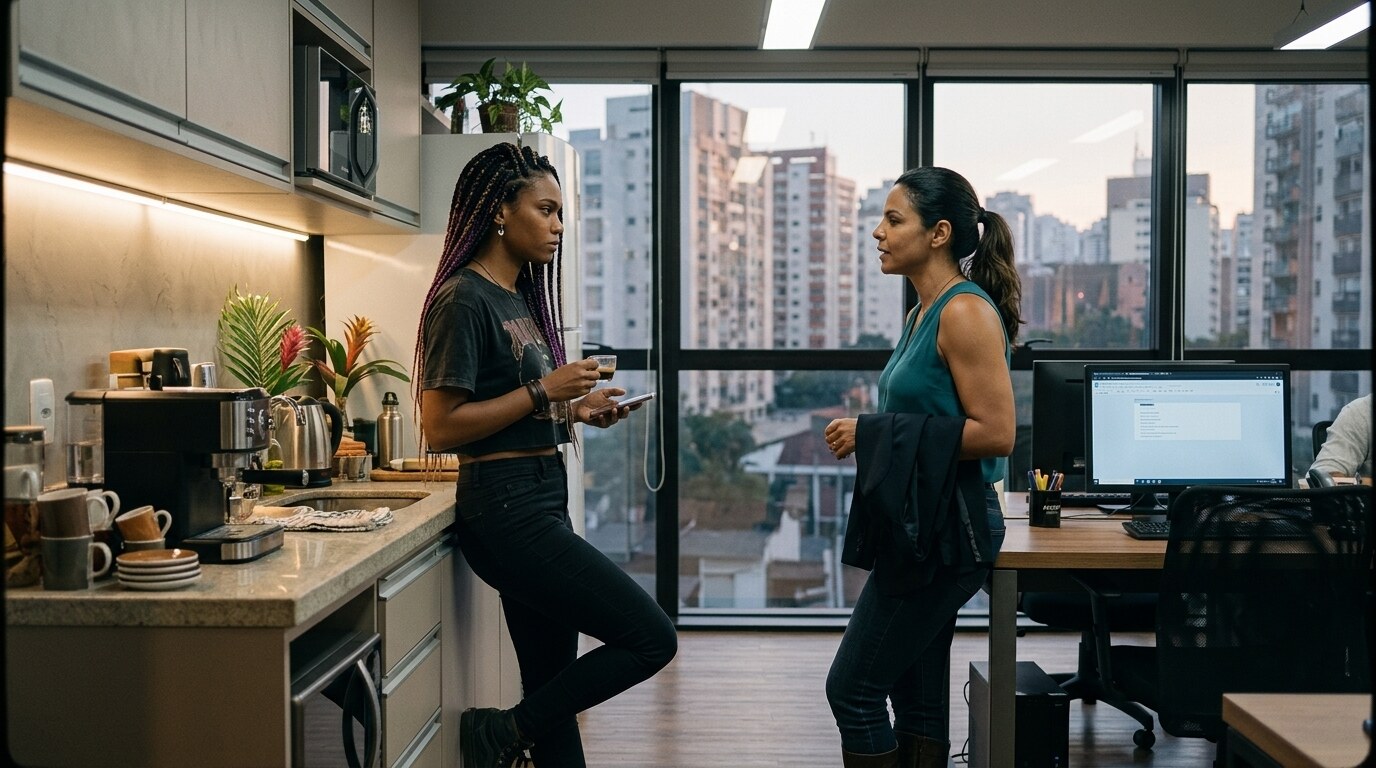
On Friday morning, Dandara was still smiling at Natalia’s message when Adriana stopped beside the kitchenette. She swallowed her coffee, expecting a question about the protocol review. Adriana glanced toward the desks, then back at her, and the pause made Dandara lower the phone.
“Natalia asked me for access to the integration discussion channel in Slack,” she said. “Did she ask you too?”
Dandara set down the cup. The pleasure she had been carrying since Natalia’s morning message went hard beneath her ribs. Tonight they would be at her apartment, eating the food Natalia had offered to bring, with no colleagues waiting to see whether this was serious. Adriana’s question arrived in the middle of that happiness like a bill.
“She wants to understand what we’re working on.”
“She can ask about a specific task. The channel has old discussions, traces, customer details. Her job doesn’t give her a need for all of that.”
Dandara looked toward the invitation form she had left open. She had not sent it. It was supposed to be an ordinary thing she could do, an invitation to the person who kept remembering what exhausted her when everyone else asked for another explanation.
“You’re happy to let Stefan sit in everything.”
The words came out sharper than she intended. Adriana’s face changed, and Dandara immediately wanted to take the comparison back. Stefan had a defined assessment assignment. She knew that. Knowing did not loosen the old feeling of having to justify wanting Natalia.
There had been questions before: a friend’s careful warning that she was moving too fast, a relative’s certainty that the right man would settle her, people who meant well and still made every girlfriend something to defend. Adriana was not those people. Dandara knew that too. But the body remembered being made smaller before the mind could sort the voices.
“His access has an owner and a scope,” Adriana said. She took a breath. “I am asking about this channel. Not asking you to stop seeing her.”
Dandara picked up the cup again although it was empty. She wished Adriana would say something plainly wrong. Something she could reject without having to carry this small, practical doubt into the evening.
“You don’t trust her,” she said.
“I don’t know what she needs those records for. She hasn’t answered that. If there’s a work reason, let’s name it and use the appropriate access.”
Adriana stopped there, pressing her lips together around whatever else she had meant to say. Dandara knew that look from difficult reviews: the effort of letting someone reach an answer herself. It made this harder to dismiss.
“I’ll think about it.”
She meant it when she said it. Back at her desk, she closed the invitation form. For five minutes she worked through a protocol review and felt almost relieved.
Then Natalia sent a photograph of a takeaway bag beside her knees in the back of a car. I remembered you hate coriander. Still seven?
Dandara smiled before she could stop herself. Nobody had to remember that. It was such a small thing to be suspicious beside, food with one ingredient left out because she had said she disliked it. She typed Seven. Come hungry and put the phone under her hand, keeping that little warmth for herself.
She would decide about the channel later, at home, where she could ask Natalia without Adriana’s voice coming between them.
What She Wanted on Friday
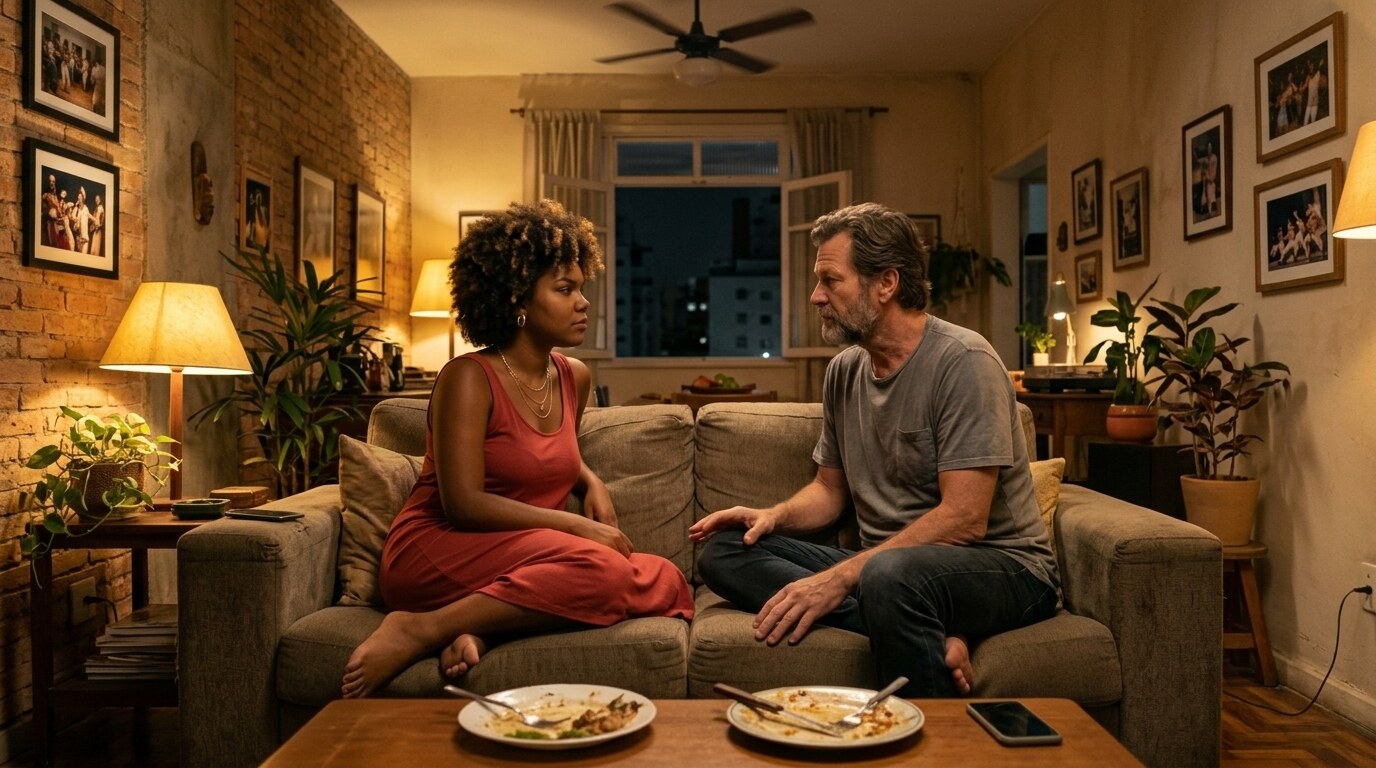
On Friday, Júlia told Stefan to bring dinner and not a laptop. He arrived carrying two hot paper bags with a solemnity that made her laugh. One handle had broken in the taxi; a patch of sauce darkened his shirt.
She kissed him, tasting rain on his upper lip, then pointed him toward the sink. While she found plates, he studied the photographs above her desk: a rehearsal, a birthday, Dandara making an obscene face behind someone who had expected a respectable picture. Júlia liked watching him discover the people who would still be here when his assignment ended. She wished she had not thought of that already.
“On Monday you kept moving your hands away from the keyboard,” she said, sitting beside him. “You wanted to do it faster.”
He laughed, looking down at them. “I wanted it to work while I was still there. Renato knew what to do. That’s not a good enough reason to take it away from him.”
She leaned against his shoulder, pleased that he had admitted it. Beneath the damp cotton he was warm and solid; she wanted to climb into his lap. She also wanted to ask what she had left unasked at the bar. The two wants interfered until she was angry at both.
“I liked watching you,” she said. “But I didn’t invite you because you were good at your job.”
His hand settled beside her knee. She placed it where she wanted it, enjoying the change in his breathing, then made herself hold his eyes. “I want you here tonight. But I don’t want to keep proving how little I need.”
His fingers stopped. She nearly laughed to soften what she had said, to rescue them both from having to take it seriously. Instead she pressed her foot against the floor. “At the bar I wanted to ask when you leave. I wasn’t asking for forever. Somehow I made every question sound like forever in my own head.”
Stefan looked toward the window. Below, a motorcycle passed, and someone shouted from the pavement. She let him have the silence until she could no longer bear it. “Your assignment is temporary. Mine is my fucking life. Don’t look surprised that I want to know where I am in it.”
He turned back. “The initial assignment is ninety days. I don’t know whether BergMotor will extend it. I haven’t arranged a return flight. Sophie is in Berlin. I will go back.”
She had asked, and now she wanted to push him away for answering. His daughter belonged in that answer; knowing it did nothing to ease the hurt. Júlia kept his hand against her knee, unwilling to turn the warmth she wanted into something she had to refuse.
“Tell me when you know. Not after you’ve decided how much I can handle.”
“I will.” He held her gaze, his face reddening. She wanted to believe the promise enough to stop there, but there was still Monday morning, her desk beside her colleagues’ desks, the possibility of reaching for him and finding only the visiting consultant.
“And sleeping with you doesn’t change who decides about my work. Or whether you tell me when my code is wrong.”
“Adriana makes the team decisions. If there’s a conflict, we tell her.”
“Before it becomes a favour.” She squeezed his fingers. “If I stop wanting this, you still work beside me.”
He nodded. “Yes. Either of us can stop.”
She had wanted that freedom, and hearing that he wanted it too hurt a little. She brought his palm to her mouth before he could mistake her silence. “I haven’t stopped.”
“Neither have I.”
She moved onto his lap, holding his gaze until his arms came around her. His mouth lost its caution when she kissed him. She wanted his hand at her back, his rough breath against her neck, the sound he made when she pulled him closer. The fan clicked through its turn; outside someone laughed, and she laughed against his mouth. Her apartment, her noisy street, this person she had chosen to bring into them.
When she stood, she took his hand. At the bedroom door he asked, “Still what you want?” She drew him inside. Later, rain covered the clicking fan. He held her too tightly for a moment, and part of her wanted to stay perfectly still, to be whatever made him need nothing else.
She shifted. “I’m not gone. You don’t have to hold me like that.”
His arms loosened. She settled beside him, finding a comfortable place for her shoulder, and remembered the dinner cooling in its bags. In a minute she would be hungry. She could ask him to get it.
The Wrong Way to Read a Picture
Thaís spotted the exhibition leaflet inside Klaus’s notebook before he could hide it beneath his arm. “You prepared for Saturday. Of course you did.” He offered it with a smile, and she leafed past the financial tables to retrieve it. “Then you can tell me whether the paintings obeyed the plan.”
Inside, the gallery smelled of old wood and wet clothes. Marília greeted her from the desk in Portuguese and warned her about a leak beside a painting of a very dry landscape. Thaís laughed. When Klaus asked what was funny, she translated; she liked that he waited for the joke instead of pretending to share it.
He stopped before a hill that towered over a row of houses. “Is that intentional?”
She leaned against his upper arm. “You think she couldn’t measure the hill?”
“No. I am asking what she wanted me to see.”
Thaís looked again. She had first found Brazilian modernist paintings in a book with cracked plastic over its cover, loving the improbable bodies and angry colours before she knew their names. Later, learning those names had made her proud and oddly nervous, as if somebody might revoke her pleasure if she explained it badly. Beside Klaus, the urge returned: have the answer, make the afternoon worth his time.
“I keep looking for the road between the houses,” she said. “You’d have to pass through someone’s kitchen to get up that hill. But I still want to go there.”
He stepped closer to the canvas. “I hadn’t noticed the doors.”
She showed him the little blue one, almost lost against a blue wall, and caught herself tracing its shape as she did when a driver failed to find something on her interface. He followed her finger. She liked him so much just then that she imagined bringing him to another exhibition next month, and another after that. It frightened her how easily those afternoons assembled themselves.
At the next picture he asked about a word in the catalogue. She knew what it meant in Portuguese. The English would not come, and she nearly offered something plausible just to keep the day moving.
“I can’t translate that,” she admitted. “Not properly.”
“Show me in Portuguese.”
“You won’t know it either.”
“Then we will be two people who don’t know it.”
She laughed and opened her phone. Shoulder to shoulder, they argued over two translations that pleased neither of them. Klaus tried one aloud with a pronunciation so terrible that she caught his sleeve. A visitor squeezed past, and she stayed close after there was space to move away. She had forgotten to worry about being a good guide.
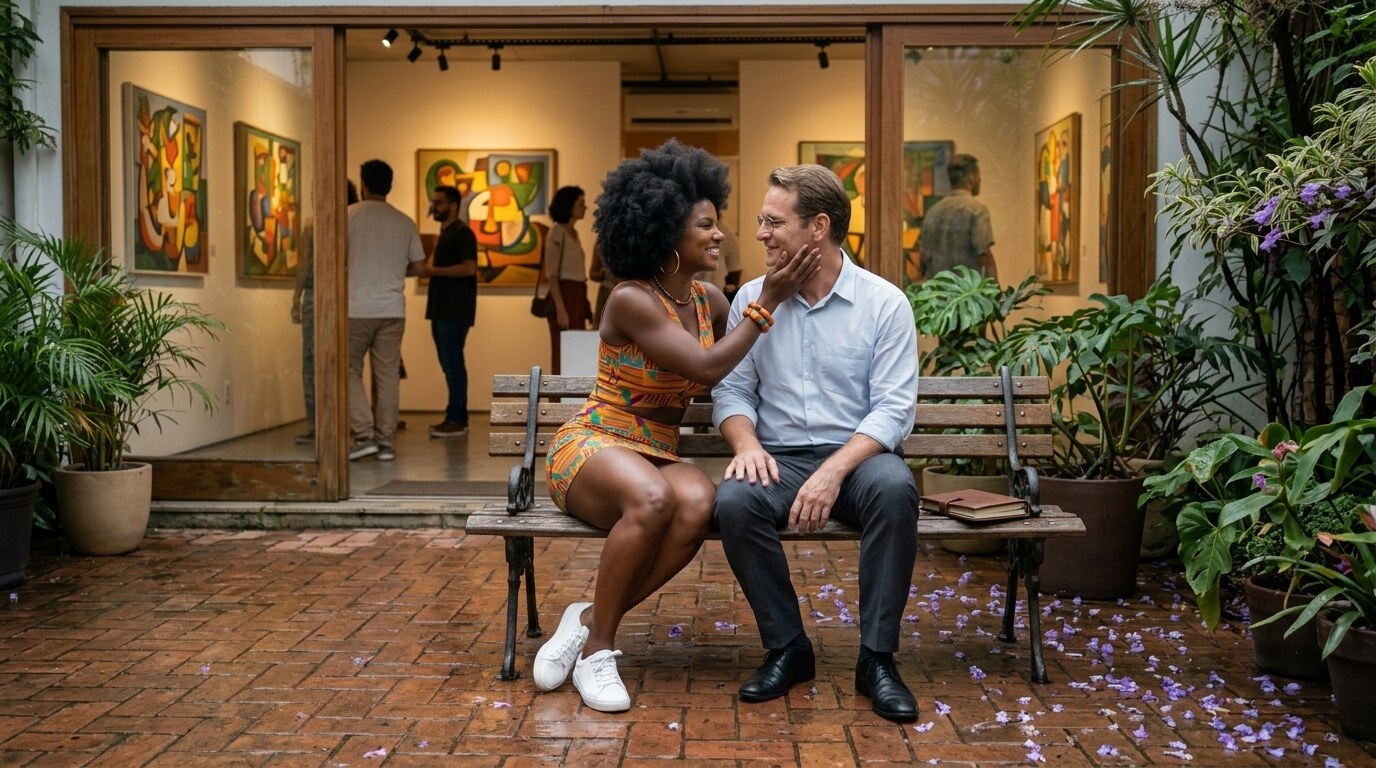
In the courtyard he set his notebook on the bench. “There. Unemployed for the afternoon.” Thaís sat beside him, knees touching his. Water clung to the leaves above them, and a bus braked beyond the wall. She wanted to kiss him. She also wanted to be kissed without first arranging the whole thing, and the wanting made her unusually still.
“Are you tired?” he asked. “Shall we go?”
She turned toward him, smiling despite her impatience. “You could ask a different question.”
His face reddened before he smiled back. “May I kiss you?”
“Yes. That’s a much better question.”
She held his cheek, feeling its roughness while his hand settled at her waist. He did not hurry. When she drew back, he followed a little and stopped; she kissed him again, pleased by that unguarded movement toward her. His glasses were crooked afterward. She straightened them, only making it harder to bear how happy he looked.
“You’re smiling,” she said.
“I know. I cannot seem to stop.”
She pressed her face against his shoulder, laughing because otherwise she might say something enormous before either of them was ready. His phone vibrated inside the notebook’s pocket. He glanced at the cover and left it closed. Thaís took his hand and asked where he wanted to eat; when he reached for the leaflet, she caught his wrist. They could find somewhere without preparing for it.
An Invitation with Her Name on It
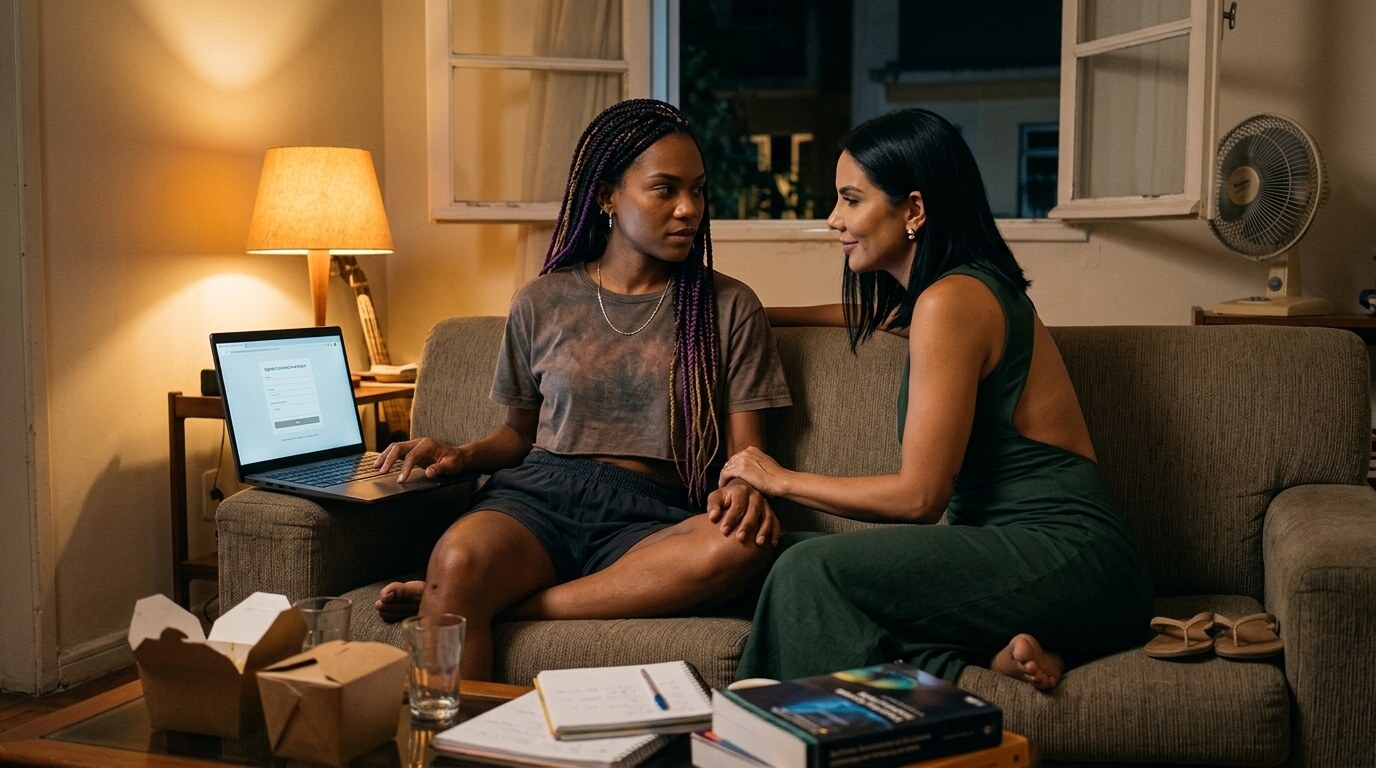
That Friday evening, Natalia reached Dandara’s apartment at seven, the takeaway bag knocking against her knee. Dandara opened the door in a faded band T-shirt and cotton shorts. Natalia set down the food, turning so the open back of her green dress caught the lamplight, and heard Dandara stop asking about her day. I wore it for you. Come here and let me see what it does. She smiled over her shoulder. Dandara caught her waist and kissed her; Natalia steadied a tipping carton without moving away.
They ate on the sofa. Dandara had found the beer Natalia liked and kept explaining that the shop had only had two left. Natalia took a grateful swallow. You went looking for it. When Dandara showed her a photograph of her cousin frowning over a program that drew crooked stars, Natalia supplied the cousin’s name. Dandara grinned and scrolled to another picture, her hand resting between Natalia’s shoulders. The fan rattled, and Natalia leaned into the touch. I could leave my phone in my bag all night. Then tell Marcus tomorrow that I forgot what I came for. She could almost hear his silence afterward.
She kissed Dandara again before mentioning Friday: one room apart, the whole day lost to documents. “If I were in your Slack channel, at least we could talk where you actually are.”
Dandara’s hand stilled. “Adriana asked me about that.” She sat back, describing the old discussions, traces and customer details. “She asked what you need them for. I couldn’t answer.”
Natalia kept their knees touching. You haven’t forgotten the question. Even with me sitting here in this dress. She looked down at their hands. “Does she think I’m pretending to care?”
“That isn’t what she asked.”
Natalia released her hand to pick up her glass. Dandara watched it, rubbing a thumb along the cushion seam. I notice every time Marcus takes his hand away. I hate that I notice. She put the glass down and left her hand beside it. “I don’t want trouble between you. Forget I asked.”
“You’re not trouble. I’m asking you a question.”
The firmness surprised her. Natalia nodded, resisting the urge to touch her again too quickly. “Then tell me.”
“Being with you doesn’t mean I can give you everything at work.”
The laptop remained closed at the far end of the sofa. Natalia could leave it there, eat another mouthful, give Dandara an evening that required nothing. She felt an impatient little heat at the prospect of returning empty-handed. I want his face when I show him. I want him to put down whatever he’s doing. She lifted her eyes. “I know you can choose for yourself. That’s one of the things I like about you.”
Dandara looked at her for several seconds before reaching for the laptop. She set it on her knees without closing the space between them. On the invitation form, Consultant support appeared in the reason field, then vanished. “Support with what?” Dandara murmured.
Natalia kept her hands in her lap. I could answer you honestly. I need to know what your team can prove before Marcus bills for fixing it. Dandara typed Integration coordination with QuantumMind and hesitated over the trackpad. Natalia smiled when she turned, resting a hand against her wrist. Dandara’s fingers relaxed beneath it; then she sent the invitation.
“One channel, including its history. Your own guest account,” she said, turning the screen. “No forwarding anything outside the company. If you need a file, ask me.”
“Of course.” Natalia read the conditions before kissing her cheek. Dandara checked the channel name again, then closed the laptop. Natalia moved the empty cartons aside and made room for her on the sofa. I heard you. I can’t pretend I didn’t. When Dandara leaned against her, Natalia brought their joined hands to her lips.
She stayed. There was pleasure in making Dandara laugh, in feeling her settle more heavily against her as the evening grew quiet. When Natalia’s phone lit beside her bag, she turned it facedown. You can wait, Marcus. I want to be there when you see what I’ve brought you. Dandara followed the movement, then laid her head on Natalia’s shoulder.
Later, in bed, Dandara found her hand without opening her eyes. Natalia waited until the fingers loosened. She could still see the words being deleted from the reason field, could feel that pause while Dandara turned to her. You asked me twice. I kissed you instead of answering. She eased her hand free and turned over, carefully enough not to wake her.
Sunday Belonged to Somebody

By Sunday morning, Natalia had filled her notebook with references from the channel. In Marcus’s suite she set it on the glass table, then raised the temperature setting and put it back. I’m cold. He likes it this way. He continued his call while she stood at the window, watching him in the reflection until she lost track of the traffic below.
“Bring it here,” he said at last. She picked up the notebook. He shook his head and held out his hand, and she went to him instead.
He drew her beside his chair. His thumb moved over her knuckles while she explained the guest invitation: one channel with its history, no repository access. At Adriana’s warning, the thumb stopped. Natalia described Dandara’s questions more carefully, watching his hand. You couldn’t have done it. She’d have asked you for a work order. I wore that dress and listened, and she asked me to stay.
“She sent it herself,” she said. “I didn’t touch the keyboard.”
He pulled her closer and kissed her. Natalia tightened her hand on his shoulder, forgetting that she had meant to make him ask about the notebook first. Again. I want your mouth again. But he reached past her for the book. When she touched his shoulder, he lifted her hand away and placed it on the table without looking up.
“I need the review requests today. Names, dates, approvals. Start with Stefan’s contact with Dieter.”
“I booked the car for two.”
“Move it to six.”
She flattened her fingers against the cold glass. I told you what I’d arranged. I didn’t ask you to arrange it. She pictured herself leaving anyway, choosing clothes in a shop while checking whether he had called. When he finally looked up, she was ready to say she would finish tomorrow. Instead she heard herself promise four o’clock.
“Good. Sit here.” He placed a chair beside his and pushed the laptop toward it. Natalia changed the booking. I want him to be my master. I want him deciding where I sit, what I do next, when I get his hands on me. But I wanted this afternoon. She sat where he had put the chair, close enough for her knee to touch his. He moved his leg to reach a cable. He hasn’t even asked whether I’ve eaten. Tell me what you need, Marcus. Give me something I can do so well you have to look at me.
The work caught her. She followed the dates back through Rodrigo’s requests and stopped at the refused bench capture. Stefan’s contact with Dieter came afterward. She checked the sequence again, finding the unanswered question carried forward into the new pack. You asked for the experiment before they blamed you for the missing answer. I’ve got what you’re going to put in your report. She drew a line between the references, pleased enough to forget the clock.
She left the files untouched and recorded the details by hand. I haven’t forwarded anything. Dandara’s face came back to her, waiting beside the invitation form. Natalia pressed harder with the pen. You’d know exactly what this is if you saw the page.
At four she turned it toward Marcus. Before she reached the second column, he took a call and read out her dates. “Have the coordination invoice ready. I want Bernardo’s approval before Monday’s review.”
Natalia held her pen against the unfinished line. I haven’t finished speaking, and you’re already arranging to be paid. When he ended the call, she continued from the interruption, making him follow the references. Only then did he look at her.
“My clever girl.”
She smiled before she could stop herself. I still want my afternoon. Say it again. He swivelled toward her and rested a hand at the back of her neck. She turned in her chair, leaning into his reach. Keep it there. I know what you want me for. I want you using me, and I want this too. She kissed him, her fingers closing around his wrist. He disengaged them and turned back to the notebook, underlining two entries for her to check.
She edged her chair nearer. He’ll take the work and the afternoon and whatever I offer afterward. I still want to make him put his hand back. She opened the discussion again.
At six the driver messaged. Dandara had written too: Have you eaten? Natalia remembered the sofa, the hand finding hers in sleep. You’d tell me to close this and come back. You’d mean it. She promised to call later and asked the driver to wait. Marcus tapped the page beside her hand. She put down the phone before he had to point again.