
Software Will Fail. Recovery Is the Real Metric
MTBF can reward inactivity. DORA shows whether your organization changes software safely and recovers when reality di...
7 min read
31.01.2026, By Stephan Schwab

Many management frameworks operate close to the snake oil line — selling beliefs and process models rather than verifiable outcomes. When the business model depends on monetizing belief instead of measurable improvement, the framework has crossed from guidance into ideology. The closer a vendor is to selling certainty in uncertain environments, the closer their offering is to pseudoscience.
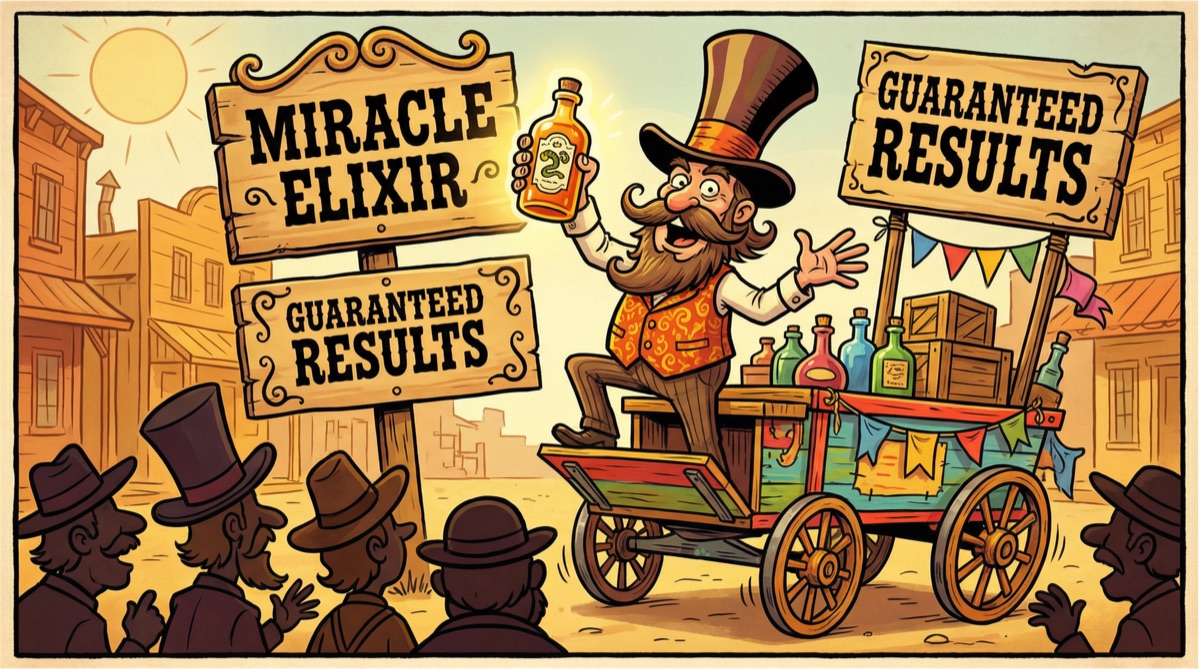
The proximity to snake oil isn’t accidental. Several structural factors push management frameworks toward dubious territory — dynamics I’ve explored in Management Frameworks Don’t Fix Software Teams:
Intangible product. Frameworks sell beliefs and process models, not something you can directly verify like software or machinery. When the product is essentially a way of thinking, measuring its effectiveness becomes subjective at best.
Promise of certainty. They target management’s desire for predictable outcomes in inherently uncertain environments. Software development, organizational change, market dynamics — these are complex adaptive systems. Promising predictability is promising something that cannot be delivered.
Rebranding old ideas. Many frameworks are thin repackagings of long-existing principles, marketed as new breakthroughs. The core concepts of iterative development, frequent feedback, and cross-functional collaboration have been known for decades. Adding new terminology and proprietary diagrams doesn’t constitute innovation.
Certification economy. The business model depends on selling training, certifications, and consulting rather than making teams more effective. When revenue comes from credential production, the incentive is to create more credentials — not to make the credentials unnecessary.
Lack of falsifiability. When a framework fails, promoters claim you didn’t implement it correctly. This is structurally identical to pseudoscience. No outcome can disprove the framework’s validity because failure is always attributed to execution rather than the framework itself.
One-size-fits-all claims. They promise universal applicability, which rarely matches reality in complex socio-technical systems. Context matters enormously in organizational effectiveness. What works in a forty-person startup bears little resemblance to what works in a forty-thousand-person enterprise.
Management seduction. They give leaders a sense of control without forcing them to understand engineering, complexity, or systems thinking. The framework becomes a substitute for genuine understanding — a set of templates and rituals that create the appearance of competent governance.
Close enough that the line depends on intent, transparency, and evidence.
The classic snake oil pattern has three elements: high promises, low evidence, low accountability. Many popular frameworks — Scrum implementations, SAFe deployments, OKR systems, value stream transformation consultancies — fit this pattern at least partially.
The distinction isn’t binary. Frameworks exist on a spectrum. Some provide genuine diagnostic value while their vendors oversell transformation promises. Some started as useful lightweight guidance and calcified into prescriptive ideologies. Some are straightforward revenue extraction vehicles with no pretense of evidence.
When a framework exhibits these characteristics, it has moved from guidance into snake oil territory:
Outcome claims without hard data. “Productivity doubles.” “Agility increases by 300%.” These claims lack rigorous, reproducible evidence. If challenged, vendors point to case studies that lack controls, confounding variables, or honest assessment of what else changed simultaneously.
Defensive logic. “If it didn’t work, your culture is wrong — not the method.” This reasoning is unfalsifiable. The framework cannot fail; only implementations can fail. This is the hallmark of ideology, not empirical practice.
Cult-like language. “True Scrum.” “Enterprise agility.” “Mindset transformation.” The vocabulary exists to create in-group identity and dismiss criticism as coming from outsiders who don’t understand. Terms become shibboleths rather than communication tools.
Certification treadmill. Constant new badges, master-coach levels, renewals. The certification structure exists to generate recurring revenue, not to validate competence. When someone can become a certified practitioner in two days, the certification measures willingness to pay, not capability.
Heavy reliance on anecdote. Success stories replace systematic evidence. The plural of anecdote is not data. Organizations that improved after adopting a framework may have improved for entirely unrelated reasons — new leadership, market conditions, staff changes, parallel initiatives.
Punishing dissent internally. “That’s resistance to change.” Criticism becomes pathologized as a psychological failing rather than engaged as substantive feedback. Organizations adopting frameworks often adopt this defensive posture, making rational assessment impossible.
Framework bloat. As frameworks age, they accumulate roles, ceremonies, artifacts, and layers. Each addition creates consulting and training opportunities. Rarely does anyone subtract. The framework becomes a bureaucracy that exists to perpetuate itself.
Understanding why frameworks sell despite their limitations explains why the market persists:
Leaders want predictability. Software development feels chaotic. Frameworks promise order. The promise is more comforting than honest acknowledgment of inherent uncertainty.
Leaders want simple diagnosis. Frameworks provide templates and checklists. “Your problem is lack of alignment” is easier than “your problem is a complex web of technical debt, organizational dysfunction, market misunderstanding, and inadequate engineering capability.”
Leaders want external legitimacy. Certifications look like action. “We hired SAFe consultants and trained everyone” is a visible intervention. Quietly improving engineering practices generates no comparable theater.
Real improvement requires engineering fluency. Understanding why code takes longer than expected, why certain architectures create friction, why some technical decisions compound into debt — this requires knowledge that many business leaders don’t have and don’t want to acquire. Frameworks offer a shortcut. As I argued in Reclaim Your Organization, executives who abdicate this understanding to methodology resellers pay a steep price.
Empirical engineering practices exist independently of belief systems:
Test-driven development produces measurable outcomes: defect rates, design quality, confidence in refactoring. You can observe whether a team practices it and correlate with outcomes.
Trunk-based development and continuous integration have clear operational definitions and measurable effects on integration friction and deployment frequency.
Lean principles rooted in operations research and queuing theory make falsifiable predictions. Little’s Law doesn’t require belief. Work-in-progress limits either improve flow time or they don’t.
Lightweight guidance that avoids universal claims and adapts to context treats recommendations as hypotheses to test, not doctrines to implement.
The distinction: these practices make claims that can be disproven. If TDD produces worse outcomes in a particular context, that’s useful information. The practice doesn’t defend itself with “you weren’t doing true TDD.”
Management frameworks become snake oil when the business model depends on selling the framework rather than improving the organization.
Once that happens, the vendor must maintain the illusion of effectiveness — even when evidence contradicts it. The vendor cannot acknowledge fundamental limitations because doing so threatens revenue. The vendor cannot recommend simpler alternatives because those alternatives don’t require the vendor.
This creates a predictable pattern: initial adoption produces enthusiasm (the Hawthorne effect plus organizational attention), followed by gradual disillusionment as promised transformations fail to materialize, followed by blame-shifting toward implementation, followed by the next framework.
Organizations cycle through frameworks not because each new framework is better, but because each new framework offers fresh hope and a fresh scapegoat for the previous failure.
Recognizing the snake oil dynamic doesn’t mean rejecting all guidance. It means asking different questions:
What evidence exists beyond anecdote? If the vendor has only case studies, ask for controlled comparisons. If those don’t exist, recognize you’re buying belief.
What would falsify this framework’s claims? If no possible outcome could demonstrate the framework’s failure, you’re looking at ideology.
Who benefits from continued adoption? If the vendor’s revenue requires your ongoing subscription, their advice is structurally compromised.
What does this framework substitute for understanding? If the framework promises results without requiring you to understand the underlying systems, that promise is probably hollow.
What lightweight alternative might achieve similar outcomes? Often, expensive frameworks overlay basic practices that teams could adopt directly.
The most effective organizations treat frameworks as sources of ideas, not as doctrines to implement. They extract useful concepts, adapt them to context, measure results, and discard what doesn’t work — regardless of what the framework prescribes.
The framework industry will persist because it addresses real needs: leaders genuinely want to improve their organizations, and genuine expertise in organizational effectiveness exists. The challenge is separating those who can actually help from those who merely profit from the appearance of helping.
The signal is accountability for outcomes. Vendors willing to tie their compensation to measurable improvements — and to define those improvements in advance, with clear measurement criteria — are distinguishing themselves from the snake oil merchants. The grateful boundaries between consultants who diagnose and developers who implement remain essential.
Those who demand full payment for training and certification, with no accountability for whether the training produces results, have revealed their business model. They are selling belief.
The proximity to snake oil isn’t about any particular framework. It’s about the relationship between promises, evidence, and accountability. Close that gap, and you have genuine consulting. Widen it, and you have a well-dressed medicine show.
Tell me what is happening. I listen, ask a few practical questions, and reflect back what I see: where the risk may sit, what may be blocking delivery, and what looks worth checking next. No pitch, no obligation. Confidential and direct.
Talk it through. Practical reflection, no pitch.
Start a ConversationTelenovelas show what we can't say in client meetings. The drama is heightened, but the patterns are real.
 Arrival
Stefan Richter arrives in São Paulo with a 90-day contract to fix delivery at AutoConnect Brasil. He finds 90 developers, 18 months of chaos, and a...
 What Is Offered First
The day before Sophie flies back to Berlin, Mateo takes them to Kuna Yala. The road climbs from the Chepo side into the mountains, the Caribbean ap...
 Collapse
Year-end arrives with the force of something everyone has been preparing not to name. A critical COBOL tax-calculation path fails on an undocumente...
Embedded into your team as an active contributor, reducing delivery friction and helping important work move cleanly.
Peer-style technical assessments before far-reaching decisions; reduce architectural and product risk early.
Ship working software to real users earlier. Measure impact and adapt based on evidence rather than assumption.
High quality, maintainable software. Short-term augmentation that leaves lasting capability in your own team.
Visibility and hands-on delivery
Navigator gives your leadership clear insight into patterns, blockers, and capacity. Our Embedded Delivery Partner writes production code with your team and gets delivery moving.