
The System Only One Person Understands
If every critical change starts with the same name, your delivery system is carrying a quiet executive risk.
8 min read
10.02.2026, By Stephan Schwab

Technical teams constantly discover better ways of working — through practice, through new tools, through the kind of learning that only happens when hands touch code. But management frameworks assume stability, not discovery. When a team finds a faster path and the framework says "that's not how we do it here," a quiet tension begins. This isn't about frameworks being wrong. It's about what happens inside people when organic insight meets institutional constraint.
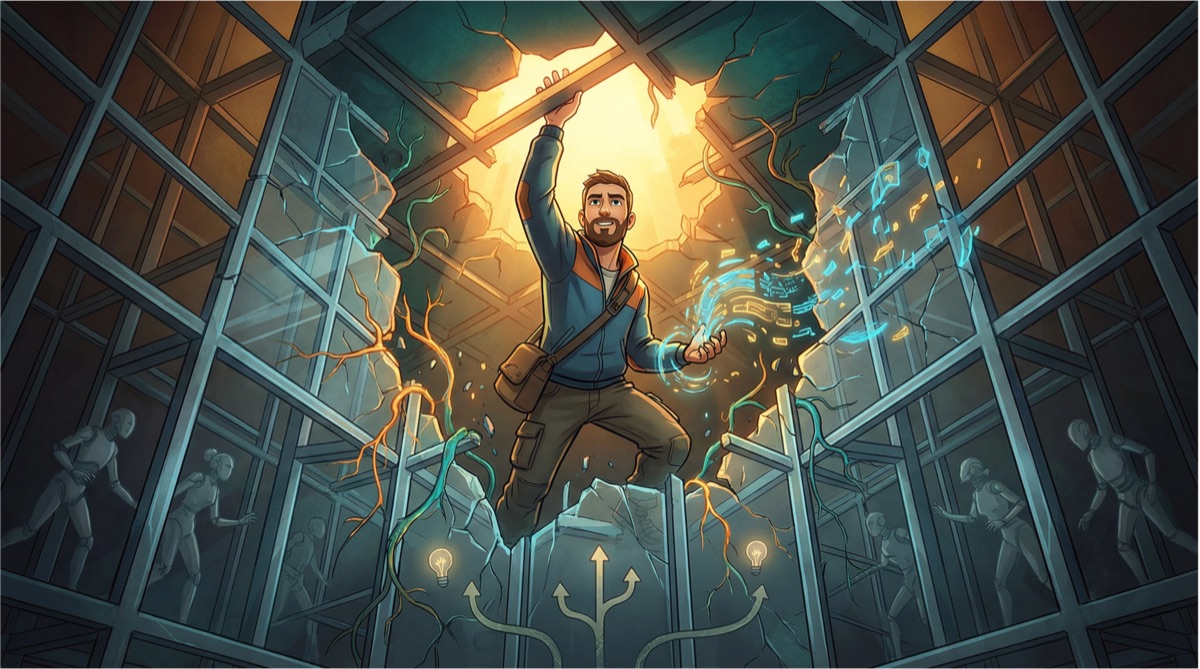
The opening line of the Agile Manifesto isn’t a historical statement — it’s a present-tense declaration. Uncovering. Not “we uncovered” or “we will uncover.” The process of discovering better ways never stops.
In 2025 and 2026, this discovery has accelerated dramatically. AI coding assistants have changed how developers explore unfamiliar codebases. What once required days of careful reading now happens in hours of directed conversation with a model that has seen millions of patterns. Teams working with legacy systems find themselves extracting business rules at speeds that would have seemed implausible two years ago.
But AI is only one vector. Teams also discover through practice — a pairing session that reveals a simpler approach, a retrospective insight that changes how work flows, a new testing technique that catches defects earlier. The specific discovery matters less than the pattern: people doing the work find better ways.
Most management frameworks carry an implicit assumption: software development is fundamentally a production process. Work enters. Defined steps occur. Product emerges. The framework’s job is to make those steps visible, predictable, and controllable.
This assumption made some sense when the primary challenge was coordination at scale. If you have hundreds of people who need to move in roughly the same direction, standardized processes reduce chaos. The framework becomes a shared language, a coordination mechanism, a way to ensure that Team A’s output fits Team B’s input.
But software development is design work, not manufacturing. The “product” that emerges from development is a design — a set of decisions about structure, behavior, and trade-offs. Those decisions benefit from learning. And learning means changing how you work based on what you discover.
Frameworks rarely accommodate this. The iteration cadence stays fixed. The prescribed meetings remain immutable. The role definitions don’t flex. When a team discovers that a recurring ceremony has become stale theater, the framework doesn’t say “stop doing what doesn’t work.” It says “the process is mandatory.”
Consider a concrete scenario. A team working on legacy modernization discovers that AI-assisted code analysis lets them extract business rules directly into executable specifications. Previously, they followed the framework-prescribed flow: analysts interview stakeholders, write requirements documents, hand documents to developers, developers implement, testers verify against the documents.
The new approach is faster and more accurate. The AI reads the legacy code. Domain experts validate what it finds. Executable tests capture the verified rules. The requirements document — that intermediate artifact the framework mandates — becomes an obstacle rather than an aid.
What happens next reveals the tension:
The team could suppress the discovery. Keep using the old flow because that’s what the framework requires. This wastes the insight and the potential efficiency gain. It also creates cognitive dissonance — people know a better way exists but aren’t allowed to use it.
The team could work around the framework. Officially follow the prescribed flow while actually using the new approach. This creates shadow practices — real work happening invisibly while visible work becomes theater for process auditors.
The team could challenge the framework. Propose that the discovery become the new standard. This requires political capital, risks being labeled as “resistant to the process,” and often fails because frameworks have institutional defenders.
None of these options feels good. Each carries psychological weight.
The tension isn’t abstract. It shows up in specific ways:
Cynicism develops. When process requirements override practical improvement, people stop believing that the organization cares about outcomes. They learn that compliance matters more than results. This cynicism is corrosive — it spreads through teams and survives long after specific frustrations fade.
Engagement drops. The Agile Manifesto’s first value — individuals and interactions over processes and tools — recognizes something fundamental about motivation. People do better work when they have agency. Framework constraints that override discovered improvements remove agency precisely where it matters most.
Trust erodes. When a team discovers something valuable and management’s response is “that doesn’t fit our process,” the implicit message is clear: your judgment doesn’t matter. Repeated enough times, this message destroys the trust that effective collaboration requires.
Talent leaves. Skilled practitioners have options. Organizations that systematically suppress improvement become places that skilled people leave. What remains is a workforce selected for compliance rather than capability.
Understanding this tension requires empathy for the people who mandate frameworks. They aren’t villains. They’re responding to legitimate needs with the tools available to them.
Visibility is a real need. Executives responsible for outcomes need to understand what’s happening. When they can’t see into engineering work — when it feels like money goes in and sometimes software comes out — the anxiety is genuine. Frameworks promise to make the invisible visible.
Accountability structures require consistency. When something goes wrong, someone asks “what happened?” Frameworks provide vocabulary for that conversation. “We followed the process” is an answer. “We adapted based on what we learned” sounds like an excuse, even when it’s the truth.
Fear drives conservatism. Allowing teams to adapt based on discovery means trusting them to make good decisions. That trust feels risky. What if they make bad decisions? What if different teams diverge so far that coordination becomes impossible? What if the flexibility becomes chaos? The framework constrains these fears by constraining the teams.
The alternative isn’t obvious. Following the Agile Manifesto’s values — genuinely valuing individuals over process, genuinely responding to change — requires a different kind of organizational capability. It requires leaders who understand enough about the work to evaluate adaptation without prescribing it. Many organizations lack this capability, so they substitute process for understanding.
The tension doesn’t have a clean resolution. Frameworks exist because real organizational needs exist. Discoveries happen because software development is learning work. Pretending either side of this equation doesn’t exist just pushes the conflict underground.
But some approaches reduce the friction:
Make discoveries visible — and explorable. When a team finds a better way, that insight needs to reach decision-makers. But here’s the uncomfortable truth: the people who mandated the framework often can’t easily admit it needs changing. Public acknowledgment feels like losing face. Tools like Caimito Navigator can help here. Navigator synthesizes patterns from daily logbooks and delivery signals, surfacing what teams are actually discovering. Its built-in observer role lets managers and executives read reports and explore these insights through AI chat — privately. They can ask questions, test assumptions, and understand implications without anyone watching. A leader can quietly investigate whether that mandated ceremony really has become theater, see the evidence, and reach their own conclusions before any public conversation happens. This private exploration removes the fear that blocks organizational learning. Over time, leaders who’ve already convinced themselves become advocates for adaptation rather than defenders of the status quo.
Distinguish governance from prescription. Organizations need visibility into delivery health — whether work is flowing, whether quality is acceptable, whether investments are producing outcomes. They don’t need to prescribe exactly how work happens. Deep insight into delivery patterns — the kind that reveals not just what’s happening but why — serves governance without constraining method. When leaders can see that a team’s adaptation is producing better flow and fewer defects, they don’t need to mandate process compliance. The evidence speaks for itself.
Create explicit space for adaptation. Some framework implementations acknowledge that local adaptation is necessary. Teams can experiment within boundaries. Successful experiments can spread. This isn’t the same as full autonomy, but it’s better than rigid prescription.
Build leadership fluency. The deepest solution is leaders who understand enough about software work to evaluate adaptation intelligently. When a CTO can assess whether a team’s discovery is genuine improvement or rationalized corner-cutting, the need for rigid process decreases. This fluency takes time to develop, but it changes what’s possible.
The Agile Manifesto’s four values anticipated this tension. Individuals and interactions over processes and tools. Working software over comprehensive documentation. Customer collaboration over contract negotiation. Responding to change over following a plan.
These values don’t prohibit process, documentation, contracts, or plans. They establish priorities. When discovery reveals a better way, the values say: adapt. When the process says one thing and the learning says another, favor the learning.
But values require trust. Trust that teams will use their judgment well. Trust that adaptation won’t become chaos. Trust that people genuinely want to deliver value, not just avoid work.
Many organizations can’t extend that trust. The fear is too strong, the past experiences too painful, the leadership capability too thin. So they buy frameworks instead. And the frameworks, designed to be adoptable by organizations that lack trust, embed that distrust into their structure.
The result is the quiet tension that technical teams live with daily. Knowing better ways exist. Knowing the framework doesn’t allow them. Wondering whether to suppress, subvert, or fight.
None of those choices should be necessary. But until organizations learn to govern through visibility rather than prescription, until leaders develop the fluency to evaluate adaptation rather than mandate process, the tension will persist. The best practitioners will keep discovering better ways. The frameworks will keep constraining them. And the friction between discovery and process will continue to burn energy that could have gone into building software that matters.
Tell me what is happening. I listen, ask a few practical questions, and reflect back what I see: where the risk may sit, what may be blocking delivery, and what looks worth checking next. No pitch, no obligation. Confidential and direct.
Talk it through. Practical reflection, no pitch.
Start a ConversationTelenovelas show what we can't say in client meetings. The drama is heightened, but the patterns are real.
 Stefan's Progress, Klaus's Report
Stefan turns one working radio fix into momentum across climate control and navigation: test first, flash fast, prove it on real hardware. Then Kla...
 The Scattered — Part One
The collapse of Whitaker Payroll means something different in every household it touches. Olivia Parker and Ryan Mitchell step into sane new jobs w...
Embedded into your team as an active contributor, reducing delivery friction and helping important work move cleanly.
Peer-style technical assessments before far-reaching decisions; reduce architectural and product risk early.
Ship working software to real users earlier. Measure impact and adapt based on evidence rather than assumption.
High quality, maintainable software. Short-term augmentation that leaves lasting capability in your own team.
Visibility and hands-on delivery
Navigator gives your leadership clear insight into patterns, blockers, and capacity. Our Embedded Delivery Partner writes production code with your team and gets delivery moving.