The Cost of Speed
As Q3 kicks off, the pressure to deliver the tournament system mounts. Anton pushes for a fast-and-dirty implementation of the matchmaking UI, arguing that TDD is slowing them down. Mariana insists on maintaining discipline, but when a critical bug slips through to the newly built staging environment, the team is forced to confront the true cost of speed. Stefan helps them realize that skipping tests doesn't save time — it just borrows it at a high interest rate.
Monday, 09:30 — The Pressure of the Clock

Anton’s fingers were flying across his mechanical keyboard, the loud clack-clack-clack of the blue switches sounding like a miniature machine gun in the quiet of the Monday morning floor.
“I don’t need a test for this, Mariana,” Anton said, not looking up from his screen. “It’s a UI controller. It takes a button click, transitions the state machine to ‘Searching’, and triggers the matchmaking API. It’s thirty lines of code. I can write it in five minutes.”
“And how do you know the state machine transitions correctly if the API is slow?” Mariana asked, her voice flat. “Or if the player clicks the button twice?”
“Because I disabled the button on click,” Anton said, finally pausing to look at her. He pushed his glasses up his nose. “Look. matchmakingButton.interactable = false; on line twelve. See? It’s impossible to double-click.”
“And what if the API call fails and the button stays disabled forever?” Stefan asked, taking a sip of his coffee. “The player is stuck in a dead UI state, and their only option is to force-quit the app.”
Anton groaned, throwing his hands up. “You two are like a tag-team of doom. It’s Monday morning. Lukas wants to see a working prototype of the tournament lobby by Wednesday’s sync. If I spend today writing unit tests for Unity UI components—which is already a pain because of the framework’s lifecycle—I won’t have anything to show him.”
“Lukas wants to see progress,” Mariana said. “But he doesn’t know that ‘progress’ built on assumptions is just a loan we have to pay back with interest next week. We spent all of Q2 paying back your loans, Anton.”
“That was backend code,” Anton argued, turning back to his keyboard. “UI is different. It’s visual. If it looks right, 90% of the time it is right. I’ll write the tests later. I promise. Let me just get the flow working first.”
Stefan watched him go back to typing. It was the classic trap: the illusion of speed. When a developer is writing code without tests, they feel incredibly productive because there are no friction points. The lines of code accumulate rapidly. The UI transitions look smooth on a local machine under perfect conditions.
But the friction hadn’t disappeared; it had just been deferred. It was waiting for them on the newly built staging environment, where the network wasn’t local, the database wasn’t empty, and the latency wasn’t zero.
“Six weeks of sanity,” Mariana muttered to Stefan as they walked back to the backend desks. “That’s what the board gave us. And Anton is already trying to spend it on shortcuts.”
“He’s under pressure,” Stefan said. “And to be fair, writing unit tests for Unity UI controllers is genuinely annoying. But he’ll learn. Some lessons can’t be taught on a whiteboard. They have to be felt.”
Tuesday, 14:15 — The Staging Parity Test

“Staging deployment complete,” Hassan said, leaning back and rubbing his eyes. “Multi-region database replicas are live in EU-West, US-East, and AP-East. Staging now mirrors production scaling behavior. Go ahead, Anton. Deploy your UI build.”
Anton smiled, his confidence returning. “Watch and learn, backend team. The tournament lobby is going live on staging.”
He executed the deployment script. On his second monitor, the Unity editor compiled the build and pushed it to the staging server. Within two minutes, the tournament lobby UI appeared on his test device.
“Lobby is open,” Anton announced, tapping the screen of his tablet. “I’m joining the queue.”
The screen transitioned to a sleek, dark blue matchmaking screen with a spinning loading indicator. Searching for players…
“Now, Sofia,” Anton said. “Join from your device.”
Sofia tapped her screen. “Joined.”
“And Mariana.”
“Joined,” Mariana said, her eyes fixed on her own tablet.
For a few seconds, the spinning indicators spun in unison. Then, Anton’s screen suddenly flashed red. A generic error popup appeared: Matchmaking failed. Connection lost.
“What?” Anton frowned, tapping the screen. “That shouldn’t happen. The API is running.”
“I’m still in the queue,” Sofia said, showing her screen. It was still spinning.
“I’m out,” Mariana said. “My app just crashed.”
Hassan pulled up the staging logs on his center monitor. “We’re seeing a flood of database exceptions from the matchmaking service. Transaction aborted due to concurrent update.”
“Replication lag,” Sofia realized, pulling up the database metrics. “The EU-West node registered Anton’s join request, but before it could replicate to US-East where Mariana is connected, Mariana’s device sent a matchmaking query. The state machine got out of sync.”
“But I disabled the button!” Anton said, his voice rising. “The UI state was ‘Searching’. How could it get out of sync?”
“Because your UI controller didn’t handle the network latency,” Mariana said, turning her screen toward him. “Your local machine has 5ms latency. Staging has 120ms between regions. Your UI assumed the state transition was instantaneous. It sent the join request, but because the button disable call was asynchronous, the player could actually tap it twice during that 120ms window. And they did.”
Anton stared at his tablet. The red error popup felt like a personal insult.
“I built the staging environment to find these exact gaps,” Hassan said quietly. “The code worked on your local machine because the machine was lying to you. Now you’re seeing the truth.”
Anton looked at Stefan, who was standing at the end of the desk row.
“Don’t look at me,” Stefan said with a small smile. “I’m just the advocate. The data is the one doing the talking.”
Wednesday, 11:00 — The Debugging Loop

By Wednesday morning, Anton had spent nearly twenty hours in a frustrating loop: make a change, compile, deploy to staging, run the test manually with three devices, watch it fail, add more print statements, and repeat.
His desk was littered with empty Club-Mate bottles and crumpled sticky notes.
“I don’t get it,” Anton muttered, staring at the terminal output. “I added a debounce timer. I added a network state check. I even added a try-catch block around the entire transition. It still crashes 30% of the time when we run it with three regions.”
“Because you’re trying to fix a race condition by guessing,” Mariana said gently. She pulled her chair closer. “You’re treating the symptom, Anton. You’re adding band-aids to the UI instead of fixing the underlying state machine logic.”
“The state machine is fine!” Anton insisted. “It’s just the timing.”
“A state machine that breaks because of timing is not fine,” Stefan said, leaning over the partition. “It’s fragile. And the only way to make it robust is to isolate the timing from the logic.”
Anton sighed, leaning back in his chair. “How? I can’t simulate multi-region replication lag in a unit test.”
“You don’t need to simulate the network,” Mariana said. “You just need to mock the network interface. If you write a test that injects a delayed response, you can assert how the state machine behaves when a second request arrives before the first one completes.”
She tapped his keyboard. “Let’s write a characterization test. Just one. Let’s describe the failure.”
Anton looked at the keyboard, then at Mariana. He was exhausted. The manual testing loop was draining his energy, and the Wednesday sync with Lukas was only three hours away.
“Fine,” he said, his voice defeated. “Show me how.”
Mariana smiled. She didn’t gloat. She just opened his IDE, created a new test file, and started typing.
“First, we define the behavior we want,” she said. “We want the matchmaking controller to ignore any incoming join requests if a request is already in flight. Regardless of whether the button is interactable or not.”
She wrote the test name: Should_Ignore_Join_Request_When_Request_Is_In_Flight.
“Now,” she said, handing him the keyboard. “Write the setup. Mock the network service to return a task that completes after 500 milliseconds. Then call JoinMatchmaking twice in rapid succession. And assert that the network service was only called once.”
Anton took the keyboard. His movements were slow at first, but as he began to translate the logic into the test structure, his rhythm returned. The clack of his keyboard became steadier, less frantic.
For the first time all week, he wasn’t writing code to build a feature. He was writing code to ask a question.
Thursday, 15:30 — The Breakthrough

“It passed,” Anton whispered.
He looked at the green checkmark on his screen as if it were a miracle.
“Of course it passed,” Mariana said, laughing. “We fixed the bug.”
It had taken them exactly ten minutes to find the race condition once the test was in place. The test had failed immediately on the first run, showing that the state machine was indeed transitioning to ‘Searching’ before verifying if the network request had actually been acknowledged by the server.
By decoupling the UI state from the network state and writing a clean, synchronous state transition logic, they had eliminated the race condition entirely.
“I spent two days manual-testing this,” Anton said, shaking his head. “Two days of compiling, deploying, and tapping three tablets simultaneously like a crazy person. And we found it in ten minutes with a thirty-line test.”
“That’s the cost of speed,” Stefan said. “When you skip the test to save time, you’re just borrowing hours from your future self at a 500% interest rate. You feel fast on Monday, but by Wednesday you’re bankrupt.”
Anton looked at the green checkmark again. “It’s… actually satisfying. Knowing that if someone changes the button logic next month, this test will catch it immediately. I don’t have to worry about it breaking silently.”
“That’s the real value of TDD,” Mariana said, packing up her laptop. “It’s not about being pure or following a religion. It’s about buying yourself peace of mind. It’s knowing that your code is correct because you have a witness statement that proves it.”
Anton turned to Stefan. “Okay, advocate. You win. It’s not theology. It’s just… very good engineering.”
“I’ll take that,” Stefan smiled. “But don’t thank me. Thank Mariana. She’s the one who sat with you.”
Anton looked at Mariana. “Thanks, Mariana. And… sorry about the ‘theology’ comments.”
“Don’t worry about it,” Mariana said, heading back to her desk. “Just make sure you write the tests for the tournament lobby UI before tomorrow’s demo. Lukas is still expecting to see it.”
“I’m already on it,” Anton said, his fingers returning to the keyboard. But this time, the clacking was different. It was the sound of a developer who knew exactly where they were going.
Friday, 16:45 — The Lesson of the Loop

Lukas tapped the screen of the tablet, watching the matchmaking queue spin, transition, and successfully connect to a simulated multi-region match.
“It’s stable,” Lukas said, a tone of genuine surprise in his voice. “We ran fifty simulated matches across three regions this afternoon, and we didn’t see a single database crash or UI freeze. How did you fix the replication lag issue so quickly?”
“We didn’t fix the replication lag,” Katja said, leaning back with a satisfied smile. “Replication lag is a physical constraint of global networks. You can’t fix it unless you find a way to make data travel faster than the speed of light.”
Lukas blinked. “Then how does it work?”
“We designed the software to expect the lag,” Katja explained. “Anton and Mariana wrote tests that simulated the delay, and they built the state machine to handle it gracefully. The UI doesn’t assume the database is instantaneous anymore. It waits for confirmation before letting the player proceed.”
Lukas looked at Stefan. “So the staging environment actually worked?”
“It did exactly what it was supposed to do,” Stefan said. “It showed the team where their assumptions were wrong before those assumptions could hurt real players. If we had launched this on production without staging parity, we would have spent the weekend in emergency meetings.”
Lukas nodded slowly, looking back at the tablet. “And the timeline? Are we still on track for the September launch?”
“We are,” Katja said. “But only because we’re not wasting time on manual debugging loops anymore. The team is writing tests as they build. It feels slower on day one, but by day five, we’re shipping working software instead of hotfixes.”
Lukas stood up, closing his laptop. “I have to admit, Katja. When you asked for six weeks of ‘operational realism,’ I thought you were just trying to buy time. But seeing this… it’s the first time in six months I’ve seen a demo that didn’t feel like it was held together by tape.”
“That’s because it isn’t,” Katja said.
She stood up and walked out of the room with him, their conversation turning to the Q3 marketing alignment.
Stefan stayed behind for a moment, looking out the window. The Berlin evening was warm and golden, the lights of the city beginning to reflect in the canal below.
On the floor outside, Anton was packing his bag. He wasn’t rushing. He wasn’t hovering over his monitor with a worried expression. He was talking to Sofia, gesturing with his hands, a relaxed laugh carrying across the quiet room.
The posture had changed.
The team wasn’t hunted anymore. They were starting to own their system, one test at a time.
Navigator — Katja Müller — 26 June 2026, 18:12
First week of the Operational Realism Initiative.
The pressure to deliver features didn’t disappear just because the board approved our budget. Anton tried to take shortcuts on Monday, bypassing tests to build the tournament matchmaking UI quickly. He wanted to show progress to Lukas.
But the new staging environment did exactly what we needed: it exposed his assumptions immediately. The multi-region database replicas introduced network latency that his local machine had hidden, causing the UI to crash under concurrent matchmaking requests.
The turning point was Wednesday when Mariana sat with him and helped him write a characterization test to isolate the race condition. It was a beautiful moment of cross-team collaboration. Once the test was in place, they found and fixed the bug in ten minutes.
Anton’s attitude toward TDD has shifted from ‘theology’ to ‘good engineering.’ He saw firsthand that skipping tests doesn’t save time — it just defers the friction to a more expensive phase of development.
Navigator signals from this week:
- Unity repository saw its first automated UI unit tests deployed.
- Staging environment stability reached 99.8% during simulated load tests.
- No weekend work logged for any developer for the second consecutive week.
- Cross-team pairing sessions (backend and Unity) increased by 40%.
We are starting to build on solid ground. The track is being paved, and the team is learning how to drive on it.
Next week we begin load testing the tournament lobby with 150,000 simulated users. The real test of our database replicas begins.
🎭 This Week's Episodes
Telenovelas show what we can't say in client meetings. The drama is heightened, but the patterns are real.
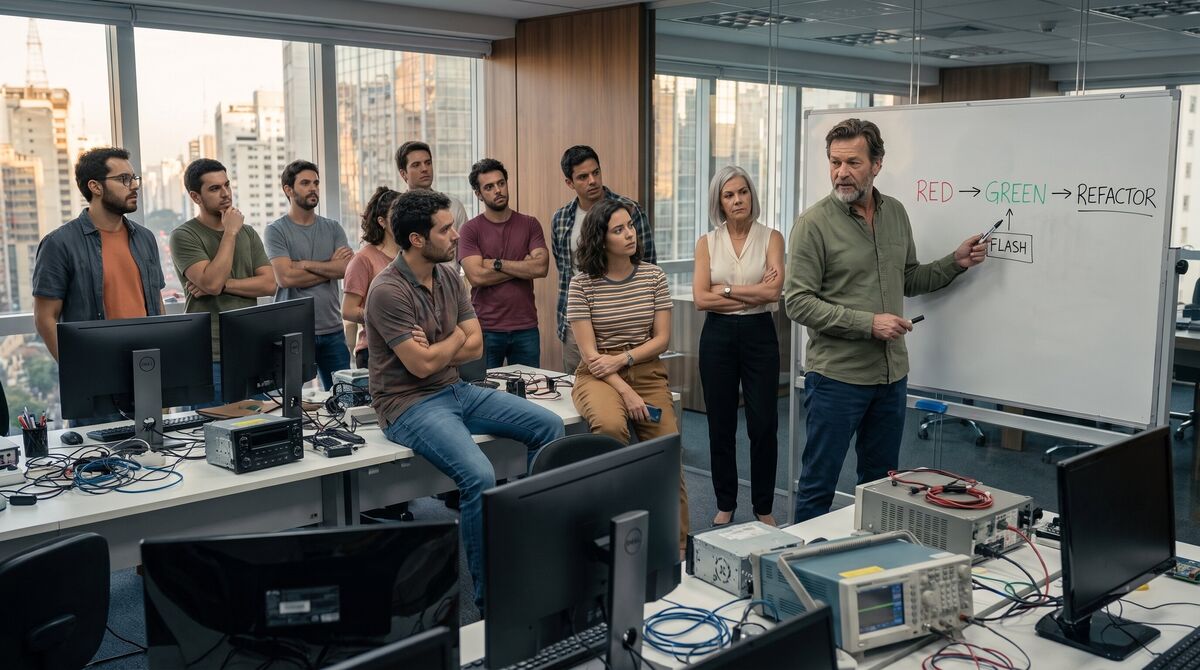 Stefan's Progress, Klaus's Report
Stefan turns one working radio fix into momentum across climate control and navigation: test first, flash fast, prove it on real hardware. Then Kla...
 The Scattered — Part One
The collapse of Whitaker Payroll means something different in every household it touches. Olivia Parker and Ryan Mitchell step into sane new jobs w...
Technical Consultancy
Embedded Delivery Partner
Embedded into your team as an active contributor, reducing delivery friction and helping important work move cleanly.
Technical Advisor
Peer-style technical assessments before far-reaching decisions; reduce architectural and product risk early.
Product & Delivery
Ship working software to real users earlier. Measure impact and adapt based on evidence rather than assumption.
Custom Software Development
High quality, maintainable software. Short-term augmentation that leaves lasting capability in your own team.
Recent Articles
- What an AI Agent Actually Is (21.09.2026)
- The LLM Will Not Come Back Tomorrow (19.09.2026)
- The One-Person AI Company Is a Greed Fantasy (15.09.2026)
- Test Production Without Leaving a Mess (10.09.2026)
- Software Will Fail. Recovery Is the Real Metric (05.09.2026)