The Load Test Reckoning
The team runs their first massive load test on the new multi-region staging environment, simulating 150,000 concurrent players. When the database replicas begin to desynchronize under the weight of the traffic, Hassan and Sofia must find a way to handle eventual consistency without breaking the player experience. Stefan helps them realize that consistency isn't a binary choice, but a design trade-off that must be managed close to the domain.
Monday, 10:15 — Preparing the Storm
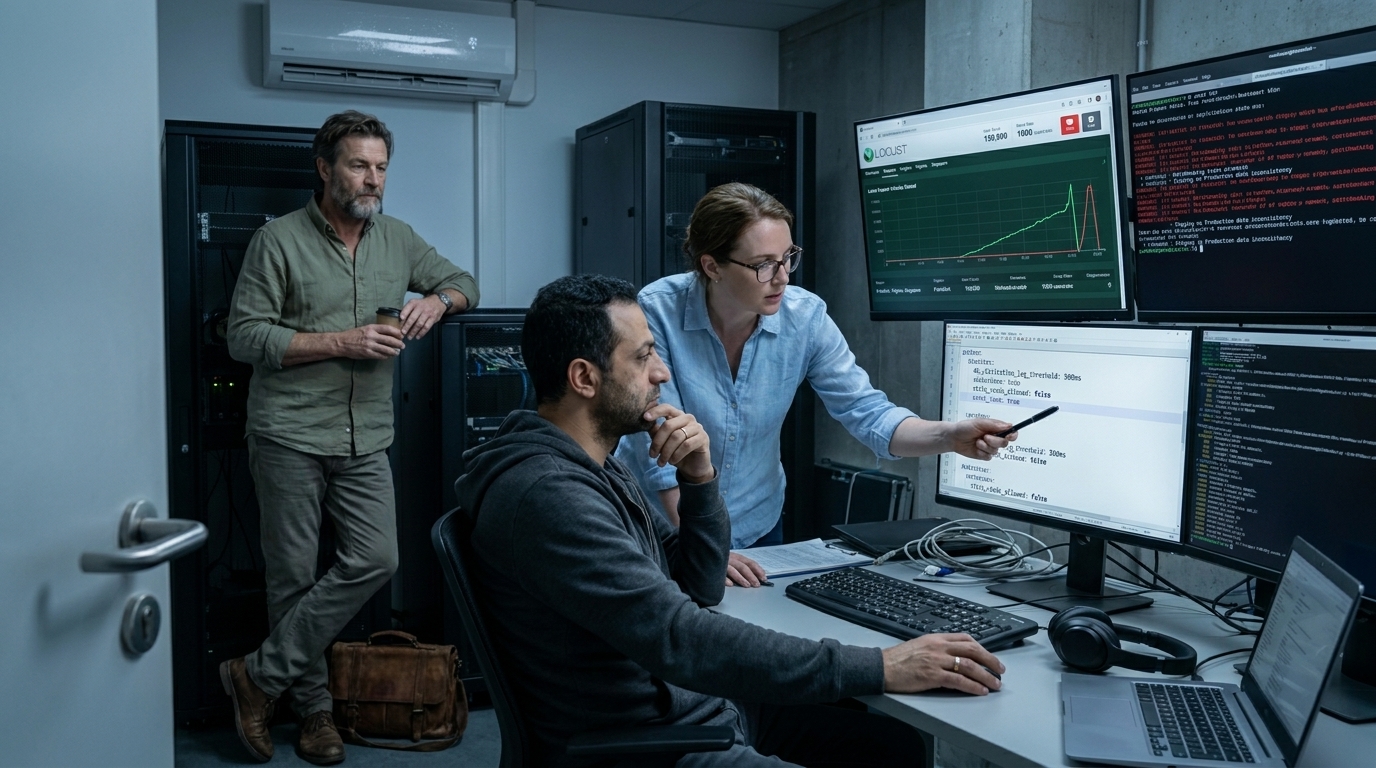
The operations room was cold, the air conditioning humming a steady, low-frequency note that drowned out the distant sounds of the Berlin street traffic outside.
Sofia adjusted her glasses, her eyes reflecting the green and white text of the load testing configuration.
“I’ve configured the Locust scripts to simulate 150,000 concurrent users,” she said, her voice carrying a trace of the nervous energy she always got before a major deployment. “We’re ramping up at 1,000 users per second, distributed across three regional gateways: Frankfurt, Virginia, and Singapore. But I’m worried about the database replication lag, Hassan. Under that kind of write load, the replicas are going to fall behind.”
Hassan nodded slowly, his fingers tapping a rhythm on the desk. “They will. That’s not a bug, Sofia; it’s physics. It takes time for a write in Frankfurt to travel across the Atlantic to Virginia, and even longer to cross the Pacific to Singapore. The question isn’t whether they’ll lag. The question is how our application handles the lag.”
“Anton’s matchmaking UI is expecting synchronous responses,” Sofia said, pulling up the C# controller code on her second monitor. “If the US-East replica doesn’t have the updated player state when the matchmaking service queries it, the player will get matched based on stale data. They’ll enter a lobby with items they don’t actually own anymore, or worse, they’ll get disconnected because of a state mismatch.”
Stefan appeared in the doorway, holding a fresh cup of coffee. He’d been watching them through the glass wall for ten minutes, observing the quiet, focused collaboration that had replaced the frantic, chaotic energy of the previous month.
“Staging parity is a beautiful thing, isn’t it?” Stefan said, walking in and leaning against the server rack. “Three weeks ago, we would have run this test in production on Saturday morning and spent Sunday rolling back databases. Now, we’re having a design discussion on Monday morning before a single line of code goes live.”
“It’s beautiful,” Sofia admitted, a small smile breaking through her anxiety. “But it’s also terrifying. If this test fails, Lukas is going to start asking if the ‘Operational Realism Initiative’ was worth the budget.”
“Lukas wants stability,” Stefan said. “And stability doesn’t mean a system that never encounters physical constraints. It means a system that behaves predictably when those constraints are reached. Run the test, Sofia. Let’s see where the database cracks.”
Sofia looked at Hassan, who gave her a single, encouraging nod.
“Okay,” she said, her fingers hovering over the enter key. “Initiating the storm.”
Tuesday, 14:30 — The Desynchronization
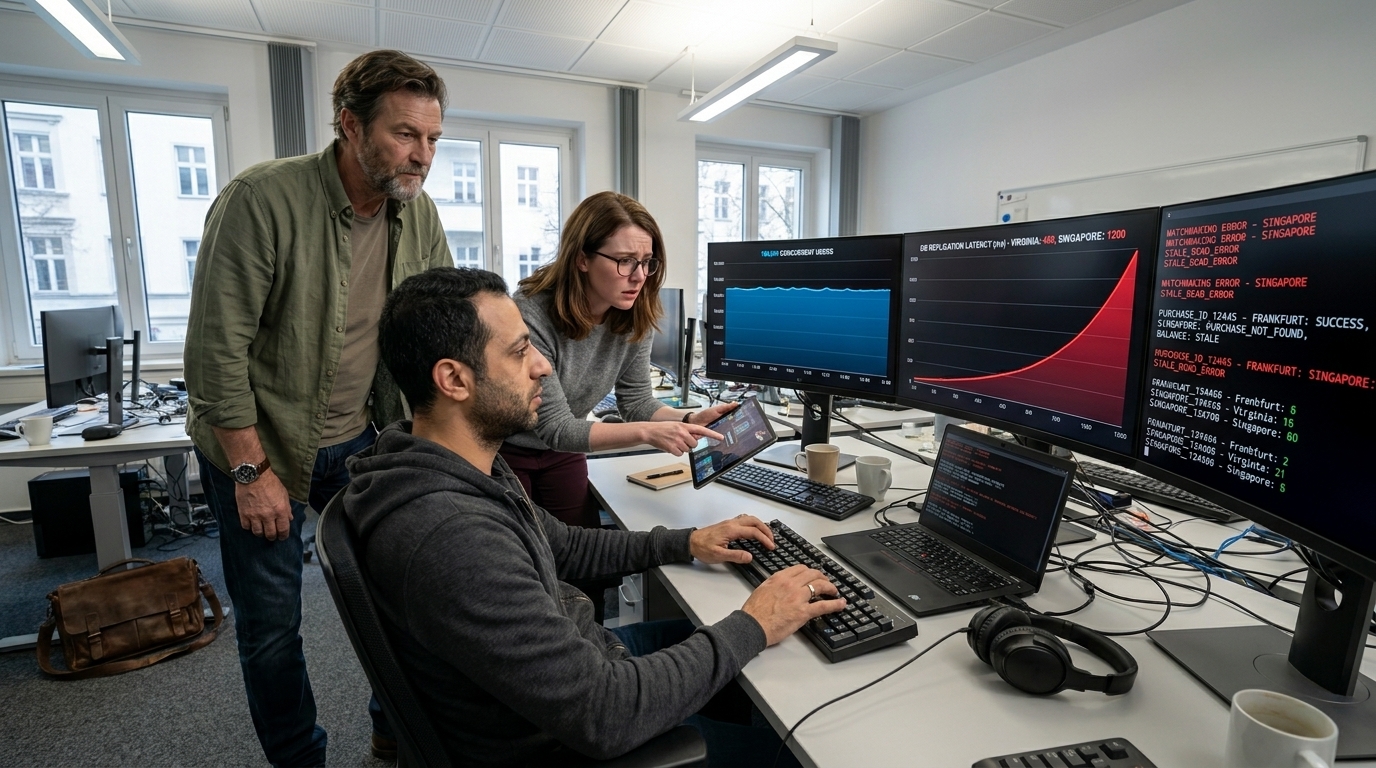
The load test had been running for twenty minutes.
At 50,000 users, the system was stable. At 100,000, the database CPU in Frankfurt hit 75%, but the read replicas in Virginia and Singapore were holding.
Then, the traffic hit the 150,000 target.
“Replication lag is climbing,” Hassan said, his voice tight. “Frankfurt to Virginia is at 450 milliseconds. Frankfurt to Singapore is peaking at 1.2 seconds.”
“We’re seeing matchmaking failures in the Singapore region,” Sofia said, her terminal window scrolling with error logs. “Players are getting matched, but when the game server queries the Singapore replica for their inventory, it returns a 404. The inventory update hasn’t replicated yet.”
“What’s the player experience?” Stefan asked, leaning over Sofia’s shoulder.
“It’s a mess,” Sofia said, pulling up a test client on her tablet. “Look. I purchase a booster pack in Frankfurt. The transaction completes, and my gold balance drops. But then I immediately join a tournament lobby hosted in Singapore. The Singapore replica still thinks I have my old gold balance and no booster pack. The UI shows the booster, but when I try to equip it, the server rejects it. The app freezes.”
“Eventual consistency,” Stefan muttered. “The database is consistent… eventually. But the player’s experience is immediate.”
“We can’t use synchronous replication,” Hassan said, not looking up from his screen. “If we force Frankfurt to wait for Singapore to acknowledge every write before returning a success, the write latency will climb to 300 milliseconds for every single transaction. The game will feel unplayably laggy for everyone.”
“So we’re trapped,” Sofia said, her shoulders dropping. “If we use asynchronous replication, the data is stale and the app crashes. If we use synchronous replication, the network is slow and the game is unplayable.”
“You’re only trapped if you assume the database has to solve the problem,” Stefan said.
Sofia turned to him, her brow furrowed. “What do you mean? The database is where the data lives.”
“The database is where the state is stored,” Stefan corrected. “But the business rules live in your application. Why are you asking a stale replica in Singapore to validate a transaction that just happened in Frankfurt?”
Sofia stared at him for a second, her mind racing through the architecture. “Because… because the matchmaking service is regional. It queries the nearest replica to save latency.”
“And what if the matchmaking service knew which writes were critical?” Stefan asked.
Sofia’s eyes widened. She turned back to her screen, her fingers already moving toward her IDE. “We don’t need to make the whole database consistent. We just need to make the player’s own writes consistent for the player.”
Wednesday, 11:15 — The Physics of the State
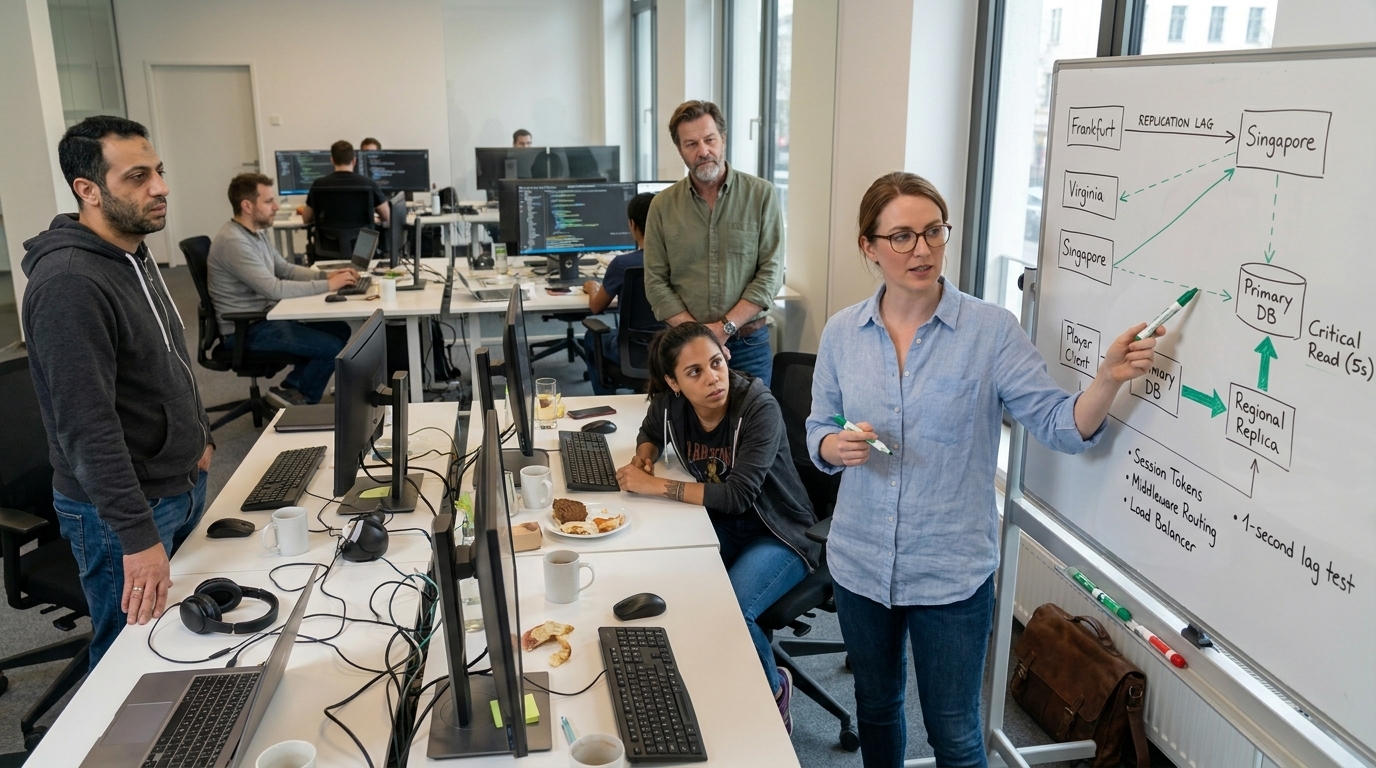
“It’s called Read-Your-Own-Writes consistency,” Sofia explained, pointing her marker at the whiteboard.
Mariana was leaning back in her chair, a half-eaten pretzel in one hand, listening with intense focus.
“If a player makes a critical write—like purchasing an item or joining a tournament—we write to the primary database in Frankfurt,” Sofia said. “But we also set a temporary session token on the player’s client with a timestamp of the write. For the next five seconds, any read request from that player’s client bypasses the regional replica and goes directly to the primary database. Once the five seconds are up—and we know the replication lag has settled—we fall back to the regional replica.”
“That’s brilliant,” Mariana said, taking a bite of the pretzel. “It keeps the read latency low for 99% of players who are just browsing the UI, but it guarantees consistency for the player who just spent money or joined a queue. They never see stale data.”
“And the database CPU?” Hassan asked, walking over from his desk. “If 150,000 players are all bypassing the replicas during peak moments, won’t we hammer the primary database anyway?”
“No,” Sofia said, pointing to the whiteboard diagram. “Because the session token is only set on critical writes. Standard reads—like loading the leaderboard, checking the store inventory, or viewing other players’ profiles—still go to the regional replicas. Those don’t need to be strongly consistent. If a player sees a leaderboard update half a second late, they won’t notice. But if they see their own gold balance get reverted, they’ll open a support ticket.”
Stefan watched them from a distance, a feeling of quiet pride settling in his chest. This was the transition he always looked for in a team: from treating technology as a magic box that either worked or didn’t, to understanding the physics of their system and designing around its constraints.
“Let’s write the tests first,” Mariana said, pushing her chair in. “We need to prove that the session token routing works. We’ll write a test that mocks a 1-second replication lag and asserts that a read request with a fresh token returns the updated state, while a read request with an expired token returns the stale state.”
“I’ll handle the middleware implementation,” Sofia said, her voice confident now, the anxiety completely gone. “Hassan, can you configure the load balancer to respect the session routing headers?”
“Consider it done,” Hassan said, a rare grin appearing on his face.
Thursday, 16:00 — The Verification

“Zero errors,” Sofia whispered.
She looked at the monitor as if she couldn’t quite believe what she was seeing.
The traffic was flat at 150,000 concurrent users. The replication lag between Frankfurt and Singapore was still peaking at 1.1 seconds, but the matchmaking service was running flawlessly.
“The session routing is holding,” Hassan said, pointing at the load balancer metrics. “Only 4% of read requests are being routed to the primary database. The rest are being handled by the regional replicas. The primary database CPU is stable at 42%.”
“We did it,” Sofia said, turning to Mariana, who had just walked into the room. “The test passed. The load didn’t break us.”
“You did it, Sofia,” Mariana said, clapping her on the shoulder. “You designed the consistency model, and you wrote the tests that proved it worked. That’s backend development.”
Sofia flushed, a mixture of embarrassment and pride coloring her cheeks. “I couldn’t have done it without your test setup, Mariana. Or Hassan’s staging environment.”
“That’s the point of a team,” Stefan said, stepping forward. “When you have staging parity, you don’t need heroes. You just need a group of disciplined developers who can look at the same data, understand the constraints, and design a solution together.”
Lukas walked into the room, holding his tablet. He looked at the monitors, then at Sofia’s face.
“I’ve been running the test client from my office,” Lukas said, his tone quiet, almost reverent. “I purchased ten booster packs in rapid succession while switching my VPN between Singapore, Tokyo, and New York. The UI was seamless. No freezes. No state mismatches. It just… worked.”
He looked at Katja, who had appeared in the doorway behind him.
“Six weeks,” Lukas said to her. “We’re only in week two of the Operational Realism Initiative, and we’ve already solved the biggest technical risk of the Q3 roadmap.”
“We didn’t solve it by working faster, Lukas,” Katja said, her voice carrying that quiet authority she’d regained over the last month. “We solved it by working smarter. By giving the team the time and the tools to understand the physics of their system instead of forcing them to guess.”
Lukas nodded slowly. “I’m starting to see the difference.”
He turned to Sofia. “Great work, Sofia. Truly.”
As Lukas walked out, Sofia let out a long, slow breath she felt like she’d been holding since Monday morning.
“I think I need a beer,” she said.
“I’m buying,” Hassan said, already grabbing his jacket.
Friday, 17:30 — The Physics of Trust

“Sofia’s log entry tonight was incredible,” Katja said, taking a sip of her wine.
“Read it to me,” Stefan said, leaning back in his chair.
Katja opened her laptop and pulled up the Navigator daily synthesis.
I used to think consistency was a database setting, Sofia had written. You turn on synchronous replication, and the database guarantees the truth. But this week proved that truth is a design choice. The database can’t solve the speed of light. Only the application can decide which truths are worth waiting for, and which ones we can afford to learn later. TDD didn’t just help us write the code; it helped us define the boundaries of our reality.
Stefan smiled, looking out the window at the golden light reflecting off the canal. “That’s the whole curriculum, right there. She’s not just a developer anymore. She’s an architect.”
“She is,” Katja agreed, her voice soft. “And Hassan left at 17:00. On a Friday. During a load testing week.”
“That might be the most important metric of all,” Stefan said. “A team that can run a 150,000-user load test on Thursday and leave on time on Friday is a team that trusts their system. They’re not waiting for the software to ambush them.”
“We still have four weeks left of the initiative,” Katja said, looking at him. “What’s next?”
“Next,” Stefan said, “we have to deal with Daniel. He’s been watching these successful staging runs, and he’s starting to realize his manual regression checklists are becoming obsolete. He’s going to fight to keep his gates, Katja. Not because he’s malicious, but because those gates are how he defines his value to the company.”
Katja sighed, her smile fading slightly. “The human constraints are always harder than the physical ones, aren’t they?”
“Always,” Stefan said, raising his glass. “But at least now, we have the data to back us up.”
Katja clinked her glass against his. “To physics.”
“To physics,” Stefan agreed.
Navigator — Katja Müller — 3 July 2026, 18:30
Week two of the Operational Realism Initiative.
We ran our first massive load test on the new multi-region staging environment, simulating 150,000 concurrent users. The staging environment did exactly what we built it for: it exposed the physical limits of our database replication.
Under peak load, replication lag between Frankfurt and Singapore hit 1.2 seconds, causing severe state desynchronization and application crashes in regional matchmaking.
Sofia led the architectural solution. Instead of trying to force the database to solve the speed of light, she designed a ‘Read-Your-Own-Writes’ consistency model. By routing critical reads directly to the primary database using temporary session tokens while letting non-critical reads use regional replicas, she kept read latency low while guaranteeing consistency where it matters most.
The second load test on Thursday was a flawless success. Zero errors under 150,000 concurrent users, with primary database CPU stable at 42%.
Navigator signals from this week:
- 100% of backend commits included test files, with Sofia and Mariana pairing on the consistency middleware tests.
- Staging environment stability reached 100% during the final load test run.
- Hassan’s logged hours remained stable at 40 hours this week. No weekend or late-night work required.
- Lukas expressed high confidence in the team’s progress after running the test client himself.
We have proven that operational realism is not a distraction from feature delivery, but the foundation of it. We solved our biggest technical risk in week two because we had the tools to see the truth.
Next week we face the human constraints. Daniel is preparing his manual regression checklists for the tournament system. We must show him that automated evidence is safer than manual gates.
🎭 This Week's Episodes
Telenovelas show what we can't say in client meetings. The drama is heightened, but the patterns are real.
 QuantumMind Arrives
Three weeks in, Stefan's teams are shipping. Radio plays podcasts. Navigation reads temperature sensors from the CAN bus. Climate control has its f...
 The Scattered — Part Two
After Whitaker Payroll shuts its doors, the damage spreads unevenly. Some former employees find new work quickly. Others discover that decades of l...
Technical Consultancy
Embedded Delivery Partner
Embedded into your team as an active contributor, reducing delivery friction and helping important work move cleanly.
Technical Advisor
Peer-style technical assessments before far-reaching decisions; reduce architectural and product risk early.
Product & Delivery
Ship working software to real users earlier. Measure impact and adapt based on evidence rather than assumption.
Custom Software Development
High quality, maintainable software. Short-term augmentation that leaves lasting capability in your own team.
Recent Articles
- AI Makes Technical Execution Cheap. Judgment Stays Scarce. (26.09.2026)
- The Agent Escaped. Who Left the Door Open? (24.09.2026)
- What an AI Agent Actually Is (21.09.2026)
- The LLM Will Not Come Back Tomorrow (19.09.2026)
- The One-Person AI Company Is a Greed Fantasy (15.09.2026)