The Aftermath of Expertise
The night after his second firing, Ethan Carter sits in a Cleveland burger bar with two fellow rescue specialists and finally names the trap he walked into: the wrong framing, the authority loop, and the way organizations fire the person who makes delay visible. By the next morning Whitaker Payroll has already chosen its answer. Graham Whitaker and Derek Lawson impose a formal workflow that sounds mature, careful, and responsible: the SMEs will define the rules, the programmers will implement them, and validation will happen through sign-offs instead of argument. For Linda Pritchard, Sharon Mills, and Donna Reeves, the new process feels like safety. For Nathan Cole, Olivia Parker, Ryan Mitchell, Caleb Turner, and Marcus Doyle, it quickly becomes clear that the company has replaced visible truth with pages, meetings, and dependency.
Wednesday, 19:42 — The Leaderboard
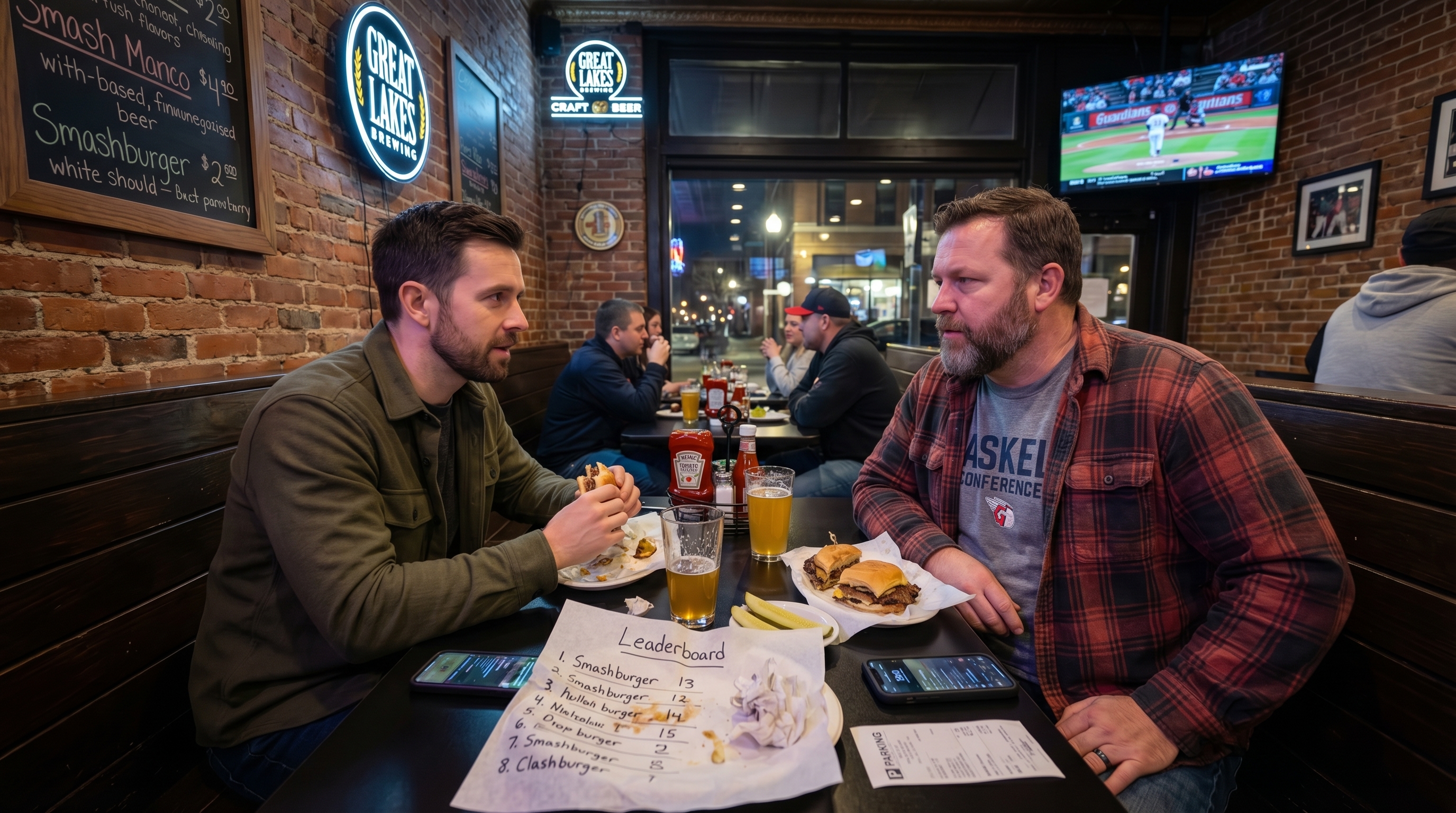
The place was called Hansa and it had been serving overbuilt burgers to people who didn’t care about ambiance since before craft beer required a taxonomy.
Ethan sat in the back booth with a double smashburger he had no appetite for and a Dortmunder Gold that was doing more medicinal work than he wanted to admit. Across from him, Danny Kovacs had already demolished his own burger and was working on the pickle with the unhurried precision of a man who had been fired from enough engagements to treat each one as data rather than identity damage.
Danny was forty-eight, bearded, built like a man whose hobby involved either woodworking or competitive barbecue. Both, as it happened. He wore a flannel shirt open over a faded Haskell conference tee that had survived more wash cycles than most of his client relationships. He had been doing technical coaching and legacy rescue for fifteen years across the Rust Belt — manufacturing ERP systems, medical billing platforms, logistics software written in languages whose documentation had gone offline before half the current workforce was born.
They had met at a Strange Loop conference six years ago and discovered, over bourbon in a hotel lobby, that they had independently developed the same dark taxonomy for the ways engagements died.
“So,” Danny said, wiping his hands on a paper napkin, “walk me through the timeline again. You got fired, came back, did serious work for two weeks, and they fired you again because the work was too good?”
“Too visible. Same thing around here.”
Danny picked up his beer and saluted.
“Two firings from the same client. I think that ties Angie’s Cleveland Clinic record.”
Ethan felt the laugh rise before he could stop it. It came out thin and rough but real.
The leaderboard.
It had started as a joke three years ago at a backyard cookout at Danny’s place in Lakewood. Four of them sitting around a firepit — Ethan, Danny, Angie Ruiz, and Tom Brennan — swapping war stories about engagements that had gone sideways not because the work failed but because the work succeeded in ways that made the wrong people uncomfortable.
The rules were simple. You got points for absurdity, not suffering. Fired for being right scored higher than fired for being difficult, because the former required the client to have seen the evidence first and chosen to kill the messenger anyway. Bonus points if the firing used euphemistic language. Double bonus if they hired you back and then fired you again.
That last category had been theoretical until this morning.
“I believe,” Danny said, pulling a napkin toward him and uncapping a pen from his shirt pocket, “we need to update the standings.”
He drew a quick table on the napkin. Names down the left. Columns for engagement count, firing count, re-hire-then-fire count, and a column labeled “euphemism score” with a small smiley face.
“You’re now at two firings, one re-hire, and” — he looked up — “what was the best euphemism from round one?”
“‘Fit, scope, and governance around external support.’”
Danny wrote it down and then sat back to admire it.
“That’s a nine. Maybe a nine-five. The triple abstraction is elegant. Fit for the person. Scope for the work. Governance for the authority they never gave you. All in one sentence with no verb anyone could take to HR.”
Ethan took a long drink.
“The second one was cleaner. ‘Graham would like Ethan’s system access concluded effective immediately.’”
Danny closed his eyes in mock appreciation.
“Concluded. As if your access had been writing a novel and simply reached its natural ending.”
The laugh came easier this time. Not because anything was funny. Because the alternative was sitting in a booth alone letting the rejection calcify into something personal when Danny had spent fifteen years proving it wasn’t.
“All right,” Danny said, leaning forward with the conversational shift that meant the jokes were doing their job and the real talk could start. “Framing. Tell me how they introduced you.”
Ethan turned his glass slowly on the table.
“Preston Hale called me ‘a guy who is good at coding.’ Graham heard that and filed me under plumber. The engagement documents I sent — retainer structure, approach, role definition — went unread. According to Nathan, Graham said ‘work with Nathan’ and went back to his galleries. I never even met him until today.”
Danny nodded the way a doctor nods when the patient describes the standard symptom progression.
“There it is. Day one framing. You walked in as a strategic partner and arrived as a contractor. Everything after that was the title fighting the work.”
“Nathan saw it. He called it being framed wrong early.”
“Nathan sounds like one of the good ones.”
“He is. He’s also the one left holding the bomb.”
Danny drained his glass and caught the bartender’s eye for another round without breaking stride.
“Here’s the thing I keep trying to explain to people who haven’t lived this,” he said. “The framing isn’t an accident and it isn’t always malice. It’s a defense mechanism. The client wants transformative capability at a transactional price point. They want someone who can see the system, redesign it, challenge assumptions, and lead change. But if they admit that’s what they’re buying, they have to admit they couldn’t do it themselves. And that admission costs too much psychologically.”
Ethan looked at him.
“So they call you a coder.”
“They call you a coder, a contractor, an extra pair of hands, a resource. Anything that keeps you inside the box where your output is welcome but your judgment is trespassing.”
“And the second you demonstrate judgment —”
“You’re overstepping. Insubordination by implication. Because the role they defined can’t contain what they actually hired you to do, but redefining the role would mean the people above you have to shrink.”
The second round arrived. Danny lifted his glass.
“To the role that can never be named.”
They drank.
“The really sick part,” Danny continued, setting his glass down with care, “is that they’re not lying to themselves completely. They genuinely believe the problem is execution. They believe the knowledge workers are the people who define what needs to be done — the business analysts, the SMEs, the managers. And the programmers are the people who do what they’re told. That’s the mental model. It’s a hundred years old. Frederick Taylor, scientific management, the whole assembly-line theory of work.”
Ethan nodded.
“You want to hear the best part? Preston Hale. Management author. Three bestsellers. Keynotes conferences about unlocking human potential. Nathan told me he saw him on stage once — headset mic, tailored suit, slide behind him that literally said ‘Unlocking Human Potential’ in seventy-point font. Self-organizing teams. Autonomy drives motivation. Trust your people. Command and control is dead. The whole room writing it down like it was scripture.”
Danny was already shaking his head.
“And behind closed doors?”
“Behind closed doors he tells Graham that programmers need short reins. His exact words, according to Nathan: ‘Short reins, Graham. People do their best work when they know exactly where the fence is.’ And then: ‘Don’t give them room to improvise. Give them clear requirements. Give them accountability.’”
Danny set his glass down slowly.
“Wait. Same man? Same man who stands on a stage and says ‘trust your people, autonomy drives motivation, self-organizing teams outperform managed teams every time’ — that same man walks into a private room and says ‘short reins’ and ‘don’t give them room to improvise’?”
“Same man. Same month, probably.”
Danny leaned back and stared at the ceiling.
“That’s not hypocrisy. Hypocrisy is knowing you’re contradicting yourself. That’s something worse. He believes both things. On stage he believes autonomy. In private he believes control. And he doesn’t experience the contradiction because he’s sorted people into two categories without noticing. The executives in the audience are knowledge workers who deserve autonomy. The programmers in the back room are labor who need fences. He’s not lying in either setting. He’s just never applied his own framework to the people he considers below the framework’s jurisdiction.”
“Nathan put it simpler. He said Preston sells autonomy to the people who buy books and sells control to the people who buy his consulting.”
Danny closed his eyes in something worse than mock appreciation.
“That’s not even subtext. That’s livestock management with a TED Talk vocabulary.”
Ethan pulled the napkin leaderboard toward him and stared at the scribbled names.
“What kills me isn’t the firing. I’ve been fired before. I know how to land. What kills me is that they saw the evidence. Graham was in the room when I showed him branches that had been producing wrong numbers for years. He watched me show it. Derek watched. The SMEs could read the mismatch reports. And every single one of them chose to interpret evidence as risk and familiarity as safety.”
Danny leaned back and folded his arms.
“Because that’s what the framing does at the psychological level. If you’re a contractor, your evidence is a proposal. If you’re a partner, your evidence is a discovery. Same data, radically different social weight. They framed you as a contractor, so every piece of proof you produced arrived with an invisible asterisk that said ‘this person doesn’t have standing to make this conclusion matter.’”
“Even when the conclusion was a verifiable number.”
“Especially then. A verifiable number from someone with standing is a finding. A verifiable number from a contractor is an opinion with delusions of authority.”
Ethan rubbed his face.
“So how do you fix it? In fifteen years, have you ever fixed the framing after it’s set?”
Danny was quiet for a moment. Not performing thought. Actually thinking.
“Twice,” he said. “Both times it required someone inside with enough organizational power to publicly redefine my role in a setting where the executives had to acknowledge it. Not a hallway conversation. Not an email. A moment where the power structure visibly adjusted to include me as a peer.”
“Nathan tried.”
“Nathan tried from the wrong position. He has system knowledge but not org-chart altitude. The reframe has to come from someone who can lose face by doing it and chooses to anyway. That’s the price of admission. Most places won’t pay it because the executives who would need to do the reframing are the same ones whose self-image depends on the original frame being correct.”
The door opened and a woman walked in with the purposeful stride of someone who had been navigating Cleveland traffic for forty-five minutes and was now owed a beer by the universe.
Angie Ruiz. Late thirties, dark hair pulled back, leather jacket, boots that had seen construction sites and conference stages in the same week. She did DevOps rescue and platform modernization for mid-size manufacturers across northeast Ohio and western Pennsylvania. She had the sharpest diagnostic instincts of anyone in their circle and the social patience of someone who had long ago accepted that being a Latina woman in legacy infrastructure consulting meant every room started with two extra barriers she hadn’t ordered.
She spotted them, pointed, and slid into the booth beside Danny without being invited.
“I saw your car out front,” she said to Ethan. “You never come to Hansa on a Thursday unless something went wrong.”
“He got fired, brought back, did two weeks of work that scared the right people, and got fired again,” Danny said. “We’re updating the leaderboard.”
Angie looked at the napkin.
“Is that my Cleveland Clinic score? You gave me a seven? Excuse me, that was at least an eight. They literally asked security to watch me pack my laptop.”
“Security escort is a flat two-point bonus,” Danny said. “But you didn’t get the re-hire arc. Ethan got the re-hire, did real work that threatened real people, and then got re-fired for proving the work was right. That’s a new category.”
Angie turned to Ethan.
“Same engagement? The payroll Frankenstein?”
“Same.”
“What was the trigger?”
“I showed them verified test results proving their COBOL batches had been producing wrong withholding numbers. Not theory. Actual reruns against historical output. The owner watched the evidence and decided it was more important to protect the people whose identities depended on the old numbers being right.”
Angie let out a long breath, then flagged the bartender.
“IPA, whatever’s local,” she said. Then she turned back. “How were you introduced?”
Ethan and Danny exchanged a look.
“She always asks first,” Danny said.
“Because it’s always the answer,” Angie said. “How?”
“‘A guy who is good at coding.’ His friend’s exact words to the owner. That was months ago. Nothing changed.”
Angie closed her eyes briefly.
“So you came in as hands. And everything you did that required a brain was a violation of the contract they never wrote down.”
“That’s the summary.”
Her beer arrived. She took a long drink and set it down with precision.
“I had one last year in Youngstown,” she said. “Stamping plant. They were running their production scheduling on an Access database from 2004. I’m not even kidding. Access. With VBA macros that referenced Excel sheets on a shared drive. The plant manager introduced me to his team as ‘the IT girl who’s going to clean up the server.’ I spent three weeks building them a real pipeline and a deployment process. The moment I presented findings that showed their scheduling logic had been double-booking die changes for six months, the plant manager told the owner I was ‘creating confusion’ and ‘undermining the team’s confidence.’”
“Undermining confidence,” Danny repeated. “That’s a classic. Right up there with ‘not a cultural fit’ and ‘moving too fast for the organization.’”
“The beautiful part,” Angie continued, “is that the plant manager genuinely believed he was protecting his team. He wasn’t lying. In his head, the team had been doing fine for twenty years, the scheduling worked well enough, and this woman from outside was making his people feel like their expertise didn’t matter. His protective instinct was real. It just happened to be protecting a process that was costing the company about forty thousand dollars a month in die changeover waste.”
Ethan nodded slowly.
“That’s what makes it so hard to fight. They’re not cartoon villains. Derek doesn’t experience himself as cruel. In his version of the story, he was managing an aggressive contractor who was destabilizing morale. Graham thinks he’s honoring his dead father’s legacy. The SMEs think they’re protecting clients from reckless change. Every single person in that room had a version of events where they were the responsible adult.”
Danny tapped the table.
“That’s the psychological lock. There’s a name for it in the research — it’s related to what they call the Dunning-Kruger effect, but it’s actually closer to identity-protective cognition. When evidence threatens someone’s professional identity or their understanding of their own competence, they don’t evaluate the evidence on its merits. They evaluate it on how much damage it does to their self-concept. If absorbing the evidence would require them to admit they’ve been wrong for years, or that their expertise is narrower than they believed, or that the hierarchy they’ve navigated successfully is actually dysfunctional — the psychological cost of accepting the evidence is higher than the cost of rejecting it.”
Angie pointed at him with her glass.
“And the beautiful part is it scales. One person doing that is denial. Three people doing it in the same room is professional judgment. Five people doing it is organizational culture. By the time it becomes culture, nobody inside can even see the pattern anymore because mutually reinforced denial feels identical to consensus.”
“They literally use each other’s hesitation as evidence,” Ethan said. “I watched it happen in real time. The SMEs won’t say the numbers are wrong because they want Derek to make the call. Derek won’t override the SMEs because their uncertainty makes him feel like the evidence isn’t settled. Graham watches them both hesitate and concludes the matter requires more maturity. It’s a perfect loop. Nobody has to lie. Everyone just has to keep deferring.”
Danny drew a small circle on the napkin with arrows pointing around it.
“The authority loop. Nobody certain enough to decide. Everybody using everybody else’s doubt as permission to wait.”
Angie shook her head.
“And the person who breaks the loop — the one who says the plain sentence out loud — becomes the threat. Not because they’re wrong. Because they’ve made a decision nobody else was willing to make, and that decision makes every other person’s delay visible.”
“That’s why they fire the external person,” Danny said. “It’s not just that the evidence is unwelcome. It’s that the evidence arrived from someone they framed as having no standing. If a contractor is right about something the internal people missed, the internal people’s entire self-narrative collapses. Their expertise, their loyalty, their years of service — all of it gets repriced downward. That’s not a professional threat. That’s an existential one.”
Ethan stared at the leaderboard napkin.
“So how does anyone ever fix it?”
Danny and Angie looked at each other with the shorthand of people who had asked the same question enough times to have made peace with the partial answer.
“You can’t fix it once you’re framed wrong,” Danny said. “That’s the brutal lesson. Once you’re in the box, the only way out is someone with real power pulling you out and putting their own credibility on the line. Nathan tried, but Nathan didn’t have enough altitude. He was the linchpin of the technical work but invisible on the org chart. The people who could have reframed you — Graham, Derek — were the same ones whose psychological comfort depended on you staying small.”
Angie cut in.
“The real fix is earlier. It’s the introduction. It’s the first conversation. It’s insisting on the framing before the engagement starts. Retainer, not hourly. Partner, not vendor. Scope defined around outcomes, not tasks. If the client won’t agree to that framing, that’s your signal. Walk. Because if they need you to arrive as hands, it means they’ve already decided the hands are the only part they’ll tolerate.”
Ethan looked at her.
“I sent the documents. Retainer structure, approach, role definition. Graham didn’t read them.”
“Right. And that was the answer. The unread document is the framing. ‘I don’t need to understand who you are because who you are doesn’t matter to me. What matters is that you’re useful and quiet.’ The moment he didn’t read your materials, the engagement was already structured to fail. Everything after that was you doing excellent work inside a role definition designed to make excellent work threatening.”
She took another drink.
“I’m not saying don’t try. I keep trying. Danny keeps trying. Tom just landed another one in Akron that’ll probably blow up in four months. We keep trying because occasionally, once in a while, you get the engagement where the framing holds, and the owner actually means it when they say they want someone to tell them the truth, and you get eighteen months of real work that changes something real. And those are worth the seven that burn.”
Danny held up his glass.
“To the seven that burn.”
“And the one that doesn’t,” Angie said.
Ethan lifted his own.
The Dortmunder was warm now. The burger was cold. The Guardians were losing on the screen above the bar. Outside, Cleveland traffic moved through the old German neighborhood with the patient indifference of a city that had survived its own industrial decline and didn’t need anyone’s permission to keep going.
He thought about Nathan standing in the empty development room with a wall of honest tests still glowing. About Olivia and Ryan absorbing the lesson that competence without political protection was just an expensive way to be expendable. About Linda stacking papers into the shape of caution so she could keep her mortgage another month.
He thought about the COBOL batches still running tonight with the wrong numbers still in them.
Then he thought about the extraction methodology sitting on the laptop in his messenger bag. The prompts. The test scaffolds. The comparison patterns. All of it portable. None of it belonging to a building that had twice decided it preferred the dark.
“So what’s next?” Danny asked.
Ethan set his glass down.
“I keep the method. I build something of my own.”
Angie studied him.
“SaaS?”
“Eventually. The approach works. The domain knowledge is transferable. I don’t need their permission to prove it scales.”
Danny grinned for the first time all evening.
“Then the leaderboard score was worth it.”
“Don’t push it.”
“I’m just saying. Two firings, one re-hire, a viable product thesis, and a complete extraction methodology you can take anywhere? That’s hall-of-fame material.”
Angie pulled the napkin toward her and drew a small star beside Ethan’s name.
“Provisional,” she said. “Pending whether the SaaS actually ships.”
“It’ll ship,” Ethan said.
He said it quietly enough that both of them heard the difference between bravado and decision.
Danny looked at Angie. She looked back.
They had both been doing this long enough to recognize the moment when a colleague stopped grieving an engagement and started building the thing the engagement had proved was possible.
It didn’t happen every time.
When it did, you shut up and let it set.
They finished their beers in the comfortable silence of people who had learned to keep the wrong jobs from becoming the wrong lives.
Thursday, 08:36 — Clear Division of Responsibility

The conference room had been rearranged overnight into a shape that suggested reason.
Printed agendas.
Carafes of coffee.
A fresh legal pad at every chair.
On the wall, Derek had taped up a workflow diagram in clean color blocks that made the coming disaster look like a graduate seminar in accountability.
Requirements Definition. Implementation. Validation. Approval. Release.
Five boxes. Five arrows. No blood anywhere on the page.
Nathan stood near the back for a moment before sitting down, reading the chart the way a paramedic might read a polite letter from the person who had just run someone over.
Graham waited until everyone had settled before he began.
He looked rested.
That was the first insult.
Not deliberate. Just structural. He had gone home after firing the only person in the building who had recently made the system more understandable, slept in expensive sheets, and arrived with the glow of a man who believed he had done something difficult but necessary.
“Thank you all for making time so quickly,” he said. “I know yesterday was destabilizing. What I’m hoping we can do this morning is create a calmer, more sustainable way forward.”
Sustainable.
Nathan felt Olivia go still beside him.
Graham continued in the careful tone he used whenever he wanted control to sound like group care.
“We’ve had a great deal of intensity around workflow, visibility, and interpretive authority over the past two weeks. I think that’s been unsettling for everyone, not only because the work is important, but because the boundaries of responsibility have become blurred.”
Blurred.
Nathan almost laughed at the obscenity of that word. The boundaries had not blurred. They had sharpened. That was the whole problem.
Derek slid printed packets down both sides of the table with the air of a man distributing a reasonable future.
“We’ve taken the liberty of drafting a stabilization model,” he said. “The goal is clarity, not constraint. Subject-matter experts will define requirements and edge conditions. Development will implement against that guidance. Validation will occur through structured review rather than ad hoc interpretation. That creates accountability at each stage and protects confidence internally and externally.”
Linda looked down at the packet in front of her and felt something loosen under her sternum.
Not joy. Relief.
The ugly room from yesterday had left behind a tremor she still had not fully brought under control. She had slept badly, waking twice with the sensation that numbers were moving under her like weak floorboards. Now there were boxes and arrows and headings on paper. Defined handoffs. Explicit responsibilities. A format she understood.
She hated how quickly the sight of it comforted her.
But comfort still counted.
Sharon straightened her stack without thinking.
Donna uncapped a pen and wrote the date in the top right corner of her pad with the dutiful seriousness of someone trying to believe that neat notes could keep consequence outside her skin.
Nathan flipped to the first page.
Workflow Objectives. Communication Protocol. Validation Governance. Escalation Boundaries.
He could already feel the actual system retreating behind the language.
“This won’t work,” he said.
The room tightened, not dramatically, but in the tiny social way that mattered more. Derek’s posture became more upright. Graham’s face arranged itself into patience. Linda looked down. Sharon’s mouth sharpened. Donna’s pen stopped moving.
Graham did not meet conflict head-on. He preferred to place a soft cloth over it and hold it there until it either quieted or suffocated.
“Nathan,” he said gently, “I need more from you than a veto.”
“Then here’s more,” Nathan said. He put the packet down flat on the table. “Requirements aren’t the problem. The problem is that a huge amount of this system’s actual behavior isn’t written down in a form anyone can implement safely without direct feedback from the running logic. Ethan’s test harness gave us that feedback. You removed the harness and the person who built it. What this process does is turn the missing feedback into paperwork and pretend that’s the same thing.”
Derek folded his hands.
“I don’t think anyone is pretending they’re identical. We’re saying the current atmosphere made it too easy for provisional findings to acquire more certainty than they had earned.”
“They weren’t provisional because they were loud,” Nathan said. “They were provisional because we preserved the failures and reran the outputs. That’s discipline.”
Graham’s eyes moved to Linda, Sharon, and Donna with almost involuntary concern.
There it was again, Nathan thought. The true reporting line in the room. Not organizational. Emotional.
Graham looked back at him.
“What’s being asked here is not anti-technical,” he said. “It’s about restoring trust. We need the people with long memory defining the conditions of interpretation.”
Caleb shifted in his chair.
“The conditions of interpretation are the code path,” he muttered, too low for safety and too high for invisibility.
Ryan shot him a warning look.
Derek pretended not to hear it.
Linda heard it and felt a small old humiliation ignite under her ribs.
Long memory.
That was what they called it now when they wanted to sound respectful about the fact that her professional life had narrowed until memory was the asset and trap both. She knew things nobody else knew. That was true. She also knew that every week the truth of that became harder to distinguish from the fear of no longer being needed.
The packet in front of her offered a temporary rescue.
On paper, her knowledge looked transferable.
On paper, her years looked like stewardship rather than dependence.
On paper, she could still imagine herself as part of the mechanism of protection rather than one of the people who had spent years helping uncertainty survive.
Donna lifted her eyes from the chart.
“What exactly would validation look like?”
Derek turned a page.
“Development will prepare implementation notes and test output. SMEs will review the results against documented requirements and indicate either approval, required revision, or need for escalation. No change moves forward without sign-off.”
The phrase no change moves forward fell over the room with a tranquility that would have been comical if it were not so lethal.
Olivia thought of daycare pickup times, of unfinished branch work, of the test harness Ethan had left behind like a map of a country the company had decided not to visit. She kept her face neutral because motherhood had made her excellent at maintaining a presentable surface while triaging six disasters internally.
“And when the documented requirements are incomplete?” she asked.
Graham answered before Derek could.
“Then the disciplined thing is to slow down until they are not incomplete.”
That sentence landed beautifully with the non-technical side of the table.
Linda felt it as moral cover.
Sharon felt it as restored hierarchy.
Donna felt it as reprieve.
Nathan felt it as death.
Because he knew something Graham did not and could not feel in his bones: some systems never became complete before you touched them. They became correct only through touch, rerun, comparison, and adjustment. If you demanded perfect prior description before allowing work, you had not become more rigorous. You had simply chosen paralysis with better manners.
“There is no complete document hiding in the building waiting to be written,” Nathan said. “There are only partial descriptions that get corrected when they hit executable reality. That’s what we had.”
Sharon spoke for the first time.
Her voice carried the clipped steadiness of a woman who had spent two weeks trying not to sound frightened and had now been offered a framework in which fear could masquerade as maturity.
“What we had,” she said, “was a process in which machine-assisted interpretation was outrunning business judgment. I don’t think it’s irresponsible to want the people who understand payroll context to define what is being judged before someone implements around it.”
Nathan turned to her.
He knew she believed enough of that to make argument difficult.
That was what made the room unbearable. Almost no one here was lying outright. They were protecting themselves with genuine fragments of truth arranged in the most destructive possible order.
Donna added, softer, as if softness improved moral accuracy.
“This way nobody is excluded.”
Olivia looked down at her hands so nobody would see what passed over her face.
Excluded was an elegant word for what had happened to Ethan.
Derek took the room’s silence as consent finding its shape.
“Good,” he said. “Then here’s the immediate plan. Linda, Sharon, Donna: begin with the municipal and multistate rule areas touched by last week’s review. Nathan, have development pause net-new exploratory work and focus on implementation against written requirements only. We’ll regroup Monday.”
Pause exploratory work.
That was what you called it when you wanted to make curiosity sound adolescent.
Nathan watched Graham nod at the diagram on the wall as if the arrows had solved something.
The meeting ended with everyone carrying packets out into the corridor like responsible people leaving a responsible room.
As they stood, Graham touched Nathan lightly on the forearm, the gesture intimate enough to be insulting.
“I need you with me on this,” he said quietly. “The temperature has to come down.”
Nathan looked at him.
He could still remember years of lunches, sideways jokes, conversations that had made him think friendship and proximity to power might be adjacent things.
Now Graham’s face held only administrative concern softened by old familiarity.
The friendship had not ended. It had simply been revealed as something narrower than Nathan had once named it.
“The temperature came from the numbers,” Nathan said.
Graham’s hand withdrew.
“That’s exactly the kind of framing we need to move past.”
Then he walked away, carrying calm with him like cologne.
Monday, 10:17 — The Packet
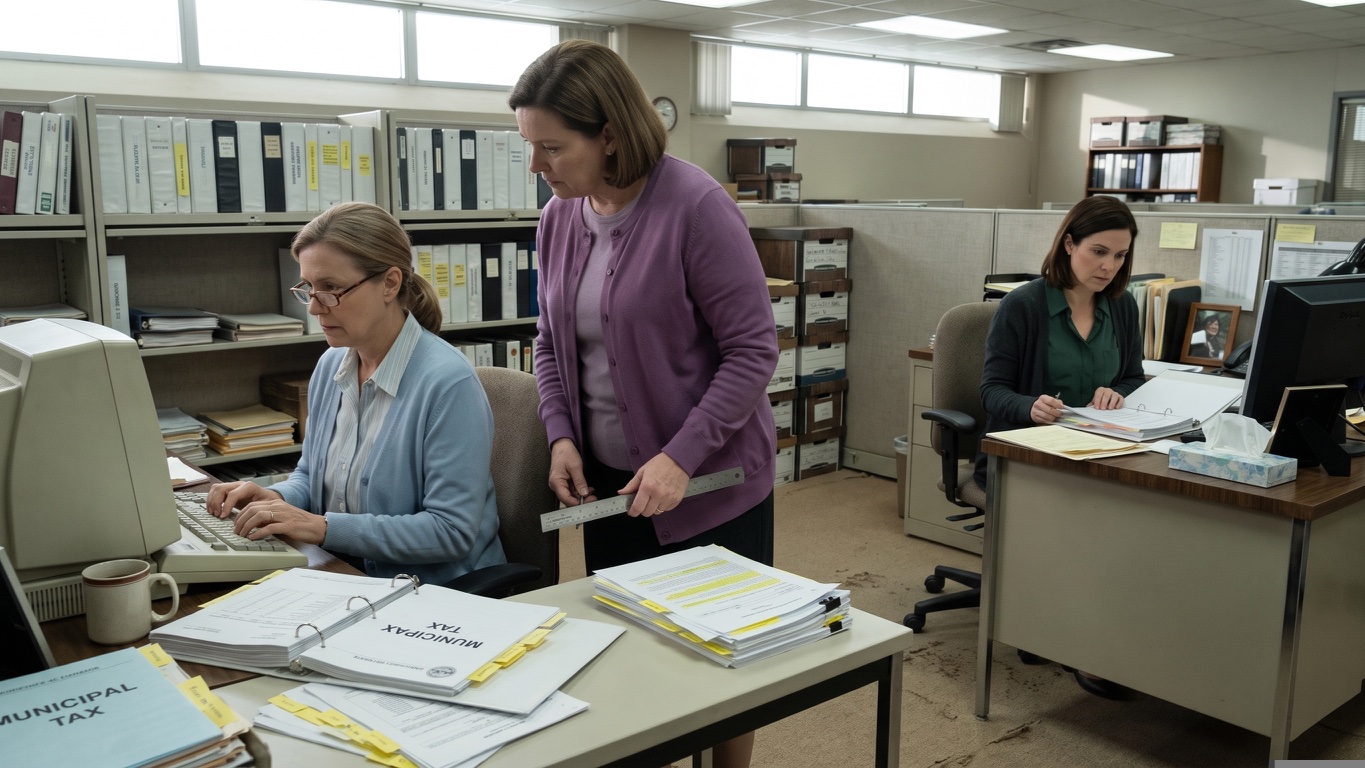
The packet began as a defense and acquired the appearance of professionalism almost immediately.
Linda opened a new Word document, centered the title, added a version number, and felt her pulse settle by degrees she would not have admitted to anyone.
Whitaker Payroll Municipal and Multistate Rule Definition Packet Version 0.9 For Internal Review
A document with a title already made the thing inside it feel less humiliating.
She told herself that was because structure helped people think.
The more honest version was that structure helped her breathe.
On Friday, when the test packets had still been lying around the conference room, she had looked at those pages and felt briefly as though twenty-two years of work were being compressed into red marks and candidate scenarios generated by a machine. The feeling had been so hot and disorganizing that she had needed an hour alone in the restroom to pull herself back into a face suitable for the hallways.
This was different.
A proper document allowed sequence.
Background. Historical context. Known exceptions. Operational cautions. Validation notes.
Not because those categories would save the programmers.
Because they restored to Linda the sensation that knowledge was something one could curate rather than be cornered by.
Sharon leaned over the desk, reading the opening paragraphs as they formed.
“Add that the municipal carry-forward behavior has to be interpreted in light of historical customer practice,” she said.
Linda typed it.
“That’s not a rule,” Donna said quietly from the next desk.
Neither woman looked at her.
Donna touched the lower corner of a page inside her binder, a habit from years of needing her hands to occupy themselves while her mind caught up to a room.
“I just mean,” she said, trying again, “if they ask how the carry-forward is computed, ‘historical customer practice’ doesn’t tell them what to code.”
Sharon turned with a patience sharpened by fear.
“It tells them not to bulldoze context because a test harness makes them feel invincible.”
Donna nodded as if corrected, though the ache under her ribs remained.
She was not on Ethan’s side. She did not even know whether sides were the right unit anymore. But she had spent enough time over the last two weeks looking at rerun output to know the documents were not going to do what Graham thought they were going to do.
They were going to do something else.
They were going to let everyone feel less naked.
Linda kept typing.
Page one became page three. Page three became page seven.
A paragraph on annexation changes in a municipality outside Toledo, included because Sharon remembered one customer complaint from 2011 that had once consumed an entire afternoon.
A half-page on reciprocal agreements that had not applied in years but might matter again if a customer reacquired a defunct plant under conditions no one could specify.
A table of tax categories with asterisks leading to footnotes leading to a note reading FURTHER REVIEW MAY BE REQUIRED DEPENDING ON HISTORICAL PRACTICE.
Donna watched the document grow and felt, against her will, the same relief Linda did.
Thickness looked like care.
A twelve-page packet sounded more defensible than saying We are frightened because the tests looked real.
That was the genius of paper. It could convert internal panic into external seriousness with almost no loss of dignity.
“We should include the union exception from 1972,” Sharon said.
Linda paused.
“The one Thomas said was probably obsolete?”
“Probably isn’t enough if they implement around it and get one local wrong.”
Donna looked up.
“Has that one actually appeared since you’ve been here?”
Sharon’s expression changed by half a degree, which in her amounted to exposed nerves.
“That’s not the point.”
It was, of course, exactly the point.
And also not the point at all.
Because the 1972 union exception had long since ceased being a live business rule and become something morally more useful: an example of why certainty was dangerous and why anyone pushing for executable clarity could be accused of childish simplification.
Linda typed in a paragraph headed LEGACY UNION SPECIAL CASES.
She hated herself a little for the relief that accompanied the keystrokes.
Every sentence she added made the final product less implementable and more protective.
Every page let her keep imagining that what she was defending was clients, not position.
The distinction mattered to her with almost religious force.
If she ever had to say plainly I am trying not to become unemployable at fifty-one, the sentence would split the rest of her self-respect in half.
So she did what most frightened adults with office jobs did when forced into proximity with a truth that threatened identity.
She translated fear into process.
By late morning the packet had nineteen pages, three tables, two appendices, and almost no sentence a programmer could turn directly into safe working code.
It looked magnificent.
That was the problem.
Donna read page fourteen and felt the same dizziness she used to feel when her sons were small and running fevers and she had to pretend calm long enough to know which pediatric nurse line question mattered first.
“Should we have an example section?” she asked. “Concrete inputs and expected outputs?”
Sharon frowned.
“That would suggest a level of conclusiveness I don’t think we’re in a position to grant.”
Donna let the idea die.
What she did not say was that the tests Ethan had generated had been ugly partly because they had dared to be concrete. The packet, by contrast, remained dignified precisely because it floated one level above consequence.
Linda inserted another heading:
KNOWN AREAS REQUIRING JUDGMENT
That section quickly became the longest in the document.
Tuesday, 14:42 — Can You Show Me Again?
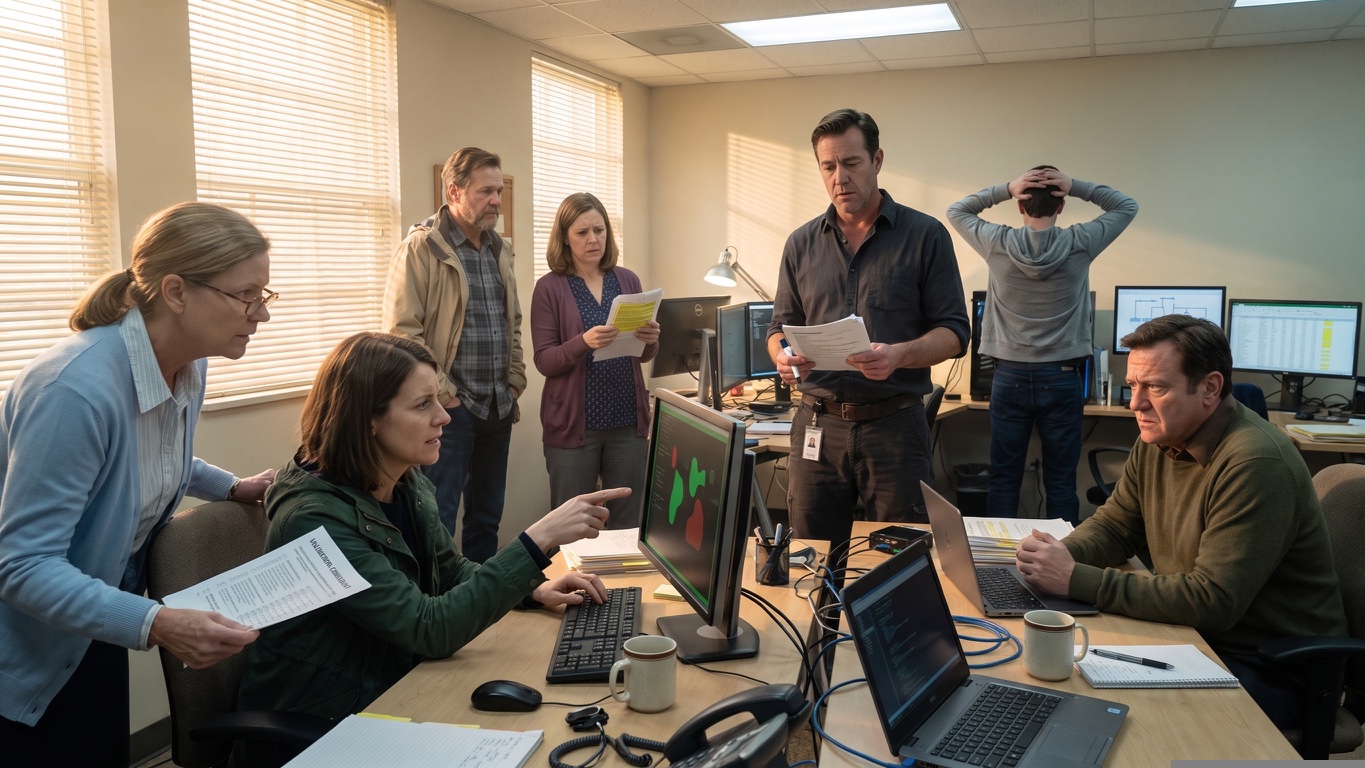
By Tuesday afternoon the formal workflow had already produced its first reliable output: interruption.
Olivia had spent twenty-three minutes trying to trace a failed validation path when Donna appeared beside her desk with the packet held to her chest like a church bulletin.
“I hate to interrupt,” Donna said, which was how office interruptions always announced themselves before proceeding to do exactly what they had apologized for. “Could you show me again how to run the comparison set for the municipal cases?”
Olivia closed her eyes for one beat too long and opened them into a version of herself suitable for work.
“Sure,” she said.
Donna sat in the spare chair with painful uprightness.
She had put on lipstick that morning in a shade slightly warmer than usual, as if the effort to remain professionally intact had extended to color palette. A small silver cross rested at her throat. Her hands smelled faintly of hand cream and paper.
Olivia typed the command.
The terminal populated with test names and output comparisons.
Donna leaned forward.
“And the red ones mean?”
“They mean mismatch,” Olivia said. “Either the implementation doesn’t match the documented expectation, or the documented expectation doesn’t match the historical output, or the historical output itself contains legacy behavior we need to decide whether to preserve.”
Donna stared at the screen as if the sentence had too many doors in it.
“So which is it here?”
Olivia pointed to the diff.
“This one says the documented rule expects the municipal carry-forward to reset after correction, but the output we’re comparing against doesn’t reset in the historical sample.”
Donna frowned.
“Then shouldn’t the expected result be changed?”
“Maybe,” Olivia said. “Or maybe the historical sample is exactly the problem Ethan was surfacing. That’s why the rerun evidence mattered.”
Donna’s face closed slightly at Ethan’s name, not in anger but in the involuntary way people reacted to a fact they had already helped exile and did not want brought back into the room as standard.
“Right,” she said. “Well. How do I know which one to select on the checklist?”
Olivia looked at the validation form Derek had introduced Monday morning.
Approve. Requires Revision. Needs Escalation.
Three boxes where the actual work should have been.
“You don’t,” Olivia said before she could stop herself. Then, seeing Donna flinch: “I mean, not from the checklist. The checklist doesn’t contain the evidence. It only records that someone felt something about the evidence.”
Donna held the pen tighter.
She had not come over here to be humiliated. She had come because the new workflow said validation belonged to her, and she was trying in the earnest, frightened way she tried most things. The problem was that the workflow had assigned her a task the language of the packet could describe without granting her the tooling or confidence to perform it.
“Can you show me again what the diff is comparing?” she asked.
Across the room, Sharon was standing over Ryan’s shoulder with a printout whose edges had already softened from repeated handling.
“This output says the nonresident withholding is being capped differently from the packet,” she said.
“Because the packet says ‘special care should be taken in historical reciprocity situations,’” Ryan said. “That isn’t a rule. That’s a warning label.”
Sharon drew herself up.
“It’s context.”
“Context is useful if it narrows the implementation space,” Ryan said, trying and failing to keep acid out of his voice. “This expands it infinitely.”
Nathan looked up from his own desk where he had been trying to translate page eleven of Linda’s packet into anything that could survive a compiler.
Page eleven contained four paragraphs on local annexation edge conditions, two sentences that sounded rule-like until they contradicted each other, and a footnote telling development to be careful not to overfit visible scenarios.
Be careful not to overfit visible scenarios.
The wording was so elegant Nathan almost admired it.
It transformed the entire concept of test-driven verification into a moral risk.
Caleb had stopped pretending not to be angry about an hour earlier.
He stood by the whiteboard, staring at the new task board Derek had asked them to maintain.
REQ-08.14 Municipal carry-forward implementation pending SME clarification. REQ-08.15 Reciprocal edge behavior awaiting escalation review. REQ-08.16 Historical exception validation incomplete.
Everything had become pending.
“This isn’t a workflow,” Caleb said. “It’s a hostage situation with stationery.”
Nathan should have told him to lower the temperature.
Instead he said, “Less poetry. More branch analysis.”
But there was no conviction in it.
Marcus sat at his desk with the packet open, trying to reconcile Donna’s checklist, the historical output file, and the actual code path Ryan had stubbed out that morning. His face had the strained stillness of a man calculating three disasters simultaneously and not knowing which one would arrive first.
He had not spoken much all day.
That was not unusual.
What was unusual was the speed with which his mouse hand kept pausing over nothing, as if his body had already figured out before his mind did that there was no clean next step available.
Nathan walked over.
“What are you stuck on?”
Marcus looked up.
“I can implement the packet if we decide the packet is law,” he said quietly. “I can implement the historical output if we decide history is law. I can implement the branch behavior if we decide the running logic is law. What I can’t do is implement all three when they’re disagreeing and the new process says the people who have to resolve the disagreement need us to explain the disagreement before they’ll resolve it.”
Nathan closed his eyes for a second.
That was the loop exactly.
The new workflow had not clarified responsibility.
It had formalized the company’s oldest trick: giving judgment to the people least willing to own it, then treating their hesitation as the reason everyone else had to wait.
Donna was still beside Olivia, working carefully through a second run.
“This one says ‘exit code 1,’” she said. “That’s bad?”
Olivia laughed once despite herself.
“Yes. Generally.”
“Can you show me again why?”
The request was so nakedly sincere that Olivia felt her irritation buckle under it.
Donna was not a tyrant. Donna was a middle-aged woman with a son in braces and an ex-husband late on support payments trying to validate a software process she had never been trained to use because Graham and Derek had confused moral seniority with technical readiness.
That did not make the situation less destructive.
It only made it sadder.
By 3:27, the entire room had become a teaching hospital for a workflow nobody believed in.
Ryan explaining diffs.
Olivia explaining exit codes.
Nathan explaining why a requirement sentence that began with depending on historical practice could not be converted directly into deterministic behavior.
Caleb editing code in ten-minute scraps between interruptions.
Marcus quietly renaming files and preserving comparisons because even when systems became absurd, someone still had to keep the evidence from being misplaced.
And on the far wall, Ethan’s old categories had been erased.
In their place Derek had taped up a laminated sign-off sheet with columns for requirement ID, development owner, SME validator, status, and escalation notes.
It looked official enough to make failure feel premature.
That was its achievement.
🎭 This Week's Episodes
Telenovelas show what we can't say in client meetings. The drama is heightened, but the patterns are real.
 Stefan's Progress, Klaus's Report
Stefan turns one working radio fix into momentum across climate control and navigation: test first, flash fast, prove it on real hardware. Then Kla...
 The Scattered — Part One
The collapse of Whitaker Payroll means something different in every household it touches. Olivia Parker and Ryan Mitchell step into sane new jobs w...
Technical Consultancy
Embedded Delivery Partner
Embedded into your team as an active contributor, reducing delivery friction and helping important work move cleanly.
Technical Advisor
Peer-style technical assessments before far-reaching decisions; reduce architectural and product risk early.
Product & Delivery
Ship working software to real users earlier. Measure impact and adapt based on evidence rather than assumption.
Custom Software Development
High quality, maintainable software. Short-term augmentation that leaves lasting capability in your own team.
Recent Articles
- What an AI Agent Actually Is (21.09.2026)
- The LLM Will Not Come Back Tomorrow (19.09.2026)
- The One-Person AI Company Is a Greed Fantasy (15.09.2026)
- Test Production Without Leaving a Mess (10.09.2026)
- Software Will Fail. Recovery Is the Real Metric (05.09.2026)