Continuous Delivery Is Not a Tool
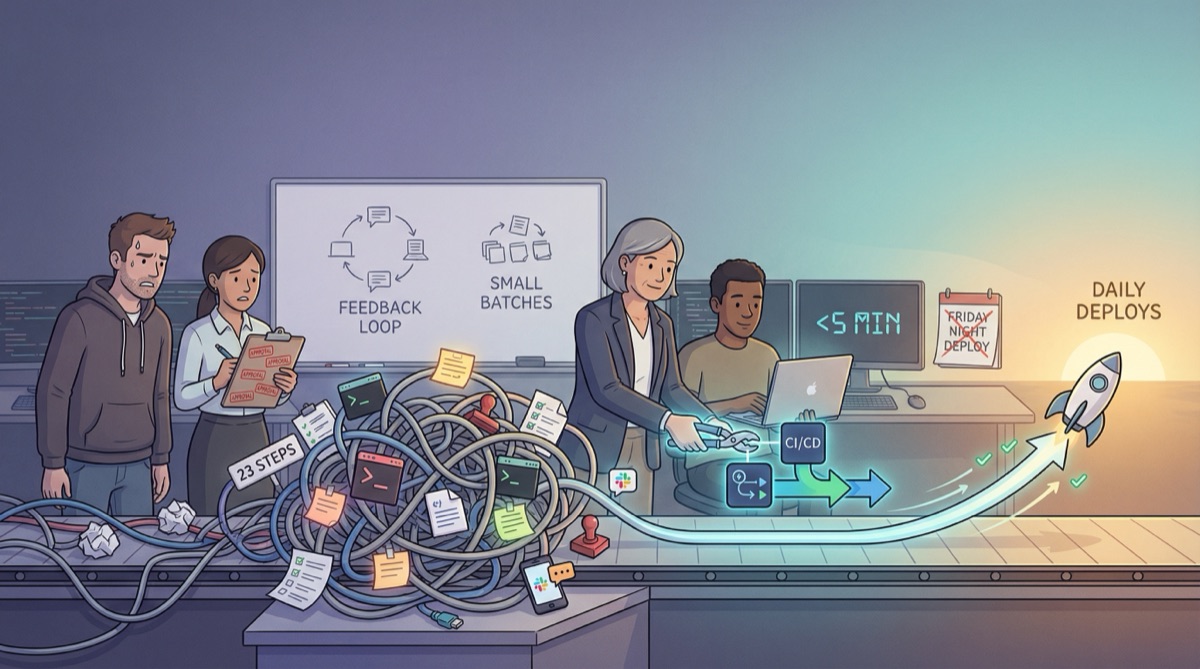
Continuous delivery is what you get when a team can merge small changes into main, run automated checks quickly, and deploy without ceremony. No heroics. No release weekend. No approval theater.
Tools can help, but tools do not create the capability. Capability comes from tight feedback loops and a pipeline the whole team trusts.
The Minimum Technical Bar
Continuous delivery fails for predictable reasons. Before you argue about Kubernetes, you need these basics:
- One shared mainline: most work lands on
mainin small increments. - Fast automated checks: tests run in minutes, not hours.
- A deployment pipeline that is boring: the same steps, every time, fully automated.
- A safe rollback story: if something slips through, recovery is quick and practiced.
If any of these are missing, deployment becomes scary. When deployment is scary, people batch changes. When people batch changes, everything gets worse.
A Practical Implementation Sequence
You do not implement continuous delivery by declaring it. You implement it by removing one constraint at a time, in an order that builds confidence.
1) Make Integration Cheap
- Reduce long-lived branches.
- Stop treating pull requests as a control mechanism.
- Use reviews to share context, not to create queues.
2) Make Tests a Feedback Loop
- Keep the default pipeline fast enough that developers actually wait for it.
- Split slow suites. Kill flaky tests. Fix the top sources of noise.
- Prefer tests that explain failure in one screen.
3) Automate the Delivery Path
- Turn the deployment procedure into a pipeline.
- Remove manual steps instead of documenting them.
- Make “what got deployed” and “why did it deploy” obvious.
4) Make Deployment Safe
- Use feature flags when incomplete work must ship.
- Practice rolling back and forward.
- Measure and alert on the handful of runtime signals that prove the release is healthy.
5) Raise Frequency by Shrinking Batch Size
Deploying daily is not a moral virtue. It is a side effect of small changes and a system that makes small changes safe.
Articles: The Building Blocks
These pieces cover the mechanics and the habits that make continuous delivery real.
- Continuous Integration
CI is the foundation. Without it, “continuous delivery” is marketing language stapled onto a fragile release process. - The Engine of Predictable Software Delivery
A practical mental model for why delivery becomes predictable only when the pipeline becomes the primary system, not a side project. - Cypress Beyond Testing: Executable Demos for Your Pipeline
Tests can do more than catch bugs. They can prove, repeatedly, that key user flows still work. - Kubernetes for the Rest of Us: Starting Small with K3s
Infrastructure matters, but only after you have the basics. Start small and keep the operational surface area honest. - Pull Requests Were Never Meant for Your Team
A blunt look at why review queues quietly destroy flow, and what to do instead when you care about integration speed.
Common Traps
Buying a CI/CD tool and calling it done
Teams end up with a fancy UI and the same old bottlenecks. The pipeline becomes a new single point of failure. People learn to ignore it.
Keeping manual gates next to automated checks
If the pipeline passes, but a human still must “approve,” you have not removed risk. You have only added delay.
Treating “deploy to production” as a special ritual
The safest deployments are the ones you do all the time. Scarcity creates drama. Drama creates fear.
Related Topics
-
Why Can’t We Deploy More Frequently?
How deployment friction accumulates, and why it blocks change. -
Why Is Software Delivery Slow?
Slow delivery is rarely a single bottleneck. It is a system. -
Software Delivery Is Unpredictable: What to Do
If shipping feels like gambling, start with signals and feedback loops.
Ready to Make Shipping Boring?
Continuous delivery is built through real work: shrinking batch size, shortening feedback loops, and removing steps that exist only because nobody trusts the system.
Schedule a 30-minute conversation if you want a fast assessment of where your delivery path is stuck and what would unblock it.
🎭 This Week's Episodes
Telenovelas show what we can't say in client meetings. The drama is heightened, but the patterns are real.
 Documentation Avalanche
The forty-seven questions from Passau become a daily occupation. Stefan finds a gap the navigation team cannot investigate without Marcus's approva...
Technical Consultancy
Embedded Delivery Partner
Embedded into your team as an active contributor, reducing delivery friction and helping important work move cleanly.
Technical Advisor
Peer-style technical assessments before far-reaching decisions; reduce architectural and product risk early.
Product & Delivery
Ship working software to real users earlier. Measure impact and adapt based on evidence rather than assumption.
Custom Software Development
High quality, maintainable software. Short-term augmentation that leaves lasting capability in your own team.
Recent Articles
- What the Last 20% of an AI-Built SaaS Looks Like (17.10.2026)
- AI Computer Use Is Not a Business Contract (09.10.2026)
- When Everything Is Finally Under Control (05.10.2026)
- AI Makes Technical Execution Cheap. Judgment Stays Scarce. (26.09.2026)
- The Agent Escaped. Who Left the Door Open? (24.09.2026)