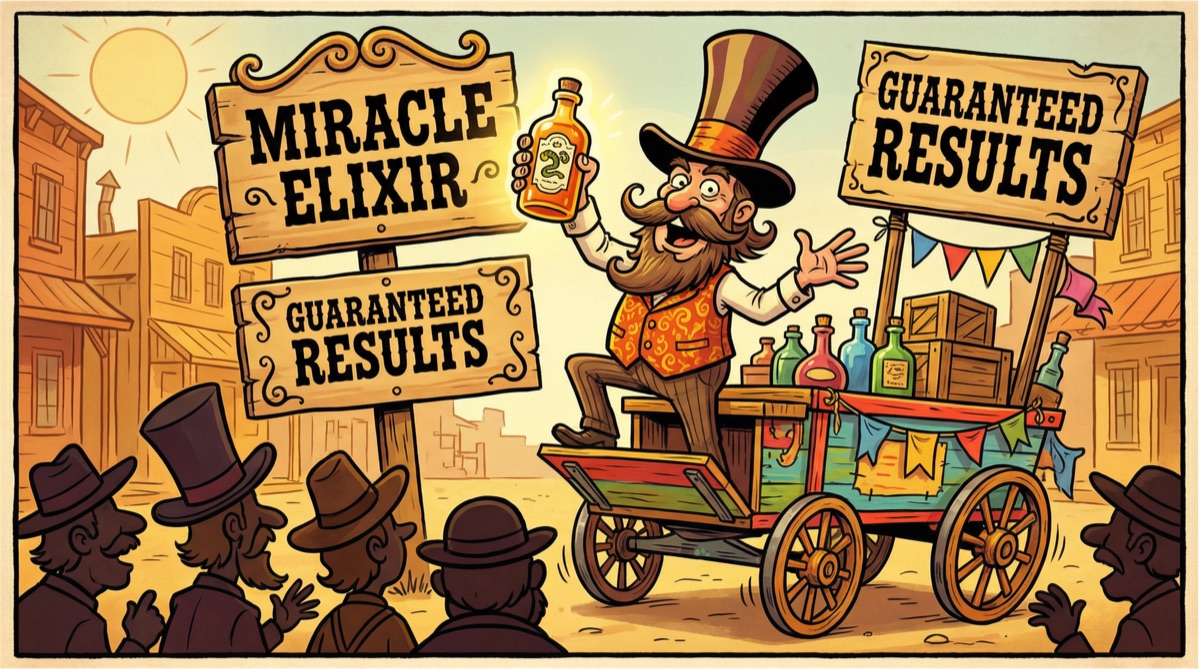
Management Frameworks and the Proximity to Snake Oil
Many management frameworks operate close to the snake oil line — selling beliefs and process models rather than verif...
5 min read
01.06.2026, By Stephan Schwab

The mistake is not hiring consultants. The mistake is expecting the same person to align stakeholders, improve execution, stabilize how changes go live, clean up ownership, and turn AI ambition into daily working practice. Those are different jobs. Some consultants are valuable because they stay above the operating mess. Hands-on experts are valuable because they step into it. That applies whether your company sells software, runs internal platforms, or depends on a knot of custom systems and vendor integrations. CTOs get burned when they pay for one and quietly expect the other.
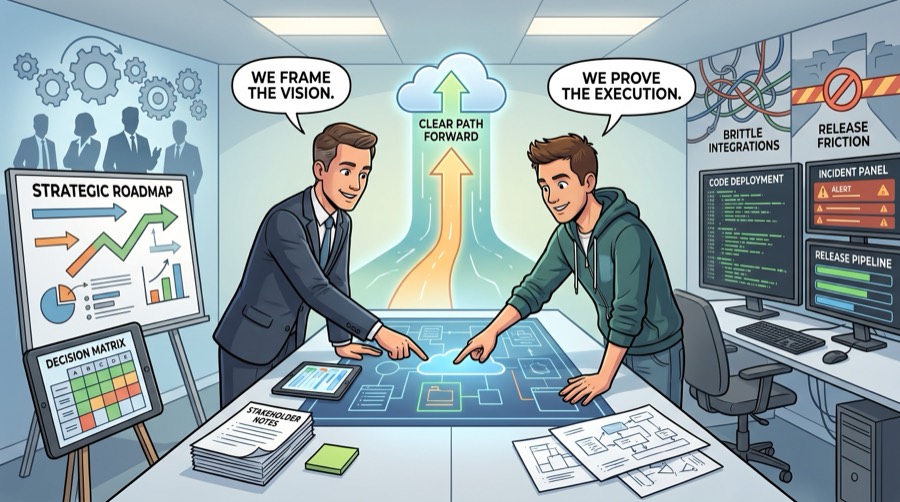
A good consultant is useful when the problem is political, structural, or strategic.
They can bring an external benchmark that cuts through local mythology. They can package a difficult message so a board, CEO, or investor group actually hears it. They can force decisions that have been politely avoided for months. They can map a portfolio, challenge a vendor story, or show where the organization is lying to itself.
That is real value. It is just not the same value as changing how technology work gets done inside the business.
If the work is mostly about priority, governance, funding logic, executive alignment, or choosing between competing paths, a consultant may be exactly the right hire.
A hands-on expert is useful when the problem sits inside the actual flow of work.
By hands-on expert, I mean someone close enough to the system to work inside it, not just talk about it from the conference room.
That means changes take too long to move. Releases are brittle. Teams depend on too many approvals. Ownership is blurred. The architecture turns every change into a small archaeological dig. Integrations fail in predictable places. The AI initiative looks impressive in slides and invisible in daily work.
Hands-on experts do not mainly sell interpretation. They trace friction to concrete causes and remove some of it. They make the path to production more reliable. They clarify ownership. They reduce handoffs. They help teams build practices that survive after the workshop glow wears off.
That is why hands-on experts can feel inconvenient. They make the conversation less theatrical and more testable.
The expensive mistake is not hiring consultants. The expensive mistake is hiring consultant-shaped help for hands-on problems.
If getting changes live is chaotic, another alignment deck is not a rescue plan. If your ERP or platform migration is stuck, a maturity model is not movement. If your internal teams and vendors cannot deliver changes without drama, a facilitation expert does not magically become the person who fixes how the work runs.
This is where many technology organizations drift into the kind of abstraction theater behind management frameworks and snake oil. Nobody is technically lying. The work is just happening one layer above the place where the pain is produced.
A consultant is often the right choice when:
That is not second-class work. It is just different work.
A hands-on expert is usually the right choice when:
Those are not messaging problems. They are operating problems.
The strongest outside help often combines both roles without pretending they are the same.
A serious consultant knows when the work now needs a hands-on expert. A serious hands-on expert knows when executive alignment, board language, or political air cover has to happen first. The healthy pattern is not territorial. It is complementary.
That matters for firms like ours too. Sometimes the right consultant creates the conditions for hands-on work to land. Sometimes the hands-on expert exposes facts that let the consultant drive a cleaner leadership decision. That is collaboration. The problem is only when one role gets dressed up as the other.
If you are evaluating outside help, ask questions that force the distinction into the open.
Weak advisors hate those questions because they collapse ambiguity. Strong ones answer them without flinching.
The grown-up position is not anti-consultant. It is anti-category error.
Consultants can be valuable. Hands-on experts can be valuable. Some firms can do both. The only part worth fighting is the lazy fiction that they all create the same kind of progress.
If you need executive clarity, buy that. If you need system change, buy that. If you need both, make the handoff explicit.
Anything else is how organizations spend six figures learning that slides do not unjam a release process, an ERP rollout, or the integration chain behind it.
Tell me what is happening. I listen, ask a few practical questions, and reflect back what I see: where the risk may sit, what may be blocking delivery, and what looks worth checking next. No pitch, no obligation. Confidential and direct.
Talk it through. Practical reflection, no pitch.
Start a ConversationTelenovelas show what we can't say in client meetings. The drama is heightened, but the patterns are real.
 Documentation Avalanche
The forty-seven questions from Passau become a daily occupation. Stefan finds a gap the navigation team cannot investigate without Marcus's approva...
Embedded into your team as an active contributor, reducing delivery friction and helping important work move cleanly.
Peer-style technical assessments before far-reaching decisions; reduce architectural and product risk early.
Ship working software to real users earlier. Measure impact and adapt based on evidence rather than assumption.
High quality, maintainable software. Short-term augmentation that leaves lasting capability in your own team.
We make delivery visible
Caimito Navigator turns your team's daily observations into compact, actionable summaries for leadership. Patterns, blockers, capacity, and momentum at a glance.