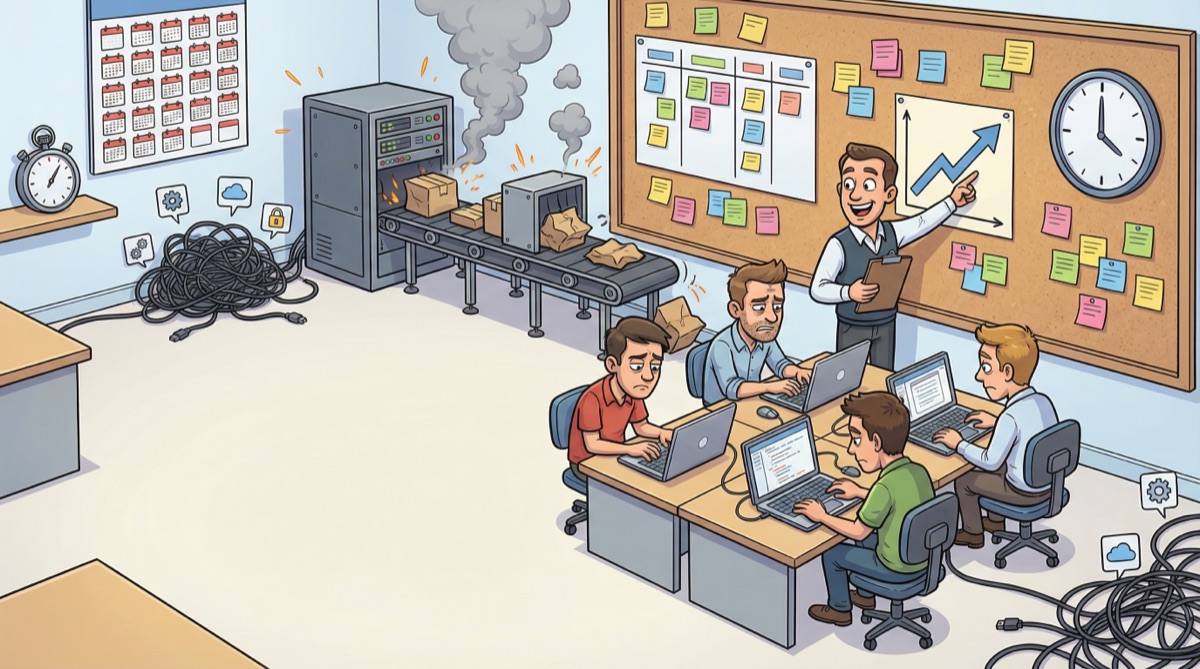
Your Teams Do Scrum. Delivery Still Hurts.
Your sprint planning runs like clockwork. Daily standups happen at 09:15 sharp. Retrospectives produce sticky notes. Velocity charts trend upward. The Scrum Master reports high ceremony compliance.
Features still take months to ship. Deployment remains a weekend ordeal. Technical debt grows faster than your teams can contain it. The predictability Scrum promised never materialized.
You didn’t implement Scrum wrong. You implemented it faithfully. That’s the problem.
Scrum is a diagnostic lens. It reveals coordination failures, unclear requirements, and planning dysfunction. Useful for diagnosis. Useless as treatment. Your organization adopted the diagnosis as if it were a cure. Ceremonies became goals. Compliance became success. Actual delivery improvements got crowded out by process overhead.
How we fix this: A Caimito Embedded Delivery Partner joins your team as a senior technical contributor. Not to run ceremonies or coach process. To write code, automate your deployment pipeline, establish test-driven development through pairing, and transfer capability your team keeps permanently. The diagnosis Scrum provides becomes actionable because someone with production experience is fixing the actual problems.
What Scrum Actually Does to Your Organization
Scrum’s ceremonies are designed to surface problems. In practice, they create new ones.
Daily standups become status reports. The original intent was coordination: who needs help, what’s blocked. Within three months, standups become performance theater. Developers rehearse their updates to sound productive. Nobody admits they’re stuck because admitting that in front of management means scrutiny. The 15-minute meeting stretches to 25 minutes. Multiply by every team, every day. Thousands of developer-hours consumed by theater that blocks honest communication.
Sprint planning becomes estimation theater. Your teams spend hours estimating work in story points. Those estimates are fiction. Everyone knows it. Developers inflate estimates to create buffers. Product owners pressure estimates downward. The resulting numbers have no predictive value. But the ceremony happened, so leadership feels informed. Meanwhile, actual risks stay invisible because story points can’t capture “this module hasn’t been touched in three years and nobody understands it.”
Velocity becomes a weapon. Management wants predictability. Velocity seems to provide it: “Team Alpha delivers 42 story points per sprint.” Except velocity is trivially gameable. Split one story into three. Inflate point values. Count incomplete work. Teams learn to optimize the metric instead of optimizing delivery. Velocity goes up. Actual output doesn’t change. Leadership makes decisions based on fiction.
Retrospectives produce inaction. “What went well? What didn’t? What will we change?” Sticky notes accumulate. Action items get recorded. Nothing changes because the obstacles are organizational: fragile deployment pipelines, approval gates, cross-team dependencies, architecture decay. The retrospective format can’t fix these. It can only name them. Naming them repeatedly without fixing them breeds cynicism.
The Scrum Master becomes a ceremony administrator. The role was supposed to remove impediments. Instead, it becomes running meetings, updating boards, generating reports. Your Scrum Master can’t fix your deployment pipeline. Can’t refactor your architecture. Can’t eliminate your approval theater. They facilitate process. Your problems are technical. Facilitation doesn’t fix technical problems.
How we fix this: Replace ceremony administration with embedded technical practice. An Embedded Delivery Partner pairs with your developers to automate deployment (23 manual steps become one button). Refactors your slowest tests while teaching your team how to write faster ones (45-minute test suite down to 8 minutes). Ships actual features while doing all this. Your team learns through practice, not presentations. The impediments a Scrum Master can only name, an Embedded Delivery Partner actually removes.
Why This Is Your Problem
This isn’t a team-level issue. It’s a strategic one.
You’re paying for overhead that produces no capability. Add up the hours: sprint planning, daily standups, sprint review, retrospective, backlog refinement. That’s 15-20 hours per week per team consumed by ceremony. For a 10-team organization, that’s 150-200 hours weekly. Over a year, that’s the equivalent of 4-5 full-time developers doing nothing but sitting in meetings. What did you get for that investment? Velocity charts and ceremony compliance reports.
Your real problems stay invisible. Scrum’s metrics measure process adherence, not delivery capability. You know how many story points each team completed. You don’t know that deployments are fragile, that integration delays dominate the week, or that approval steps keep stalling releases. Scrum’s lens doesn’t show you these things. Caimito Navigator does, because it captures what developers actually experience daily: blockers, waiting time, deployment friction.
Developer talent walks out. Good developers want to ship code and see it used. Scrum traps them in estimation meetings and status rituals. They spend more time describing work than doing it. The best ones leave for organizations that let them write code. You’re left with developers who tolerate process overhead because they don’t have better options. That’s a talent death spiral.
Framework dependency replaces organizational learning. Each Scrum certification costs money. Each coach contract costs money. Each tool license costs money. And all of it creates dependency on external process rather than building internal capability. When the coaches leave, you have ceremony habits but no engineering improvements. The deployment pipeline is still fragile. The test suite still takes 45 minutes. The architecture still fights every feature change.
How we fix this: Caimito Navigator does not replace useful delivery metrics. It replaces Scrum’s fictional metric theater with qualitative analysis: where time actually goes, what blocks developers, which decisions are stalled, and where delivery friction keeps repeating. Weekly synthesis shows you patterns no velocity chart reveals. When a narrow DORA baseline helps, use it. Do not confuse that with KPI management. The Embedded Delivery Partner makes those invisible problems visible to you in business terms and fixes them alongside your team. When the engagement ends, your team owns the capability. No certification renewals. No coach contracts. No dependency.
What Scrum Promised vs. What You Got
| Scrum Promised | What You Got |
|---|---|
| Predictable delivery through sprints | Sprints that end with “carry-over” because work is inherently unpredictable |
| Transparency through ceremonies | Performative transparency where problems get named but never fixed |
| Continuous improvement through retros | Sticky notes on walls and action items nobody executes |
| Self-organizing teams | Teams organized around ceremony compliance, not delivery effectiveness |
| Working software every sprint | Demo-able software that isn’t production-ready because deployment is still manual and scary |
| Faster time to market | More meetings, same delivery speed, less time for actual development |
The gap between promise and reality isn’t your team’s fault. Scrum addresses coordination and planning. Your bottlenecks are technical: deployment friction, test suite reliability, integration delays, architecture decay. Scrum has nothing to say about any of these. Zero. It’s a coordination framework applied to an engineering problem.
How we fix this: The Embedded Delivery Partner closes the gap between what Scrum promised and what you actually need. Predictable delivery comes from automated pipelines, not sprint planning. Transparency comes from production data, not ceremony reports. Continuous improvement happens when someone refactors your architecture alongside your developers, not when sticky notes accumulate on a wall. Working software every sprint becomes real when deployment is a non-event, not a weekend ordeal.
Articles: Understanding Why Process Theater Fails
These articles examine why framework compliance doesn’t produce delivery improvement, and what does.
The Core Problem: Frameworks vs. Capability
- Management Frameworks Don't Fix Software Teams
Why process frameworks promise delivery improvement but produce ceremony compliance. The structural mismatch between coordination tools and engineering problems. - The Framework Adoption Lifecycle
The predictable trajectory from enthusiastic adoption through compliance theater to disillusionment. Every framework follows this pattern. Scrum is no exception. - What Happened to Agile?
How Agile's original focus on technical practices got replaced by Scrum's ceremony-centric approach, and why the certification industry accelerated the decay. - Management Frameworks and the Proximity to Snake Oil
The certification economy that sustains Scrum. When the business model depends on selling process, capability transfer becomes an anti-goal.
What Actually Improves Delivery
- The Engine of Predictable Software Delivery
Predictability comes from technical practices: automated testing, continuous integration, deployment pipelines. Not from sprint planning ceremonies. - Technical Practices That Drive Business Results
Test-driven development, trunk-based development, continuous deployment. These produce measurable business outcomes. Story points don't. - Frameworks vs. Visualization: Process or Insight?
The difference between Scrum's process roles and actual visibility into delivery reality. You need insight, not roles.
Why Developers Resist (And They’re Right To)
- We Don't Take Advice From Non-Developers
Scrum Masters who can't write code lack credibility with developers. Certification doesn't substitute for production experience. - Why Electricians Have Authority and Developers Don't
Would you ask an electrician to justify their wiring decisions in a sprint review? The absurdity of imposing process frameworks on skilled practitioners. - Intrinsic Motivation and Software Developers
How ceremony overhead destroys the autonomy and mastery that drive developer performance. Process compliance kills the thing you need most. - Reclaim Your Organization
Breaking free from methodology resellers who profit from your continued dependency on their process frameworks.
How we fix this: Reading about the problem is the first step. Fixing it requires someone who writes production code. An Embedded Delivery Partner brings decades of hands-on experience to your team. Not theory. Not slides. Actual technical practice: test-driven development, trunk-based development, continuous deployment. The credibility developers demand because the person teaching them can do the work.
Telenovela Episodes: Process Theater in Action
These episodes dramatize what Scrum dysfunction looks like from inside. Fiction, but recognizable.
Código del Destino: Framework Consultant Destroys a Team
Bruno Cavalcanti arrives with his “Cavalcanti Framework for Operational Excellence.” What follows is a textbook case of process theater consuming a development team.
- Episode 3: El Consultor
The consultant arrives. Daily Accountability Sessions. Rigid timelines. Mandatory status reports. A developer gets humiliated for being 8 minutes late. Sound familiar? - Episode 4: Secretos y Mentiras
Phase Two: mandatory 15-minute time tracking. A developer gets fired for "insufficient compliance" while actively debugging a production crash. The framework doesn't care about context. - Episode 5: Al Borde del Abismo
Developers fired for low velocity and story points. Performance improvement plans based on framework metrics, not delivery results. The human cost of process theater. - Episode 8: El Juicio
The reckoning. Real metrics vs. framework theater: 312% overhead per development task. Negative 47% net productivity. The consultant gets fired. The damage remains.
More episodes: Código del Destino — All Episodes
Código de Fuego y Estrellas: QuantumFlow and the Ceremony Industrial Complex
Set on an alien world in 2130, this sci-fi series proves that process theater transcends time and space. Drakos Methodius sells “QuantumFlow” with “Daily Quantum Standups” and “Quantum Velocity Index.”
-
Episode 2: El Vendedor de Estrellas
Publishes on May 26, 2130. Come back then.
The charming framework vendor arrives with QuantumFlow. "Daily Quantum Standups." "Monthly Alignment Ceremonies." "Quantum Velocity Index." Lúcio calls it out: "Frameworks don't write tests. Ceremonies don't fix code."
More episodes: Código de Fuego y Estrellas — All Episodes
Signal Through Noise: When Process Masks Reality
A game studio trapped in crunch discovers that Scrum ceremonies were hiding problems instead of solving them.
- Episode 1: The Crunch That Never Ends
Features jammed into overloaded sprints. Decisions based on gut feelings instead of signals. The crunch never ends because the process hides capacity reality. - Episode 10: The Technical Debt Reckoning
Bug reports marked "future sprint" that never get scheduled. A 2-sprint estimate becomes 6. Board pressure vs. technical reality. Velocity fiction meets production truth. - Episode 16: The Code Review That Isn't a Review
"Approval without understanding is just ceremony." Four-minute code reviews. Emoji approvals. Review process exists. Reviews don't.
More episodes: Signal Through Noise — All Episodes
How we fix this: These stories are fiction, but the dysfunction is real. An Embedded Delivery Partner embeds in your team for 3 to 6 months. Weeks 1-2: joins the team, reads the code, identifies bottlenecks. Weeks 3-12: builds features, automates deployment, establishes testing practices through daily pairing. Your team gains skills through shared work. By month 4, your developers automate processes, write reliable tests, and deploy without drama. Navigator’s ongoing reports confirm whether the improvements persist after the engagement ends.
What to Do Instead
Stop optimizing a coordination framework for engineering problems. Do this instead:
Measure what matters, not what Scrum measures. Deployment frequency. Lead time from commit to production. Defect escape rate. Actual time developers spend writing code vs. sitting in meetings. These tell you whether delivery is improving. Velocity and story points tell you nothing except how well your teams learned to game the system.
Fix the deployment pipeline. If deploying takes more than 15 minutes or requires manual steps, that’s your bottleneck. Not sprint planning quality. Not retrospective technique. The pipeline. Automate it. Make it reliable. Make deployment boring. Every Scrum ceremony in the world won’t help if your team is afraid to push code to production.
Replace ceremony with capability. Instead of a Scrum Master who facilitates meetings, get a senior developer who pairs with your team and transfers skills. Someone who automates the deployment pipeline alongside your people. Who establishes test-driven development by writing tests together, not presenting slides about testing strategy. Capability transfer through practice, not process adoption through training.
Get real visibility. Caimito Navigator captures daily work, blockers, waiting time, and delivery patterns. No story points. No velocity fiction. Real signals: “The same architecture decision is blocking multiple people.” “Integration delays dominate the week.” “Deployment friction keeps resurfacing in the same places.” That’s the visibility Scrum promises but can’t deliver because Scrum measures process, not reality.
Keep what works, drop what doesn’t. Maybe a brief daily sync is genuinely useful for your team. Keep it. Maybe the retrospective format produces actual improvements. Keep it. But drop everything that’s pure ceremony. Sprint planning that produces meaningful coordination? Worth the time. Sprint planning that produces fictional story point estimates? Waste.
How we fix this: You don’t have to figure this out alone. An Embedded Delivery Partner helps you separate what’s working from what’s theater. During the first two weeks embedded in your team, they identify exactly which ceremonies add value and which consume hours without result. Then they fix the technical bottlenecks that ceremonies were supposed to address but never could: fragile pipelines, slow tests, manual deployment, architectural decisions that nobody makes. Your team keeps the coordination habits that work and drops the rest.
Related Topics
-
Why Is Software Delivery Slow?
The broader pattern behind failed improvement efforts. Scrum is one symptom inside a larger delivery problem. -
Development Team Struggles with Delivery
When the symptoms go beyond Scrum. Technical debt, deployment friction, and the hidden obstacles. -
Why Can’t We Deploy More Frequently?
Deployment frequency reveals the gap between ceremony compliance and actual delivery capability. -
Corporate Culture Examples
Corporate culture shapes whether Scrum becomes genuine collaboration or performative compliance. -
Caimito Navigator
Daily logbooks and weekly synthesis replace Scrum theater with delivery reality.
Ready to Move Past Scrum Theater?
Scrum isn’t evil. Used as a diagnostic lens, it reveals real coordination problems. But most organizations don’t use it that way. They use it as a prescribed solution that generates ceremony overhead without fixing engineering problems.
Your teams need capability, not compliance. Automated pipelines, not sprint rituals. Fast tests, not velocity charts. Real visibility, not story point fiction.
Schedule a 30-minute conversation to discuss why Scrum isn’t improving your delivery and what embedded technical practice can actually change.
🎭 This Week's Episodes
Telenovelas show what we can't say in client meetings. The drama is heightened, but the patterns are real.
 Documentation Avalanche
The forty-seven questions from Passau become a daily occupation. Stefan finds a gap the navigation team cannot investigate without Marcus's approva...
Technical Consultancy
Embedded Delivery Partner
Embedded into your team as an active contributor, reducing delivery friction and helping important work move cleanly.
Technical Advisor
Peer-style technical assessments before far-reaching decisions; reduce architectural and product risk early.
Product & Delivery
Ship working software to real users earlier. Measure impact and adapt based on evidence rather than assumption.
Custom Software Development
High quality, maintainable software. Short-term augmentation that leaves lasting capability in your own team.
Recent Articles
- A Useful AI Model Can Still Carry a Backdoor (20.10.2026)
- What the Last 20% of an AI-Built SaaS Looks Like (17.10.2026)
- AI Computer Use Is Not a Business Contract (09.10.2026)
- When Everything Is Finally Under Control (05.10.2026)
- AI Makes Technical Execution Cheap. Judgment Stays Scarce. (26.09.2026)