Fantasmas del Sprint
The emergency board meeting convenes, but Alejo arrives prepared with a counter-attack that threatens to unravel everything. As accusations fly, a series of flashbacks reveal the truth of Diego's final months at FinPulso — the burnout, the impossible expectations, and the betrayals both personal and professional that drove him into the shadows. The team must confront their own complicity in creating the conditions that destroyed their best developer.
The Gathering Storm
FinPulso boardroom. 8:47 AM.
The boardroom has never felt smaller.
Don Hernando sits at the head of the table, his weathered hands flat on the mahogany surface. To his left, Sebastián clutches a folder of printed evidence — Isabella’s documentation, Stefan’s technical findings, screenshots of Alejo’s encrypted conversations with Marco.
To Don Hernando’s right, the chair is empty. Alejo hasn’t arrived.
On the wall-mounted screen, Mariana Ríos watches from São Paulo. Her video connection is crisp, her expression unreadable. She joined the call at exactly 8:30, asked no preliminary questions, and has been waiting in silence ever since.
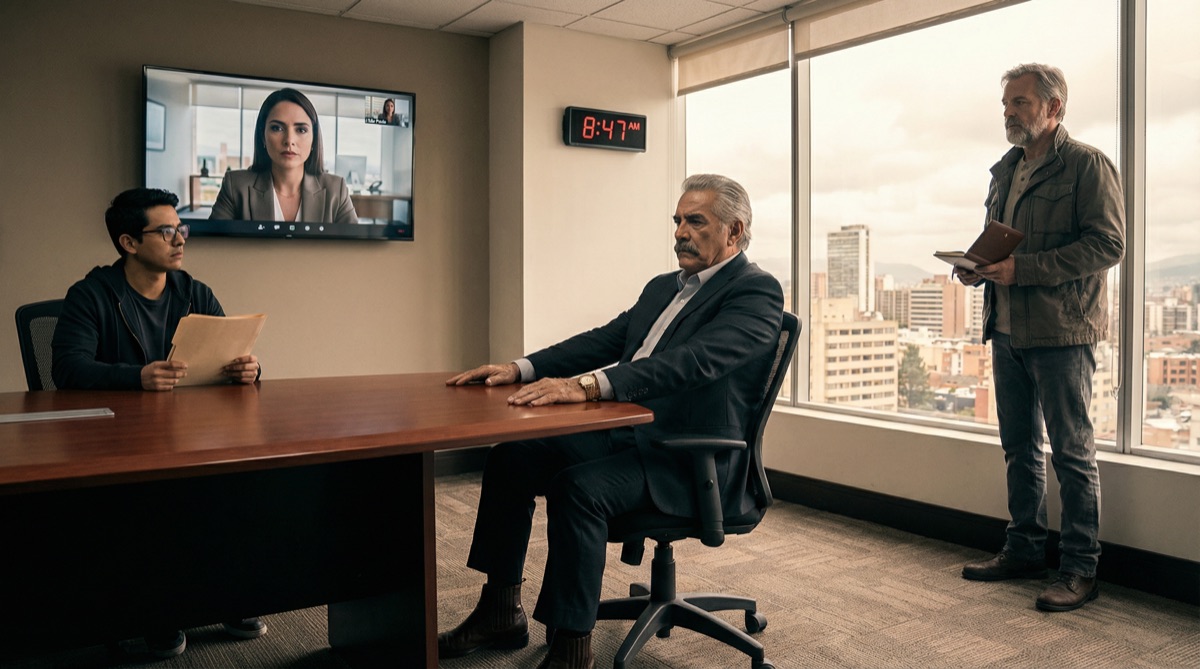
Stefan stands by the window, technically not invited but also not dismissed. He’s here as a witness — and possibly as protection.
“He’s late,” Sebastián says, breaking the silence.
“He’s calculating.” Don Hernando’s voice is flat. “Deciding which story to tell.”
The door opens.
Alejo enters wearing his most expensive suit — Italian, navy, perfectly tailored. His smile is bright and warm, completely disconnected from the tension in the room.
“My apologies for the delay. Traffic from Rosales was impossible.” He takes his seat, adjusting his cuffs. “Shall we begin?”
The Counter-Attack
Sebastián presents the evidence methodically, just as Stefan coached him the night before. The falsified metrics. The altered code. The term sheet with MiPago. The intercepted messages between Alejo and Marco.
Alejo listens without interrupting. His expression shifts from polite attention to studied concern to something that might be sorrow.
When Sebastián finishes, the silence stretches.
“May I respond?” Alejo’s voice is gentle, almost wounded.
“That’s why you’re here.” Don Hernando’s eyes are hard.
Alejo stands, straightening his jacket as if preparing for a pitch. “First, let me say that I understand why Sebastián believes what he believes. He’s been under tremendous pressure. We all have. And when people are stressed, they look for villains.”
He walks to the window, forcing Stefan to step aside.
“The metrics adjustment he mentioned? That was my attempt to correct a counting error that underreported our performance. I informed the board at the time that we were revising our methodology. Perhaps the communication wasn’t clear enough.”
“You multiplied transaction counts by 1.5,” Sebastián says. “That’s not a methodology revision.”
“It’s a weighted average that accounts for transaction value, not just volume. Standard practice in fintech reporting.” Alejo’s smile doesn’t waver. “I have the industry benchmarks if you’d like to review them.”
On the screen, Mariana leans forward. “And the term sheet with MiPago?”
“Exploratory. Preliminary. The kind of strategic conversation any responsible CFO should be having.” Alejo spreads his hands. “I never hid that I was exploring partnership opportunities. The board authorized me to assess strategic options.”
“You authorized yourself,” Don Hernando says quietly.
“I informed you I was having conversations. You said, and I quote, ‘Handle it.’” Alejo turns to face the old man. “I was handling it. For you. For the company. For all of us.”
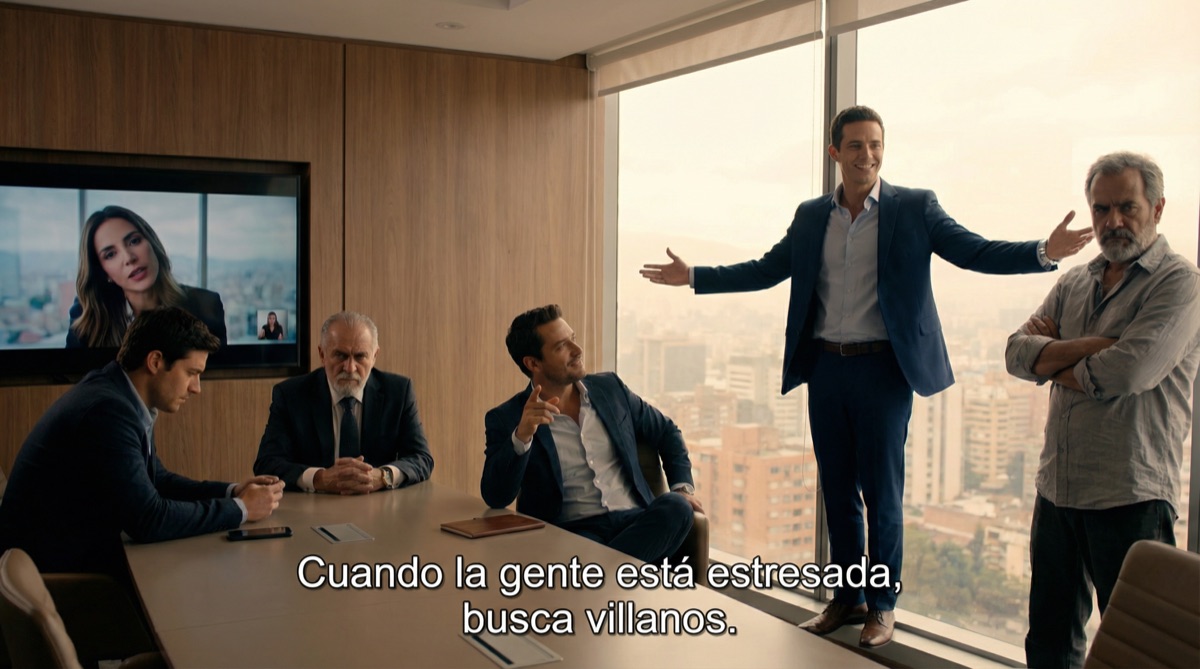
Stefan watches the performance with grim recognition. He’s seen this before — the confident reframing, the strategic partial truths, the way an experienced manipulator can make the accuser look like the aggressor.
“And the messages with Marco Benedetti?” Mariana asks. “Discussing timelines for the MiPago deal?”
Alejo’s smile tightens almost imperceptibly. “Where did you obtain those messages?”
“That’s not relevant—”
“It’s extremely relevant. If someone is intercepting private communications between board members and external consultants, that’s a serious breach.” He looks at Stefan. “Perhaps our German guest can explain his surveillance methods?”
Stefan says nothing.
“I see.” Alejo nods slowly, as if confirming a suspicion. “So this entire proceeding is based on illegally obtained evidence presented by an outside consultant with no authority and no accountability?” He turns to Mariana. “Is this how we conduct governance now?”
The Unsent Letter
Flashback: Four months earlier. Diego’s apartment, 2:37 AM.
Diego stares at the email draft on his screen. The subject line reads: I can’t do this anymore.
His desk is a disaster zone — energy drink cans, cold empanadas wrapped in paper, a stress ball he’s squeezed into misshapen oblivion. Three monitors display the production logs he’s been watching for eighteen hours straight.
The incident started at 8 PM the previous night. A payment processing error that affected 12,000 transactions. The kind of bug that shouldn’t have happened if anyone had listened to him about the technical debt three months ago.
But they didn’t listen. They never listen.
Sebastián (11 PM) Any update? The board is meeting tomorrow and I need to report the status.
Sebastián (11:47 PM) Diego?
Sebastián (12:22 AM) I know you're online. The error logs show you're still working.
Sebastián (1:15 AM) Please respond. Don Hernando is asking.
Diego ignored every message. He was too deep in the code, too focused on the fix that would save everyone’s reputation while destroying his nervous system.
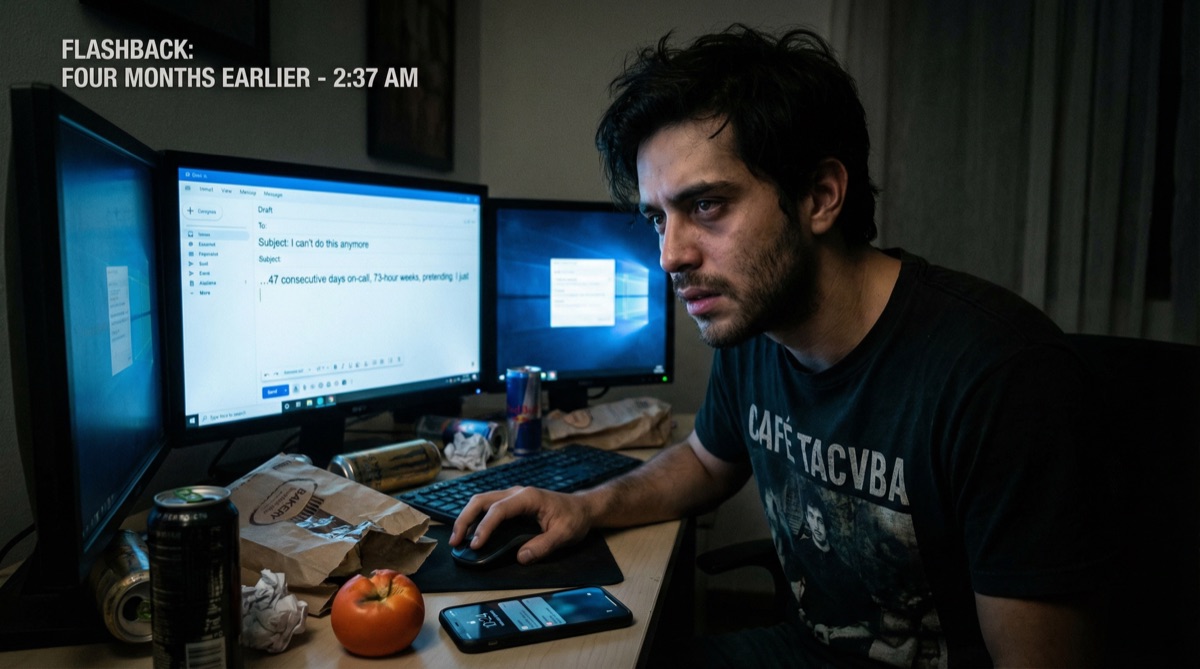
Now, at 2:37 AM, the immediate crisis is resolved. The fix is deployed. The transactions are reprocessing. By morning, it will look like nothing ever happened.
And Diego is writing his resignation letter.
I’m writing this at 2 AM, which is apparently when I do my most honest thinking.
This is the fourth production emergency this month. Each one was preventable. I documented the risks in my Technical Risk Assessment (attached again, in case you lost it). I begged for two weeks to add test coverage. I was told there was no time.
There’s never time for quality. There’s always time for emergencies.
I have been on-call for 47 consecutive days. My average weekly hours since September are 73. I have missed my mother’s birthday, my cousin’s wedding, and three appointments with a therapist I started seeing because I can’t sleep anymore.
But the worst part isn’t the hours. It’s the pretending.
Every sprint review, we demo features that don’t actually work. Every investor meeting, we show slides with numbers we know are inflated. Every board meeting, I watch Alejo present a version of reality that has no connection to what’s actually in production.
And everyone knows. Sebastián knows. Isabella knows. Even Don Hernando, in his gut, knows something is wrong. But no one says anything because saying something means admitting we’re in trouble.
I can’t pretend anymore.
I have attached evidence of specific discrepancies. I know this might be career suicide, but I’d rather be unemployed than complicit.
— Diego
He reads it three times. His finger hovers over the send button.
Then his phone buzzes. A message from Luciana.
Luciana Still at office? I'm at Marco's event. It's amazing. You should come.
Luciana Wait, are you still working? At this hour?
Diego Production issue. Fixed now.
Luciana You work too much, mi amor. Marco says your company doesn't appreciate you. He says in Europe developers are treated like artists.
Diego Marco says a lot of things.
Luciana He's actually really smart. You should talk to him sometime. He has ideas about how to fix your agile problems.
Diego I have to go. I'll call you tomorrow.
Luciana ❤️
Diego looks at the resignation letter. At the evidence he’s compiled. At the messages from Sebastián asking for status updates at midnight.
He selects all. He deletes.
Then he opens a new document and starts a fresh Technical Risk Assessment — the third one this quarter. The professional version. The one that says everything in language no one will understand, attached to emails no one will read.
He saves the draft of the resignation letter to a hidden folder. Insurance, he tells himself. For later.
The Debugging Nightmare
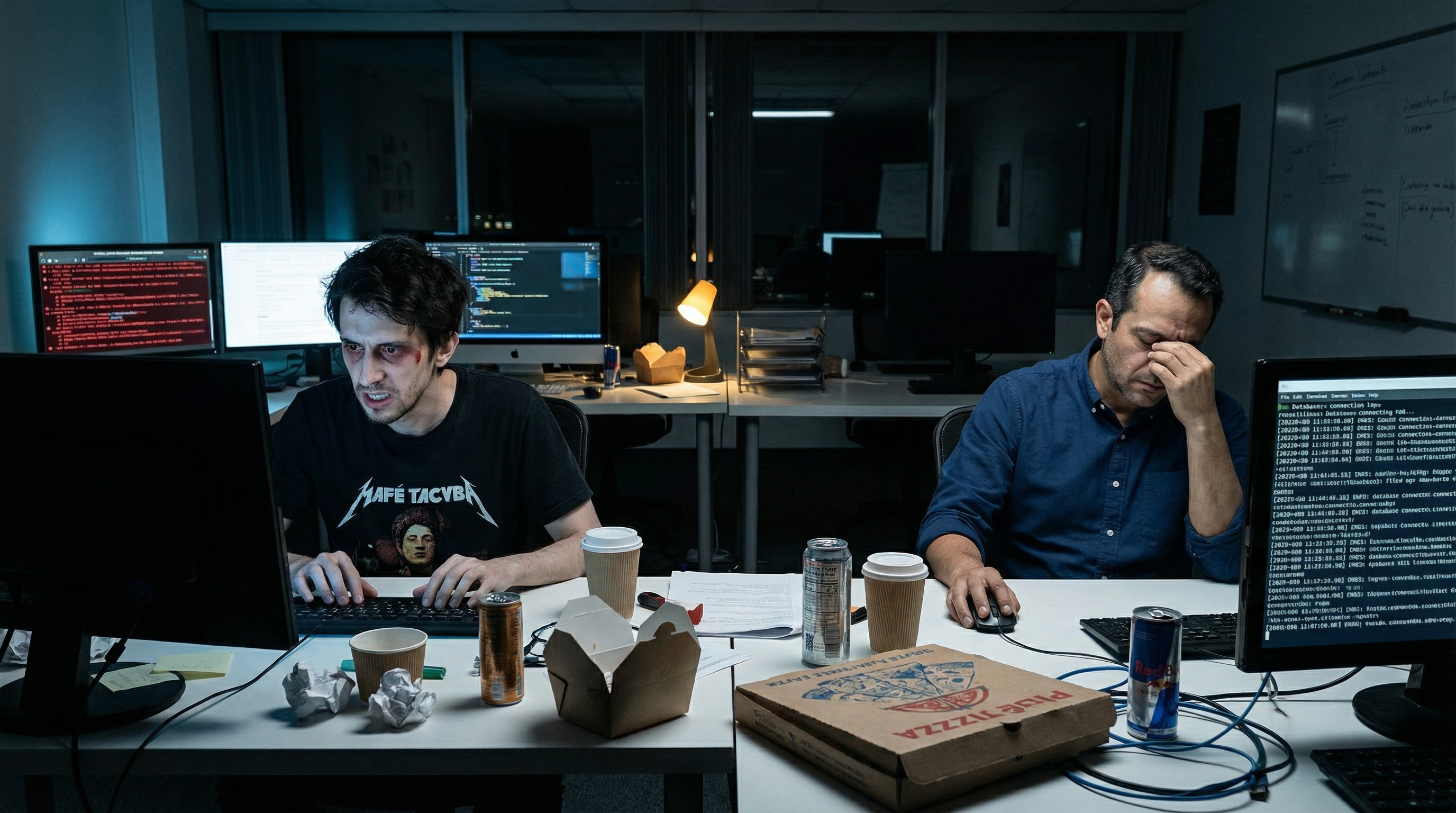
Flashback: Three months earlier. A late-night debugging session.
Diego stares at the error logs scrolling across his screen. It’s 1:47 AM, and the payment processing module has been throwing intermittent timeouts for three hours. The team deployed a “minor fix” yesterday afternoon — Sebastián called it “non-disruptive” — but now transactions are failing at random intervals.
Pipe is beside him, his face illuminated by the glow of his own monitor. At 44, Pipe has seen this before. Too many times.
“The connection pool is exhausted,” Pipe mutters. “Look at this — the queries aren’t releasing connections properly. We patched the auth module last week, but we didn’t test the integration.”
Diego traces the code path, his fingers flying over the keyboard. “The patch added a new validation step. It should be closing the connection, but…” He runs a test query. “It’s hanging. The database thinks the connection is still active.”
Pipe leans back, rubbing his eyes. “We need to rollback the patch. But Sebastián wants the auth feature live for tomorrow’s demo.”
“Demo or production? We can’t have both.” Diego’s voice is sharp, exhaustion making him blunt. “This isn’t sustainable. Every ‘minor fix’ breaks something else. We need proper testing, not duct-tape deployments.”
Pipe says nothing. He knows Diego is right. But he also knows the cycle — pressure from above, compromises from below, disasters in the middle of the night.
Diego pushes the fix live at 2:15 AM. The timeouts stop. The demo will work. For now.
But as he watches the green status indicators, he knows this is just another ghost in the machine. Another sprint that haunts the codebase.
The Pivoting Patriarch
Present day. The boardroom.
The argument has shifted. Alejo, sensing advantage, is now questioning the entire basis of the investigation.
“Let me understand,” he says, his voice dripping with reasonableness. “Stefan Richter — a contractor with no equity, no board seat, no formal authority — has been conducting surveillance on company executives. He’s been accessing production systems using credentials obtained from… where, exactly?”
Stefan’s face remains impassive.
“And based on this unauthorized surveillance, he and Sebastián have compiled a dossier of accusations against me — the CFO who has kept this company solvent through three near-death experiences.” Alejo shakes his head. “If anyone should be investigated, it’s not me.”
“The evidence speaks for itself,” Sebastián says, but his voice has lost its confidence.
“Evidence obtained illegally. Evidence interpreted by someone with a financial interest in finding problems.” Alejo turns to Don Hernando. “You brought me in because you wanted professional management. Real governance. And now, because I did my job too well — because I found efficiencies and built relationships and positioned us for growth — I’m being treated like a criminal.”
Don Hernando has been silent for five minutes. His face reveals nothing.
“Tell me about Jorge,” he says finally.
The question catches everyone off guard. Alejo’s smile flickers.
“I’m sorry?”
“My son. Jorge. You reminded me of him — that’s why I trusted you.” Don Hernando’s voice is soft, almost gentle. “But Jorge would never have hidden things from me. Jorge would never have positioned himself for personal gain at the family’s expense. Jorge would never have looked me in the eye and lied.”
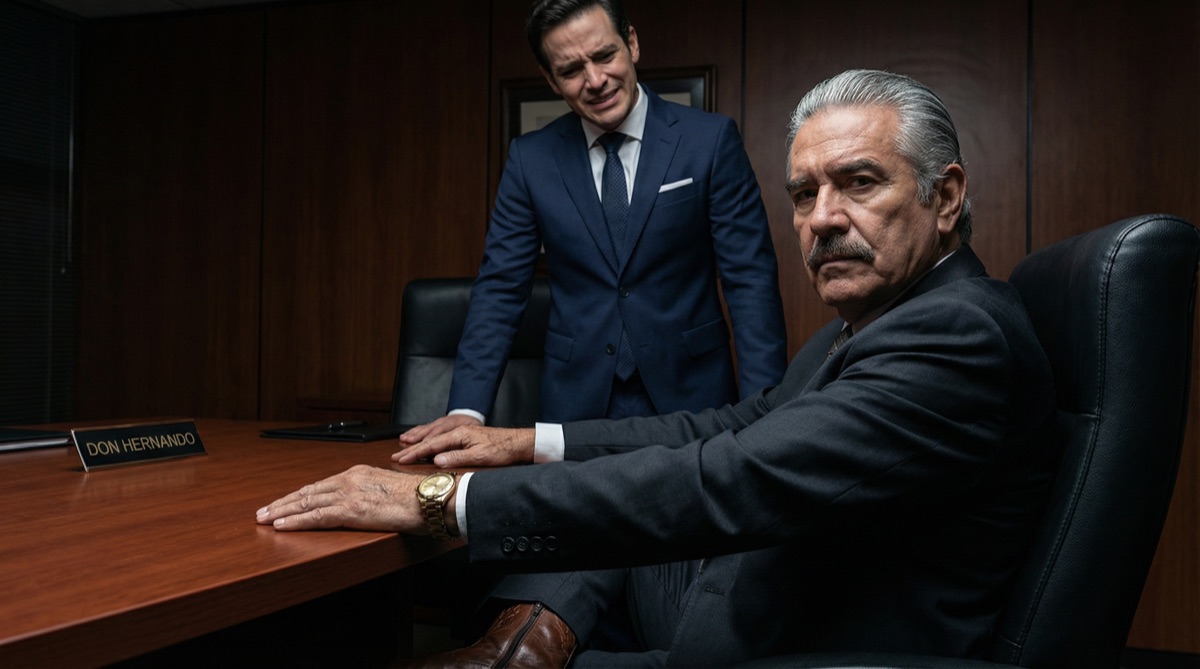
“With respect, Don Hernando, I’m not your son. And this comparison—”
“You’re right. You’re not my son.” The old man stands, slowly, his hands on the table. “My son was honest. Sometimes painfully so. He told me things I didn’t want to hear. He pushed back when I was wrong. He died before I could tell him I was proud of him.”
The room is very quiet.
“You told me what I wanted to hear. You made problems disappear before I knew they existed. You surrounded me with comfort and called it competence.” Don Hernando’s voice drops. “That’s not loyalty, Alejo. That’s manipulation.”
“I was protecting you—”
“You were protecting yourself.” Don Hernando picks up one of the printed screenshots — Alejo’s message to Marco about the MiPago timeline. “This is dated before you had any authorization to negotiate. Before we discussed strategic options. Before you ‘informed’ me of anything.”
Alejo’s composure cracks, just slightly. “That document is—”
“Real. Authentic. Incriminating.” Mariana’s voice cuts through from São Paulo. “I’ve had my team verify the metadata. It’s genuine.”
When They Still Had Each Other
Flashback: Five months earlier. Diego’s apartment, 2 AM.

Diego unlocked his apartment door as quietly as he could, laptop bag weighing down his shoulder. Another production emergency, another all-nighter. He was exhausted, wired on coffee, ready to collapse.
The lights were off, but he could see Luciana in their bed, her silhouette outlined by the city lights filtering through the window. She’d waited up — he could tell by the book on the nightstand, still open.
“Lo siento,” he whispered, setting down his bag. “Production issue. I texted but—”
“I know.” Her voice was soft, not angry. She sat up, sheet pooling around her waist. She was wearing his old conference t-shirt, the fabric thin and worn. “You’re here now.”
“I need to shower, I smell like—”
“I don’t care.” She reached for him, pulling him down to the bed. Her hands found the buttons of his shirt, working them open with practiced ease. “You work too hard, Diego.”
“The system was down, users were—”
“Shh.” She kissed him, silencing the excuses. Her lips were warm, familiar. Her hands pushed his shirt off his shoulders, traced the tension knotted in his back. “They can wait until morning. Right now, you’re mine.”
He kissed her back, letting the stress drain away. This was what mattered. This woman who knew him, who waited for him, who still wanted him even when he came home smelling of stale coffee and midnight panic.
They made love slowly, quietly, her body warm against his, her breath in his ear whispering his name. Afterward, she curled into him, her head on his chest.
“I miss you,” she murmured.
“I’m right here.”
“No. I miss you. The you who used to take me dancing. Who laughed. Who didn’t check his phone during dinner.” Her fingers traced patterns on his skin. “I’m losing you to that company.”
“It won’t always be like this. After the funding, after we stabilize—”
“There’s always an after.” She kissed his shoulder. “Just… don’t forget there’s a life outside the code. Don’t forget me.”
“Never,” he promised.
But he was already thinking about the deployment schedule. Already mentally reviewing the fix he’d just pushed. Already half-gone.
He didn’t notice when her hand stopped moving. Didn’t see the resignation in her eyes.
The Night Diego Saw
Flashback: Three months earlier. Andrés Carne de Res restaurant.
Diego didn’t want to come. Work dinners exhausted him — the forced camaraderie, the drinking he couldn’t keep up with, the endless small talk about things he didn’t care about.
But it was Sebastián’s birthday, and Luciana insisted.
“You never come out anymore,” she’d said that morning. “People are starting to talk.”
“Let them talk.”
“Diego.” She touched his face. “I love that you’re dedicated. But you need to live too. Just one night. For me.”
So he came. He dressed in his least-faded jeans and a shirt without band logos. He smiled when people made jokes he didn’t find funny. He nursed the same beer for two hours while watching Luciana dance to cumbia with Isabella and Laura.
She was beautiful. She was always beautiful. And lately, she’d seemed distant — distracted by something she wouldn’t name.
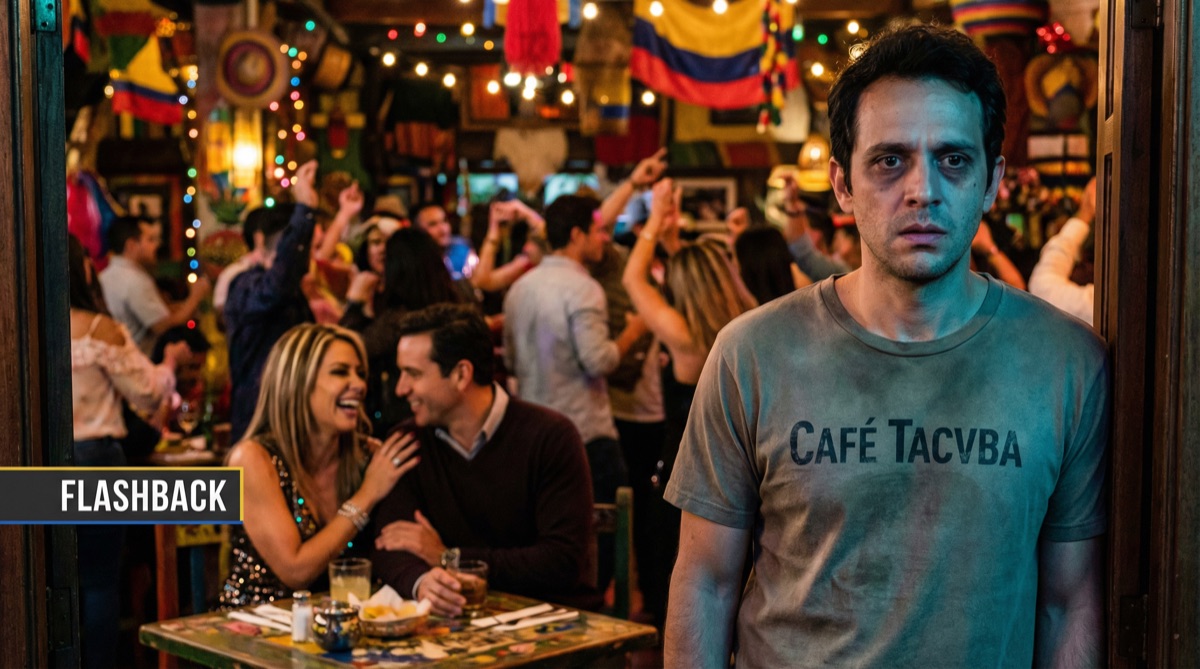
Around 11 PM, Diego stepped outside for air. The restaurant sprawled across multiple buildings, interconnected by paths lined with folk art and recycled sculptures. He wandered toward a quieter patio, away from the noise.
That’s when he saw them.

Luciana and Marco, pressed against the wall of a corner alcove designed for privacy. Marco’s hands were on her waist, pulling her close. Her fingers tangled in his hair. They were kissing — not the tentative brush of new lovers, but the desperate hunger of people who’d done this before.
Marco’s mouth moved to her neck. Luciana’s head tilted back, exposing her throat, a soft sound escaping her lips that Diego couldn’t hear but could imagine. Marco’s hands slid lower, possessive, and she arched into him.
The world went red.
Diego’s glass slipped from his fingers and shattered on the decorated concrete, but he didn’t hear it. Couldn’t hear anything over the roaring in his ears. His chest seized — a physical pain, like someone had reached in and squeezed his heart until it cracked. His stomach twisted, bile rising. He wanted to scream. He wanted to charge at them, rip Marco away, demand answers.
But his body wouldn’t move. He stood frozen, forced to watch his girlfriend — the woman he’d been planning to propose to, the woman he’d neglected while debugging at 3 AM — melt into another man’s arms.
Puta madre. All those late nights. All those “I’m just networking” excuses. All those times she said Marco was “just a colleague.” All those times she came home smelling different — perfume he hadn’t bought, wine he didn’t drink.
He’d been a fucking idiota. A blind, lovesick pendejo working himself to death while she was spreading her legs for a smooth-talking Italian parasite.
Marco noticed him first. He didn’t stop kissing Luciana’s neck, but his eyes met Diego’s over her shoulder. His expression shifted from surprise to something like amusement — the smug satisfaction of a man who’d won. He whispered something against Luciana’s skin, and she turned.
Her lipstick was smeared. Her dress was rumpled. Her hair fell loose from where Marco’s hands had pulled it free.
Their eyes met across twenty meters of decorated concrete.
Their eyes met across twenty meters of decorated concrete.

Diego watched Luciana’s face cycle through emotions — shock, guilt, fear. She stepped away from Marco, smoothing her dress with trembling hands. Her mouth opened, closed. No words came out.
She didn’t run to him. Didn’t try to explain. Just stood there, caught, looking small and guilty and utterly fucking selfish.
Marco smiled and raised his glass in a mock toast. The arrogance. The casual cruelty.
“Hijo de puta,” Diego breathed. His hands were shaking. His vision blurred with tears he refused to let fall. His entire body felt like it was vibrating, rage and heartbreak colliding until he couldn’t tell them apart.
He wanted to destroy something. Someone. But instead, he turned and walked away. Because what was the point? She’d made her choice. She’d been making it for weeks, probably months, while he was too fucking stupid to see.
Diego walked back inside. His legs felt like they belonged to someone else. He found Sebastián, who was too drunk to notice anything wrong. He said he wasn’t feeling well. He took a taxi home.
He didn’t cry. He was too fucking exhausted for tears. Too hollowed out. Instead, he sat in the dark of his apartment, bottle of aguardiente in his lap, thinking about all the late nights he’d spent fixing problems while Luciana was… where? In Marco’s bed? Laughing at him?
“Mierda,” he whispered to the empty room. “Mierda mierda mierda.”
At 3 AM, he opened the hidden folder with his unsent resignation letter. He read it again.
This time, he didn’t delete it. His hands were steady now — the cold steadiness of a man who had nothing left to lose. He added a new paragraph:
P.S. — The company culture that allows code fraud also allows personal betrayal. When you treat people as resources to be optimized rather than humans to be valued, you shouldn’t be surprised when they treat each other the same way.
I’m done being a resource.
He still didn’t send it. But he started building his exit — documenting everything, creating backups, installing the monitoring that would let him watch from outside.
Two weeks later, he stopped coming to the office.
The Verdict
Present day.
The board meeting has lasted three hours. Coffee has been ordered and ignored. Alejo has tried every defense — procedural objections, character attacks, threats of legal action.
None of it worked.
Mariana speaks first. “Based on the evidence presented, I’m calling for an immediate vote to remove Alejandro Vega as CFO and from the board of directors.”
“You don’t have authority to—”
“I represent 40% of this company’s equity, Mr. Vega. I have exactly the authority our shareholders’ agreement gives me.” Her voice is cold. “Don Hernando?”
The old man nods. “I vote in favor.”
“Sebastián?”
“In favor.”
“That’s a majority.” Mariana’s image on the screen doesn’t change, but there’s satisfaction in her voice. “Mr. Vega, your access to company systems will be revoked within the hour. You have 48 hours to collect personal belongings from your office. We’ll discuss severance terms through lawyers.”
Alejo is very still. When he speaks, his voice has lost its charm.
“You’re making a mistake. This company needs me more than you know. The relationships I’ve built, the investors I’ve cultivated—”
“Will be informed of the circumstances of your departure.” Mariana cuts him off. “I suggest you focus on your legal exposure rather than making threats.”

Alejo looks at each of them — Don Hernando, Sebastián, Stefan, the screen where Mariana watches.
“This isn’t over,” he says quietly. Then he walks out, his Italian shoes clicking on the floor.
The door closes behind him.
Don Hernando exhales slowly. “Now we rebuild.”
The Return
The next morning. FinPulso office.
The atmosphere is strange — equal parts relief and uncertainty. Word has spread that Alejo is gone, but no one knows the full story. Rumors multiply.
Stefan is at his usual corner desk when the elevator opens.
Diego walks in.
He looks different than the photos — thinner, his beard trimmed, dark circles still visible but somehow less pronounced. He carries a laptop bag over one shoulder and pauses at the entrance, taking in the office he hasn’t seen in three months.
Camila notices first. Her face lights up with something between surprise and joy. She half-rises from her desk, then catches herself, uncertain of the protocol.
Pipe looks up, his expression cycling from shock to suspicion to cautious hope.
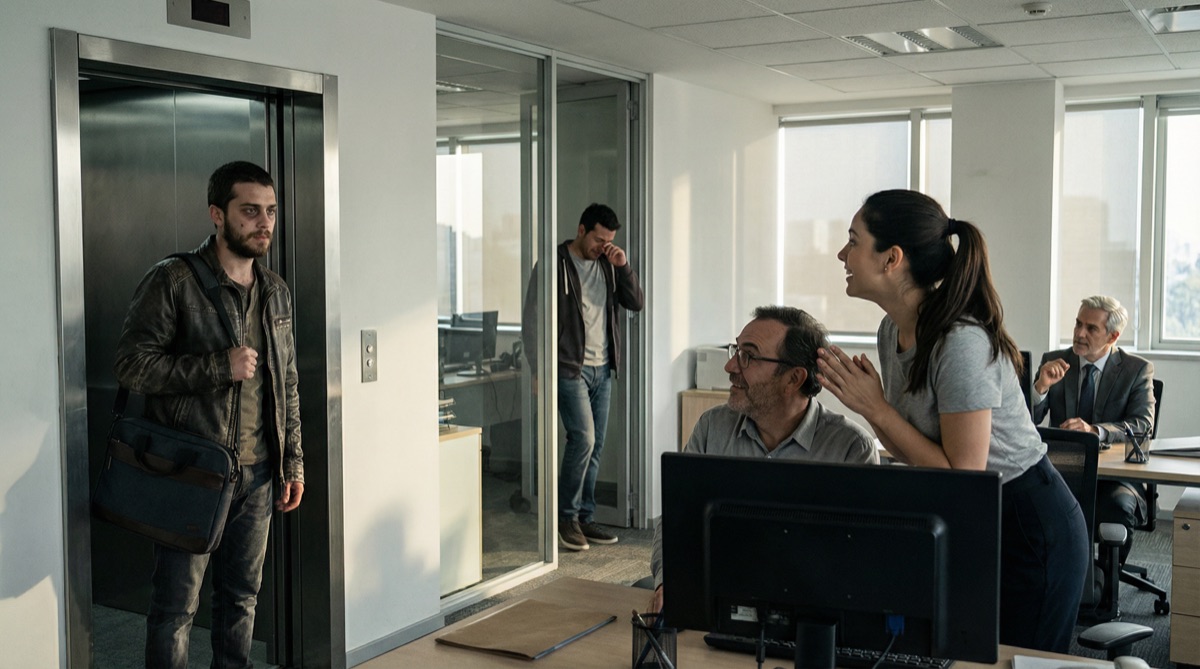
Sebastián emerges from his office. “Diego.” His voice cracks slightly. “You came.”
“You asked.” Diego walks toward the development area. “And Camila’s been sending me her code for review. Did you know she’s building a complete rebuild of the payment processing module?”
“I… no, I didn’t know that.”
“It’s better than what we have in production. Better architecture. Better tests. Better everything.” Diego sets his bag down at an empty desk. “I’m not back as an employee. Not yet. But Stefan and I talked, and I think I can help.”
Stefan nods once, a small acknowledgment.
“What do you need?” Sebastián asks.
“Coffee. A whiteboard. And an honest answer to one question.”
“Anything.”
Diego’s face is unreadable. “Why didn’t you read my reports? The real reason. Not the excuses you’ve been telling yourself.”
The question hangs in the air. Sebastián is silent for a long moment.
“Because I was scared,” he says finally. “Because if I read them — really read them — I’d have to admit that everything was broken. And I didn’t know how to fix it.” He meets Diego’s eyes. “I still don’t know. But I’m ready to try.”
Diego nods slowly. “That’s the first honest thing you’ve said to me in a year.”
The Ghosts We Carry
That evening. The rooftop terrace.
Stefan finds Diego standing at the railing, watching the Bogotá sunset paint the mountains in shades of orange and pink. The city sprawls below, indifferent to the small dramas of one fintech startup.
“You came back faster than I expected,” Stefan says.
“Camila’s project. I reviewed the code last night.” Diego doesn’t turn around. “It’s good. Really good. Better than anything I built when I was here.”
“She learned from your work.”
“She learned from my mistakes.” Diego finally turns. “The patterns she’s using — they’re the opposite of what I did. Smaller functions. More tests. Less cleverness, more clarity.” He almost smiles. “She figured out what I never could: that simple is harder than complex, but it’s worth it.”
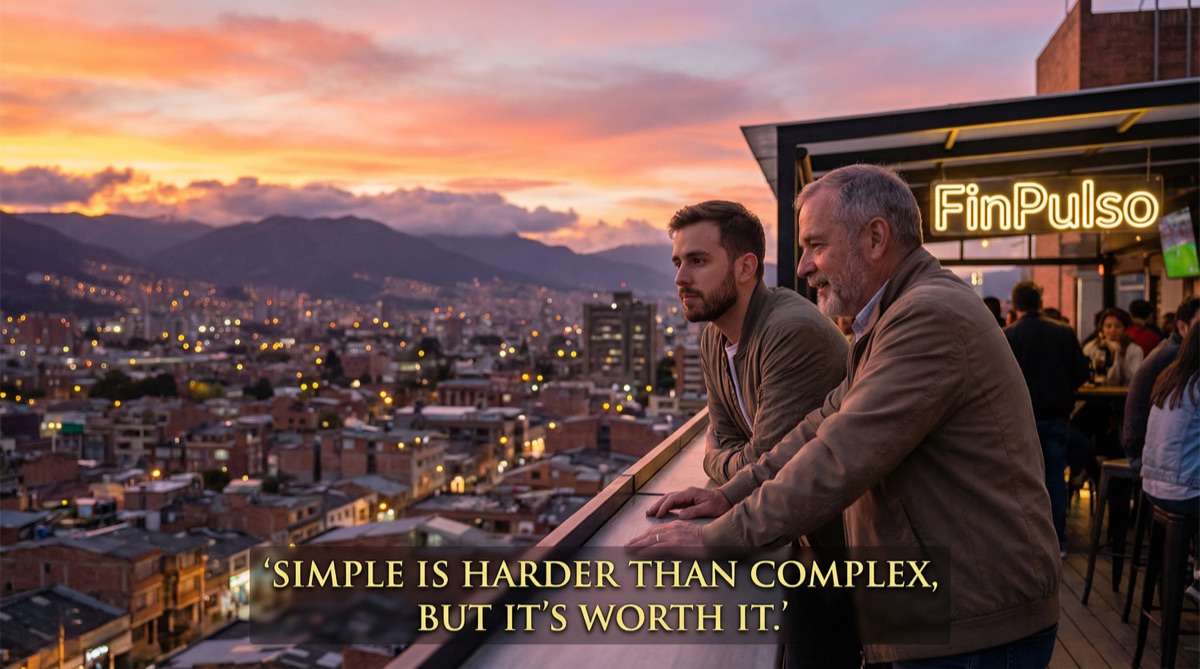
Stefan leans against the railing. “What happened wasn’t your fault. The conditions you worked in — they would have broken anyone.”
“Maybe.” Diego is quiet for a moment. “But I let it break me instead of breaking the conditions. I complained in emails no one read instead of refusing to deploy code that wasn’t ready. I burned out instead of setting boundaries.”
“You were young. And alone.”
“I was twenty-six. Old enough to know better.” Diego shakes his head. “The unsent resignation letter — I’ve read it a hundred times. Every word is true. But I never sent it because I was afraid of what would happen.”
“And now?”
“Now I’m not afraid anymore. Or maybe I’m afraid of different things.” Diego looks at Stefan. “I’m afraid of watching Camila make the same mistakes. I’m afraid of this company failing because no one tells the truth. I’m afraid of spending the rest of my life building beautiful systems that get destroyed by politics and ego.”
“Those are reasonable fears.”
“They’re not going away.” Diego straightens. “But I can work with them. And maybe this time, I can help build something that lasts.”
Stefan nods. “¿Y eso está en producción?”
Diego laughs — a genuine, unexpected sound. “Not yet. But it will be.”
The Weight of Tomorrow
FinPulso office. Night.
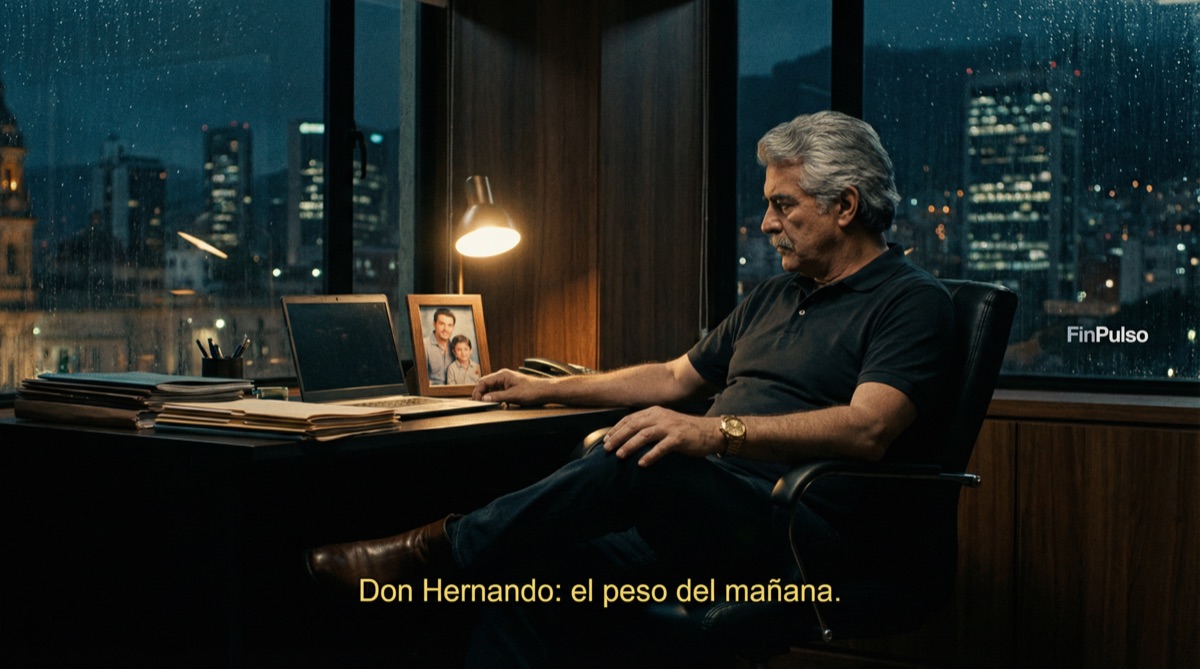
The office is mostly empty. Laura is the last to leave, as usual — she glances at the light still on in Don Hernando’s office but doesn’t disturb him. Some vigils are private.
In the development area, Camila works at her desk, headphones on, lost in code. Her private repository is open on her second monitor, but for the first time, she doesn’t feel the need to hide it. Diego reviewed it. Stefan approved it. Tomorrow, they’ll start planning the migration.
Sebastián is in his office, door open, staring at the wall where a whiteboard holds the beginnings of a recovery plan. His phone buzzes — a message from Isabella.
Isabella Heard Diego came back. Are you okay?
Sebastián I think so. Ask me again in a week.
Isabella I'm proud of you. For finally speaking up.
Sebastián It was too late. Diego warned me months ago.
Isabella It's never too late to start doing the right thing. That's the whole point.
He smiles at the phone, just slightly.
In Suba, Diego sits in his apartment, surrounded by his servers and monitors, drafting an email to Pipe. An olive branch wrapped in technical questions — asking about the legacy systems, acknowledging that Pipe knows things no documentation captured.
And in a hotel bar in Zona Rosa, Alejo sits alone with a whiskey he’s barely touched. His phone shows a half-composed message to Marco, but he hasn’t sent it. He’s thinking. Planning. The first battle is lost, but the war isn’t over.
Tomorrow, the real work begins.
For everyone.
🎭 This Week's Episodes
Telenovelas show what we can't say in client meetings. The drama is heightened, but the patterns are real.
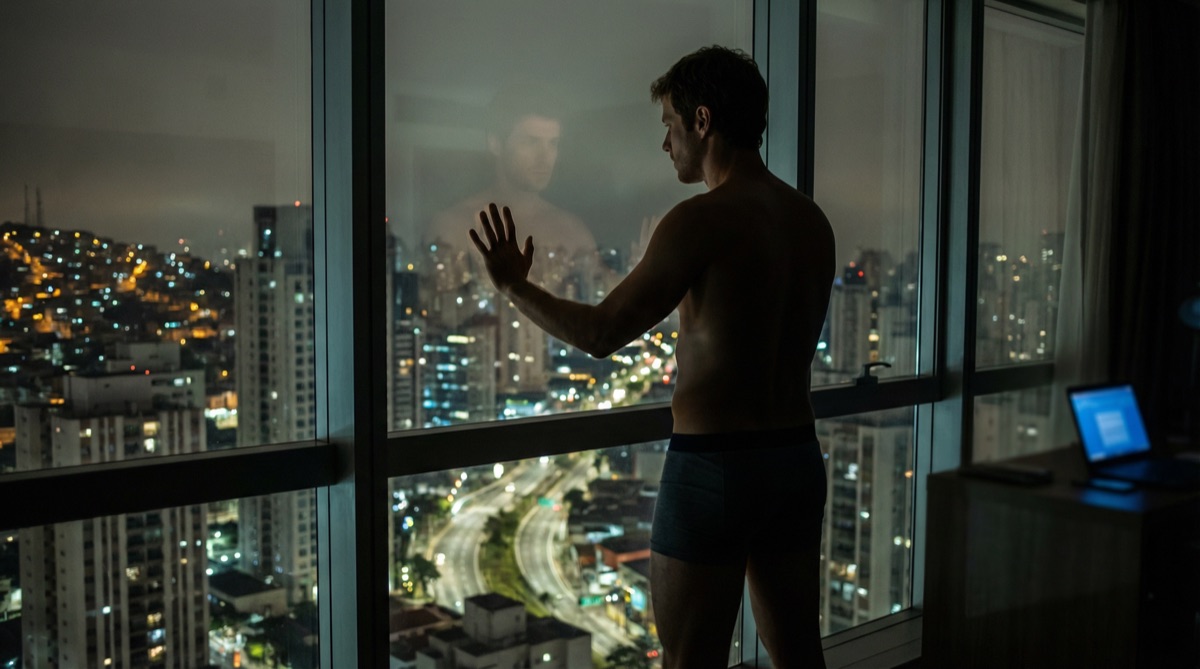 Arrival
Stefan Richter arrives in São Paulo with a 90-day contract to fix delivery at AutoConnect Brasil. He finds 90 developers, 18 months of chaos, and a...
 What Is Offered First
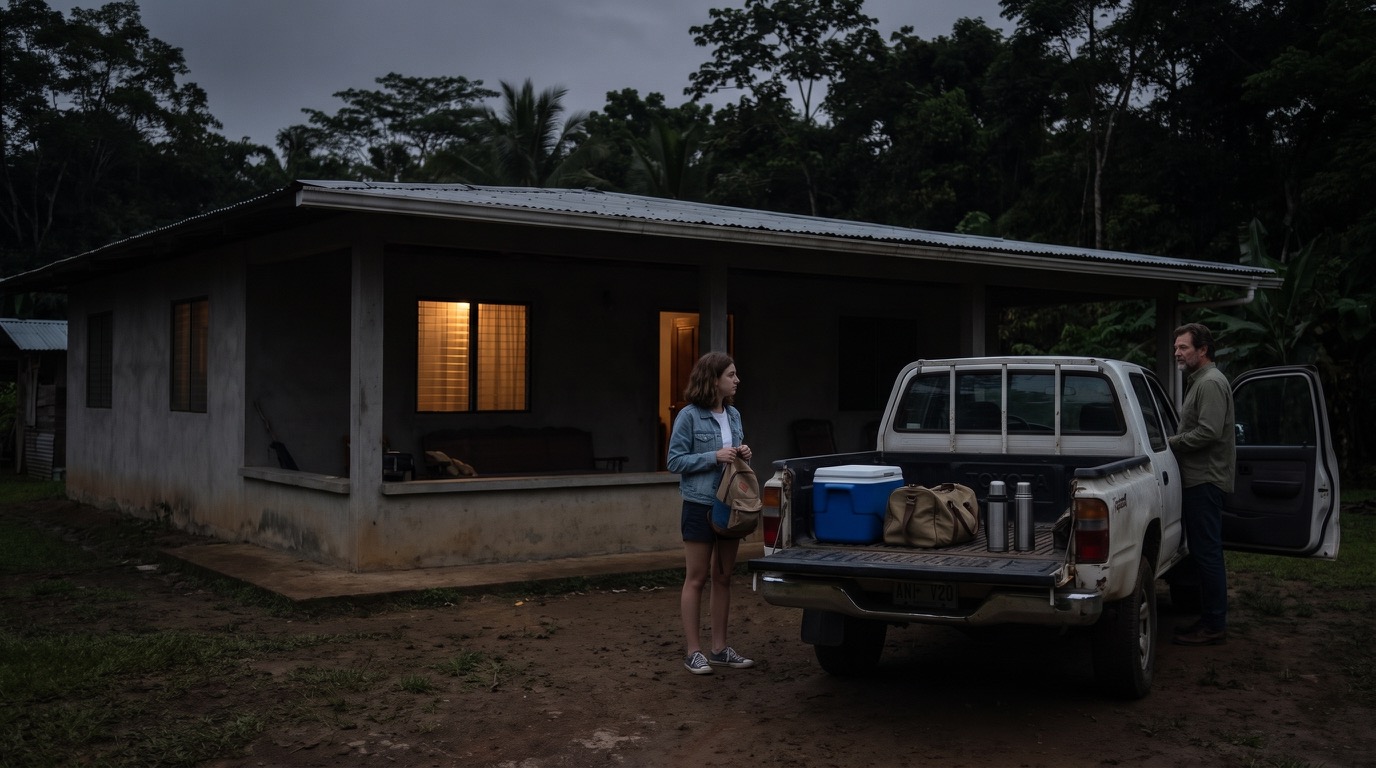
The day before Sophie flies back to Berlin, Mateo takes them to Kuna Yala. The road climbs from the Chepo side into the mountains, the Caribbean ap...
 Collapse
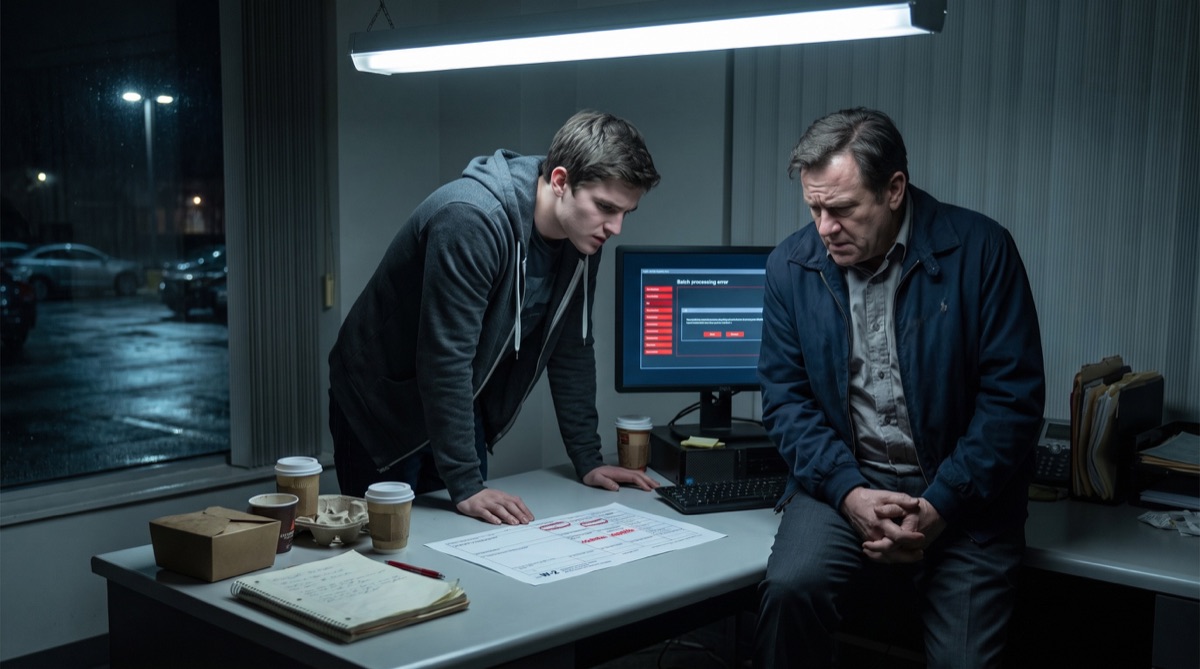
Year-end arrives with the force of something everyone has been preparing not to name. A critical COBOL tax-calculation path fails on an undocumente...
Technical Consultancy
Embedded Delivery Partner
Embedded into your team as an active contributor, reducing delivery friction and helping important work move cleanly.
Technical Advisor
Peer-style technical assessments before far-reaching decisions; reduce architectural and product risk early.
Product & Delivery
Ship working software to real users earlier. Measure impact and adapt based on evidence rather than assumption.
Custom Software Development
High quality, maintainable software. Short-term augmentation that leaves lasting capability in your own team.
Recent Articles
- The One-Person AI Company Is a Greed Fantasy (15.09.2026)
- Test Production Without Leaving a Mess (10.09.2026)
- Software Will Fail. Recovery Is the Real Metric (05.09.2026)
- Stop Outsourcing Your Product Language (01.09.2026)
- Software Has Always Moved Up the Stack (29.08.2026)
Explore More