Cenizas
The demo disaster has left FinPulso in ruins. Mariana convenes the board for a final decision: invest more or cut losses. Stefan presents a radical recovery plan based on continuous delivery, but faces resistance from those who want to maintain the status quo. Everything changes when Camila — the quiet junior developer — reveals she's been building something in secret. A working prototype. And it might be the only thing that can save them.
The Morning After
FinPulso office. Friday, 8:30 AM.
The office has the feeling of a wake. Developers sit at their desks, but no one is working. The whiteboards from the war room still display their desperate plans — monuments to yesterday’s failure.
Camila is the first to arrive, as always. She makes coffee. She checks the error logs. She does what she always does: the quiet work that keeps systems running while everyone else is distracted by drama.
But today, she also opens a folder on her laptop labeled “Project Fénix.” A folder no one knows about.
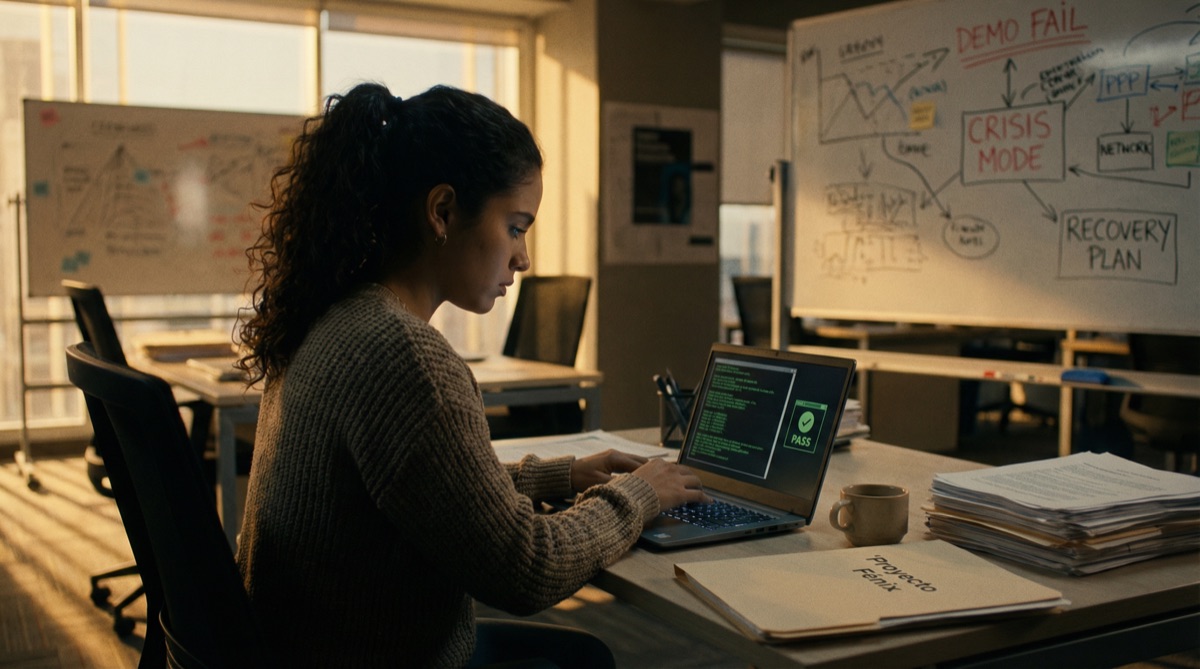
Diego arrives next. He looks like he hasn’t slept — because he hasn’t. He’s been analyzing what went wrong, tracing the cascade of failures that brought down the demo.
“Connection pool exhaustion,” he says, sitting next to Camila. “The reporting module was running a legacy query that never releases connections. We missed it because—”
“Because no one ever tests the reporting module,” Camila finishes. “I know. I’ve been saying that for months.”
Diego looks at her — really looks at her, perhaps for the first time. “You have, haven’t you?”
“I say a lot of things. Nobody listens to the junior developer.”
Something in her tone makes Diego pause. But before he can respond, the elevator doors open, and Don Hernando walks in with Stefan, Laura close behind.
The old man’s face is carved from stone. He’s wearing the same suit he wore to his son’s funeral — the suit of important days. Bad days.
“Conference room,” he says. “Everyone. Now.”
The Reckoning
9:00 AM.
They gather like survivors around a campfire: Don Hernando at the head of the table, Stefan standing by the window, the developers clustered at one end. Sebastián sits apart, staring at a tablet displaying yesterday’s error logs as if they might reveal something new.
Isabella enters last, her eyes red from a sleepless night. She sits next to Sebastián but doesn’t look at him.
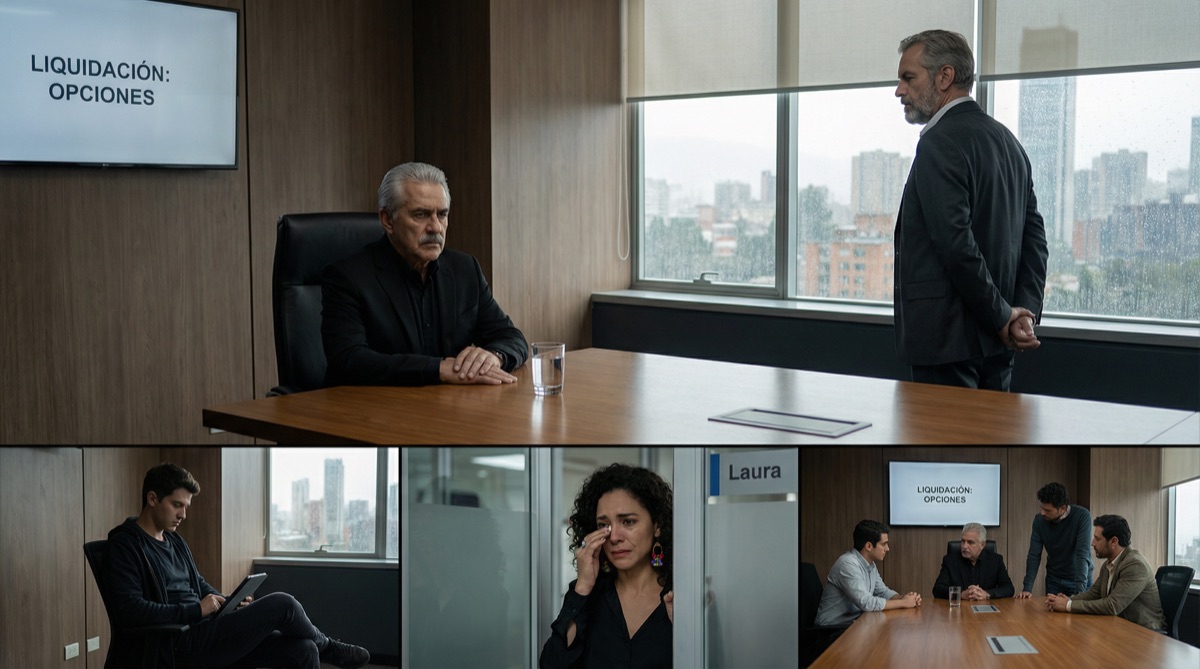
“Mariana called this morning,” Don Hernando says without preamble. “She and her partners have discussed the situation. They’re flying back to Bogotá on Monday for a formal board meeting. They will decide whether to continue their investment or demand liquidation.”
The word hangs in the air. Liquidation.
“They want to see a recovery plan,” Don Hernando continues. “Something credible. Something that shows we understand what went wrong and can prevent it from happening again.” He looks at Stefan. “I’ve asked our German friend to prepare such a plan.”
Pipe snorts. “A plan. As if a plan will fix what happened.”
“A plan won’t fix the past,” Stefan says quietly. “But it might save the future. If there’s still a future to save.”
“Is there?” Sebastián asks. His voice is hollow. “I’ve run the numbers. Even with a bridge round, we have maybe four months of runway. That’s not enough time to rebuild the platform from scratch.”
“No,” Stefan agrees. “It isn’t.”
“Then what are we talking about? Fairy tales?”
Stefan moves to the whiteboard. He picks up a marker, considers it, sets it down again.
“I’ve been observing FinPulso for three weeks now,” he says. “I’ve pair-programmed with every developer. I’ve read the codebase. I’ve studied the deployment logs — what little exists of them. And I’ve identified the core problem.”
“The code is shit,” Pipe says. “We know.”
“The code is debt. Debt accumulated over two years of impossible deadlines and pressure to show progress that didn’t exist. But that’s not the core problem.” Stefan pauses. “The core problem is that this company has been optimizing for appearances instead of reality. For demos instead of deployment. For investor confidence instead of user value.”
Don Hernando’s expression doesn’t change. But his hands tighten on the armrests.
“And your solution?”
“Stop pretending. Start delivering.”
The Plan
9:30 AM.
Stefan draws on the whiteboard as he speaks. Not diagrams — just words, connected by arrows.
Day 1-30: Foundation
- Automated deployment pipeline
- Basic test coverage for critical paths
- Production monitoring and alerts
Day 31-60: Stability
- Daily deployments to staging
- Weekly deployments to production
- Incident response process
Day 61-90: Velocity
- Feature flags for safe releases
- Metrics-driven development
- User feedback loops
“This isn’t a rebuild,” he explains. “It’s a transformation. We stop pretending the old system works and start building the capability to actually deliver software.”
“In three months?” Isabella asks. “You said yourself we can’t rebuild the platform in four.”
“We don’t rebuild the platform. We rebuild the process. And we start delivering value — small value, incremental value — within the first two weeks.”
“Value to whom?” Sebastián asks. “Our users have never even seen the real platform. They’ve only seen the demos.”
“Then maybe it’s time they see something real.”
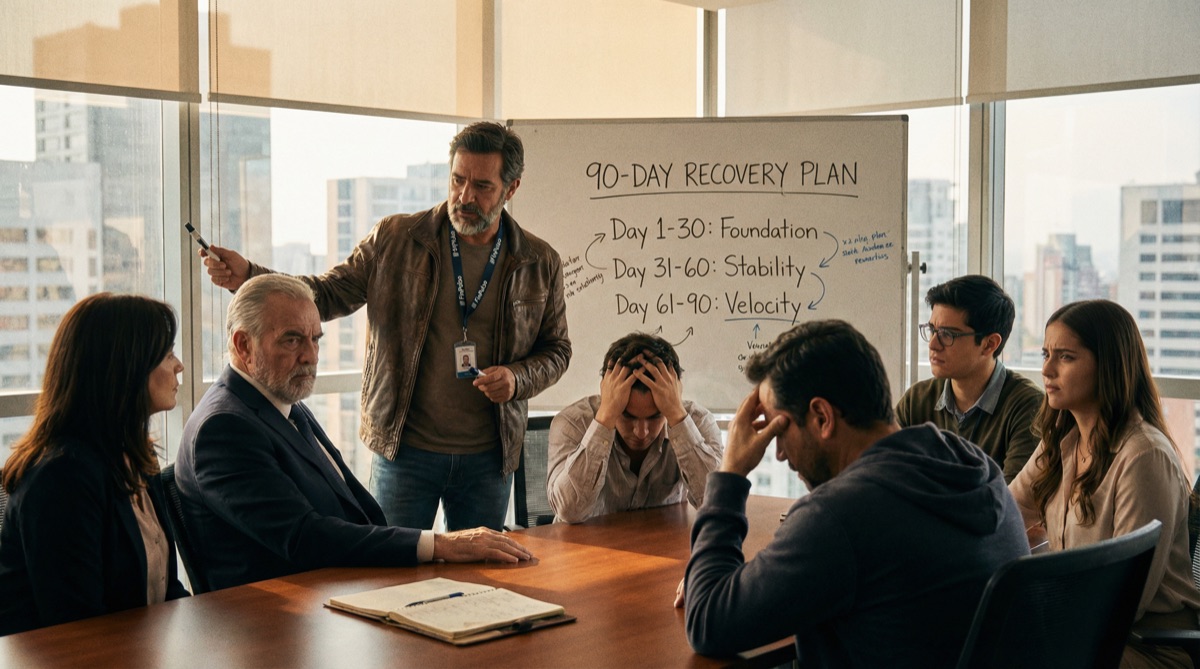
The room is silent. Pipe is shaking his head slowly. Diego is staring at the whiteboard with an intensity that suggests he’s actually considering the proposal. Isabella is watching Don Hernando, trying to read his reaction.
“This plan requires something,” Stefan says. “Something this company hasn’t had.”
“What?” Don Hernando asks.
“Honesty. Radical, uncomfortable honesty. About what works. About what doesn’t. About what we can actually deliver versus what we’ve been promising.” Stefan meets the old man’s eyes. “Yesterday, you asked me what happens now. This is what happens now. We tell the truth. Or we die.”
Don Hernando is silent for a long moment. Then:
“Laura. Get Mariana on the phone. Tell her we’ll have a presentation ready for Monday. A real one.”
“Patrón, I—”
“And someone find me coffee. Real coffee. This is going to be a long weekend.”
The Secret
11:00 AM.
The team disperses to begin preparations. Stefan is reviewing deployment infrastructure with Diego. Pipe is grumbling over legacy documentation. Isabella is drafting talking points for the board presentation.
Camila approaches Stefan when no one else is watching.
“May I show you something?”
Stefan looks up from his laptop. He’s learned to recognize that tone — the one developers use when they’re about to reveal something important.
“Of course.”
She leads him to her desk, away from the others. She pulls up the folder she checked this morning.
“I’ve been building this for three months,” she says quietly. “In my spare time. Nights. Weekends. I call it Project Fénix.”
Stefan looks at her screen. At first, he doesn’t understand what he’s seeing. Then he does.
It’s a payment processing module. Clean architecture. Comprehensive test coverage — the kind Diego used to write before he burned out. Integration tests that actually pass. And at the bottom of the screen: a deployment log showing daily automated releases to a staging environment she’s been running on her personal cloud account.
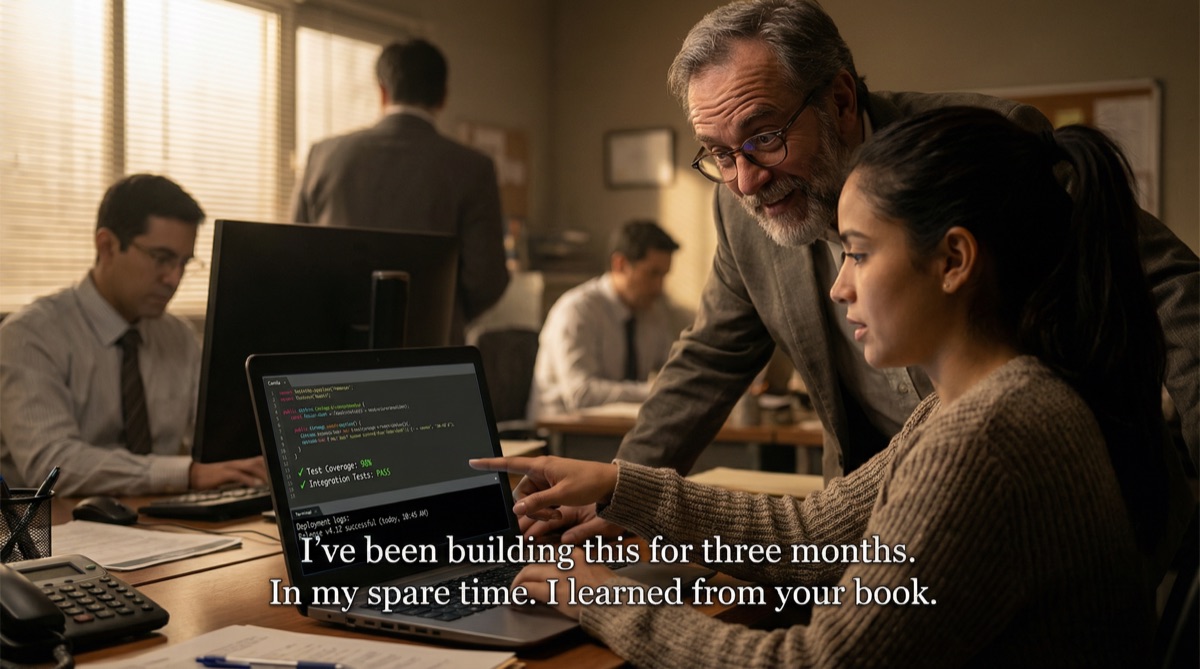
“You’ve been doing continuous delivery,” Stefan says slowly. “On your own. While everyone else was building a house of cards.”
“I learned from your book,” Camila says. “The one you wrote five years ago. About sustainable software delivery. I found it online.”
“I remember writing that.” Stefan scrolls through her code. “This is… remarkable. The transaction handling is cleaner than anything in the main codebase. How did you—”
“I rewrote it from the requirements documents. The original ones, before they got corrupted by scope creep. The platform we promised investors — the simple, reliable payment processor — it’s possible. It just got buried under features no one asked for.”
Stefan sits back. He’s looking at Camila differently now. Not as a junior developer. As a colleague.
“Why didn’t you tell anyone?”
“I tried.” Her voice carries a familiar frustration. “I sent Sebastián a proposal four months ago. He said it was ‘interesting’ but we didn’t have bandwidth. I showed Alejo a demo — he said it was too simple, that investors want sophistication. I even mentioned it at a team meeting once. Pipe told me to focus on my assigned tasks.”
“And you kept building anyway.”
“Someone had to.” She closes the laptop halfway. “The question is: does it matter? Is this too little, too late?”
Stefan is quiet for a moment. Then he stands.
“Diego. Pipe. Sebastián. I need you here. Now.”
The Revelation
11:30 AM.
They crowd around Camila’s desk. She’s nervous now — this is more attention than she’s received in her entire time at FinPulso. But Stefan stands beside her, and his presence is steadying.
“Show them,” he says.
She opens Project Fénix again. Walks them through the architecture. Demonstrates the test suite — 847 passing tests, zero failures. Shows the deployment logs: 94 successful releases over 12 weeks, average deployment time 4 minutes.
Diego is the first to speak. “You’ve been running this on AWS? Your personal account?”
“The free tier, mostly. A few dollars a month for database hosting.”
“The transaction module…” Diego leans closer. “This handles the concurrent connections problem. The one that crashed the demo. You solved it.”
“Connection pooling with automatic recovery. It’s not rocket science. It’s just… correct.”
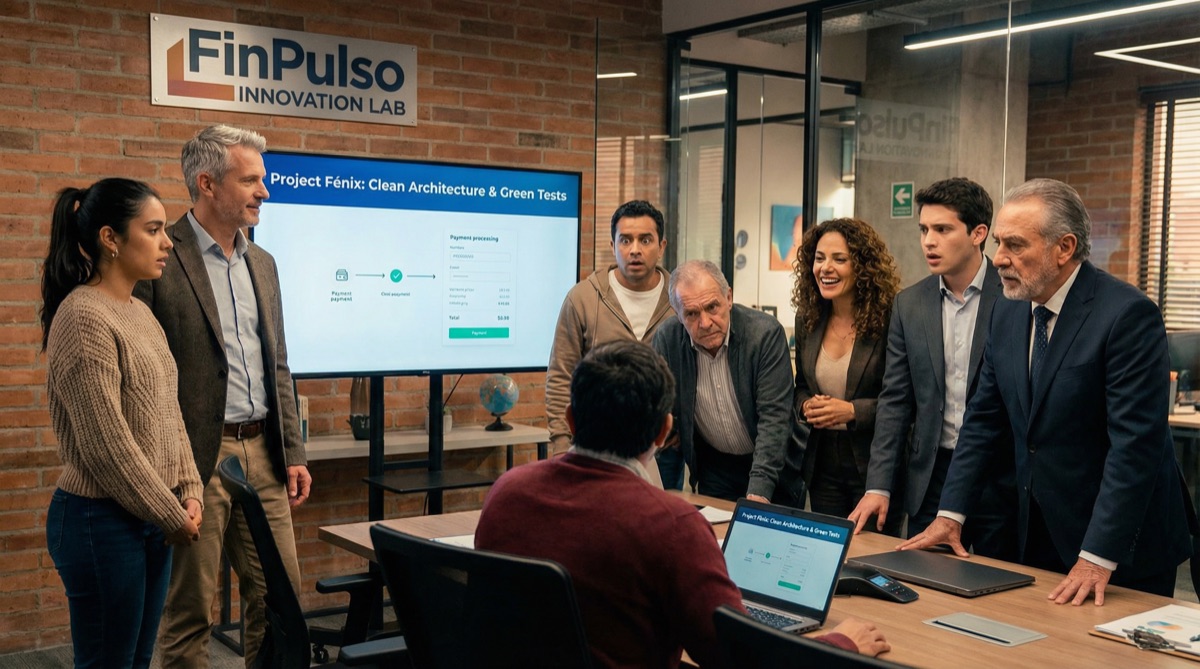
Pipe is shaking his head, but his expression has changed. Not cynicism anymore. Something like wonder.
“You built this alone? No code review? No pair programming?”
“I reviewed it myself. Multiple times. And I watched every talk by Diego on the internal wiki. The ones from before—” She hesitates. “Before things got bad.”
Diego blinks. “You watched my old talks?”
“All of them. The one about test-driven development changed how I think about code.” Camila’s voice is quiet but firm. “You’re good, Diego. Really good. The codebase just… buried it.”
For a moment, Diego can’t speak. He’s being seen — his old self, the one who cared about craft — by someone who paid attention when no one else did.
Sebastián has been silent, studying the code. Now he looks up.
“Can it scale? The payment volume we promised investors—”
“I’ve tested it with simulated load,” Camila says. “Ten thousand transactions per minute. It held. The main platform crashes at two thousand.”
“Why?” Sebastián’s voice is almost pleading. “Why does it work when ours doesn’t?”
“Because I started with tests. Every feature, every edge case — I wrote the test first, then made it pass. There’s no hidden complexity because every piece of complexity is documented in the test suite.”
Stefan speaks. “This is what continuous delivery looks like. Not as a process document. Not as a consultant’s recommendation. As working software, built by someone who refused to accept that failure was inevitable.”
The room is silent.
Then Pipe says something no one expected.
“Mija, why the hell didn’t we listen to you?”
The Conversation
2:00 PM.
Don Hernando has been briefed. He stands at the window of his office, looking out at the Bogotá afternoon, processing what he’s just been told.
Stefan sits across from his desk. Camila hovers near the door, unsure if she should be here.
“This junior developer,” Don Hernando says slowly. “She built a working system. By herself. While my expensive team was failing.”
“She built what the team could have built,” Stefan corrects. “If they’d been allowed to work correctly. She wasn’t fighting deadlines no one could meet. She wasn’t being told to add features that didn’t exist. She was just… building.”
“And you’re saying we should use her system instead of ours?”
“I’m saying her system is ours. It’s what FinPulso promised to be. Simple. Reliable. Real.” Stefan leans forward. “Monday, when Mariana and her partners arrive, you have two options. You can show them another presentation — slides, promises, apologies. Or you can show them Project Fénix. Working software. Something they can touch.”
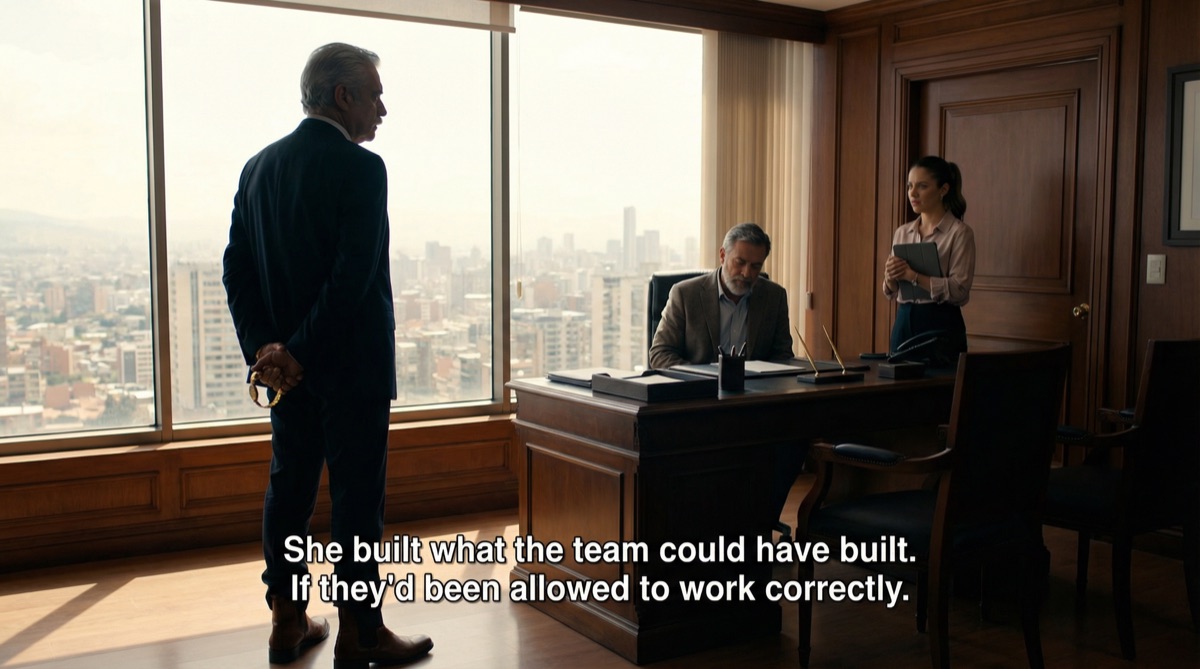
Don Hernando turns. His eyes find Camila.
“You,” he says. “Come here.”
Camila approaches, uncertain. The old patriarch studies her the way he studies horses at auction — assessing breeding, temperament, potential.
“Why?” he asks simply.
“Why what, señor?”
“Why build this thing in secret? Why not demand recognition? Why not threaten to leave unless we listened?”
Camila considers the question. “Because leaving wouldn’t fix the problem. And threatening wouldn’t make anyone listen. The only thing that works…” She pauses. “Is work that works.”
Something shifts in Don Hernando’s expression. A flicker of recognition.
“Jorge used to say something similar,” he murmurs. Then, louder: “My son. He said that making demands is for people who have no leverage. The people who change things are the ones who simply do the thing, and let the results speak.”
“He sounds like he was wise.”
“He was. And I was too stubborn to hear him.” Don Hernando walks to his desk. “Camila Torres. Starting today, you report directly to Stefan. You’re the technical lead for Project Fénix. Your budget is whatever you need to make this real by Monday.”
“I—” Camila falters. “I don’t know if I’m ready to lead—”
“Neither did I, when my father handed me the ranch at twenty-two.” Don Hernando’s smile is thin but genuine. “You’ll figure it out. People who build things in secret because they care — those people figure it out.”
The Push
Saturday, 9 AM.
The office has transformed again — but differently this time. Not the frantic energy of the war room. Something calmer. More focused.
Camila stands at the main whiteboard, marker in hand. For the first time, everyone is looking at her.
“The goal is simple,” she says. “By Monday morning, Project Fénix needs to be running on FinPulso’s official infrastructure. Not my personal AWS account. The real thing.”
“What about the existing platform?” Sebastián asks.
“We don’t touch it. Fénix runs in parallel. The investors see both — what we have, and what we’re building. Radical honesty, like Stefan said.”
Diego is already at his laptop. “I’ve pulled the Fénix repository. The architecture is clean, but it’s designed for single-server deployment. We’ll need to containerize it for our Kubernetes cluster.”
“That’s your task,” Camila says. “Stefan suggested you’d know how.”
“I do.” Diego’s fingers are moving faster than they have in months. “Give me three hours.”

Pipe surprises everyone. “I know the production database schema better than anyone.” His voice is rough, almost angry — but the anger is turned inward. “If you need Fénix to read from the same data sources, I can build the adapters.”
“You’d do that?” Camila asks.
“Mija.” Pipe’s jaw works. He looks down at his hands — the hands of a man who’s been writing code for thirty years and somewhere along the way forgot why he started. “I’ve been a bitter old cabrón for too long. Bitching about everything, contributing nothing. I’ve been waiting for someone to build something worth a damn. I just didn’t expect it to be you.” His voice cracks slightly. “No offense.”
“None taken.” Camila’s eyes are wet.
“None taken.”
Stefan moves between stations, watching, occasionally asking questions. But mostly, he stays out of the way. This is their moment, not his.
Isabella arrives with coffee and sandwiches. “I can’t code,” she says, “but I can make sure you don’t starve. And I can document every step for the investor presentation.”
“The presentation should be the software,” Camila says. “But… documentation helps. Thank you.”
By Saturday evening, Fénix is running in a staging environment on FinPulso’s infrastructure. By Sunday morning, it’s processing test transactions without a single error.
At 3 PM Sunday, Camila runs a full load test: ten thousand simulated payments. The system handles them in under eight minutes.
She stares at the success metrics, not quite believing what she’s seeing.
“It works,” she whispers.
“Of course it works.” Diego is beside her, equally exhausted, equally amazed. “You built it to work.”
The Shadow Returns
Sunday, 8 PM.
While the team celebrates their first real success in months, a phone rings in a hotel room across the city.
Alejo answers.
“The board meeting is tomorrow,” says the voice on the other end. Marco, calling from somewhere in Europe. “Is the old man going to sell?”
“He should. They have nothing. The demo was a disaster.”
“My sources say differently.” Marco’s tone is careful. “They say there’s movement. The developers are working. Something new.”
Alejo’s eyes narrow. “What kind of movement?”
“I don’t know yet. My contact went silent after Thursday. But there’s energy in that office. Not the energy of defeat.”
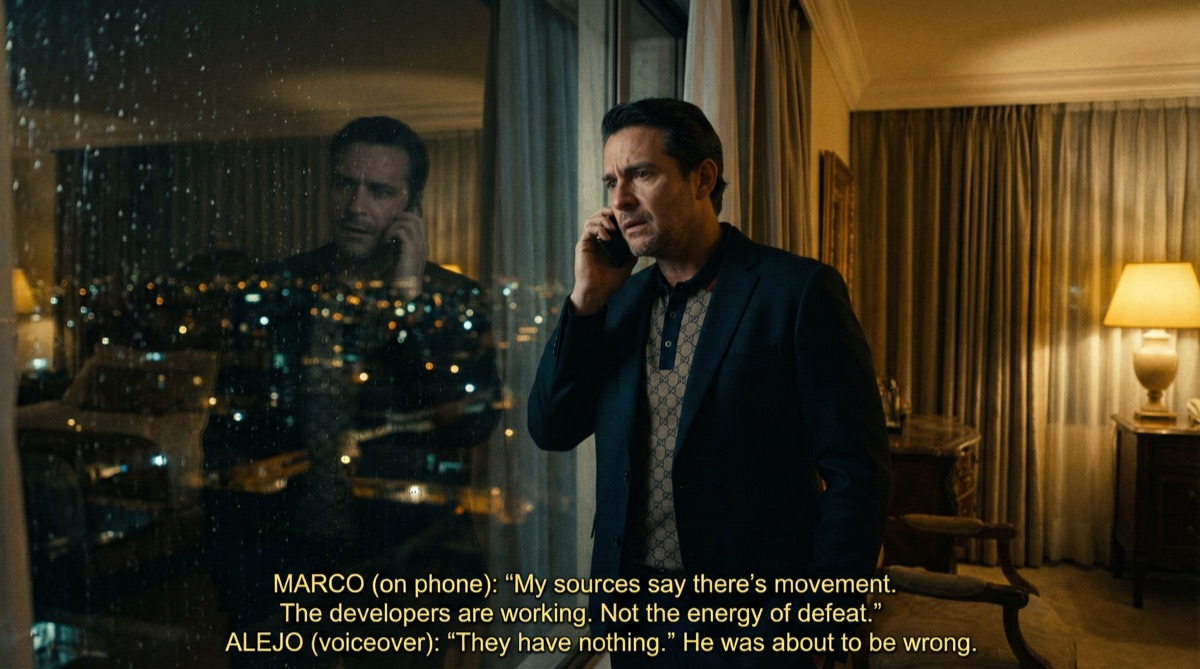
Alejo is quiet for a moment. He’s been certain that FinPulso would collapse — that the demo failure was the final blow. He’d already prepared his pitch to Mariana: take his side, force a merger with MiPago, emerge as CEO of the combined company.
But if something has changed…
“I need to be at that meeting,” he says.
“You were removed from the board.”
“I still own ten percent. They can’t prevent a shareholder from attending.” Alejo’s mind is racing. “Book me a flight. First thing tomorrow. I want to see for myself what they’re planning.”
“And if they have something real?”
“Then I find a way to take credit for it.” Alejo’s smile returns, though it doesn’t reach his eyes. “Or destroy it. Whichever is easier.”
The Night Before
Sunday, 11 PM.
The office is quiet now. Most of the team has gone home to sleep — real sleep, not the exhausted collapse of the war room. Only Stefan and Camila remain.
She’s running one final round of tests. He’s writing notes for tomorrow’s presentation.
“You know they might still say no,” Stefan says without looking up. “Mariana’s partners. They might decide the risk is too great, regardless of what we show them.”
“I know.”
“And if they do?”
Camila considers the question. “Then I have a working payment system, a lot of experience, and proof that I can build things that matter. That’s not nothing.”
Stefan sets down his pen. “No. It’s not.”
“Can I ask you something?”
“Of course.”
“Why do you do this? Travel to broken companies, try to fix them. It can’t pay well enough to justify the frustration.”
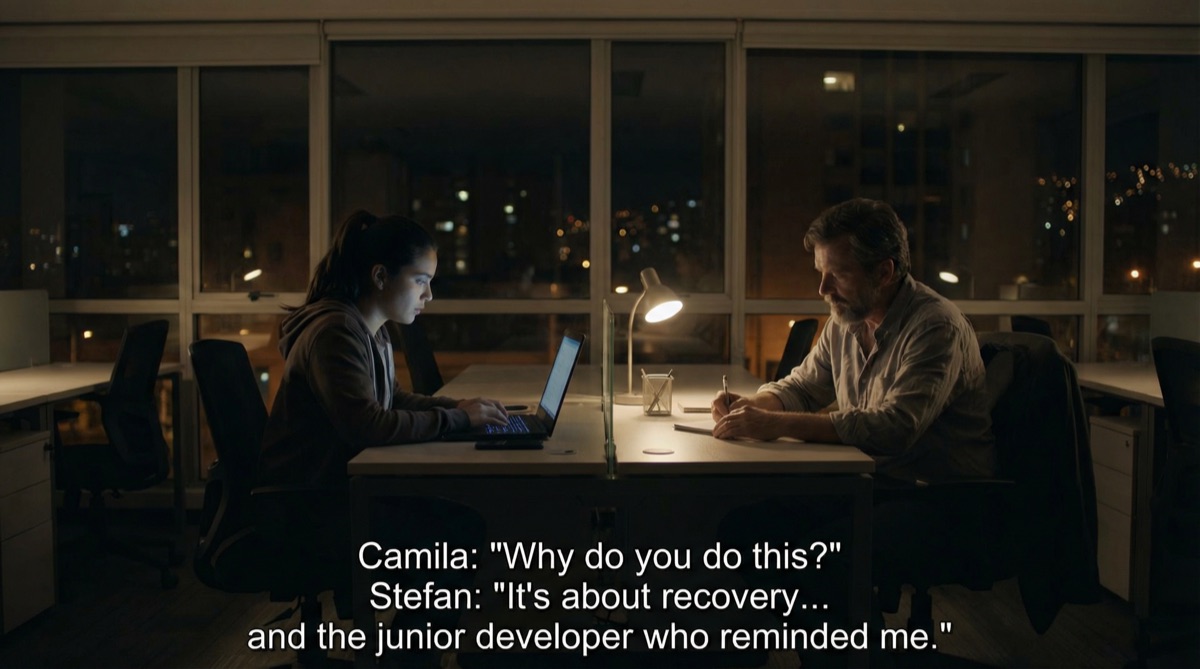
Stefan is quiet for a long moment.
“I burned out once,” he says finally. “Badly. I was running a team at a company that demanded the impossible, and I gave it to them, until there was nothing left of me to give. I spent six months on my finca in Panama, doing nothing but walking with my horses and wondering if I’d ever want to work again.”
“What brought you back?”
“A junior developer. At a company I consulted for years earlier. She sent me an email saying that something I’d taught her had changed her career. That she was now leading a team, and they were shipping good software, and she wanted me to know it mattered.”
Camila blinks. “That’s…”
“That’s why I do this. Not for the companies. Not for the investors. For the Camilas. The people who care about craft even when no one is watching. The ones who build in secret because they believe things can be better.” He meets her eyes. “You reminded me of her. Of why I started.”
The moment stretches. Then Camila smiles — the first real smile Stefan has seen from her.
“Tomorrow,” she says. “We show them what real software looks like.”
“Tomorrow,” Stefan agrees. “We tell the truth.”
The Arrival
Monday, 2 PM.
They come in the same convoy of black SUVs: Mariana and her partners from São Paulo. Eduardo, Patricia, Victor. The same people who watched the demo crash three days ago.
But this time, there’s a surprise.
As Don Hernando greets them in the lobby, a fourth figure emerges from a taxi behind the convoy. Impeccable suit. Predator’s smile.
Alejo.
“Don Hernando,” he says smoothly. “I hope you don’t mind. As a shareholder, I felt it important to attend.”
Don Hernando’s expression freezes. Laura takes an involuntary step backward. But Mariana — Mariana’s eyes narrow with interest.
“Alejandro,” she says. “I thought you’d left the company.”
“A misunderstanding. I stepped back temporarily to give the team space. But I remain deeply committed to FinPulso’s success.” He glances at Don Hernando. “Whatever form that success takes.”

The lobby feels suddenly colder.
“Shall we?” Mariana gestures toward the elevators. “I believe you have something to show us.”
Don Hernando leads the way, but his jaw is tight. This was supposed to be a fresh start. Alejo’s presence is a reminder that the old battles aren’t finished.
Stefan catches Camila’s eye as they enter the conference room.
Stay focused, his look says. The work speaks for itself.
She nods. She’s ready.
The Presentation
2:15 PM.
The conference room is arranged differently today. No podium, no formal presentation screen. Instead, there’s a laptop connected to a monitor, showing a terminal window with live metrics.
“Before we begin,” Don Hernando says, “I want to be clear about something. What you’re about to see is not a pitch. It’s not a promise. It’s working software.”
He steps aside and gestures to Camila.
The investors exchange glances. A junior developer leading the presentation? Victor looks skeptical. Eduardo looks curious. Patricia is already taking notes.
Alejo’s smile falters, just slightly.
“My name is Camila Torres,” she begins. “I’m a software developer at FinPulso. And for the last three months, I’ve been building something in secret.”
She walks them through Project Fénix. Not with slides — with code. With tests. With live demonstrations. She processes a payment in front of them. Then another. Then a hundred simultaneously.
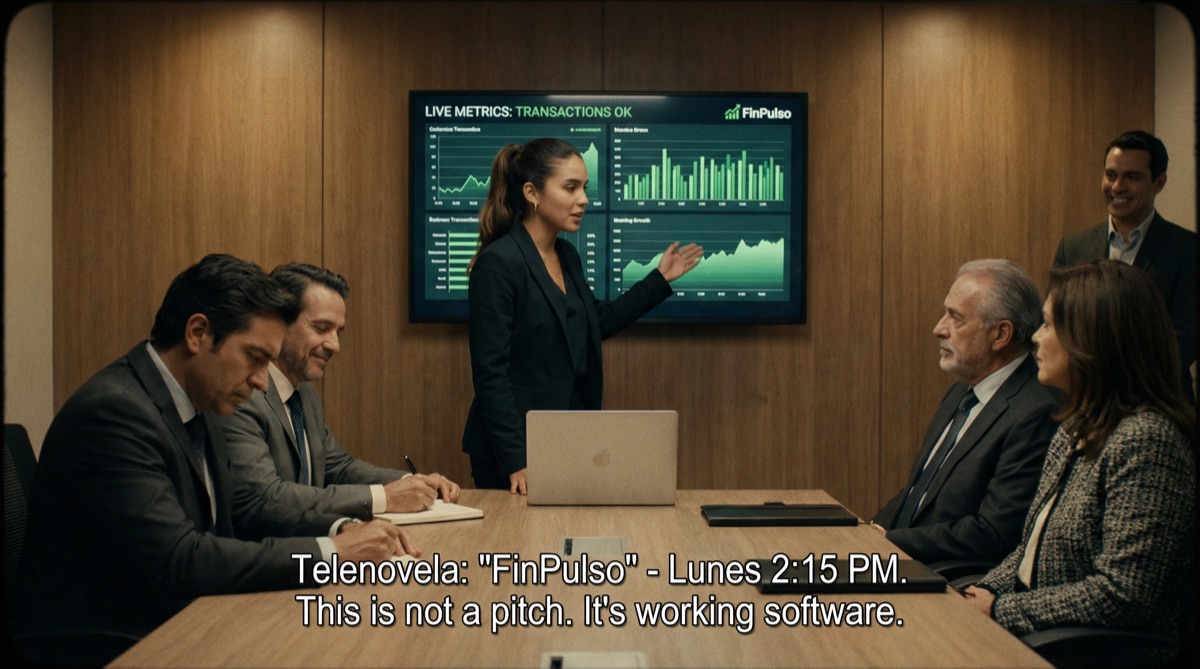
“The system you saw Thursday was built to impress,” Camila says. “This system was built to work. There’s a difference.”
Victor speaks. “The test coverage—”
“Ninety-two percent. Every critical path is tested. Every edge case is documented. You can read the tests yourself — they’re in the repository.”
“And the deployment process?”
“Automated. Triggered by code commit. Average deployment time: four minutes.” Camila pulls up a log. “We deployed twelve times this weekend. Zero failures.”
Patricia looks up from her notes. “You built this alone?”
“I started alone. This weekend, the team helped migrate it to production infrastructure.” Camila glances at Diego, at Pipe, at Stefan. “I proved it was possible. They proved it was real.”
Eduardo leans back in his chair. He hasn’t said anything. But his expression has shifted from skepticism to something else.
“And the old platform?” Mariana asks. “The one that crashed?”
“Still exists. Still broken. We’re not hiding from that.” Camila takes a breath. “But we’re not hiding behind it either. Stefan has a 90-day plan to transition fully to the new architecture. We can walk you through the phases.”
Alejo has been silent throughout. Now he speaks.
“Impressive demonstration.” His voice is smooth, congratulatory. “But surely a prototype built by a junior developer isn’t sufficient basis for continued investment? What about scalability? Security audits? Enterprise readiness?”
He’s trying to sow doubt. Camila recognizes the technique.
“Those are valid questions,” she says calmly. “And I have answers for each of them. Would you like to hear them, or would you prefer to keep asking questions that assume I haven’t thought this through?”
The room goes very quiet.
Alejo’s smile freezes.
Victor — the technical partner — actually laughs. “I think I like her.”
The Verdict
4:00 PM.
The investors have retreated to Don Hernando’s office for deliberation. Mariana leads the discussion while Don Hernando, surprisingly, has left them alone.
He finds Stefan in the development area, watching the team work.
“Whatever happens,” Don Hernando says quietly, “I owe you an apology.”
“For what?”
“For yesterday. And the day before. And every day since you arrived.” The old man looks suddenly tired. “I hired you to save my company, then fought you at every turn. I demanded honesty but punished anyone who gave it to me. I—” He stops. “I was doing what I’ve always done. And it wasn’t working.”
“It takes courage to admit that.”
“It takes more courage to keep showing up, even when the old fool won’t listen.” Don Hernando manages a small smile. “If they invest — if we survive — I want you to stay. Not as a consultant. As… I don’t know. Advisor. Partner. Someone who can tell me when I’m being an idiot without fearing for their job.”
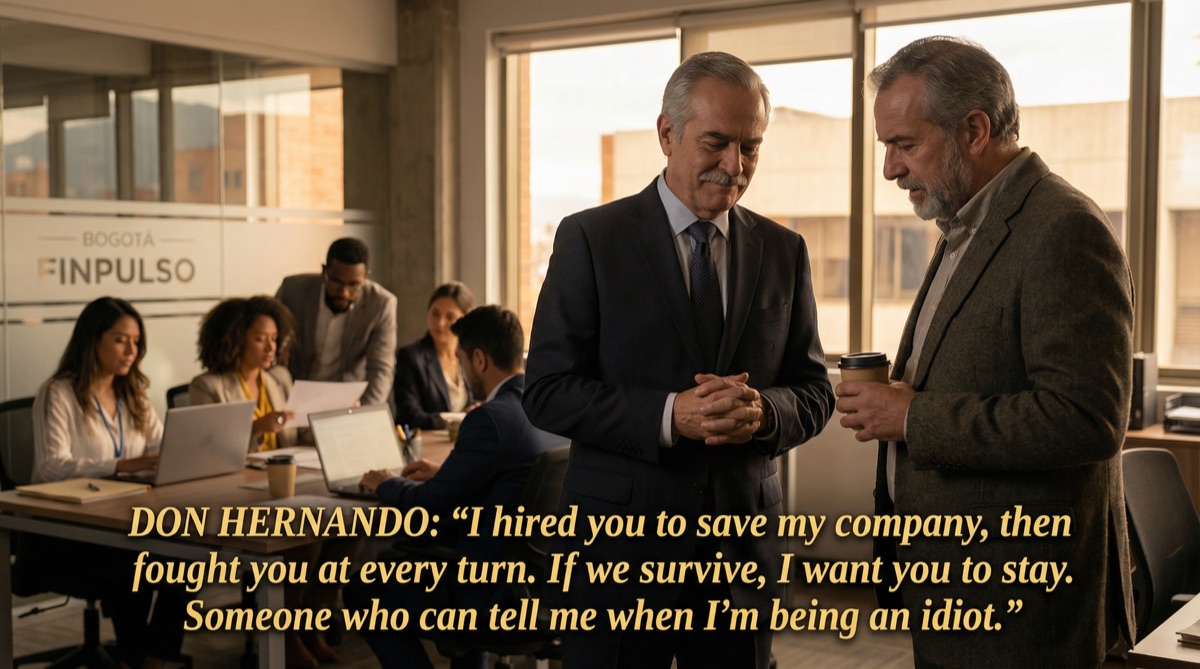
Stefan considers. “Let’s see what Mariana says first.”
“Fair.” Don Hernando straightens his jacket. “Whatever she says, one thing is certain: the girl — Camila — she’s remarkable. I had her in my company for two years and never saw it.”
“You weren’t looking.”
“No. I wasn’t.” The old man’s voice is heavy with regret. “How many others have I not seen? How many Jorges have I missed because I was too busy managing instead of listening?”
Before Stefan can answer, the office door opens. Mariana emerges, followed by her partners.
Her expression is carefully neutral.
“We’ve reached a decision,” she says.
The Answer
4:15 PM.
Everyone gathers. The developers, Don Hernando, Stefan, even Alejo — though he stands apart, arms crossed, already calculating his next move.
“I’ll be direct,” Mariana says. “What we saw Thursday was unacceptable. A company at FinPulso’s stage should not be presenting demos that crash. Should not be making promises that can’t be kept. Should not be—” she pauses, “—showing investors one thing while the reality is something else entirely.”
Alejo nods, positioning himself with the criticism.
“However.” Mariana’s gaze moves to Camila. “What we saw today was different. Not a desperate attempt to salvage the situation. A genuine foundation for something real.”
She walks toward the development area. Toward the team.
“Victor tells me the codebase is clean. Eduardo says the transaction logic is sound. Patricia believes the deployment process is more mature than companies twice your size.” She stops in front of Camila. “And all of that was built by a junior developer, in her spare time, because she believed things could be better.”
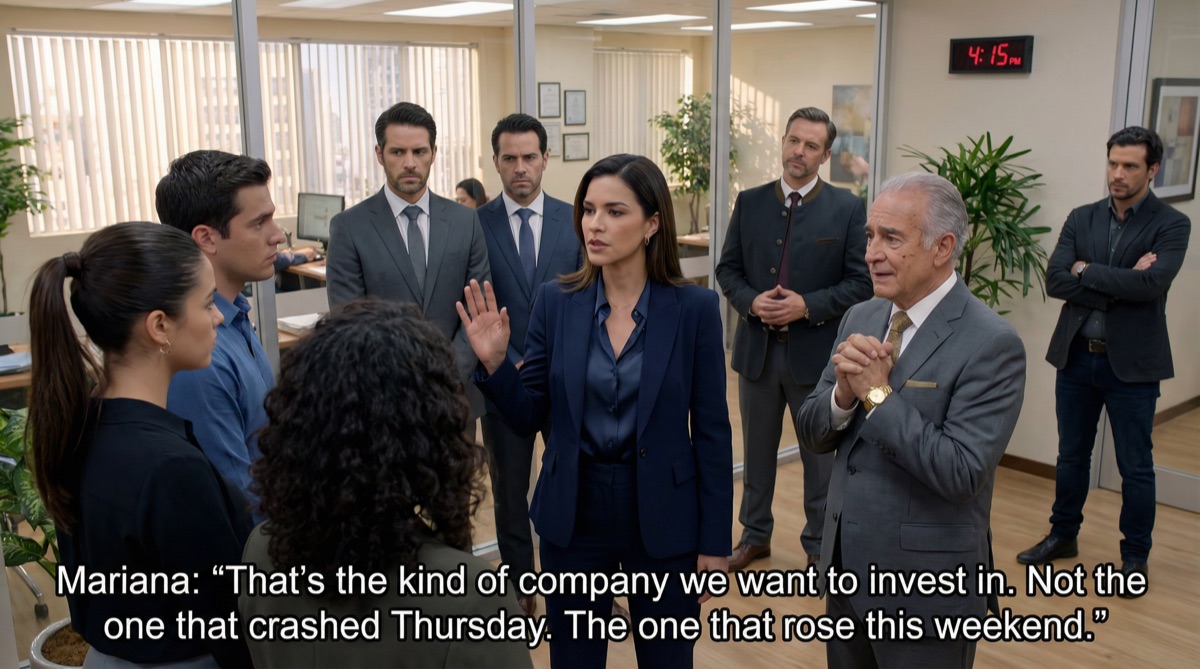
Mariana turns back to the room.
“That’s the kind of company we want to invest in. Not the one that crashed Thursday. The one that rose this weekend. So here is our offer.”
She names a number. Not the full bridge round they’d hoped for — but enough. Enough to extend the runway. Enough to complete Stefan’s 90-day plan. Enough to give Project Fénix a chance.
“There are conditions,” she continues. “Monthly progress reviews. Technical audits. And—” she glances at Alejo, “—a governance restructuring to ensure alignment between leadership and execution.”
Alejo’s smile finally dies.
“What kind of restructuring?” he asks.
“The kind where people who build things have a voice. And people who only talk about things… don’t.”
The room is silent.
Then Don Hernando extends his hand to Mariana.
“Deal,” he says.
The Aftermath
6:00 PM.
The investors have departed. Alejo has vanished — no goodbyes, no final word. Laura reports seeing him make an angry phone call from the lobby before climbing into a taxi.
The team gathers in the conference room one last time. Not for a crisis meeting. Just to breathe.
“We did it,” Sebastián says, as if he can’t quite believe it.
“We haven’t done anything yet,” Camila corrects. “We bought time. Now we have to deliver.”
“The hardest part,” Stefan agrees. “The work itself.”
But Diego is smiling — actually smiling, for the first time since he returned to FinPulso. “I’d forgotten what this feels like. Shipping something real. Having it work.”
“Don’t get too comfortable,” Pipe grumbles. “Tomorrow we start the migration. There’s a lot of legacy code that needs to die.”
“Some of it is your legacy code,” Diego points out.
“I know. That’s why I have to kill it myself. A matter of honor.”
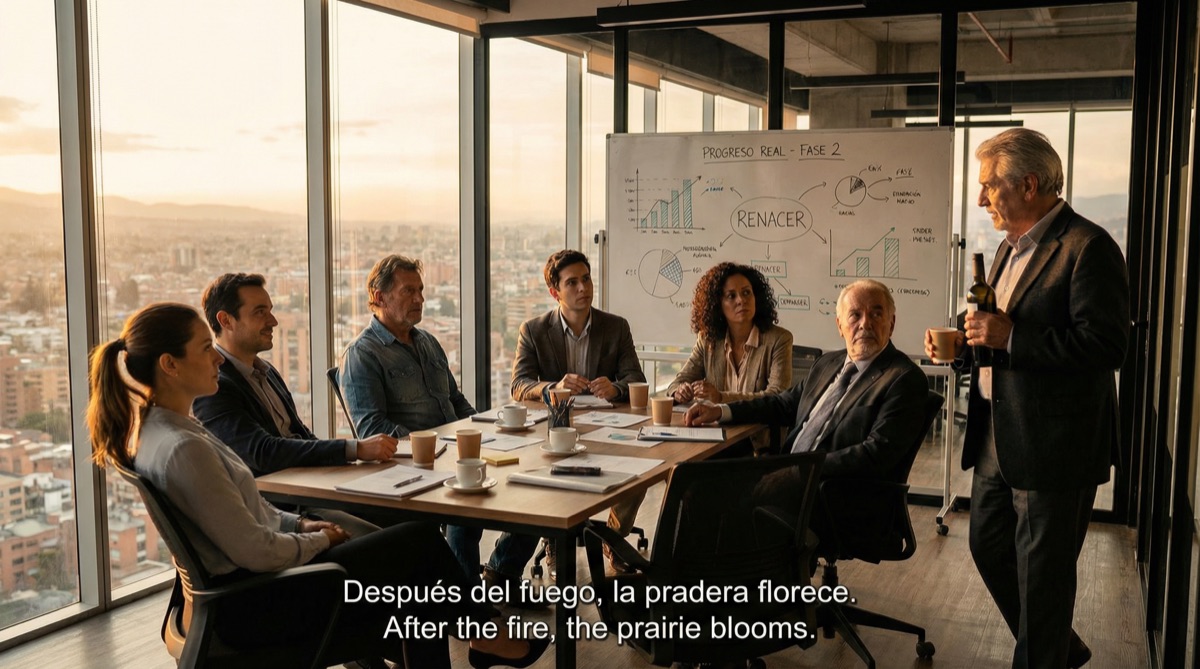
Don Hernando enters last. He looks around the room — at the developers, at Stefan, at the woman who saved his company.
“There’s a phrase,” he says slowly, “that the gauchos use on the plains. Después del fuego, la pradera florece. After the fire, the prairie blooms.”
He walks to Camila.
“I owe you an apology,” he says. “For two years of not listening. For dismissing ideas because of who presented them. For building a culture where someone had to work in secret to do the right thing.”
Camila doesn’t know what to say. So she says nothing.
“Tomorrow,” Don Hernando continues, “we start again. Differently. But tonight—” he produces a bottle of aguardiente from behind his back, “—tonight, we celebrate surviving the fire.”
Stefan catches Camila’s eye across the room.
You did this, his look says.
We did this, hers replies.
And somewhere across the city, Alejo makes another phone call.
“The investment went through,” he says. “They chose to double down.”
“That’s… unexpected,” Marco replies. “What happened?”
“A junior developer. Someone nobody noticed. She built something real while we were playing chess with shadows.”
“What are you going to do?”
Alejo is silent for a long moment.
“Find a new game,” he says finally. “One where I make the rules.”
He hangs up. He looks out at the Bogotá night.
This round is lost. But the war, he knows, has only just begun.
🎭 This Week's Episodes
Telenovelas show what we can't say in client meetings. The drama is heightened, but the patterns are real.
 Arrival
Stefan Richter arrives in São Paulo with a 90-day contract to fix delivery at AutoConnect Brasil. He finds 90 developers, 18 months of chaos, and a...
 What Is Offered First
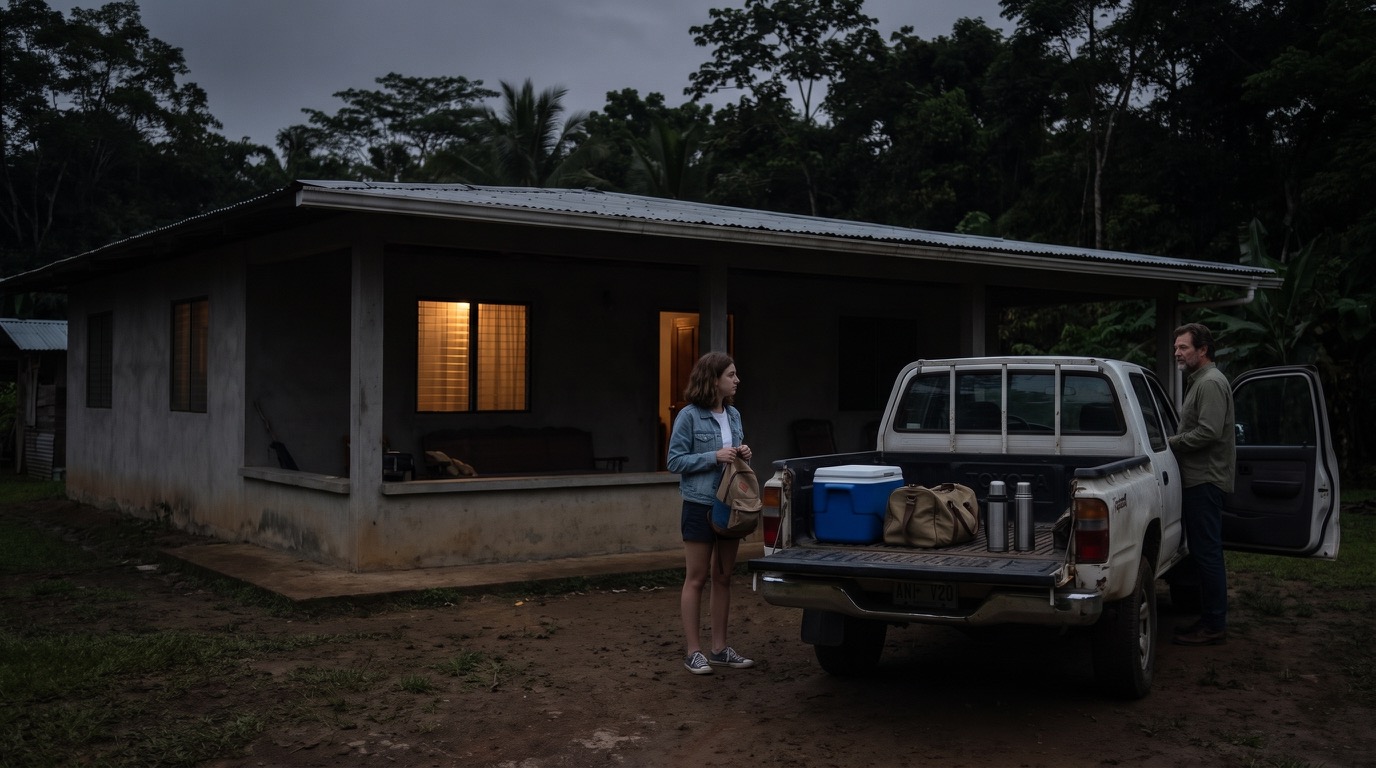
The day before Sophie flies back to Berlin, Mateo takes them to Kuna Yala. The road climbs from the Chepo side into the mountains, the Caribbean ap...
 Collapse
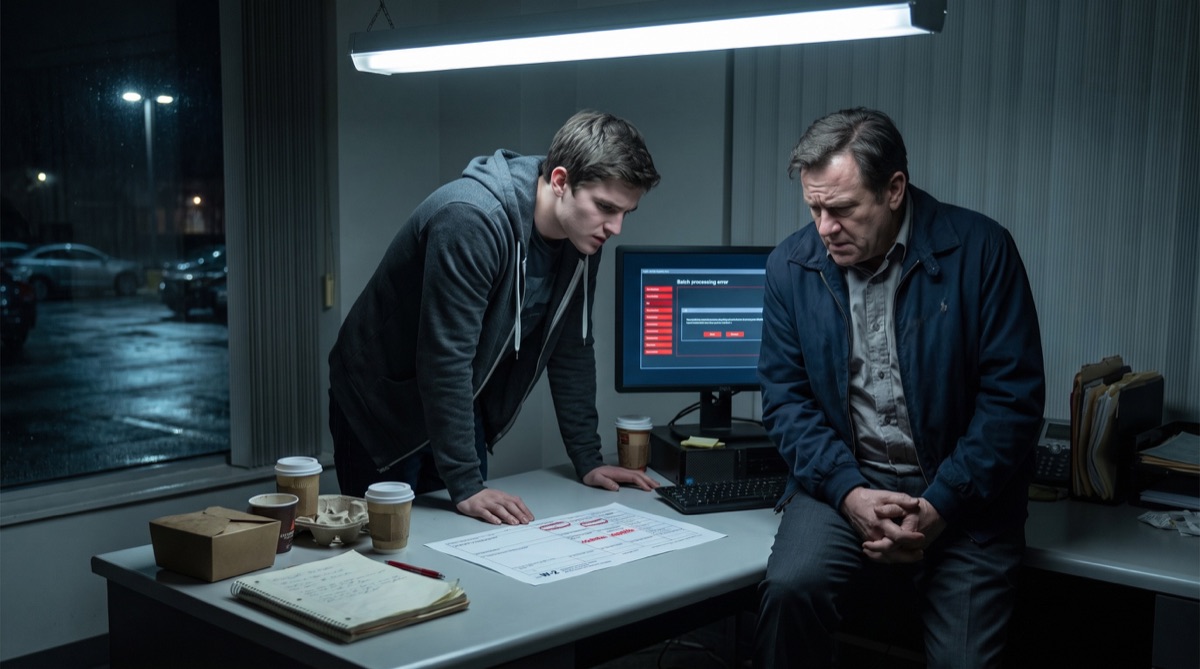
Year-end arrives with the force of something everyone has been preparing not to name. A critical COBOL tax-calculation path fails on an undocumente...
Technical Consultancy
Embedded Delivery Partner
Embedded into your team as an active contributor, reducing delivery friction and helping important work move cleanly.
Technical Advisor
Peer-style technical assessments before far-reaching decisions; reduce architectural and product risk early.
Product & Delivery
Ship working software to real users earlier. Measure impact and adapt based on evidence rather than assumption.
Custom Software Development
High quality, maintainable software. Short-term augmentation that leaves lasting capability in your own team.
Recent Articles
- The One-Person AI Company Is a Greed Fantasy (15.09.2026)
- Test Production Without Leaving a Mess (10.09.2026)
- Software Will Fail. Recovery Is the Real Metric (05.09.2026)
- Stop Outsourcing Your Product Language (01.09.2026)
- Software Has Always Moved Up the Stack (29.08.2026)
Explore More