The First Confrontation
Nathan Cole thinks the Detroit tax defect has finally become visible enough to be handled like an adult problem: evidence on the screen, a bounded fix, a meeting with Derek Lawson, and a chance to speak plainly for once. Then the old company does what it always does. A support emergency pulls Nathan away, Ethan Carter walks into Derek's office alone, and the conversation turns into a lesson in how a threatened hierarchy makes coercion sound like care. By evening, Derek has translated his offense into budget language so polished Nathan does not understand, until too late, what has already been decided.
Wednesday, 08:12 — The Packet
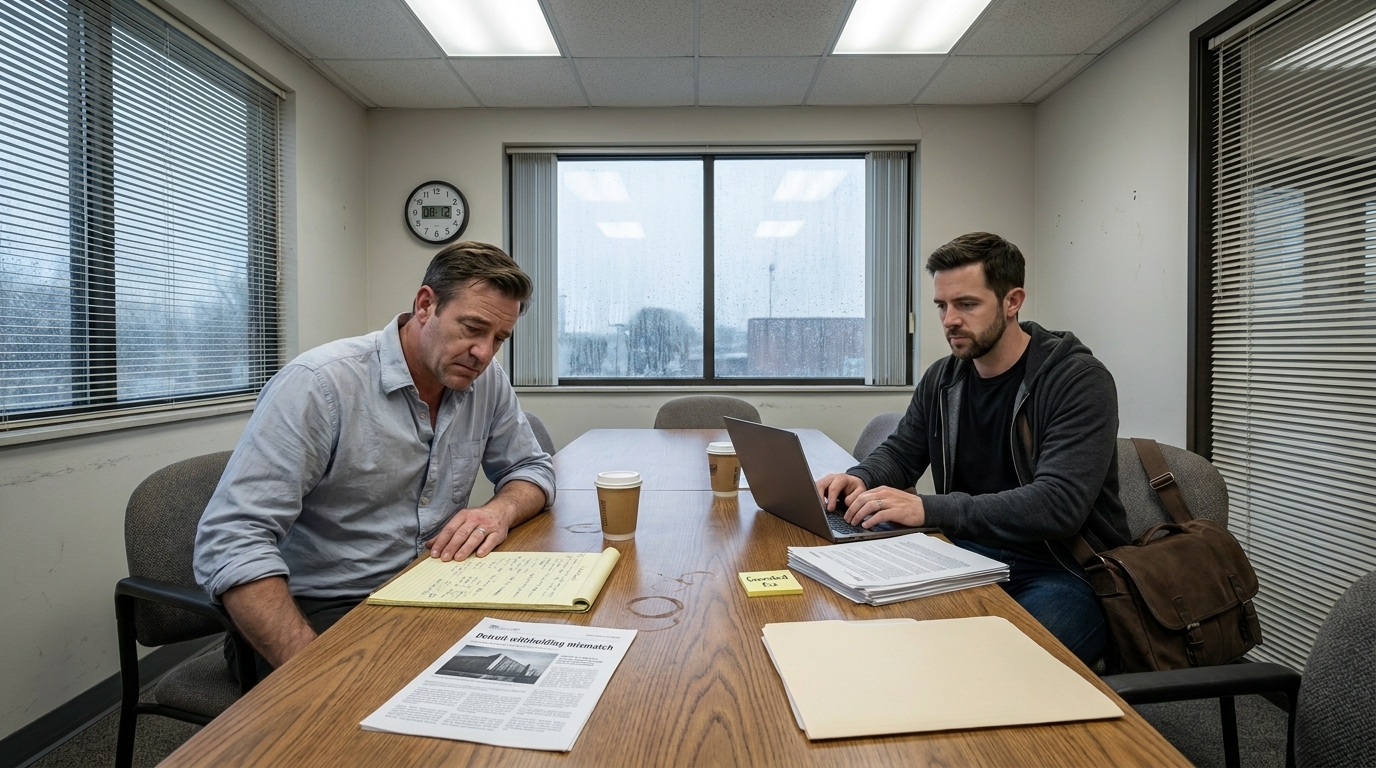
Nathan had spent enough years in this building to know the difference between a meeting and a sacrifice.
A meeting had a calendar invite and a stated purpose. A sacrifice had those too, but the real function was to let reality enter the room just far enough for someone above him to push it back out again with cleaner language.
He looked at the packet on the table and tried to believe this one was different.
Ethan had arranged the pages in the order a sane person would need them. First, the Detroit mismatch the client had already forced into daylight. Second, two more municipalities where the same lookup pattern could produce the same kind of error. Third, the proposed fix: move the jurisdiction override logic into the new C# service, cover it with scenarios, gate it behind a feature flag, run it in staging until they were certain, then release with a client communication that was precise instead of panicked.
No grand rewrite. No manifesto. No cloud sermon.
Just harm, evidence, boundary, fix.
Nathan ran his thumb along the edge of the packet until the paper bit lightly into his skin.
“This is the most reasonable version of this conversation we can possibly bring him,” he said.
Ethan sat across from him with one ankle hooked under the chair rung, reading the printout again even though he already knew every line. He had the irritating calm of a man who believed facts could still matter if arranged properly.
“It should be,” Ethan said. “We’re not asking for permission to feel important. We’re asking to stop shipping wrong numbers.”
Nathan gave a tired smile that disappeared almost immediately.
“You say that like those are the same thing to everyone.”
Ethan looked up. “They should be.”
That was what Nathan liked and feared in equal measure. Ethan wasn’t naive in the childish sense. He knew systems lied. He knew organizations protected themselves. He just kept acting as if the defect itself ought to have more moral weight than the choreography around the defect.
In this company, that made him dangerous.
Nathan picked up the top page. On it, Ethan had highlighted the blunt line from the failing scenario:
Expected 20.52. Got 16.52.
No accusation. No theory of motive. Just a number refusing to become a euphemism.
“If Derek asks whether this is isolated,” Nathan said, “start with Detroit, then the pattern. Don’t jump to ‘systemic’ unless he makes you define terms.”
Ethan leaned back. “It is systemic.”
“I know.”
“Then if he asks, I’ll answer the question.”
Nathan let out a breath through his nose. “That’s what I’m afraid of.”
Ethan’s expression softened, not with pity, which Nathan would have hated, but with the recognition of a man who could see another man living inside rules he did not respect.
“You want him to hear it without feeling cornered,” Ethan said.
“I want him to hear it without deciding the problem is me for bringing it in.”
That sat between them for a moment with the weight of something too old to explain from scratch.
The conference room smelled faintly of toner, burnt coffee, and the wet wool of Nathan’s coat drying over the back of a chair. Outside the door came the usual office noises: a phone ringing too long, someone laughing too brightly at something not funny, the small metallic clack of Linda’s binder rings opening and closing somewhere down the hall.
Ethan tapped the third section of the packet.
“This part matters most,” he said. “The fix is bounded. Nobody has to swallow a philosophy. We mirror the lookup in the service, lock it behind a flag, compare outputs, and turn it on only when the numbers line up. We reduce harm and buy ourselves room.”
Nathan nodded.
This was why he had wanted Ethan in the room. Not because Ethan was theatrical. The opposite. Ethan had a way of making a frightening thing sound finite, and finite was the only size of truth this building ever had a chance of tolerating.
“And the client note?” Nathan asked.
“Short,” Ethan said. “No self-protection language. No ‘we appreciate your patience while we investigate.’ Just: we identified the rule path, we’re validating the correction, here’s when you get the next update.”
Nathan almost laughed.
“If you say ‘self-protection language’ out loud to Derek, he’ll taste blood.”
Ethan’s mouth pulled to one side. “Then I won’t say it that way.”
Nathan looked at him for a second longer than the moment required.
It had been years since he had prepared for a meeting by thinking about how to keep the truth intact, rather than how to make it survivable for people above him. The feeling in his chest wasn’t quite hope. Hope was too clean a word. This felt more like standing on ice that might actually hold and being angry that the sensation had become unfamiliar.
The calendar reminder flashed on Nathan’s screen.
10:30 — Derek Lawson — Detroit remediation path
He checked the time. Enough margin to walk Ethan through the packet again. Enough time, maybe, to keep the thing from turning into a spectacle.
Then his desk phone started ringing from the open area.
Nathan froze.
Nobody else picked it up.
It rang again.
He knew that rhythm. Support line forwarded to his extension because someone, somewhere, had heard the phrase payroll discrepancy and decided the oldest ritual in the company still applied.
Nathan closed his eyes once.
“Don’t,” Ethan said quietly.
Nathan opened them. “If it’s a live file issue, I can’t not.”
“You can call back in three minutes.”
Nathan gave him a look that was almost gratitude and almost despair.
“That’s not how this place trains people.”
The phone rang a third time.
He stood, already feeling the meeting slide away from the version he had tried to build.
“I’ll be back before Derek gets here,” he said. “If he’s early, stall him. Small first. Detroit. Then pattern. Then bounded fix.”
Ethan gathered the packet into one clean stack. “Nathan.”
Nathan paused in the doorway.
“If he asks the plain question,” Ethan said, “I’m giving the plain answer.”
Nathan’s hand tightened around the door handle.
He wanted to tell him not to. He wanted to say that in this building plain answers turned into disciplinary events with no witnesses and no names attached to the damage. But he also wanted, with a hunger that embarrassed him, for one person in one room to tell the truth and not immediately apologize for the shape of it.
“I know,” Nathan said.
Then he went to answer the phone.
Wednesday, 10:37 — Five Minutes
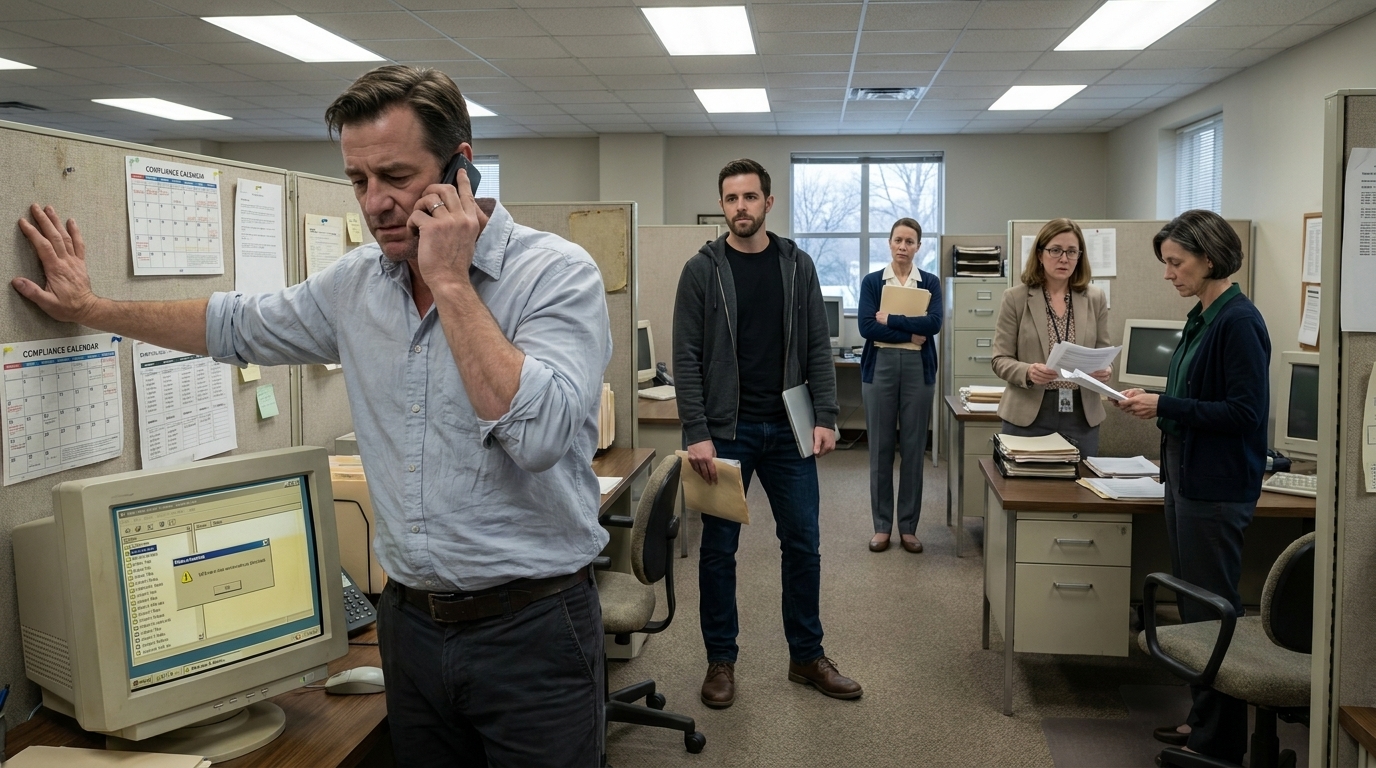
The call should have taken two minutes.
That was the first lie every day at Whitaker Payroll told.
Nathan stood with the handset jammed hard against his ear while a payroll administrator from Akron talked in a breathless, angry loop about a plant manager who had uploaded the wrong adjustment file twice, a union deduction that had doubled for forty-three employees, and a CFO who was now threatening to halt transmission until someone “competent” called him back.
Nathan could hear crying in the background at the client site. Not loud. Not performative. Just someone at the edge of a bad day hearing it get worse.
He pinched the bridge of his nose until stars moved behind his eyelids.
“Open the audit table,” he said. “Not the summary. The audit table. No, not in the VB6 screen. In SQL. I know. I know you don’t usually go in there. I’m telling you where.”
Across the aisle, Ethan waited without hovering. The packet stayed tucked under one arm. He checked the conference-room clock through the glass panel, then looked back at Nathan.
Ten-thirty.
Derek would not come to them. Derek would summon. Which meant every extra minute Nathan spent here widened the angle at which Ethan would have to walk into that office alone.
Nathan caught Ethan’s eye and mouthed, Five minutes.
Ethan gave one short nod.
Linda drifted closer under cover of needing something from the filing cabinet. Nathan saw her in the reflection on a dark monitor: dark cardigan, careful bob, mouth set in that neutral line she used when she wanted to look like concern itself had put on sensible shoes and come to check on you.
Sharon and Donna didn’t get up, but their stillness had a listening quality to it.
“No,” Nathan said into the phone, trying to keep impatience out of his voice and failing. “The row with the manual override flag. Read me the date on that row.”
He listened.
2009.
Of course it was 2009.
An old emergency workaround breeding quietly in the dark until it became policy by age alone.
Nathan looked down the aisle again. Ethan was already moving.
Not rushing. That would have looked guilty. Just heading toward the inevitable with the packet, the laptop, and the face of a man refusing to practice embarrassment in advance.
Nathan pulled the handset tighter to his ear and stepped half out of the aisle.
“Ethan.”
Ethan stopped.
“Start without me,” Nathan said.
A beat.
Not because Ethan doubted him. Because they both knew what those words might cost.
“You sure?” Ethan asked.
Nathan almost said no.
Instead he looked at the support line blinking on hold, at Linda pretending not to watch, at the old company gathering itself around the smallest possible interruption like tissue around a splinter.
“I’ll be right behind you,” he said.
It wasn’t a promise. It was a prayer in office clothes.
Ethan tipped his head once and kept walking.
Nathan watched him disappear around the corner toward Derek’s office, the packet held flat against his side, and felt a physical drop inside his chest. Not panic exactly. Something colder. The intuition of a man who has lived long enough under bad systems to recognize the soundlessness that comes right before the damage starts.
He turned back to the call.
“Okay,” he said. “Back to the override row. Read me the code.”
Wednesday, 10:44 — The Gentle Knife
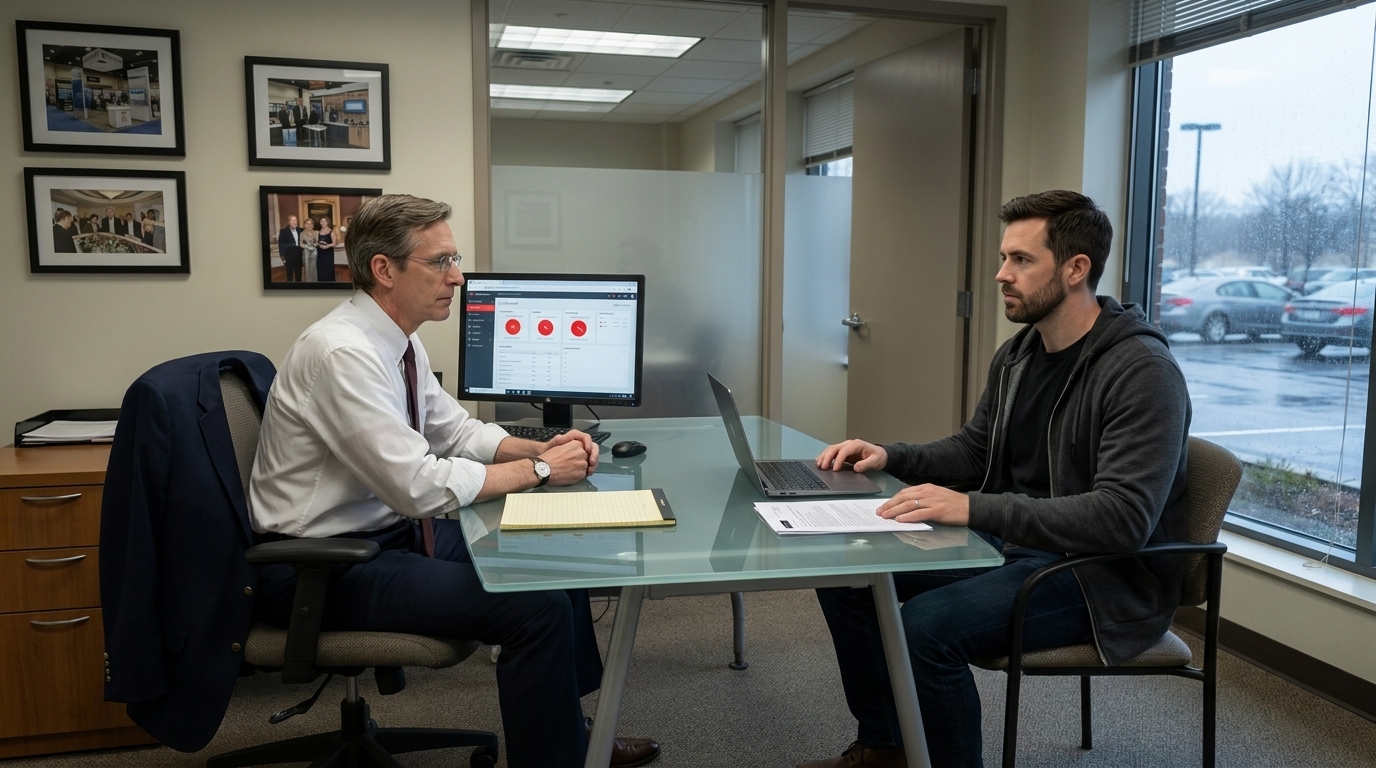
Derek Lawson stood when Ethan entered, which was generous of him in exactly the way a staged gesture is generous.
“Ethan,” he said, smiling with careful warmth. “Nathan got pulled into something live. I’m sorry about that. These places always choose their own timing.”
He said these places as if he were not one of the people manufacturing the weather.
Ethan set the packet on the desk and took the offered chair.
“He said I should walk you through the Detroit issue and the remediation path,” Ethan said.
Derek sat back down. “Perfect. I’d love the short version first.”
Short version.
The phrase landed lightly, but Ethan heard the sorting logic underneath it. Not what is true. What is containable.
He opened the packet to the first page.
“The Detroit withholding problem isn’t a one-off bug,” he said. “It’s a rule-path problem. We traced it to a manual override pattern that can survive from one emergency fix into ongoing payroll without anyone explicitly reauthorizing the logic. Detroit is where the client forced it visible. There are at least two other municipalities where the same pattern can produce the same class of error.”
Derek’s expression did not change, but his hand stopped moving on the legal pad.
“Can,” he repeated.
“Yes.”
“Has?”
Ethan met his eyes.
“We have reproduced Detroit. We have enough evidence to treat the pattern itself as credible risk, not theory.”
Derek tapped his pen once on the glass desk.
“And Nathan feels comfortable with that framing?”
There it was already. Not the numbers. The chain of ownership around the sentence.
“Nathan asked me to walk you through it,” Ethan said. “The important thing is the fix is bounded.”
He turned to the third section and slid it forward.
“We mirror the override logic in the new service, cover it with scenarios, compare against staging output, and gate the correction behind a feature flag. We don’t touch production until the numbers line up. Then you can communicate clearly to affected clients what changed and why.”
Derek read the page without really reading it. Ethan could tell by the movement of his eyes. Derek was literate in the forms of control, not the substance.
“I appreciate the discipline,” Derek said. “I do. This is thoughtful work.” He looked up. “What worries me is the social surface around it.”
Ethan kept his face still.
“Meaning?”
“Meaning confidence,” Derek said. “Meaning how much unfinished interpretation starts circulating once something technical gets translated too early into certainty.”
Outside the office glass, a support rep walked past carrying a stack of envelopes. Somewhere down the hall a printer started up with a dry mechanical chatter. The office kept breathing its small administrative breaths while Derek arranged the ethical problem into a communications problem.
Ethan rested his hand flat on the paper to keep from folding it.
“The numbers are not unfinished interpretation,” he said. “They are numbers.”
Derek smiled again, almost sympathetically.
“Of course. But organizations don’t experience numbers in isolation. They experience them in a context. And part of leadership is sequencing that context so people aren’t forced into conclusions before they’re actually useful.”
Ethan had heard versions of this speech in enough industries to recognize the move. The defect was real. The harm was real. But the greater sin, somehow, was allowing reality to arrive without managerial escort.
He kept his voice level.
“I’m not asking you to panic anyone. I’m saying developers and clients can’t carry less harm by pretending not to know what we know.”
Derek’s fingertips came together in front of him. He liked this pose because it made patience look like principle.
“No one is pretending,” he said. “I’m asking for stewardship. There is a difference between discovery and broadcast.”
“The screen in the open area is internal.” Ethan said it plainly. “It exists because internal teams need to know when the run is telling them the truth.”
Derek’s gaze sharpened by a degree.
“The screen exists,” he said, “in a shared environment where people without the right framing can engage with it as if it were a verdict.”
“It is a verdict on the run.”
That did it.
Not outwardly. Derek did not bristle, raise his voice, or lean forward like a man in a losing argument. He only grew more composed. Ethan had seen men like this before. Every increase in smoothness meant the real offense had landed.
“Ethan,” Derek said softly, “I think this may be where role clarity matters.” He glanced once at the packet. “You were brought in to strengthen development. Nathan values your technical judgment. I value it too. But client trust, organizational confidence, and how sensitive findings move through the company can’t be improvised by whoever happens to discover something first.”
Contract programmer.
He didn’t say the phrase. He didn’t have to. It sat in the room like a hidden caption under every sentence.
Ethan felt heat move up the back of his neck, not because he felt personally slighted, though he did, but because he could see the structure so clearly now. A wrong number mattered less than the fact that the wrong person had helped it become legible.
He kept his hands open on the desk.
“I’m not asking to own your client relationships,” he said. “I’m asking you not to make truth wait for permission. If a detected defect has to pass upward privately before the people doing the work can treat it as real, you’re optimizing for deniability, not correction.”
Silence.
A longer one this time.
Derek let it sit. Ethan could almost watch him choosing the shelf he wanted this conversation to live on later when he retold it. Not a disagreement about harm. Not an argument about ethics. An issue of tone. Of fit. Of a contractor who didn’t understand how institutions held confidence.
When Derek spoke again, his voice was gentle enough to pass for concern.
“I hear the intention behind that,” he said. “I do. And I don’t think you’re wrong to care about harm. But in a regulated business, care without governance can become its own form of risk. We need defects brought upward first. Quietly. With context. Before people start building interpretations that outrun our ability to manage them well.”
He wrote something on the pad. Not a note Ethan could read. Just the performance of notation.
“Going forward,” Derek continued, “technical findings come through Nathan to me. No broader visibility, no client-facing language, no public signaling until we’ve aligned internally. That’s not suppression. It’s stewardship.”
Ethan looked at him and understood, with an exhaustion that felt older than the room, that Derek believed the words as he said them. Not fully. Not cleanly. But enough. Enough to sleep on. Enough to let administration do the violence for him later while he retained the sensation of having behaved responsibly.
“You know the Detroit number is wrong,” Ethan said.
Derek’s pen stopped.
The office around them went oddly sharp in Ethan’s senses. The faint citrus of furniture polish. The hum from the monitor. A drop of rain walking down the outside of the window.
“I know,” Derek said after a beat, “that this requires a disciplined response.”
There was the answer.
Not yes.
Not no.
The managerial middle where responsibility could stand forever without touching the ground.
Ethan closed the packet.
“Then that’s all I have,” he said.
Derek looked almost relieved by the neatness of that.
He stood, extending the meeting into an ending before Ethan had technically offered one.
“I appreciate the work,” he said. “Truly. Nathan needs support. What he doesn’t need is more noise around him. Let’s keep you focused where you’re strongest.”
Ethan rose too.
He took the packet, but left one copy of the remediation page on the desk.
“What he’s strongest at,” Ethan said, “is carrying consequences nobody else wants to name.”
Derek’s smile held.
“All the more reason,” he said, opening the door, “to reduce unnecessary strain.”
Ethan walked out before the room could teach him one more lesson in the difference between a human voice and a humane one.
Wednesday, 11:06 — Fit and Governance
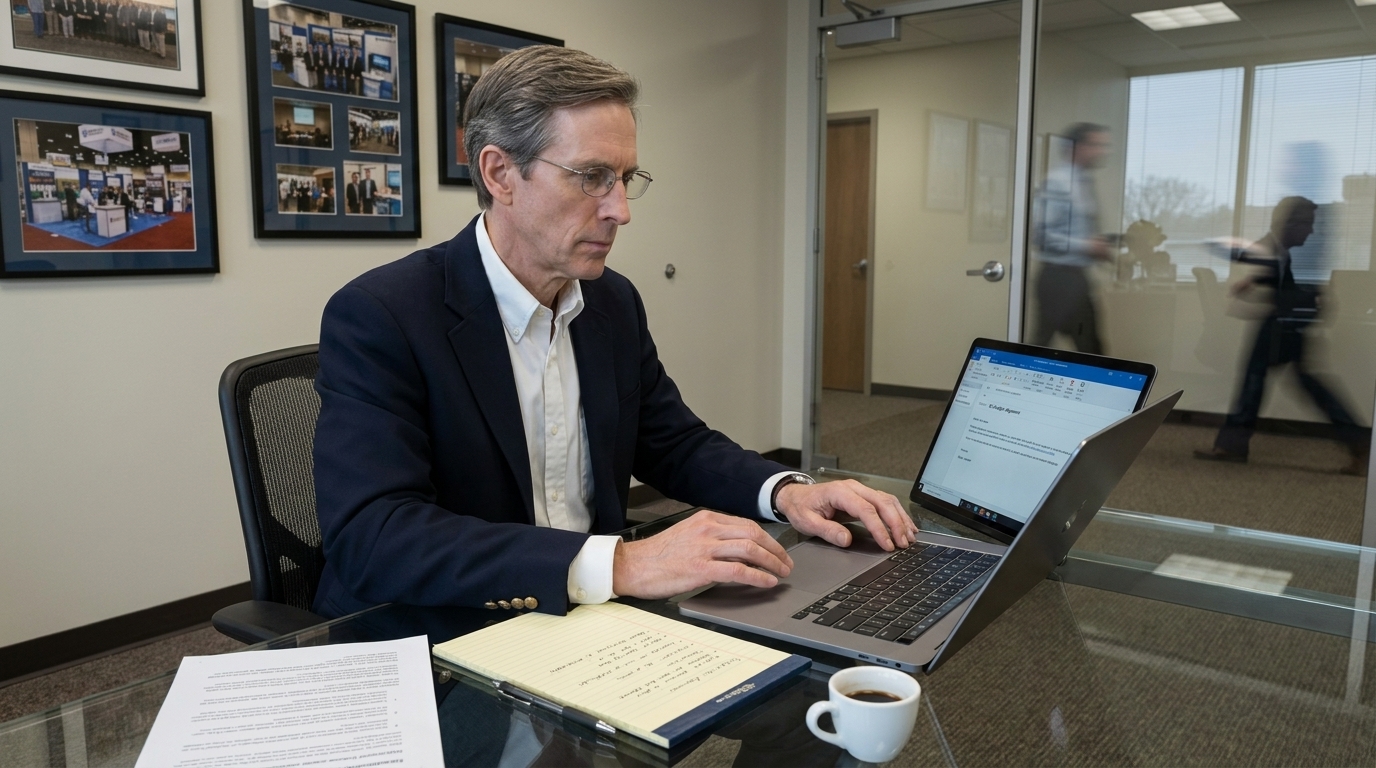
Derek stayed standing for a moment after Ethan left, one hand still on the doorknob.
Not because he was shaken. He would never have granted the moment that kind of drama, even privately.
Because the man had made the mistake of being correct in a way Derek could feel.
That was the problem.
If Ethan had been arrogant, Derek could have disliked him cleanly. If Ethan had been theatrical, he could have dismissed him as one more consultant who needed an audience. But Ethan had spoken in the plain moral grammar Derek disliked most: numbers, harm, sequence, responsibility. He had done it without raising his voice. He had done it as though the defect outranked the room.
Which meant the room had to reassert itself.
Derek sat and looked at the remediation page Ethan had left behind.
It was good work.
He knew that the way people know a bridge is solid without understanding structural mathematics. The pages fit together. The bounded fix sounded sane. Even the feature-flag language comforted the administrative part of him that loved reversible things.
But another recognition sat beneath it, sourer and more urgent.
If a contract programmer could walk into his office and speak that plainly about a defect, then Nathan had already allowed the technical side of the house to start behaving as if visibility itself conferred authority.
That could not spread.
Not because Derek wanted the numbers to stay wrong. The sentence formed in him and he almost believed it. Of course he wanted the numbers right.
He just wanted the rightness to arrive through the right people, in the right order, with his hand still on the valve.
Outside his office, Linda crossed the aisle with her binder pressed to her ribs. She did not look in, but Derek recognized the shape of her worry now. The screen in the open area. The client email. Ethan’s refusal to speak in cushions. The whole building had started to feel the pressure of conclusions trying to form without authorization.
Derek opened a new email.
Subject: Q4 budget alignment
He stared at the blank body for a second, then began to type.
Nathan,
I’m rebalancing contractor spend and support structure for the remainder of the quarter. Please treat Ethan Carter’s allocation as concluded after today and keep momentum with the internal team while we revisit fit, scope, and governance around external support.
He paused.
Too clear.
He backspaced three words and rewrote the sentence until it could be read two ways by a tired man moving too fast.
I’m rebalancing contractor spend and support structure for the remainder of the quarter. Please act accordingly on Ethan Carter’s line and keep momentum with the internal team while we revisit fit, scope, and governance around external support.
Better.
Still deniable. Still administrative. Still the sort of message a person could misread as a billing question if he needed, for one more night, to believe that adults would say the ugly thing aloud before making it real.
Derek added one more sentence.
Ops will clean up access on the back end as part of that adjustment, so no action needed there unless something odd surfaces tomorrow.
He read the whole thing once.
Then again.
He was not firing Ethan, he told himself. That language was too crude for what this was. He was correcting a fit problem. Protecting confidence. Reducing strain on Nathan. Creating space while governance caught up with speed.
He hit Send before the sentence lost its grooming.
For a moment he sat very still and listened to the email leave.
Then he took the remediation page Ethan had left behind, squared it with the edge of the desk, and placed it under the legal pad where it could stop accusing him with its visible competence.
Wednesday, 18:41 — Budget Adjustments
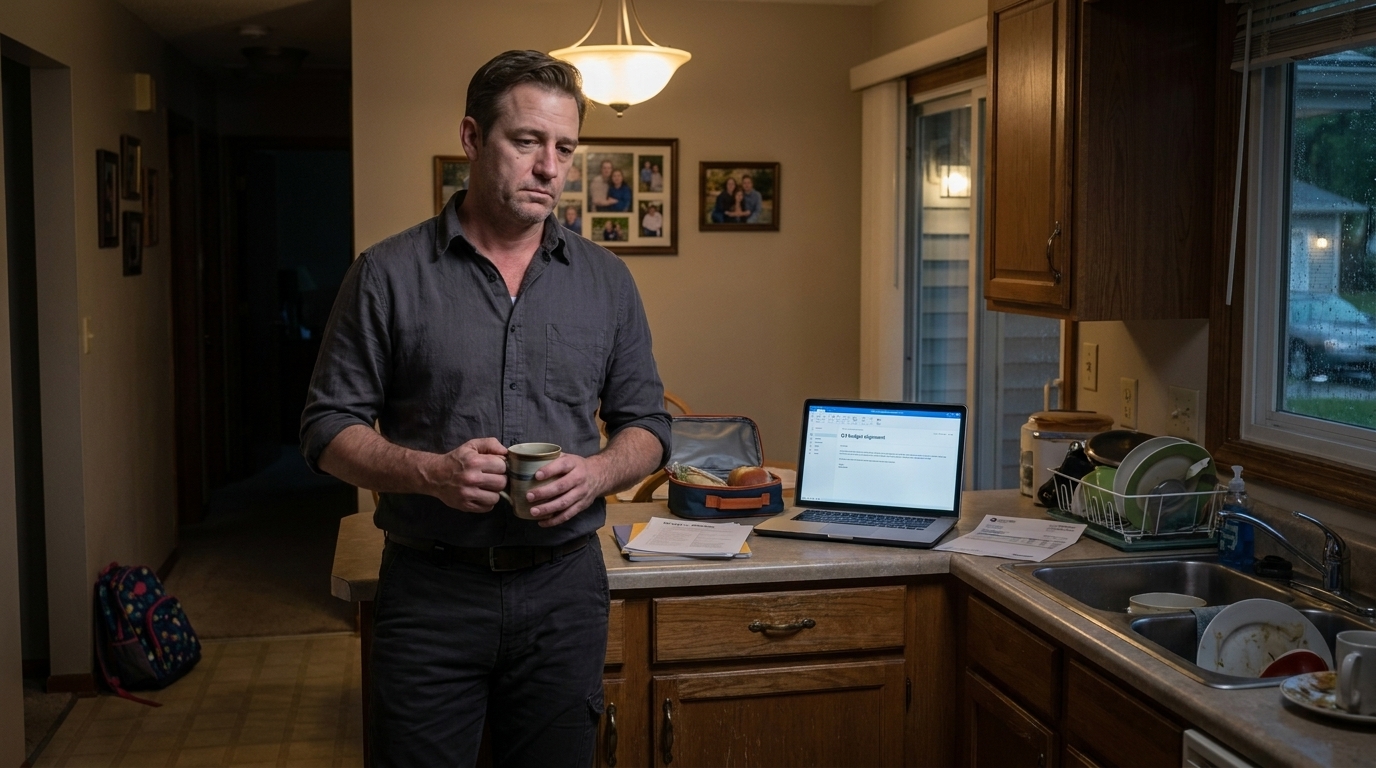
By the time Nathan got home, the day had already hardened into the kind that left a residue in the body.
The Akron issue had become three issues. Detroit had become a second call from Great Lakes asking for timing, not reassurance. Linda had stopped by his desk twice with questions that were too polished to be innocent. Donna had sent a follow-up email copying Sharon on a historical exception nobody had asked about. Ryan had quietly taken the wall screen off the shared monitor after Ethan said, flatly, “Derek asked for less public visibility.”
Nathan had not missed the sentence.
He had missed the meeting.
That fact sat under everything else like a bruise you only feel when something brushes it.
His wife had put a plate in the microwave and gone upstairs with the kind of silence that was less merciful than anger. One of the kids had left a worksheet on the counter covered in crooked multiplication and pencil ghosts where wrong answers had been rubbed away too hard.
Nathan stood in the kitchen after eating half the reheated chicken without tasting it, laptop open, work still bleeding into the house in thin gray tabs.
His inbox refreshed.
Derek Lawson.
Q4 budget alignment.
Nathan opened it with the flat, tired reflex of a man who expected one more demand for a spreadsheet he had never claimed to own.
He read the first sentence once.
Then again.
I’m rebalancing contractor spend and support structure for the remainder of the quarter. Please act accordingly on Ethan Carter’s line and keep momentum with the internal team while we revisit fit, scope, and governance around external support.
Below that:
Ops will clean up access on the back end as part of that adjustment, so no action needed there unless something odd surfaces tomorrow.
Nathan stared at the screen.
Act accordingly.
Fit, scope, and governance.
Clean up access on the back end.
He could feel the meaning trying to organize itself, but exhaustion kept blurring the edges. Contractor spend. Maybe Derek wanted Ethan off client-facing work. Maybe he wanted hours frozen until finance reapproved them. Maybe this was another one of his administrative sulks translated into budgeting language because saying what he meant would have required owning it.
Nathan rubbed a hand over his face and felt stubble rasp under his palm.
His phone buzzed with a text from Ethan.
How bad was the rest of it?
Nathan looked from the text to Derek’s email and back again.
In the bedroom upstairs, a floorboard creaked. A child coughed in sleep. The refrigerator motor kicked on with a tired mechanical hum.
He typed with both thumbs.
Messy. Derek is doing his governance thing. I got an email about contractor spend and access cleanup. Reads like budget theater. Let’s talk in the morning before you start.
The reply came back after a minute.
Okay. I’ll be there early.
Nathan set the phone down but kept looking at it, as if the right interpretation might still surface if he sat still enough.
He went back to Derek’s email.
Read it a third time.
A fourth.
The ugliness stayed just outside the range of certainty.
That was Derek’s gift.
Never enough plain language to let you accuse him cleanly. Always enough pressure to make the consequences arrive anyway.
Nathan should have called. He knew that even through the fatigue. He should have phoned Ethan and said don’t come in until I talk to Derek. He should have forwarded the email to himself at work and started a fight that night instead of waiting for daylight to make the sentence look less cruel.
Instead he closed the laptop.
Not because he felt safe.
Because he was too tired to tell the difference between a warning and an administrative mood.
He stood alone in the kitchen for a moment with his hand on the counter, listening to the house settle around him.
Tomorrow, he told himself.
Tomorrow he would pin Derek down to the actual words.
Upstairs, rain began again, ticking lightly against the window over the sink.
On the dark screen of the closed laptop, Nathan could see his own reflection looking back at him with the exhausted uncertainty of a man who had just been told something terrible in a language designed to remain deniable until after it was done.
🎭 This Week's Episodes
Telenovelas show what we can't say in client meetings. The drama is heightened, but the patterns are real.
 Documentation Avalanche
The forty-seven questions from Passau become a daily occupation. Stefan finds a gap the navigation team cannot investigate without Marcus's approva...
Technical Consultancy
Embedded Delivery Partner
Embedded into your team as an active contributor, reducing delivery friction and helping important work move cleanly.
Technical Advisor
Peer-style technical assessments before far-reaching decisions; reduce architectural and product risk early.
Product & Delivery
Ship working software to real users earlier. Measure impact and adapt based on evidence rather than assumption.
Custom Software Development
High quality, maintainable software. Short-term augmentation that leaves lasting capability in your own team.
Recent Articles
- What the Last 20% of an AI-Built SaaS Looks Like (17.10.2026)
- AI Computer Use Is Not a Business Contract (09.10.2026)
- When Everything Is Finally Under Control (05.10.2026)
- AI Makes Technical Execution Cheap. Judgment Stays Scarce. (26.09.2026)
- The Agent Escaped. Who Left the Door Open? (24.09.2026)