The Run Tells the Truth
Ethan Carter turns the harness into a habit: every change runs the batch in daylight, and the Cucumber scenarios refuse to lie. Nathan Cole feels something like relief for the first time in years, because the system can finally accuse itself without waking him up at 02:18. Linda Pritchard feels the opposite. Evidence in English drains her moat faster than any modernization pitch ever did. Derek Lawson loves the dashboard until he realizes what it implies: if the run can tell the truth, it can also tell whose decisions kept the truth buried. By the time Nathan sends one honest sentence to a client, the room has already started treating visibility itself as the threat.
Monday, 07:44 — The Board
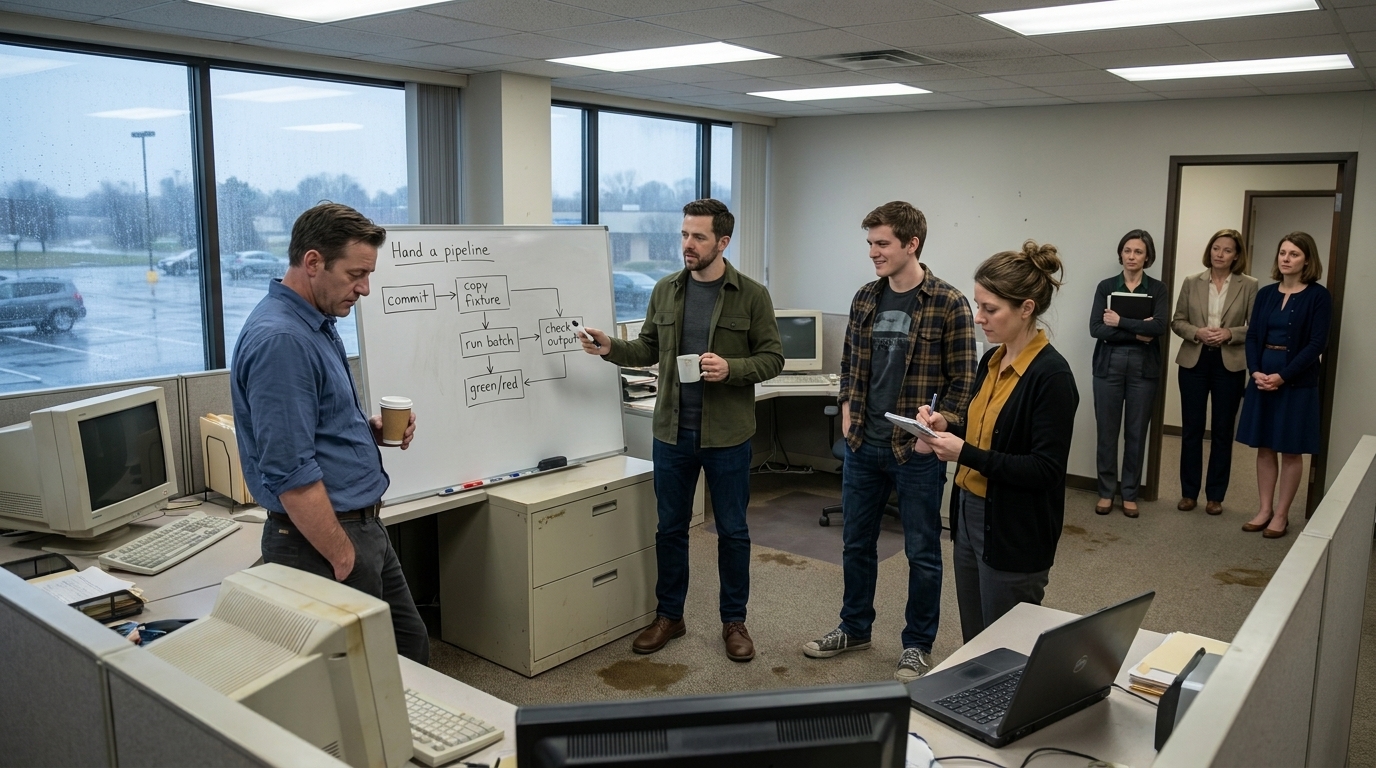
Ethan drew the last box and capped the marker.
He didn’t look like he was introducing a revolution. He looked like he was sketching a grocery list.
Nathan stared at the board until the boxes blurred.
This was the part that always died.
Not the “we should modernize” part. Everyone loved that sentence. They said it at trade shows. They said it in all-hands meetings when someone asked why the VB6 client still looked like it had been shipped on a CD.
The part that died was the part where modernization stopped being a feeling and became a schedule.
Ethan tapped the board once with the marker cap, not hard, just enough to make everyone look where he wanted them to look.
“Every change runs the harness,” he said. “No exceptions.”
Caleb gave a low whistle before he could stop himself. Ryan said nothing, but his gaze moved from box to box like he was pricing the risk hidden inside each arrow. Olivia wrote the sentence down in one clean line, as if recording it might make it harder to kill later.
Nathan repeated it under his breath. “No exceptions.” In his mouth the words sounded reckless, almost childish. In this building the safest thing you could do was nothing, and the second-safest thing was to call the nothing prudence.
Linda’s shoes clicked over the tile. She came to the edge of the group holding her binder against her ribs, not interrupting the meeting so much as changing its gravity.
“What does that mean,” she asked, her voice level enough to pass for curiosity, “for the nightly run?”
Nathan felt his shoulders pull tight before his mind caught up. Linda was not asking because she needed clarification. She was asking because she had already heard the threat. No exceptions meant no private gates. No private gates meant no one got to bless the truth before anyone else saw it.
Ethan turned to face her with the same calm he’d used on the whiteboard. “It means the nightly run stays exactly what it is. The harness doesn’t touch production. It runs on staging. Same runtime. Same collation. Same folders. But it runs whenever we change anything that might affect the batch.”
Donna’s fingers creased the top page of her notebook. “And who decides what might affect it?”
Ethan took that one seriously too. “The harness decides.”
Sharon’s mouth compressed into a line. “The harness isn’t… a person.”
There it was. Nathan heard the fear under the grammar. A person could be delayed, softened, persuaded into remembering context. A harness would only remember input and output, and it would remember both in writing.
Ethan looked back at the board as if the answer lived there in plain sight. “Right now, the batch runs at 02:18. It processes hundreds of client files. It produces thousands of paychecks. And the only test is whether Nathan hears a phone ring later.”
The room went still around Nathan. He felt the old drop in his stomach, the one that came whenever someone described his life with enough accuracy to make it visible. Ethan didn’t press the point. He just finished it.
“That’s not compliance,” he said. “That’s a prayer.”
Caleb’s grin died. Olivia stopped writing. Ryan cleared his throat with the careful sound of a man deciding whether he wanted to be heard at all.
“We can wire it into a build server,” Ryan said. “A job that triggers on commit. Runs the features. Posts results.”
Nathan turned to him. Ryan almost never volunteered the dangerous version of a good idea unless a crisis had already forced everyone else into honesty.
“Exactly,” Ethan said.
He reached into his messenger bag and pulled out his laptop. No reveal, no flourish. Just a scarred machine with a sticker on the lid that said Ship Small. Nathan thought, absurdly, of the last laptop someone had opened in that room: a consultant three years earlier, all PowerPoint and gradients and promises about cloud transformation. They had promised dashboards, predictability, sleep. They had survived twelve days and left behind a binder of printed slides Linda still kept like evidence that the company had already tried change once and could therefore reject the next twenty attempts for free.
Ethan brought no slides. He brought a shell prompt.
“Before we make it fancy,” he said, opening a config file, “we make it boring.”
The words landed harder than they should have. Nathan watched a path to the staging server appear on screen, then a command to run cucumber. A few lines of text, nothing polished, nothing managerial. Caleb leaned in until Nathan could smell deodorant and coffee on him.
“What’s the trigger?” Caleb asked.
“A commit,” Ethan said.
Linda’s binder made a dry cracking sound under her grip. “Commit where?”
Ethan paused just long enough for the room to tense. Nathan already knew the answer. He had seen the retainer paperwork. GitHub. History. Evidence. The opposite of what this building believed source code should be.
“On GitHub,” Ethan said.
Linda’s mouth flattened. Derek Lawson still hadn’t arrived, and Nathan almost wished he would, not because Derek would help but because Derek’s presence distributed blame like insulation. Without him, the moment belonged too clearly to Nathan and Ethan. If it blew up, the chain of consequences would run right back through whoever had allowed visibility in the first place.
Olivia raised her hand a little, halfway between habit and apology. “Is that allowed?”
Ethan looked up. “Allowed by who?”
Color rose into Olivia’s face. Nathan felt the same answering heat in his own neck. Allowed by Derek. Allowed by a company that treated source code like contraband and version history like a security risk.
Nathan’s phone lit on the table before anyone could say more.
Payroll Run Review — 08:15 — Derek’s office.
Ethan saw the reminder and, to his credit, did not look at Nathan with sympathy. Nathan stood, throat gone dry, and looked once more at the board. A pipeline. A promise. A target someone had now had the bad manners to draw in permanent marker.
“I have to go,” Nathan said.
Ethan gave one small nod. “We’ll keep it small.”
Nathan wanted to believe him. But he knew what small became in buildings like this when it threatened the wrong person. It became a fire hazard. It became intent. It became a match struck in a room full of old paper.
Monday, 08:19 — The Compliance Smile
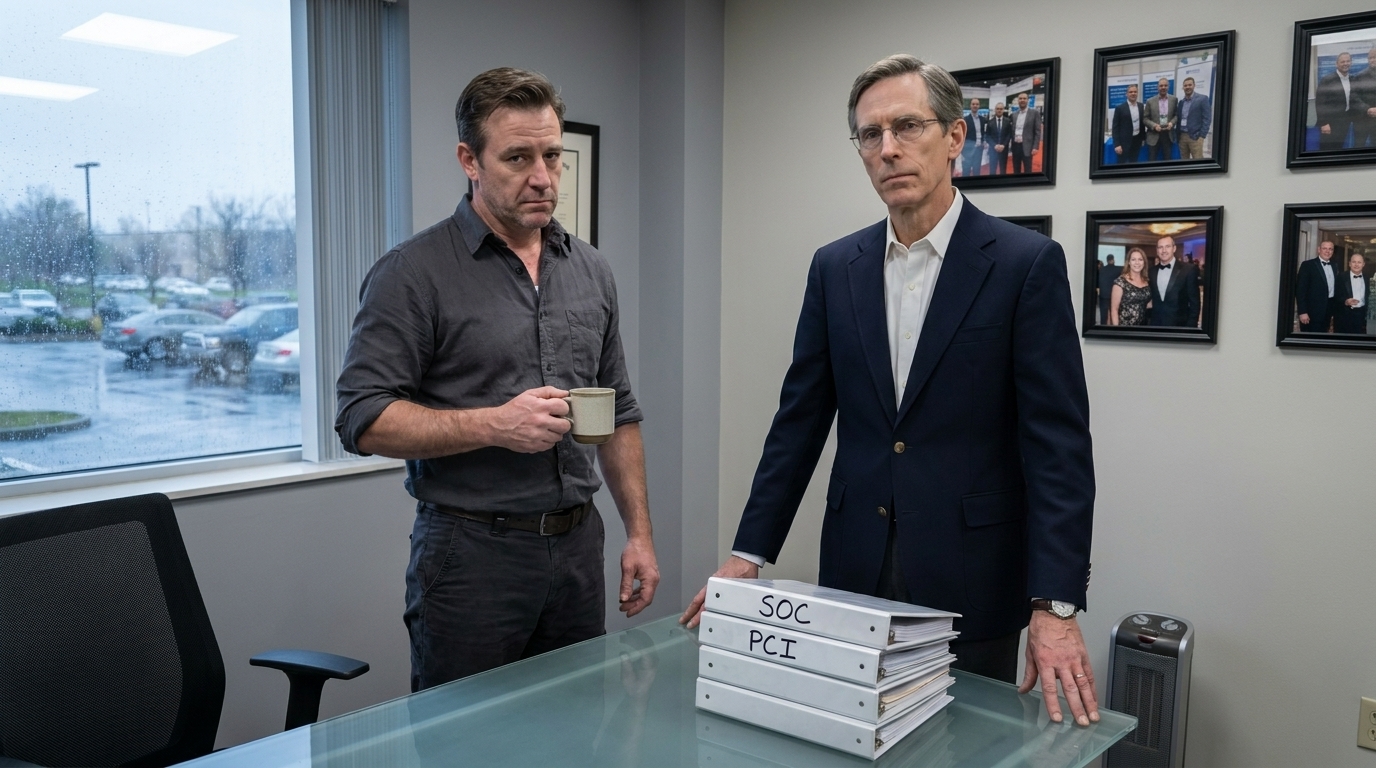
Derek Lawson looked like someone who’d never seen a production outage.
Nathan knew that wasn’t technically true.
Derek had seen outages.
From the safe side of the glass, watching Nathan solve them.
Derek smiled at Nathan the way you smile at a delivery person you depend on and have still somehow decided ranks below you.
“Good weekend?” Derek asked.
Nathan’s mouth twitched around the lie before he spoke it. He had spent Saturday morning patching a jurisdiction table by hand and Sunday night rerunning files because a client had changed union-dues logic and the system had responded to the change like a kicked animal.
“Sure,” he said.
Derek slid a sheet of paper across the desk. A checklist. Boxes, signatures, titles. Derek loved paperwork the way some men loved prayer: not because it changed reality, but because it let them feel accompanied while reality stayed inconvenient.
“I think we have an opportunity to bring a little more maturity to the process,” Derek said. “Nothing dramatic. Just a bit more structure around how changes move.”
Nathan’s eyes moved over the bullet points.
Change request. Impact assessment. Approval. Documentation.
Words that meant one thing in companies that actually shipped software and something completely different in buildings where software was treated like an heirloom vase everyone blamed the nearest programmer for breathing on.
Derek leaned back in his chair, pleased with the page between them. “I heard you and Ethan are making good progress.”
Nathan felt the prickle under his skin immediately. You and Ethan, as if Ethan were a tool Nathan had checked out of storage, as if progress were a deliverable Derek could claim so long as it arrived without any accounting attached.
“We’re building a harness,” Nathan said. “It runs the batch on staging and checks outputs.”
Derek nodded as if the nouns were enough. “Great. Love it. Audit trail. Controls. This is what I’ve been pushing for.”
Nathan nearly laughed, and the effort of not doing it made his jaw ache. Derek had spent years pushing against anything that required downtime, budget, or an admission that the system had defects. But Nathan knew which truths were acceptable in daylight and which ones only got you left alone with the consequences.
Derek clasped his hands over the checklist. “The key is, we reduce risk in a way that doesn’t create unnecessary concern while the work is still taking shape.”
Nathan looked at him and felt his pulse in his wrists. To Derek, risk meant one thing and one thing only: embarrassment with witnesses.
The technical truth bothered him, but not in a way that produced courage. He knew just enough to understand that Ethan might be right and not enough to feel entitled to say the SMEs were wrong. So he reached, as always, for the one authority structure that let him avoid deciding while still sounding decisive.
“So,” Derek went on, still warm, “let’s make sure changes come through me before they travel too far. No surprises. Just a little discipline around pacing.”
Nathan swallowed. Ethan was the least cowboy person Nathan had ever met. Ethan was boring on purpose. That was what made him dangerous. He removed the romance from the rescue and left only the evidence.
Nathan’s phone buzzed. The display showed a client name.
Great Lakes Staffing — Payroll Manager.
His pulse jumped hard enough to feel in his teeth. Derek saw the screen and his smile tightened at the edges.
“You should take that,” Derek said. “That’s exactly where your attention is most valuable.”
Nathan stepped into the hallway and answered on the second ring. “Cole.”
The payroll manager didn’t bother with pleasantries. “Your Detroit city tax is wrong again. My CFO is asking whether we should switch providers.”
Nathan closed his eyes. Four dollars. Always the same ghost, never enough to look theatrical, always enough to rot trust from the inside.
“I’m on it,” he said.
When he turned back toward Derek’s office, he could already feel the shape of the next hour: Derek’s concern, Derek’s offense, Derek’s determination to control the story more aggressively than the defect. Nathan thought of Ethan’s whiteboard with its blunt little colors. Green. Red. Truth. He wasn’t afraid of the bug. He was afraid of what happened when the bug acquired a dashboard and a timestamp and a witness.
Monday, 11:32 — The First Green
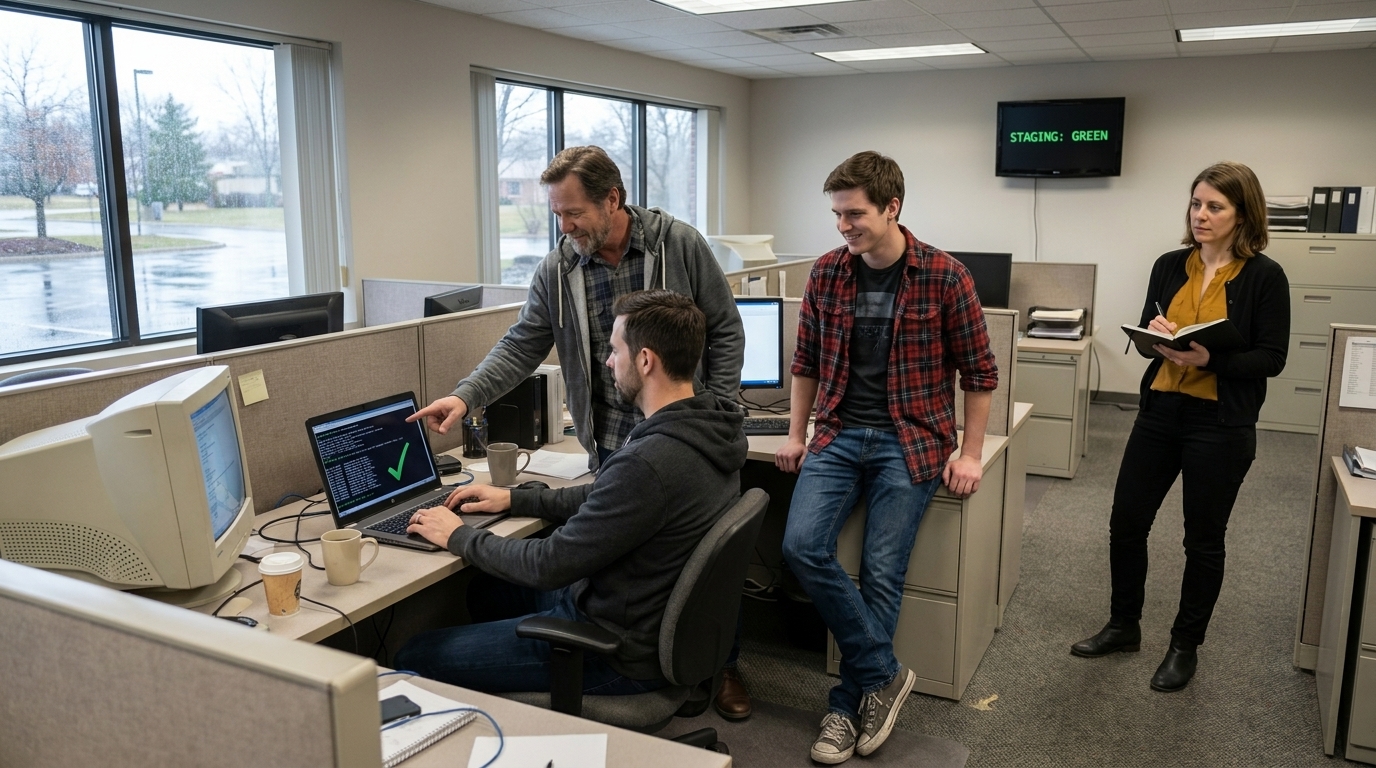
By late morning, the harness had a heartbeat.
It wasn’t fast.
It wasn’t elegant.
It didn’t have the kind of glossy interface that made executives clap.
It had one job.
Tell the truth.
Ethan pushed a change and leaned back while the job ran.
He didn’t watch the scrolling output like Nathan did.
He watched Nathan watch it.
Nathan stood behind him, arms folded tight across his chest, as if holding his ribs in place.
The job log ticked forward.
Copy fixture.
Kick batch.
Wait.
Parse output.
Compare.
The cursor blinked.
Nathan’s throat worked.
Caleb whispered, “He’s going to puke.”
Olivia elbowed him without looking away.
Nathan heard them anyway.
He didn’t care.
The job finished.
A green check appeared.
Nathan exhaled like he’d been underwater.
It was a stupid thing to feel relief about.
A test run on a staging server.
But Nathan’s body didn’t know how to separate “staging” from “paychecks.”
His body just knew whether the system had proven itself today.
Ethan turned the laptop slightly so Nathan could see.
“Four scenarios,” Ethan said. “Same as last time. Two still fail. But the harness ran. It didn’t time out. It didn’t lie. It did the boring thing.”
Nathan nodded.
His palms were damp.
He wiped them on his pants without thinking.
Ryan pointed at the wall-mounted TV.
“I can keep that up,” Ryan said. “Just a simple status board. Green or red.”
Ethan nodded.
“People don’t need details,” Ethan said. “They need a signal.”
Nathan’s chest tightened again.
Signal meant accountability.
In a healthy place, that was good.
Here, accountability was a weapon.
Linda walked past the desk, saw the wall-mounted screen, and stopped so abruptly Donna almost bumped into her.
The binder under Linda’s arm shifted higher against her body, more shield than office supply now. She looked at the TV, took in the simple green state, and then moved her eyes to Ethan.
“You’re putting that where everyone can see it,” she said.
It wasn’t a question. It was the formal registration of an injury.
Ethan didn’t flinch. “Yes.”
Linda’s mouth tightened. “And when it’s red?”
Nathan felt the room cool by a few invisible degrees. Caleb stopped smiling. Olivia’s pen froze above her notebook. Ryan’s hand fell away from the screen as if he had touched something live.
“When it’s red,” Ethan said, “we fix what made it red.”
Linda gave a laugh so small it almost counted as politeness. “That’s not how this place works.”
Ethan looked up at her. “That’s how software works.”
The silence between them held. For a second Nathan could see the scene from Linda’s side: a man in his forties, in a hoodie, speaking as if rules were physical laws instead of negotiated territory. Linda had lasted thirty years by understanding the opposite. In her world, rules were politics, and survival belonged to whoever controlled interpretation.
Her gaze slid back to the screen. Green she could live with. Green meant nothing had yet escaped containment. Red would mean questions. Questions would mean explanation. Explanation would mean the binder in her arms was no longer the last court of appeal. And if the explanation landed badly, Linda already knew how the room would move: Sharon would look to her, Donna would look to both of them, Derek would ask what the SMEs believed, and Graham would trust whichever answer sounded most protective of his father’s people.
Linda walked away without giving Ethan the dignity of another sentence. Donna followed her with her face drained pale. Sharon came last, chin tucked, glasses chain catching the fluorescent light.
Caleb let out the breath he’d been holding. “She’s going to kill us,” he murmured.
Nathan stared at the green check.
He wasn’t thinking about Linda.
He was thinking about the call from Great Lakes.
Detroit city tax wrong again.
A CFO asking whether to leave.
And for the first time in years, Nathan had something he could send back that wasn’t an apology.
He had evidence.
He had a failing scenario.
He had a red box waiting to happen.
Nathan’s relief was sharp enough to hurt.
Because relief in this building always came with a price.
That night, Olivia stood in her kitchen with one shoe still on, cutting chicken into smaller pieces while her daughter explained, in great emotional detail, why carrots were a personal attack. Her husband opened the fridge with the tired choreography of people who had done the same evening together a thousand times and asked, lightly, “So is the new guy helping, or is this another one of your company’s improvement rituals?”
Olivia kept cutting. “Maybe helping,” she said. “He’s not shiny. That’s a good sign.” She thought of Ethan at the whiteboard, talking about boring things like they might save lives. “He’s with Nathan. Asking the right questions. Making things testable.”
Her husband looked over at that. “So maybe you stop getting those nine o’clock messages.”
Olivia gave a short laugh without humor. “Maybe Nathan stops getting the two a.m. ones first.” She set the plate down in front of her daughter and felt, before she could stop it, how quickly hope turned into bargaining in places like this.
Across town, Ryan stood at the bathroom sink while his son brushed his teeth with the seriousness of a man cleaning a weapon. His wife leaned in the doorway, folding tiny shirts from the dryer into uneven squares. “You said there’s some contractor in there now,” she said. “The guy who’s supposed to help.”
Ryan rinsed toothpaste foam from the edge of the sink. “Ethan,” he said. “Yeah. Hoodie. Calm. Acts like broken things are allowed to be described plainly.”
His wife snorted softly. “That sounds expensive.”
“Probably,” Ryan said. Then, quieter: “But he might actually help Nathan.”
That was the part that stayed in the room after the rest of the conversation moved on. Not optimism exactly. Just the fragile possibility that one exhausted man might not have to keep holding up an entire company with his body.
Tuesday, 15:07 — The Message
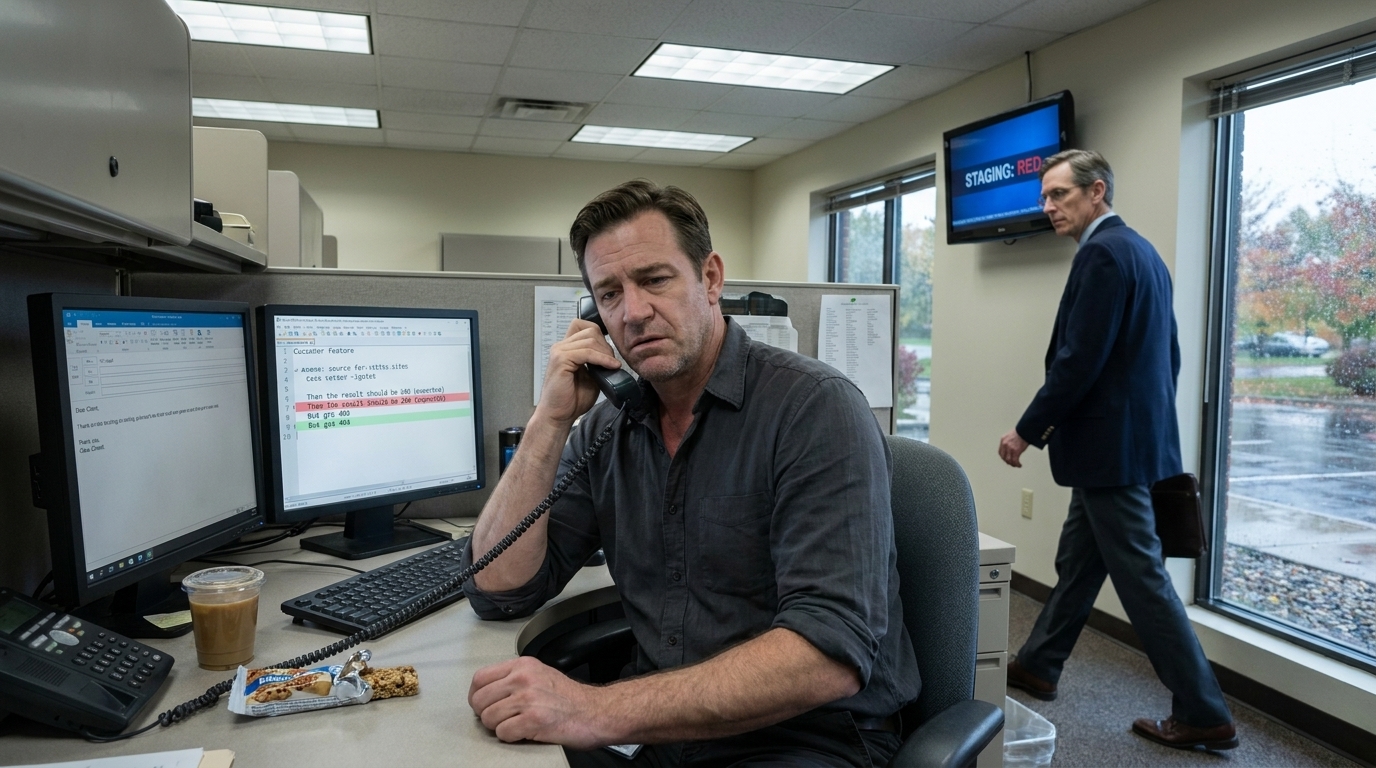
The first red came faster than Nathan expected, though that was only because he had spent years being trained to think truth should arrive slowly, privately, with enough time for somebody important to soften it.
Nothing new had broken. That was the worst part. The harness had not created a defect. It had simply dragged an old one into daylight. Ethan had merged a small parser change so the job could read one more field from the COBOL output. The run completed, checked the Detroit scenario, and failed in blunt red letters on the wall-mounted screen where support staff, admins, and anyone else passing by could see it.
Nathan watched Derek notice from halfway down the aisle. There was no scene, no demand, no raised voice. Just a tiny interruption in his stride, a glance that lingered one beat too long, and a hardening at the edge of his jaw before he kept walking as if the word on the wall were a projector glitch instead of a public indictment.
Before Nathan could decide what to do with that red bar, his phone rang.
Great Lakes.
He answered on the first buzz.
“Cole.”
The payroll manager did not bother with hello. “I am not getting on another call with my CFO and telling him we’re still looking into it.” Her voice was low and furious in the way people got when they had already spent their panic and were down to humiliation. “Did you actually find the problem or not?”
Nathan looked at the failed scenario on his screen. He looked at the same failure on the wall where half the office could see it. He looked once, involuntarily, toward the aisle where Derek had slowed just enough to register the red.
His mouth had gone dry so fast his tongue felt thick. A pulse knocked under his jaw hard enough to blur the edges of the room for a second. He could feel sweat gathering under his shirt even though the office still carried the damp chill from outside.
There was no safe sentence left.
“Yes,” Nathan said.
Silence on the line. Not relief. Readiness.
“Then I need that in writing,” she said. “Now. Something I can forward. I’m not walking into that room empty-handed while your company decides how careful it wants to sound.”
Nathan closed his eyes for one beat. On one side of him: a client who was done carrying the embarrassment for them. On the other: Derek, already feeling the story slide out of his control. Nathan could almost feel both hands on him at once.
His chest tightened until the next breath came shallow. It was the old sensation again, the one this place had trained into him: being reduced to a narrow piece of pipe with pressure building at both ends.
“You’ll have it in two minutes,” he said.
He ended the call and yanked open the top drawer of his desk. Under a nest of charging cables, stale mints, and unopened mail sat the orange prescription bottle he had started keeping beside the antacids. Use sparingly, the label said. That had been optimistic. Nathan shook one chalky white tablet into his palm and swallowed it dry before chasing it with cold coffee that tasted burnt enough to make his eyes water.
For a second he stayed bent over the drawer, breathing through his nose and waiting for the room to stop narrowing.
His phone lit again, not ringing this time.
You promised you’d be home for dinner tonight. They asked again.
He stared at the text from his wife until the words blurred, then turned the phone face down like that could postpone the damage.
He opened the email draft to Great Lakes. He wrote the sentence he had never once been permitted to send in plain English.
We have reproduced the issue in a controlled staging environment and are implementing a verified fix.
His hands shook while he typed, not because the words were technically difficult but because they felt illegal. Now they also felt irreversible. His fingertips kept slipping off the keys. He backspaced twice, swallowed against the acid pushing up his throat and the bitter dust of the pill still stuck there, and forced himself to keep moving before the old obedience could take hold again. He attached the screenshot anyway. Cucumber output, merciless and simple: Expected 20.52. Got 16.52. FAILED. Linda’s warnings rose in his head with familiar authority. Don’t give clients ammunition. Don’t admit fault. Don’t make it real. But the client had already forced the room past euphemism. Nathan hit Send before the older reflex could reach his hands.
The call from Derek came almost immediately.
Nathan let the phone buzz until the last possible second, then answered with a flat “Yeah” that fooled neither of them. Derek’s voice came back too smooth, stripped of surprise, already arranged into managerial order. Nathan was to come to his office now.
By the time Nathan stood, his stomach had already tightened around the shape of the meeting. His knees felt strangely hollow, the weakness humiliating enough to make him angrier. On the way down the aisle he passed the screen again. STAGING: RED. The word no longer looked like a status. It looked like accusation, evidence, maybe even revenge. He thought of Ethan’s whiteboard from Monday morning and the sentence he had half-dismissed then.
The pill sat in him like a superstition. Maybe it would catch up in ten minutes. Maybe it would do nothing. Lately nothing seemed to arrive before the damage did.
Automation makes enemies.
Now, with the whole office walking past a truth that used to belong to 02:18 and Nathan’s private dread, he believed it.
Tuesday, 15:18 — The Chain
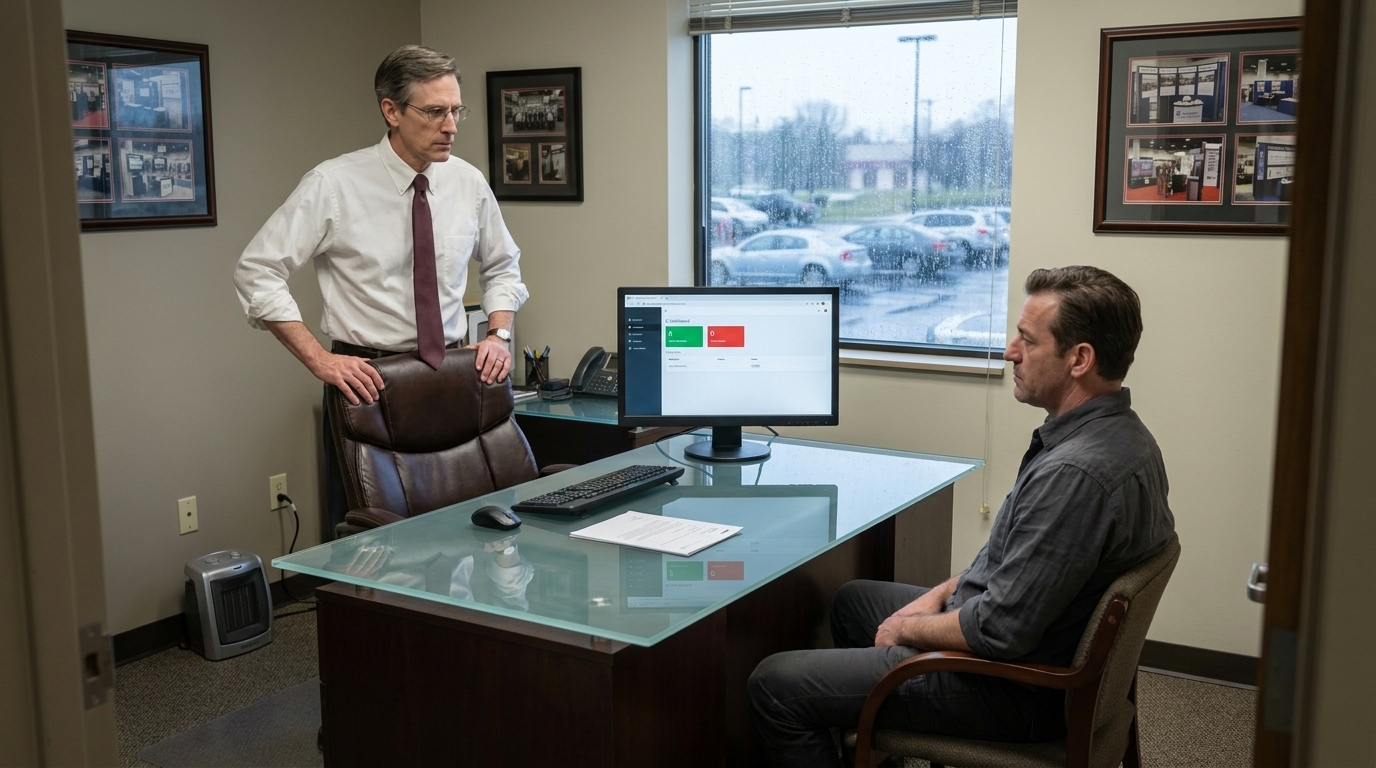
Derek made a point of staying on his feet.
It was a small cruelty, almost elegant in how practiced it was. Nathan was meant to stand there and receive the scolding like a schoolboy. Instead he sat down without asking and looked at the sheet of paper waiting on the desk between them.
The email was printed.
Derek had printed it.
For a second Nathan could not stop staring at that fact. Ink on paper. A screenshot stapled to it. The sentence he had sent to Great Lakes turned into evidence, as if honesty itself were now the breach under investigation.
His skin prickled. The room smelled faintly of printer heat and Derek’s expensive soap, and the combination turned his stomach enough that he had to lock his jaw before it showed.
He could feel the tablet dissolving somewhere beneath the nausea, too little and too late, like every other intervention in his life.
Derek touched the page with two fingers.
“This isn’t how I’d like us communicating something this sensitive,” he said.
Nathan’s mouth had gone dry. He could feel the pulse in his throat, in his wrists, in the cramped muscles across his shoulders. “It’s true.”
Derek’s face barely changed. That was what made him so hard to bear. Other people got loud. Derek only became smoother, more managerial, as if he were ironing human feeling flat in real time.
“Accuracy matters,” he said. “But so does how information lands.”
Nathan looked at him and felt something inside his chest sink with a slow, sick certainty. He had heard versions of that sentence for years, though not always in those words. Don’t alarm the client. Don’t make it formal. Don’t put it in writing. Don’t let the failure become real enough that someone with authority has to own it.
Derek tapped the paper again. “You told them we had confirmed an error.”
Nathan lowered his eyes to the email. He saw his own sentence there, small and calm and cleaner than the truth had any right to be. Then he looked back up.
“We are wrong.”
That finally stripped the smile away.
Not much. Just enough.
The pleasant executive language Derek liked to wear around groups vanished with it. No transparent leadership. No shared accountability. No talk of partnership. Just a man guarding the story that protected him.
When he spoke again, he used the soft voice Nathan hated most, the one that pretended reason while tightening the screws.
“Nathan, listen to me,” he said. “Of course we address it. That’s the work. But we need to be thoughtful about the trail we create while we’re still understanding scope. Once language like this leaves the building, people can start forming conclusions that are hard to walk back.”
The sentence hit harder than Nathan expected. Not because he respected Derek’s judgment. Because he was tired, and tired people bruise faster. Nathan had missed dinners, ball games, Sunday mornings, pieces of himself, keeping this place alive one invisible patch at a time. To hear all of that compressed into a warning about optics and other people’s conclusions made something sharp move behind his ribs.
He folded his hands together under the desk because otherwise Derek would see them shaking.
Outside, rain began ticking against the window. On Derek’s monitor the dashboard still sat open with its red bar across the top, mute and humiliating and pure.
Derek glanced toward it. “And that screen needs a more appropriate audience.”
Nathan almost laughed from sheer disbelief. “It is internal.”
“Not in its current form.” Derek turned back to him. “People are engaging with it before they have the framing to do that well.”
Nathan pictured the open area. The support staff slowing down as they passed the board. Olivia looking at the red status and understanding exactly what it meant. Linda hearing the first questions before she had time to frame the answers herself. He thought of all the nights that had ended with Nathan alone in the dark, fixing the company before sunrise so everyone else could walk into a normal morning.
That was the whole disease in one picture. Everyone knew enough to feel danger. Nobody wanted to be the first person to own what the danger meant.
“They should ask questions,” Nathan said quietly.
Derek’s expression changed by less than a full degree. “They should be given what is useful for them to hold,” he said. “That’s part of responsible leadership.”
That was the real sentence. Everything before it had just been packaging.
Nathan sat very still. He could hear the little electric hum from Derek’s monitor. He could smell coffee gone stale in the mug on the credenza. He could feel his own exhaustion like weight sewn into his clothes.
Derek kept talking, laying the chain out link by link and calling it structure. Nathan and Ethan could keep working. Client communication would be centralized through Derek. Changes would be surfaced through Derek. Ethan would stay focused on development rather than broader conversations. The rules came one after another in a calm voice, each one another hand around the throat of the thing Ethan had built.
He would take the defect first. He would add context. He would ask the SMEs to weigh in. He would brief Graham carefully. The chain sounded responsible because it redistributed ownership so efficiently that nobody inside it ever had to say, plainly and alone, the number is wrong.
If a defect appeared, Derek said, it should come to him directly first. Quietly. With context. Before it became a signal other people started interpreting for themselves.
“Understood?” Derek asked.
Nathan hated that word. In this room it never meant do you follow me. It meant do you accept being reduced. It meant will you bow without making me do this the ugly way.
He thought of Ethan in the open area, of the board on the wall, of how strange it had felt to send a client one honest sentence. He thought of how quickly honesty had been dragged in here and laid on a desk like contraband.
Nathan nodded once.
It felt like betrayal even though he knew it was survival.
Derek relaxed immediately, as if the room itself had become more comfortable now that obedience had been restored. He sat down, smoothed the printed email with the flat of his hand, and put the whole thing back into a language he could admire himself in.
“Good,” he said. “We’re building maturity.”
Nathan nearly broke at that, not outwardly, not in any way Derek would have had to witness, but somewhere inward and humiliating. Because there it was again: the theft. The work was Nathan’s. The night calls were Nathan’s. The fear was Nathan’s. And the story Derek would tell about all of it would be maturity.
When Nathan got to the hallway, his hands were shaking so badly he had to press them hard against his thighs to make them obey. He stood there for a moment, breathing through his nose, trying to get his face back into something other people could survive looking at.
Ethan looked up the second Nathan stepped into the open area. He took in Nathan’s expression, the stiffness in his shoulders, the fact that Nathan was holding himself together one deliberate muscle at a time.
“Chain-of-command?” Ethan asked.
Nathan nodded.
Ethan’s jaw tightened. He didn’t say I’m sorry. He didn’t say it’ll be fine. He knew better than that.
“We keep it small,” he said.
Nathan wanted to believe him so badly it almost hurt. But the board was red. The client had the screenshot. Derek had the printed email on his desk. And Nathan, standing there in the fluorescent light with his hands still shaking, understood that what Ethan had made was already too true to stay small for long.
🎭 This Week's Episodes
Telenovelas show what we can't say in client meetings. The drama is heightened, but the patterns are real.
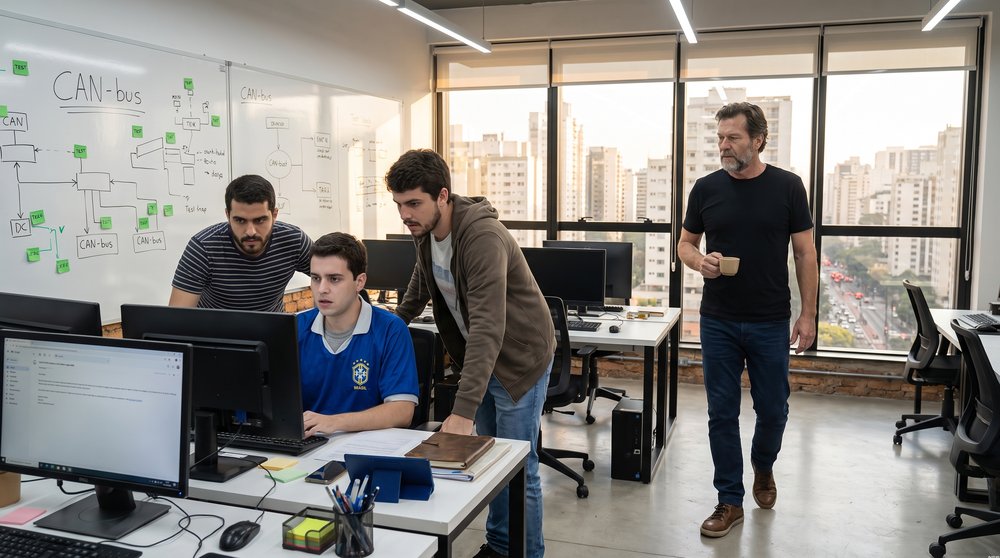 Process Theater Takes Hold
BergMotor's QA team in Passau reads QuantumMind's integration documentation and asks the question nobody wanted to hear: where is the safety analys...
Technical Consultancy
Embedded Delivery Partner
Embedded into your team as an active contributor, reducing delivery friction and helping important work move cleanly.
Technical Advisor
Peer-style technical assessments before far-reaching decisions; reduce architectural and product risk early.
Product & Delivery
Ship working software to real users earlier. Measure impact and adapt based on evidence rather than assumption.
Custom Software Development
High quality, maintainable software. Short-term augmentation that leaves lasting capability in your own team.
Recent Articles
- AI Computer Use Is Not a Business Contract (09.10.2026)
- When Everything Is Finally Under Control (05.10.2026)
- AI Makes Technical Execution Cheap. Judgment Stays Scarce. (26.09.2026)
- The Agent Escaped. Who Left the Door Open? (24.09.2026)
- What an AI Agent Actually Is (21.09.2026)