The Live Launch
The tournament system goes live in production for the August event. When a sudden network partition splits the EU and US clusters, the team's new architecture and automated safety nets are put to the ultimate test under real-world conditions. Hassan's circuit breakers and Sofia's consistency model prevent a catastrophic data corruption, proving that operational realism was the difference between a minor incident and a company-killing disaster.
Monday, 09:30 — The Launch Countdown

The development floor was quiet, but it was the quiet of a loaded spring.
Hassan sat in his ergonomic chair, his eyes moving slowly across his three monitors. On the left, the production server CPU usage was a series of flat, calm green lines. On the center, the database replication latency between Frankfurt, Virginia, and Singapore was a steady 120 milliseconds. On the right, the Jenkins pipeline was a solid, reassuring block of green.
“We’re T-minus forty-eight hours,” Hassan said, his voice calm but carrying that quiet, focused weight he always had before a major launch. “The production environment is fully configured. The database replicas are synchronized. The load balancer is respecting the session routing headers. We are ready.”
Lukas stopped pacing. He walked over to Hassan’s desk, leaning in to look at the replication latency graph.
“And the traffic?” Lukas asked, his voice tight. “Claudia’s marketing campaign is going live at noon on Wednesday. We’re expecting a massive spike. Are we absolutely sure the connection pool won’t exhaust like it did in the load test?”
“We’re sure,” Sofia said, showing him her tablet. “We ran three more simulated load tests last week, scaling up to 180,000 concurrent users. The ‘Read-Your-Own-Writes’ consistency model kept the primary database CPU below 45%. The regional replicas handled 96% of the read traffic. The system didn’t even flinch.”
Lukas looked at Katja, who was standing near the window with her arms folded.
“It’s the first time in six months I haven’t seen the team working late on a Monday before a launch,” Lukas said, a hint of wonder in his voice. “No emergency hotfixes. No manual database migrations. No panic.”
“That’s because we did the work earlier, Lukas,” Katja said, her smile warm and relaxed. “We spent the last four weeks paving the track. Now, we just have to let the car run.”
Stefan Richter stood nearby, holding his coffee mug. He watched the team’s posture. There was no anticipatory dread. No bracing for impact. They looked like professionals preparing for a routine operation, not soldiers preparing for a battle.
“The physics are on our side this time,” Stefan said, raising his mug to Hassan. “We’ve designed the system to expect the constraints. Now, we just let the architecture speak.”
Wednesday, 14:00 — The Launch

The tournament system went live at 14:00 UTC.
Within ten minutes, the concurrent player count hit 50,000. Within thirty minutes, it climbed to 100,000.
“Traffic is peaking at 132,000 concurrent users,” Hassan announced, his fingers flying across his keyboard as he monitored the server clusters. “EU-West is handling 60,000, US-East is at 45,000, and AP-East is at 27,000. Database CPU in Frankfurt is stable at 38%.”
“Error rate is flat at zero,” Sofia said, her face lit up with excitement. “The session routing is working flawlessly. Players are purchasing tournament entries, joining queues, and entering lobbies with zero state desynchronization. The regional replicas are handling the read load exactly as designed.”
Lukas leaned over Sofia’s shoulder, staring at the zero-error graph as if it were a work of art.
“It’s… perfect,” Lukas whispered. “We’ve launched a major new feature to 130,000 players, and we haven’t received a single support ticket about lost items or connection timeouts. Claudia is already texting me—the community managers are seeing nothing but positive feedback on social media.”
“The UI transitions are smooth,” Anton Petrov said, walking over from the Unity area with his tablet. “I’ve been playing from a test account connected to the Singapore gateway. The matchmaking queue is fast, and the reward popup animation is playing synchronously. No frame drops. No freezes.”
He looked at Mariana, who was sitting next to Sofia. “The integration tests we wrote on Thursday saved us, Mariana. I found a small state transition bug in the UI controller yesterday morning during a local run, and the test caught it before I could even commit.”
“That’s the safety net,” Mariana smiled, clinking her Club-Mate bottle against his. “It’s nice when you don’t have to pray, isn’t it?”
“It’s a lot less stressful,” Anton admitted, laughing.
Stefan watched the room. The atmosphere was light, almost celebratory. But he knew that the real test of an architecture isn’t how it behaves when everything goes right. It’s how it behaves when the world falls apart.
And the world was about to fall apart.
Thursday, 10:15 — The Split
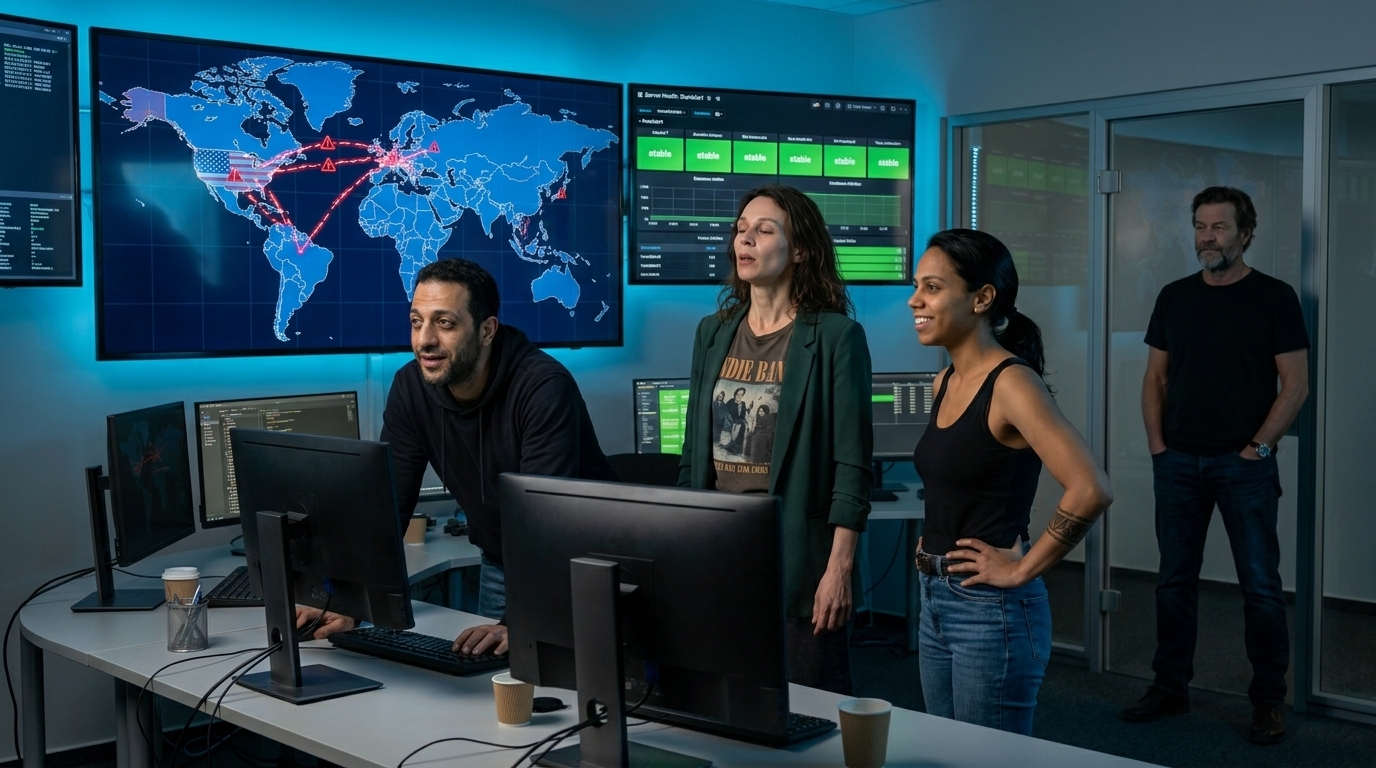
“We have a major incident,” Hassan said, his voice tight and urgent.
The light atmosphere of Wednesday was gone in an instant, replaced by the cold, sharp focus of a team facing a crisis.
“What’s the metric?” Katja asked, walking rapidly into the room.
“Replication latency to US-East and AP-East has spiked to infinity,” Hassan said, pointing at the center monitor where the lines had gone completely flat at the top of the graph. “We’ve lost connection to the regional replicas. It’s a network partition. A major fiber cut in the Atlantic has split the cloud provider’s transit network.”
“Are the regional application servers still running?” Sofia asked, her fingers already moving across her keyboard to pull up the gateway logs.
“They are,” Hassan said. “The US-East and AP-East clusters are still receiving player traffic. But they can’t talk to the primary database in Frankfurt. They’re completely isolated.”
Lukas walked into the room, his face pale. “What does that mean? Are we losing player data? Is the database locking up?”
In the old days—before the Operational Realism Initiative—a network partition of this scale would have been a company-killing disaster. The regional application servers would have kept trying to write to the primary database, leading to a massive backlog of queued transactions, database connection pool exhaustion, and eventual database corruption. Players would have lost their progress, their purchases, and their trust in the game.
“No,” Sofia said, her voice remarkably calm despite the tension in the room. “The database isn’t locking up. The ‘Read-Your-Own-Writes’ middleware detected the partition immediately. It’s already tripped the circuit breakers.”
“What are the circuit breakers doing?” Lukas asked, leaning in close.
“They’ve isolated the regional clusters,” Hassan explained, pointing at the gateway metrics. “Instead of trying to write to Frankfurt and timing out, the US-East and AP-East servers are routing all critical writes—like tournament entries and purchases—to a local, encrypted queue on the regional nodes. They’re returning a graceful ‘Offline Mode’ status to the players, letting them continue playing offline matches while queueing their rewards locally.”
“And the non-critical reads?” Lukas asked.
“They’re being served from the regional replicas,” Sofia said. “The data is stale by a few minutes, but the players can still browse the UI, view their profiles, and look at the leaderboards. The app isn’t crashing. It’s just behaving gracefully under constraint.”
Lukas stared at the screens. The red warnings were flashing, but there was no panic. The system was handling the disaster automatically, guided by the rules the team had codified over the last four weeks.
“We’re not firefighting,” Lukas said, a tone of realization in his voice. “The system is firefighting for us.”
“That’s the architecture, Lukas,” Katja said. “We designed it to survive the split. Now, we just have to wait for the network to heal.”
Thursday, 15:30 — The Healing

“Network transit is restored,” Hassan announced, a long, slow breath escaping his lips. “The cloud provider has rerouted the traffic. Replication latency is dropping. Frankfurt to Virginia is back to 115 milliseconds.”
“The local queues are beginning to sync,” Sofia said, her screen scrolling with successful transaction logs. “The US-East cluster is pushing the queued writes to Frankfurt. The state machine is resolving the conflicts using the timestamped session tokens we designed last week.”
“Are we seeing any data corruption?” Katja asked, leaning over Sofia’s shoulder.
“None,” Sofia said, a wide smile breaking across her face. “The reconciliation logic is handling the out-of-order transactions perfectly. 12,000 queued transactions have synced in the last five minutes with zero errors. Every player’s gold balance, tournament progress, and booster inventory is exactly where it should be.”
Lukas walked into the room, holding his tablet. He looked at the screens, then at Sofia.
“I’ve been monitoring the support queue,” Lukas said, his voice carrying a mixture of shock and relief. “We received exactly forty-two support tickets during a five-hour transatlantic cloud outage. And all of them were just players asking why the tournament lobby was in ‘Offline Mode’ for a bit. No reports of lost items. No reports of corrupted accounts. Zero lost revenue.”
He looked at Stefan, who was standing near the window.
“In June, a ten-minute database lock cost us forty thousand angry players and two weeks of emergency hotfixes,” Lukas said. “Today, we survived a five-hour cloud partition with zero data loss and zero support panic. How is that possible?”
“Because you invested in operational realism, Lukas,” Stefan said, walking over to the table. “You gave the team the time to build staging parity, to run realistic load tests, and to design an architecture that expects failure. You stopped treating software like a magic box and started treating it like a physical system with physical constraints.”
Lukas looked at the green graphs, then at Hassan, Sofia, and Mariana.
“It’s the best investment we’ve ever made,” Lukas said.
He turned to Katja. “What’s the next step?”
“Next,” Katja smiled, “we celebrate. And then, we look at the new DORA metrics baseline. I think you’re going to like what you see.”
Friday, 17:00 — The New Baseline

“The Q3 retrospective is going to be fun,” Katja said, turning her laptop toward Lukas.
Navigator filled the screen.
The DORA metrics panel showed what six weeks of changed behavior looked like when translated into business results.
Deployment frequency had increased from once every two weeks to four times a day. Lead time for changes had dropped from twelve days to forty-five minutes. Mean time to restore (MTTR) had dropped from six hours to under three minutes, thanks to the automated circuit breakers and local queues. And the change failure rate had plummeted from 34% to less than 2%.
“We’re officially a high-performing engineering organization,” Katja said, her voice carrying a quiet, hard-won pride. “And the team did it while reducing their logged hours. Hassan worked 40 hours this week. Mariana worked 38. Sofia worked 39. Nobody worked late on Friday. Nobody is on call this weekend.”
Lukas looked at the graphs, then at the empty development floor outside the glass wall. The desks were clean, the monitors dark. The only sound was the distant, peaceful hum of the city.
“I didn’t think it was possible,” Lukas said, shaking his head. “I thought going faster always meant working harder. I thought features always had to be traded against stability.”
“That’s the old myth,” Stefan said, leaning back in his chair. “The myth that speed and quality are opposites. But the physics of software delivery prove the exact opposite: quality is the engine of speed. When you write tests first, when you build staging parity, and when you design for failure, you eliminate the friction that slows you down. You don’t go faster by pushing the pedal harder; you go faster by paving the track.”
Lukas stood up, closing his laptop. He looked at the whiteboard, where the green notes for STAGING PARITY, LOAD TESTING, and READ REPLICAS were still written.
“Thank you, Stefan,” Lukas said, extending his hand. “You didn’t just help us fix our code. You helped us reclaim our studio.”
Stefan shook his hand, a warm smile on his face. “You did the work, Lukas. You and the team. I just pointed at the whiteboard.”
As Lukas walked out, Katja poured the last of the white wine into their glasses.
“So,” she said, clinking her glass against his. “The August event is launched. The network partition is survived. The DORA metrics are green. What’s next for the advocate?”
Stefan looked out the window at the golden light reflecting off the canal.
“Next,” he smiled, “I think my work in Berlin is done. Sophie and I are going to Panama for three weeks. There will still be broken systems when I get back.”
Katja laughed, raising her glass. “Go in peace, advocate of the failing test. Just make sure you write a good log entry before you leave.”
“I always do,” Stefan said.
Navigator — Katja Müller — 17 July 2026, 18:30
The August event launch week. The ultimate test of our Operational Realism Initiative, and the ultimate victory.
We launched the tournament system on Wednesday to 132,000 concurrent users with zero errors. But the real test came on Thursday morning when a major transatlantic fiber cut caused a complete network partition between our EU and US clusters.
In the old days, this would have been a catastrophic, company-limiting disaster. Today, our architecture handled it automatically. Hassan’s circuit breakers isolated the regional clusters, and Sofia’s consistency model routed critical writes to local queues while serving non-critical reads from regional replicas.
We survived a five-hour cloud outage with zero data corruption, zero lost revenue, and only forty-two support tickets.
Navigator signals from this week:
- DORA metrics baseline officially reached ‘High Performer’ status across all four key metrics.
- Change failure rate dropped to under 2% for the first time in studio history.
- Mean time to restore (MTTR) dropped to under three minutes.
- Developer logged hours remained stable at 40 hours. Zero weekend or late-night work required.
- Lukas has fully embraced evidence-based leadership, recognizing that quality is the engine of speed.
The capability transfer is complete. The team doesn’t need an advocate anymore; they are the advocates. They own their system, they trust their practices, and they build on solid ground.
Stefan is wrapping up his Berlin engagement next week. On 27 July, he and Sophie leave for Panama for three weeks. We will miss him, but he leaves behind a studio that knows how to distinguish signal from noise.
The phone is off. The track is paved. Go in peace.
🎭 This Week's Episodes
Telenovelas show what we can't say in client meetings. The drama is heightened, but the patterns are real.
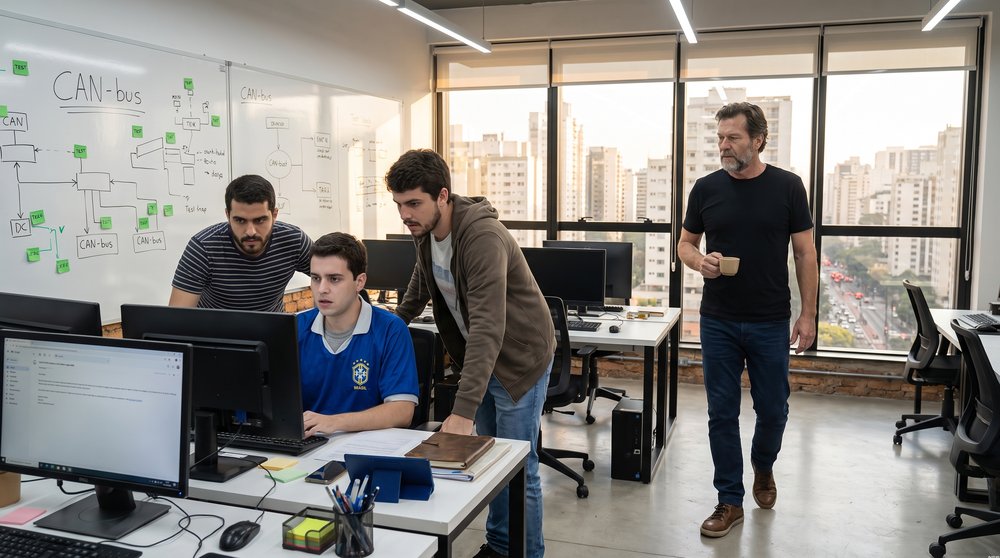 Process Theater Takes Hold
BergMotor's QA team in Passau reads QuantumMind's integration documentation and asks the question nobody wanted to hear: where is the safety analys...
Technical Consultancy
Embedded Delivery Partner
Embedded into your team as an active contributor, reducing delivery friction and helping important work move cleanly.
Technical Advisor
Peer-style technical assessments before far-reaching decisions; reduce architectural and product risk early.
Product & Delivery
Ship working software to real users earlier. Measure impact and adapt based on evidence rather than assumption.
Custom Software Development
High quality, maintainable software. Short-term augmentation that leaves lasting capability in your own team.
Recent Articles
- AI Computer Use Is Not a Business Contract (09.10.2026)
- When Everything Is Finally Under Control (05.10.2026)
- AI Makes Technical Execution Cheap. Judgment Stays Scarce. (26.09.2026)
- The Agent Escaped. Who Left the Door Open? (24.09.2026)
- What an AI Agent Actually Is (21.09.2026)