The New Baseline
With the tournament system successfully launched and the network partition survived, the team gathers for a Q3 retrospective. Katja and Stefan present the new DORA metrics baseline, showing how six weeks of operational realism transformed Pixel Spree from a firefighting studio into a high-performing engineering organization. The team reflects on their journey, realizing that the real victory isn't just the green graphs, but the peace of mind and trust they've built together.
Monday, 09:15 — The Synthesis of Success
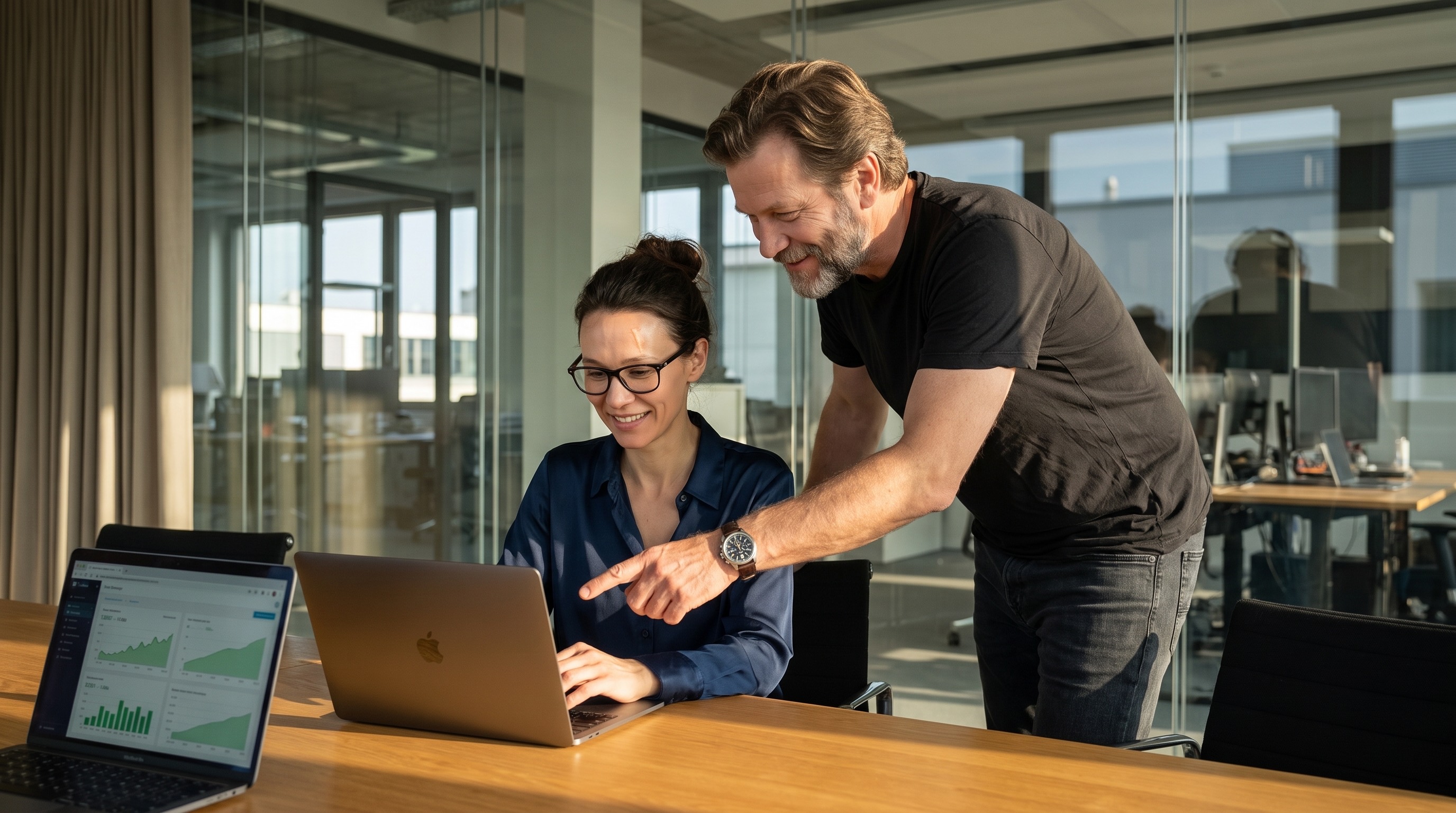
The morning sun was streaming through the floor-to-ceiling windows of the glass conference room, casting long, warm shadows across the polished oak table.
Katja took a slow sip of her coffee, her eyes fixed on the Navigator dashboard. For the first time in her two years as CTO of Pixel Spree, she didn’t feel the familiar, low-grade dread that usually accompanied a Monday morning.
“Look at the lead time,” Katja said, her voice carrying a quiet, hard-won satisfaction. “Forty-five minutes. Six weeks ago, it took us twelve days to get a single line of code from a developer’s laptop into production. Now, a developer can write a test, write the code, get it reviewed, and deploy it before lunch.”
“And the change failure rate is at 1.8%,” Stefan said, pointing at the green line on the screen. “In Q1, one out of every three deployments resulted in a hotfix or a rollback. Last week, we deployed the tournament system to 130,000 players, survived a major transatlantic network partition, and didn’t have to roll back a single commit.”
“It’s the physics, Stefan,” Katja smiled, leaning back in her chair. “We stopped trying to force the team to work faster, and we started paving the track. The staging environment, the automated load tests, the database replicas—they eliminated the friction that was slowing us down.”
“The metrics don’t lie,” Stefan said. “But the most important metric isn’t on this screen.”
Katja raised an eyebrow. “Oh? And what’s that?”
Stefan gestured toward the glass wall, looking out at the development floor. “Look at them.”
Outside, the floor was quiet, but it was the quiet of focused, relaxed productivity. Mariana was pairing with Sofia at a standing desk, both of them laughing at something on the screen. Hassan was writing documentation, his posture relaxed, his headphones resting around his neck. Daniel was talking to one of his testers, pointing at a green pipeline status on his monitor.
Nobody looked hunted. Nobody was bracing for impact.
“They trust their system,” Stefan said. “And more importantly, they trust each other. That’s the real baseline, Katja. You can’t measure it in a dashboard, but you can see it in the way they stand.”
Wednesday, 14:00 — The Whiteboard of Reality
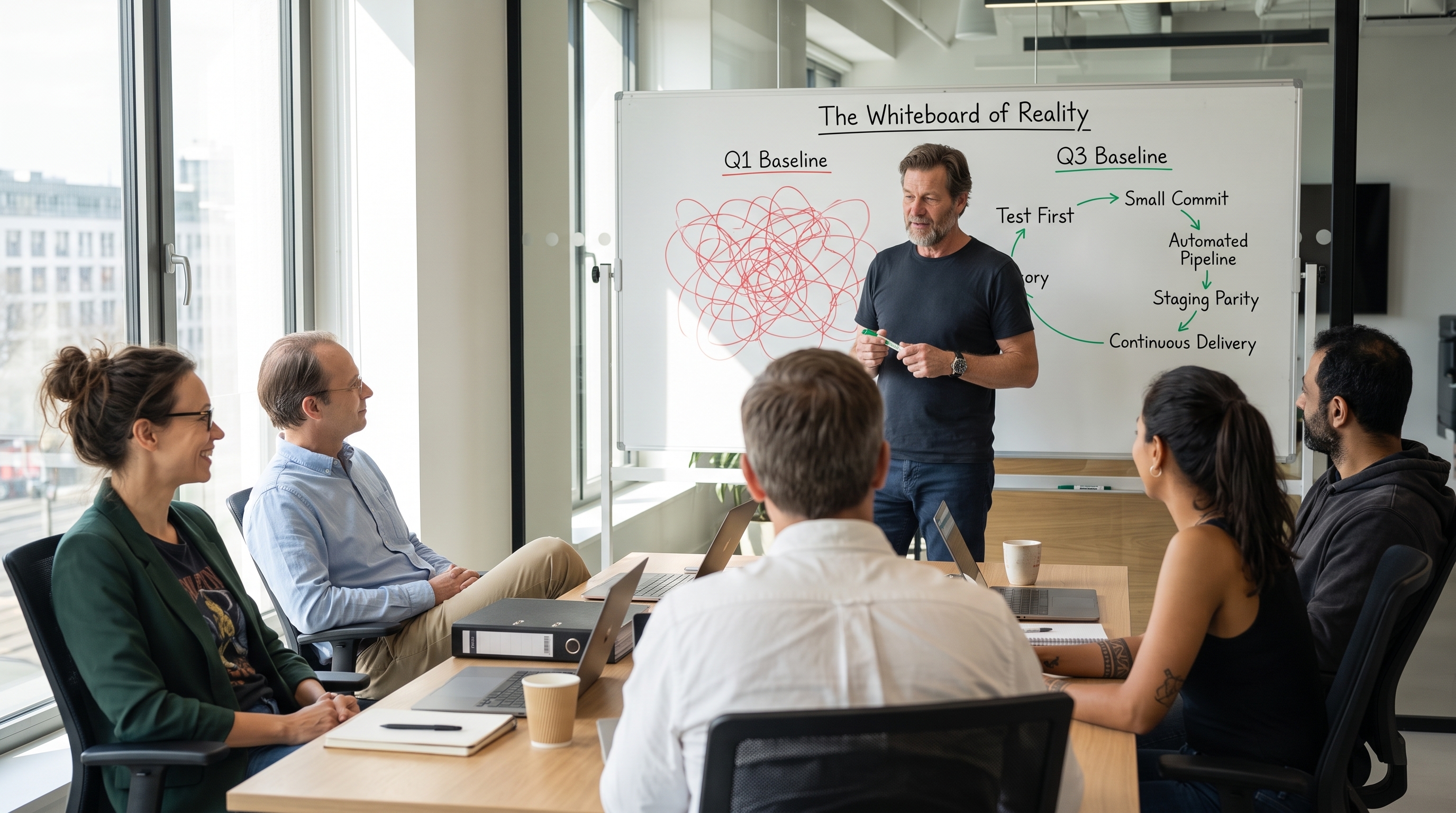
“Let’s look at where we started,” Stefan said, tapping the red side of the whiteboard.
He had drawn a chaotic, tangled web of lines representing the Q1 baseline: long-lived branches, manual regression checklists, Friday night deployments, single points of failure, and constant firefighting.
“This was the ‘Hero Method’,” Stefan said. “A system that depended on Hassan working until 03:00, Mariana writing hotfixes under pressure, and Daniel acting as a human gatekeeper. It felt fast on Monday, but by Friday, the organization was bankrupt.”
The team laughed, a relaxed, shared sound of recognition. They had lived that chaos for months, and the memory was still fresh enough to make the current peace feel sweet.
“Now, let’s look at the new baseline,” Stefan said, turning to the green side of the board.
He drew a clean, structured loop: Test First -> Small Commit -> Automated Pipeline -> Staging Parity -> Continuous Delivery.
“This is the ‘Pragmatic Method’,” Stefan said. “We’ve codified our quality standards into the pipeline. We’ve built a staging environment that actually mirrors production. We’ve designed our architecture to expect failure, like the network partition we survived on Thursday. We don’t need heroes anymore, because we have a system that supports us.”
“I have to admit,” Daniel said, leaning back in his chair with his hands behind his head. “I was terrified when you asked me to automate my checklists. I thought I was giving up control. But seeing the pipeline run in three minutes—and knowing that my team’s visual polish checks are the only manual gates left—it’s the first time in three years I’ve felt like I can actually focus on quality instead of just paperwork.”
“And the code is cleaner,” Anton said, spinning his stylus between his fingers. “I still think TDD is a bit of a sermon, Stefan. But writing the tests first for the matchmaking UI… it made the code smaller. I didn’t write any speculative abstractions because the test forced me to write only what was needed. It’s… efficient.”
“That’s the whole point, Anton,” Mariana smiled. “We’re not being pure. We’re just being lazy in the best possible way. We write the test so we don’t have to debug it later.”
Lukas looked at the whiteboard, then at Katja. “Six weeks ago, I thought we were taking a massive risk by delaying the tournament system to build a staging environment. But seeing these numbers… we didn’t delay the feature. We actually accelerated it. We shipped a stable, multi-region tournament system in six weeks. In the old days, that would have taken us three months of chaotic development and another month of hotfixes.”
“Quality is the engine of speed, Lukas,” Katja said, her voice carrying that quiet, authoritative clarity. “We paved the track, and now we can run as fast as we want.”
Wednesday, 15:30 — The Reflections of the Team
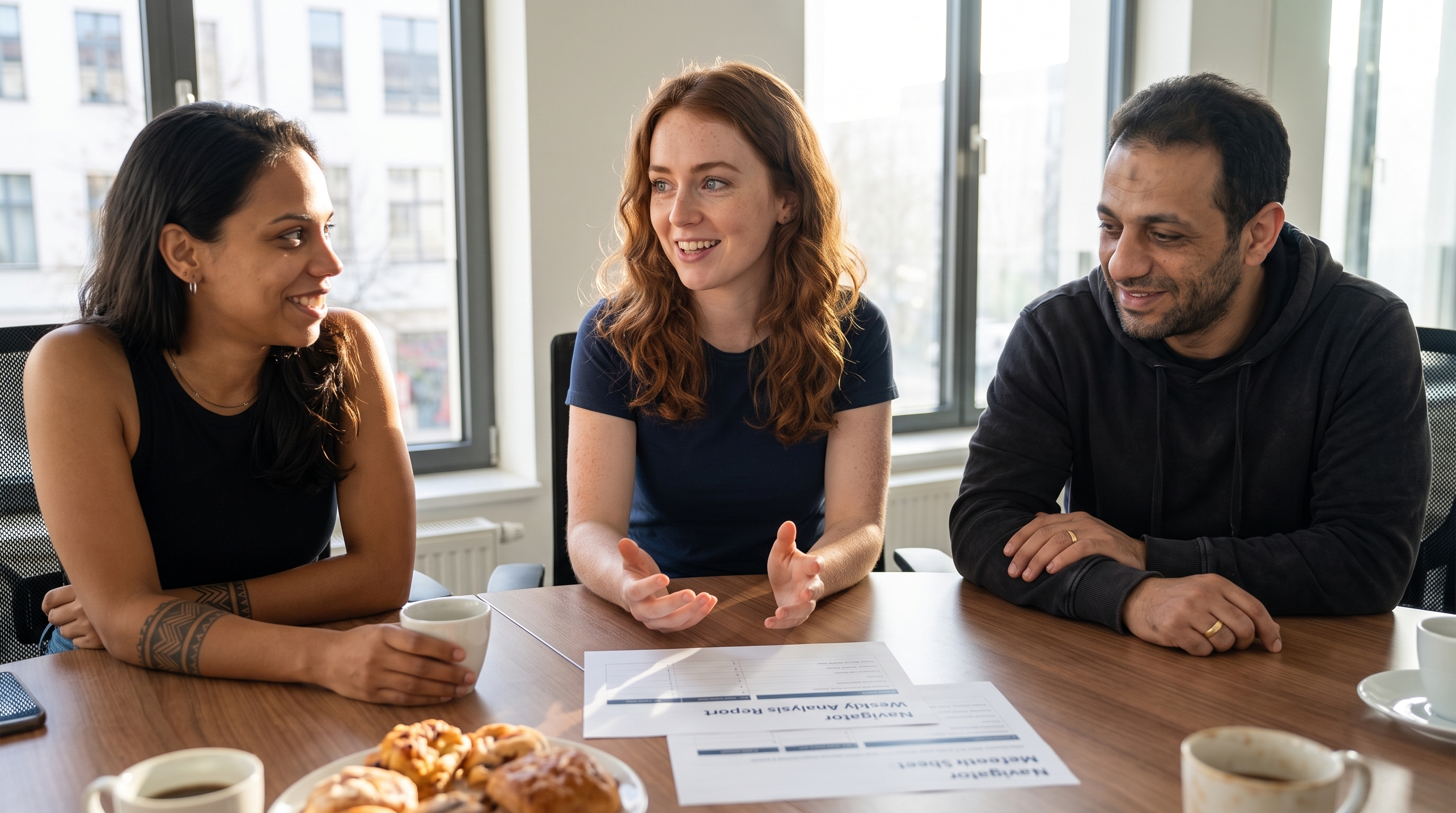
“The biggest change for me wasn’t the code,” Sofia said, her voice quiet but carrying a new, confident resonance. “It was the conversation.”
The room went quiet, the team turning to listen to her.
“In Q1, when something broke, the first question was always ‘Who did this?’” Sofia said. “We spent hours in status meetings defending our decisions, hiding our mistakes, and trying to look smart. It was exhausting.”
She looked at Mariana, then at Hassan.
“This week, when the network partition hit, nobody asked who broke the network,” Sofia said. “We didn’t look for someone to blame. We just looked at the metrics, understood the physical constraints, and let the architecture handle it. We worked as a team because the data was there for everyone to see. There was no noise; there was only the signal.”
“It’s the first time in two years I’ve left on time on a Friday during a launch week,” Hassan said, a rare, genuine smile lighting up his face. “I went to a concert in Kreuzberg. I slept eight hours. I didn’t check my phone once. That’s the metric I care about.”
“And that’s the metric that matters,” Stefan said, stepping forward. “A high-performing organization isn’t one where people work eighty hours a week to ship features. It’s one where the software is so predictable, and the team is so aligned, that the work becomes ordinary. You don’t need drama to deliver value.”
Lukas stood up, raising his coffee cup. “To the new baseline,” he said.
“To the new baseline,” the team echoed, clinking their cups and bottles together.
Stefan watched them, a feeling of complete, satisfying closure settling in his chest. The capability transfer was complete. They didn’t need him to draw diagrams on the whiteboard anymore. They were the ones holding the markers.
Thursday, 10:00 — The Departure of the Advocate

“So,” Katja said, handing him the small, wrapped package. “Panama on Sunday?”
“Panama,” Stefan said, taking the gift. “Three weeks with Sophie. The work can wait until after that.”
“Good,” Katja said, with a small laugh. “Let the work wait for once.”
“I keep telling teams to stop treating recovery like a luxury,” Stefan said, slipping the package into his duffel bag. “It would be embarrassing not to listen to my own advice.”
He looked around her office, then out at the development floor. “You’ve built something special here, Katja. Don’t let the next growth spike tempt you to go back to the old shortcuts.”
“We won’t,” Katja said, her voice serious and determined. “The team knows what solid ground feels like now. They won’t go back to the swamp. And neither will I.”
She extended her hand. “Thank you, Stefan. You didn’t just help us fix our delivery. You helped us find our pride again.”
Stefan shook her hand, then pulled her into a brief, warm hug. “You had the pride all along, Katja. You just needed to clear the status theater out of the way so you could see it.”
He slung his bag over his shoulder and walked out of her office, heading toward the elevators.
As he walked across the floor, Mariana looked up from her desk. She stood up, raising her fist in a mock metal salute. “Go in peace, advocate of the failing test.”
“Keep the pipeline green, Mariana,” Stefan laughed, returning the salute.
Sofia waved from her monitor, a wide, confident smile on her face. Hassan gave him a single, respectful nod. Daniel actually stood up and shook his hand.
“Don’t let those Brazilian developers write any Assert.IsTrue(true),” Daniel warned with a wink.
“I’ll make sure they write proper witness statements,” Stefan promised.
The elevator doors slid open with a soft chime. Stefan stepped inside, turned to face the floor, and watched the doors slide shut on a studio that was finally, fully alive.
Friday, 17:30 — The Empty Floor

The development floor was quiet.
The afternoon sun had faded, replaced by the deep, cool violet of a Berlin summer dusk. The streetlights along the canal were flickering on, and the distant sound of music and laughter from the beer gardens drifted through the open windows.
The desks were clean. The chairs were pushed in. The monitors were dark.
Hassan had left at 16:30. Mariana and Sofia had gone to grab a drink together at 17:00. Daniel had closed his office at 17:15. Even Lukas had left before the sun went down.
On the wall-mounted display near the entrance, the Jenkins pipeline dashboard glowed in the dim light.
A single, solid block of green.
All tests passing. Staging stable. Production stable.
There was no noise. There was no drama. There was no panic.
The software was running, the database replicas were syncing, and the players were playing. And the team was home, sleeping, drinking, living their lives, trusting that the system they had built would protect them until Monday morning.
The track was paved. The race was won.
And the studio was finally at peace.
Navigator — Katja Müller — 24 July 2026, 18:00
The final log entry of the Operational Realism Initiative.
Stefan finished his Berlin engagement yesterday. On Sunday, he and Sophie leave for Panama for three weeks. We gave him a proper send-off, but the real gift was the retrospective we held on Wednesday.
We presented the new DORA metrics baseline, and the numbers are undeniable. We have officially transitioned from a low-performing, firefighting studio to a high-performing engineering organization. Deployment frequency is up, lead time is down to forty-five minutes, MTTR is under three minutes, and our change failure rate is below 2%.
But the real victory is the culture. Sofia’s reflection during the retro summed it up perfectly: we’ve stopped looking for someone to blame, and we’ve started looking at the physics of our system. We’ve replaced status theater with automated evidence.
Navigator signals from this week:
- DORA metrics baseline stabilized at ‘High Performer’ status.
- 100% of commits across both backend and Unity repositories included automated test coverage.
- Zero production incidents logged for the third consecutive week.
- Developer logged hours averaged 39 hours this week. No weekend or late-night work required.
We are on solid ground. The capability transfer is complete, and the team is ready to own their future.
Thank you, Stefan. Go in peace.
The pipeline is green. The floor is empty. The phone is off.
🎭 This Week's Episodes
Telenovelas show what we can't say in client meetings. The drama is heightened, but the patterns are real.
 Documentation Avalanche
The forty-seven questions from Passau become a daily occupation. Stefan finds a gap the navigation team cannot investigate without Marcus's approva...
Technical Consultancy
Embedded Delivery Partner
Embedded into your team as an active contributor, reducing delivery friction and helping important work move cleanly.
Technical Advisor
Peer-style technical assessments before far-reaching decisions; reduce architectural and product risk early.
Product & Delivery
Ship working software to real users earlier. Measure impact and adapt based on evidence rather than assumption.
Custom Software Development
High quality, maintainable software. Short-term augmentation that leaves lasting capability in your own team.
Recent Articles
- A Useful AI Model Can Still Carry a Backdoor (20.10.2026)
- What the Last 20% of an AI-Built SaaS Looks Like (17.10.2026)
- AI Computer Use Is Not a Business Contract (09.10.2026)
- When Everything Is Finally Under Control (05.10.2026)
- AI Makes Technical Execution Cheap. Judgment Stays Scarce. (26.09.2026)