The Production Readiness Review
With the staging environment stable and the database replicas synchronized, the team prepares for the final production readiness review of the tournament system. But when Daniel insists on a manual regression checklist that would delay the launch by two weeks, Katja and Stefan must find a way to turn his manual gates into automated evidence. Stefan helps Daniel realize that automated tests aren't a threat to his authority, but the ultimate tool for scaling his expertise.
Monday, 09:15 — The Binder of Truth

Daniel tapped the silver pen against the open page of his binder, the sharp click-click sounding like a metronome in the small office.
“I have 147 manual regression test cases in this binder,” Daniel said, his voice carrying the quiet, stubborn weight of a man who had spent ten years defending the gates of software quality. “Every single one of them must be executed and signed off before the tournament system goes to production. It’s non-negotiable, Katja.”
Katja rubbed her temples, looking at the sheer volume of paper. “Daniel, we have six weeks for the entire Operational Realism Initiative. If your team spends two weeks manually running 147 test cases, we won’t have time to deploy the database replicas to production before the August event.”
“Then we delay the event,” Daniel said simply. “My job is to ensure we don’t ship bugs. If we ship this tournament system and it crashes like the summer event did, the players won’t care that we had a nice staging environment. They’ll just care that the game is broken.”
“But that’s the point, Daniel,” Stefan said, leaning forward and resting his elbows on his knees. “The staging environment is stable because we’ve already automated 95% of the scenarios in your binder. Mariana’s cache tests, Sofia’s consistency middleware tests, and Anton’s UI state machine tests are running on every single commit. They run in three minutes. Why do we need to spend two weeks running them manually?”
Daniel looked at Stefan, his eyes narrowing slightly. “Because a machine doesn’t have intuition, Stefan. A machine checks if the database query returns the expected result. It doesn’t check if the UI feels laggy, or if the transition animation looks weird, or if the font size is too small on an older iPhone. Automated tests are a safety net, yes. But they aren’t a replacement for a human tester who knows what a good game feels like.”
He closed the binder with a heavy, satisfying thud.
“I’m not signing off on a green pipeline,” Daniel said. “I sign off on evidence.”
Stefan looked at Katja, then back at Daniel. He understood the fear. For years, Daniel’s authority had been built on his ability to say “no.” His manual checklists were his shield, and his sign-off was his sword. If the pipeline became the source of truth, what was left of his role?
“We’re not asking you to trust a green pipeline blindly, Daniel,” Stefan said quietly. “We’re asking you to help us build it. If you don’t trust the automated tests, let’s look at what they’re actually testing. And if there’s a gap, let’s write a test that proves your intuition.”
Daniel stared at the black binder, his hand resting on the cover. “You can’t automate intuition, Stefan.”
“Maybe not,” Stefan said. “But you can automate the evidence.”
Tuesday, 14:30 — The Pipeline Demonstration

“This is the regression suite for the matchmaking service,” Mariana said, pointing at the screen where a terminal window was scrolling with test outputs. “It runs forty-two distinct scenarios, including multi-region latency simulation, database connection pool exhaustion, and cache stampede protection.”
Daniel leaned closer, his glasses sliding down his nose. “And how does it verify the multi-region race condition? The one where the player joins from Singapore before the Frankfurt write replicates?”
Mariana hit a key, pulling up a C# test file. “Right here. Line forty-five. We spin up a local test container representing the Singapore replica. We inject a 1.2-second delay into the replication stream. Then we trigger the matchmaking API from a simulated client. The test asserts that the API returns a PendingSync status instead of a 404, and that the client UI displays the correct loading state.”
She clicked a button. The test executed. Within twelve seconds, a green checkmark appeared next to the test name: Should_Handle_Replication_Lag_Gracefully.
Daniel was quiet. He looked at the code, then at the green checkmark, and then at Mariana.
“Twelve seconds,” Daniel muttered. “It takes my team three hours to set up the VPNs, configure the test accounts, and run that scenario manually. And we can only do it twice before the database gets cluttered.”
“And this runs on every single pull request,” Mariana said. “If Anton changes a line of code in the Unity UI that breaks this transition, the pipeline turns red before the code even gets merged to the main branch. He can’t ship it to staging, let alone production.”
“It’s fast,” Daniel admitted, his voice dropping. “But it’s still just checking data. What about the visual bugs? Last week, we had a bug where the tournament entry button was partially covered by the player’s avatar on smaller screens. Your unit tests didn’t catch that.”
“No, they didn’t,” Stefan said, stepping forward. “Because that’s a layout bug. But that’s exactly where your team’s expertise is valuable, Daniel. Instead of spending hours manually verifying database transactions that the machine can check in seconds, your team should be focused on the visual polish, the user flow, and the edge cases that the machine can’t see.”
Daniel looked at the green pipeline blocks on the screen. The skepticism was still there, but the defensiveness was beginning to crack.
“If I don’t run the manual regression,” Daniel said, “how do I know the visual polish is actually happening?”
“We build a visual regression test,” Stefan said. “We let the machine take screenshots of the UI on ten different device resolutions and compare them to a baseline. If a single pixel is out of place, the pipeline flags it for your review. You don’t have to search for the bug; the machine brings the bug to you.”
Daniel looked at his silver pen, spinning it between his fingers. “Show me how to build that.”
Wednesday, 10:45 — The Resistance of the Gatekeeper
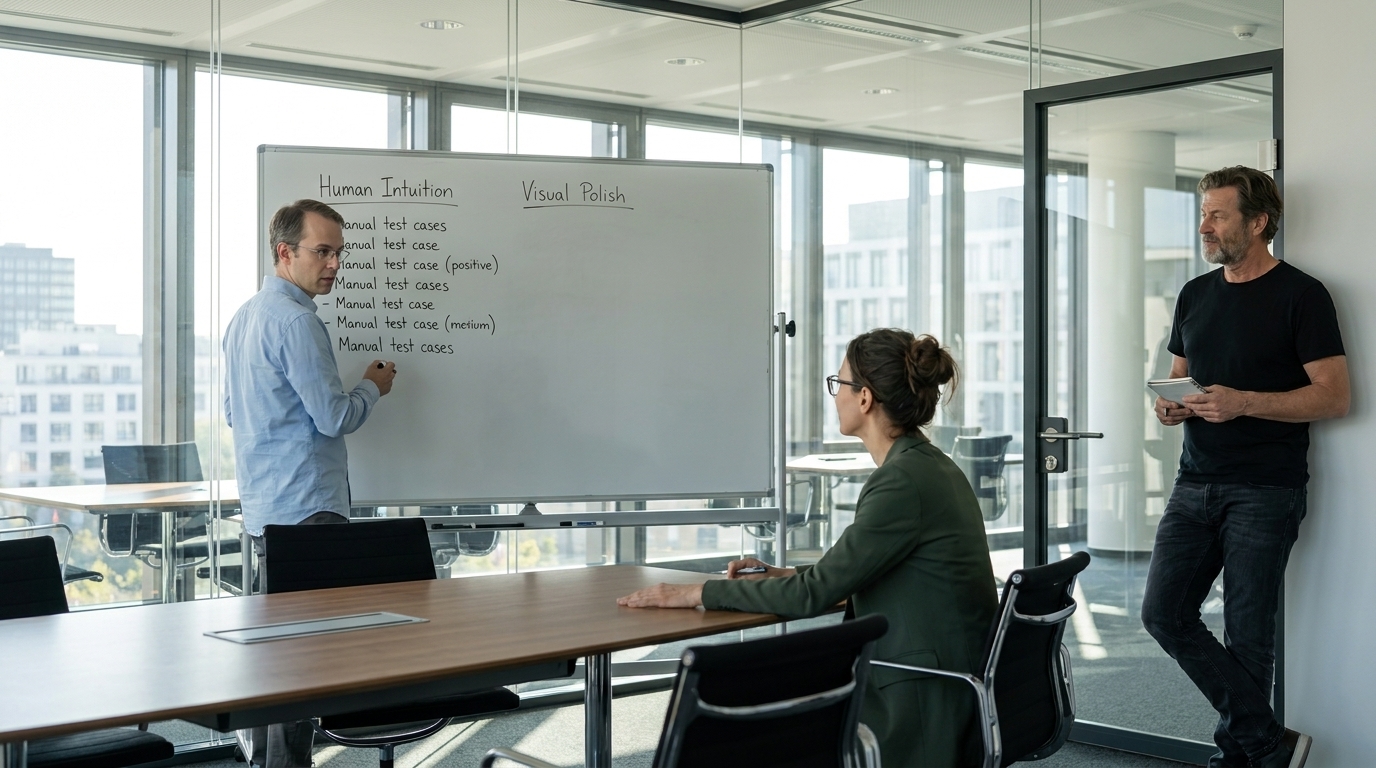
“A visual regression test is fine for layout,” Daniel said, writing Visual Polish on the board. “But what about the ‘feel’? What about the moment when the player wins a match, and the reward popup appears? If the animation is slightly delayed, or if the sound effect doesn’t match the visual cue, the player feels a disconnect. A machine can’t feel that, Stefan.”
“I agree,” Stefan said, walking over to the table. “And we’re not trying to automate the ‘feel’. That’s pure human experience. But how many of your 147 test cases are actually about the ‘feel’?”
Daniel paused, his marker hovering over the board. He looked at his list.
“Maybe ten,” he admitted.
“So 137 of your test cases are about verifying that data matches, that transactions don’t fail, and that the database doesn’t lock up under load,” Katja said, her voice gentle but firm. “You’re spending 90% of your team’s time acting like a human compiler, Daniel. You’re running repetitive, mechanical checks that the machine can do faster and more reliably than any human.”
“It’s safe,” Daniel said, his jaw tightening. “Manual testing is safe. I know exactly what has been checked because my team checked it. When a pipeline is green, I don’t know if the test was actually written correctly, or if someone just wrote Assert.IsTrue(true) to bypass the gate.”
“Then let’s review the tests together,” Stefan said. “The same way we review code. We don’t let developers merge code without a review; we shouldn’t let them merge tests without a review either. Your team should be the code reviewers for the test suite, Daniel. You are the quality advocates. If a developer writes a weak test, your team rejects the PR.”
Daniel turned to face them, his back to the whiteboard. “You’re asking me to change my entire department. We’ve been doing manual regression for three years. It’s how we’ve kept this game from falling apart.”
“It’s how you kept it from falling apart when the team was small,” Katja said, standing up and walking to the board. “But we’re at 85 people now, Daniel. We have 147 priorities. If we keep using manual gates, we will become the bottleneck. The developers will start bypassing QA entirely because they can’t wait two weeks for a sign-off. And then we’ll have no quality control at all.”
She placed her hand on his shoulder. “We don’t want to eliminate QA, Daniel. We want to scale you. We want your expertise to run on every single commit, 24 hours a day, without you having to lose your weekends.”
Daniel looked at the whiteboard, then at Katja’s hand on his shoulder. The silence in the room was heavy, the weight of a transition that felt like a leap of faith.
“Okay,” Daniel said quietly. “But if a bug slips through to production because we automated the check, it’s on you.”
“It’s on all of us,” Katja said. “That’s what a team is.”
Thursday, 15:15 — The Executable Intuition

“Now, write the assertion,” Mariana said, her voice encouraging. “We want to verify that the RewardPopup state transitions to ‘Active’ within 150 milliseconds of the MatchWon event.”
Daniel typed the assertion slowly, his fingers unfamiliar with the syntax but his logic precise.
Assert.IsTrue(popupState.TransitionTime <= 150);
“That’s it,” Mariana said. “Now run it.”
Daniel clicked the run button. A small Unity test window popped up, simulated the match win, and verified the animation transition time. Within three seconds, a green checkmark appeared.
“It verified the animation timing,” Daniel said, a tone of wonder in his voice. “I didn’t have to open the app, play a match, win it, and count the frames manually. The test did it in three seconds.”
“And it will do it every time Anton updates the UI framework,” Mariana said. “Your intuition about the animation delay is now codified into the pipeline. It’s an executable requirement, Daniel. It’s permanent.”
Daniel stared at the screen, his silver pen resting on the desk. He wasn’t spinning it anymore.
“I spent three hours last month debugging a frame-drop issue on the reward screen,” Daniel said, looking up at Stefan. “If we had this test then, we would have caught it on the first commit.”
“Exactly,” Stefan said. “You’re not a gatekeeper anymore, Daniel. You’re an architect of quality. You’re designing the safety net that lets the developers run as fast as they want, knowing that they can’t fall.”
Daniel let out a short, sharp laugh. “It feels… strange. Not having to run the checklist.”
“It’s called freedom, Daniel,” Mariana smiled, heading back to her desk. “Get used to it. We have a lot more tests to write.”
Daniel turned back to his screen, his fingers returning to the keyboard. He wasn’t looking at his black binder anymore. He was looking at the code, his mind already mapping out the next scenario he wanted to codify.
Friday, 17:00 — The Green Sign-Off
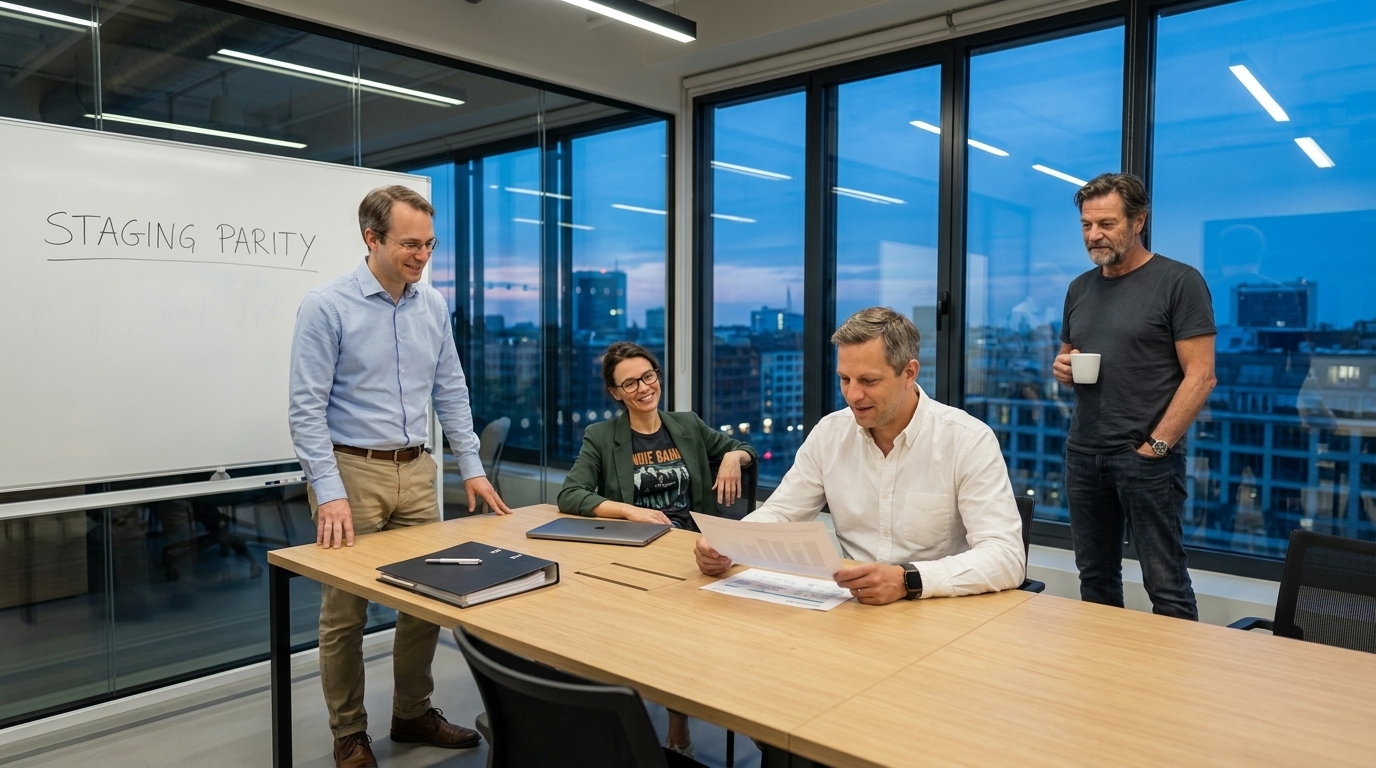
Lukas looked at the printed report, then at Daniel.
“So,” Lukas said, a hint of amusement in his voice. “No manual regression checklist this time?”
“No,” Daniel said, his voice calm and confident. “The manual regression checklist is obsolete, Lukas. We’ve codified 135 of the 147 test cases into the automated pipeline. The remaining twelve cases—the ones that require actual human feel—were executed by my team this afternoon. It took us two hours instead of two weeks.”
He pointed to the green pipeline status on the screen.
“The tournament system is production-ready,” Daniel said. “The evidence is right there. Every single commit has been verified against our quality standards. We are ready to launch.”
Lukas looked at Katja, a look of genuine admiration in his eyes. “Two hours instead of two weeks. That’s… incredible, Katja.”
“It’s the power of automated evidence,” Katja said, her smile warm and relaxed. “We didn’t just build a staging environment, Lukas. We built a culture of quality. The developers and the QA team are working together now, writing tests and verifying behavior before the code even hits staging.”
She looked at Daniel. “And we couldn’t have done it without Daniel’s expertise. He didn’t just let us automate his checklist; he helped us design the tests that make the pipeline trustworthy.”
Daniel flushed slightly, but his smile remained. “It’s just good development, Katja.”
Stefan watched them from the window, the warm Berlin evening air carrying the sound of laughter and clinking glasses from the courtyard below.
The transition was complete.
The team had stopped fighting each other and started fighting the complexity of their system. They had turned their manual gates into automated safety nets, and in doing so, they had unlocked a level of speed and confidence they hadn’t seen in months.
Outside, the city was dark and still. Inside, the team was ready for the launch.
Navigator — Katja Müller — 10 July 2026, 18:15
Week three of the Operational Realism Initiative.
The hardest constraint we faced this week wasn’t physical; it was organizational. Daniel, our QA Lead, insisted on running his 147 manual regression test cases before signing off on the tournament system. It would have delayed our production launch by two weeks.
Stefan and Mariana helped him see that automated tests aren’t a threat to his department, but a tool to scale his expertise. By demonstrating the speed and reliability of the CI pipeline and helping him write his first executable integration test for UI animation timing, they broke through his resistance.
Daniel has officially signed off on the production readiness review. We did it in two hours instead of two weeks, with 135 test cases fully automated and running on every commit.
Navigator signals from this week:
- 100% of QA-reviewed pull requests included automated test coverage.
- Regression testing cycle time dropped from 10 days to 3 minutes.
- Daniel’s logged sentiment shifted from ‘defensive’ to ‘collaborative’ in his daily logs.
- Cross-team alignment reached an all-time high, with QA and development pairing on test design.
We are production-ready. The staging environment is stable, the database replicas are synchronized, and the pipeline is green.
Next week, we launch the tournament system in production for the August event. The real-world traffic will test our architecture, our consistency model, and our team’s resilience. But for the first time, we are launching with complete confidence.
🎭 This Week's Episodes
Telenovelas show what we can't say in client meetings. The drama is heightened, but the patterns are real.
 QuantumMind Arrives
Three weeks in, Stefan's teams are shipping. Radio plays podcasts. Navigation reads temperature sensors from the CAN bus. Climate control has its f...
Technical Consultancy
Embedded Delivery Partner
Embedded into your team as an active contributor, reducing delivery friction and helping important work move cleanly.
Technical Advisor
Peer-style technical assessments before far-reaching decisions; reduce architectural and product risk early.
Product & Delivery
Ship working software to real users earlier. Measure impact and adapt based on evidence rather than assumption.
Custom Software Development
High quality, maintainable software. Short-term augmentation that leaves lasting capability in your own team.
Recent Articles
- When Everything Is Finally Under Control (05.10.2026)
- AI Makes Technical Execution Cheap. Judgment Stays Scarce. (26.09.2026)
- The Agent Escaped. Who Left the Door Open? (24.09.2026)
- What an AI Agent Actually Is (21.09.2026)
- The LLM Will Not Come Back Tomorrow (19.09.2026)