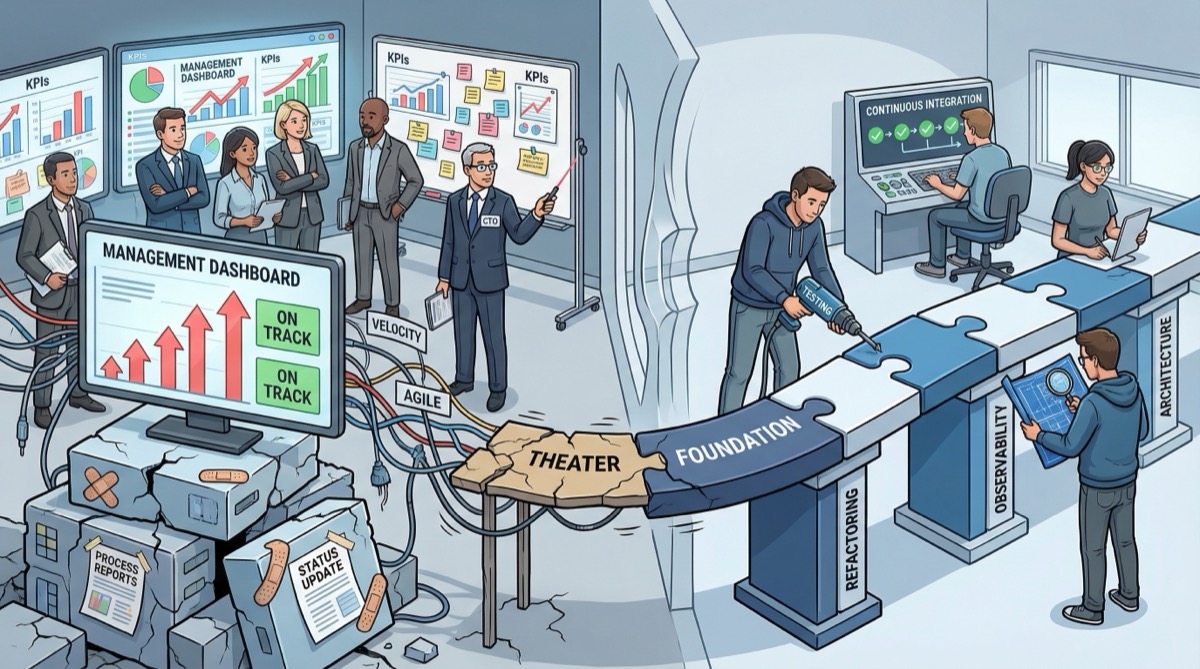
The Financial Issue
When delivery gets messy, many organizations respond with process changes, tighter supervision, or a new management vocabulary because those interventions look cheaper and easier to explain.
The hidden cost stays in the work itself. Code remains hard to change. Tests stay brittle. Releases stay risky. Rework grows. Delay compounds. AI just accelerates the bill.
The Financial Response
Treat technical practice as an operating investment, not as developer preference.
For leadership, that usually means three decisions:
- Build enough technical understanding to see testing, refactoring, integration discipline, and architecture boundaries as cost controls on rework, incidents, delay, and fragility.
- Remove blockers teams cannot remove themselves: approval bottlenecks, dependency drag, tool friction, delayed decisions.
- Create a reliable way to surface capability gaps early, including hands-on external perspective when important risks are not yet visible from inside the team.
AI-Assisted Development: 3-Day Intensive
A focused remote class for teams that want to adopt AI without sacrificing delivery discipline, architecture quality, or verification rigor.
- 3 remote days
- Agentic coding with XP discipline
- Test-first development and safe refactoring
- Continuous integration and architecture guardrails
Delivery Integrity Intervention
When the problem is already inside the codebase and the delivery system, an Embedded Delivery Partner works with the team in production code and transfers capability through real delivery work.
- Hands-on embedded support
- Production code, not workshop-only guidance
- Capability transfer through shared work
- Designed for teams already under strain
The class improves the return on AI adoption. The embedded intervention helps make hidden delivery risks visible early enough to reduce the drag already eroding time, budget, and credibility.
What Process Spending Does Not Buy

Budget spent on coordination and oversight still has limits. The damage starts when leadership expects those costs to substitute for technical capability.
A new cadence does not teach test design. Weekly planning, daily standups, quarterly OKRs, shorter sprints, kanban boards, cycle-time management, heavier work planning, more elaborate preparation, and the many other coordination ideas borrowed from manufacturing and assembly work do not help a team learn how to specify behavior, isolate risk, or build a useful test suite.
More supervision does not teach refactoring. Watching people more closely does not help them untangle coupling, improve naming, or reshape a brittle module safely.
Better reporting does not teach architecture. Dashboards can show that delivery hurts. They cannot teach how to split a monolith, stabilize integration boundaries, or reduce hidden dependencies.
Incentives do not create judgment. Rewarding velocity, utilization, or story completion does not produce technical judgment. It produces gaming.
People management does not create operational discipline. A team does not learn continuous integration, trunk-based development, release automation, or production observability because someone gave a speech about accountability.
At best, management can create conditions where people improve. At worst, it can crush the very conditions improvement requires.
What Produces Financial Return
Financial return comes from capability built into the work. There is no shortcut around that.
Pairing with stronger developers transfers judgment in context. People learn while solving real problems, not while listening to abstractions detached from code.
Test-driven development forces precision. It teaches developers to think about behavior, boundaries, and feedback before they bury mistakes in implementation.
Continuous integration makes integration pain visible early. Teams stop pretending separate pieces will somehow fit together later.
Trunk-based development reduces delay and forces smaller, safer changes. That in turn develops the habit of incremental thinking.
Refactoring inside feature work teaches teams to improve design while delivering, instead of fantasizing about a future cleanup that never comes.
Production feedback teaches reality. Logs, incidents, rollout behavior, and user outcomes are harsher and more useful than any retrospective script.
Working beside someone who can actually do the craft changes more than any framework rollout. Capability transfers through shared work.
This is what engineering integrity means in practice: improving the system by improving how the work is done.
AI Raises the Stakes. It Does Not Remove the Need for Capability
AI changed the economics of software development. It did not repeal the need for judgment.
Code generation is cheaper. Scaffolding is faster. Translation from intent to syntax takes minutes instead of days. That shift fools a lot of people into thinking capability matters less now.
The opposite is true.
When code gets cheap, verification matters more. Teams now need stronger tests, clearer specifications, and tighter feedback loops because bad code can be produced at industrial speed.
When prototypes get easy, architecture gets easier to fake. A screen that works once is not a system you can trust. The gap between demo success and production reality gets wider when teams skip design discipline.
When AI becomes a thinking partner, weak thinking gets amplified. A strong developer can use AI to explore faster, refactor safely, and understand legacy code sooner. A weak team can use the same tools to generate a larger mess.
When people replace specifications with prompts, drift becomes inevitable. Prompts are wishes. Tests are constraints. The team that relies on prose and hope will lose to the team that relies on executable checks.
That is the new AI challenge in one sentence: speed multiplies whatever discipline already exists. If the team has integrity in its practice, AI accelerates it. If the team is sloppy, AI industrializes the sloppiness.
What Management Can Responsibly Do
Leadership still matters. Just not in the magical way consultants promise.
Protect focus time so developers can solve hard problems without being chopped into meeting-sized fragments.
Fund technical practice instead of buying another process overlay. Testing, automation, refactoring capacity, observability, and deployment reliability are investments, not developer hobbies.
Remove organizational blockers that teams cannot remove themselves: approval bottlenecks, dependency paralysis, tool friction, unclear ownership, and delayed decisions.
Listen to evidence when the work says the current approach is failing.
Bring in hands-on help when the team needs stronger practice in the code, not stronger messaging around the code.
That is the boundary. Management can create the conditions for improvement. It cannot substitute for the improvement itself.
Articles: Capability Over Process Substitutes
These articles build the case from different angles: why frameworks fail, why technical authority matters, and which practices actually improve delivery.
The Core Argument
- Management Frameworks Don't Fix Software Teams
Frameworks can reveal symptoms. They do not repair the work. Root causes live in code, architecture, feedback loops, and technical practice. - Technical Practices That Drive Business Results
The cleanest bridge between craft and business value. Technical excellence is not a luxury line item. It is what makes reliable delivery possible. - The Engine of Predictable Software Delivery
Predictability comes from disciplined technical habits, not from managerial choreography wrapped around unstable work.
Why Process Substitutes Fail
- What Happened to Agile?
The technical core got replaced by ceremony, certification, and managerial packaging. The damage was structural, not accidental. - The Framework Adoption Lifecycle
Organizations buy frameworks when delivery hurts, then discover they purchased vocabulary and ceremony instead of capability. - When Methodology Becomes Identity
Once the method becomes a loyalty test, evidence loses. Technical reality gets punished to preserve the narrative.
Why Technical Authority Matters
- We Don't Take Advice From Non-Developers
Advice about software from people who cannot build software usually creates overhead, resentment, and expensive fiction. - Why Electricians Have Authority and Developers Don't
Software teams keep losing authority because too many organizations replace visible craft with narrative and supervision. - When Discovery Collides with Process
Software work is discovery. Trying to manage it like repeatable factory output breaks both learning and delivery.
The AI-Era Version of the Same Problem
- The End of Coding is the Return of Product Development
AI removed typing as the bottleneck. That makes specification, verification, and responsibility more important, not less. - The Concept Document Was a Workaround
When prototypes become cheaper than documents, concept papers stop reducing risk and start adding delay, meetings, and false confidence. - Vibe Coding Isn't Software Development
The demo works. The system does not. AI prototypes are cheap. Sustainable systems still require disciplined development. - Tests Beat Instructions for AI Coding Agents
The cleanest explanation of why executable constraints matter more than prompt files, conventions, or wishful prose. - When AI Becomes Your Thinking Partner
AI is most useful when it amplifies clear thinking, strong judgment, and technical discipline already present in the team. - AI as Your Legacy Code Archaeologist
AI can speed up understanding. It cannot replace the craft needed to decide what to preserve, what to refactor, and what to trust.
Telenovela Episodes: The Human Cost of Losing Integrity
These episodes show what happens when organizations try to manage around missing capability instead of building it.
La Startup
- Episode 4: Fantasmas del Sprint
The ghosts are not in the sprint plan. They are in burnout, shortcuts, and the belief that pressure can replace practice. - Episode 7: Desde Cero
Rebuilding starts only when the team confronts the technical reality it kept postponing.
Código del Destino
- Episode 3: El Consultor
The consultant sells order. The code keeps demanding competence. - Episode 4: Secretos y Mentiras
Compliance grows while capability stays flat. The numbers look managed. The work does not.
Signal Through Noise
- Episode 10: The Technical Debt Reckoning
Delayed technical truth always comes due. Process language does not cancel the bill. - Episode 16: The Code Review That Isn't a Review
Process without judgment becomes empty ceremony. Approval without understanding is not quality control.
Related Topics
-
Why Scrum Isn’t Improving Your Delivery
Sprints do not create capability. Ceremony around weak technical practice just makes the weakness more expensive. -
Why Is Software Delivery Slow?
Slow delivery is usually accumulated friction, not weak motivation and not a missing management intervention. -
Software Delivery Unpredictable — What to Do?
Predictability comes from visible blockers, shorter feedback loops, and stronger practice in the work. -
AI-Assisted Development: 3-Day Intensive
A concrete capability uplift for teams that want to adopt AI without turning delivery into a prompt-driven mess. -
Embedded Delivery Partner Embedded, hands-on help for teams that need stronger technical practice, not another management layer.
Ready to Stop Managing Around the Problem?
If capability is the bottleneck, no management style will save you.
The only serious question is whether you are willing to improve the work itself.
🎭 This Week's Episodes
Telenovelas show what we can't say in client meetings. The drama is heightened, but the patterns are real.
 Arrival
Stefan Richter arrives in São Paulo with a 90-day contract to fix delivery at AutoConnect Brasil. He finds 90 developers, 18 months of chaos, and a...
 What Is Offered First
The day before Sophie flies back to Berlin, Mateo takes them to Kuna Yala. The road climbs from the Chepo side into the mountains, the Caribbean ap...
 Collapse
Year-end arrives with the force of something everyone has been preparing not to name. A critical COBOL tax-calculation path fails on an undocumente...
Technical Consultancy
Embedded Delivery Partner
Embedded into your team as an active contributor, reducing delivery friction and helping important work move cleanly.
Technical Advisor
Peer-style technical assessments before far-reaching decisions; reduce architectural and product risk early.
Product & Delivery
Ship working software to real users earlier. Measure impact and adapt based on evidence rather than assumption.
Custom Software Development
High quality, maintainable software. Short-term augmentation that leaves lasting capability in your own team.
Recent Articles
- The LLM Will Not Come Back Tomorrow (19.09.2026)
- The One-Person AI Company Is a Greed Fantasy (15.09.2026)
- Test Production Without Leaving a Mess (10.09.2026)
- Software Will Fail. Recovery Is the Real Metric (05.09.2026)
- Stop Outsourcing Your Product Language (01.09.2026)